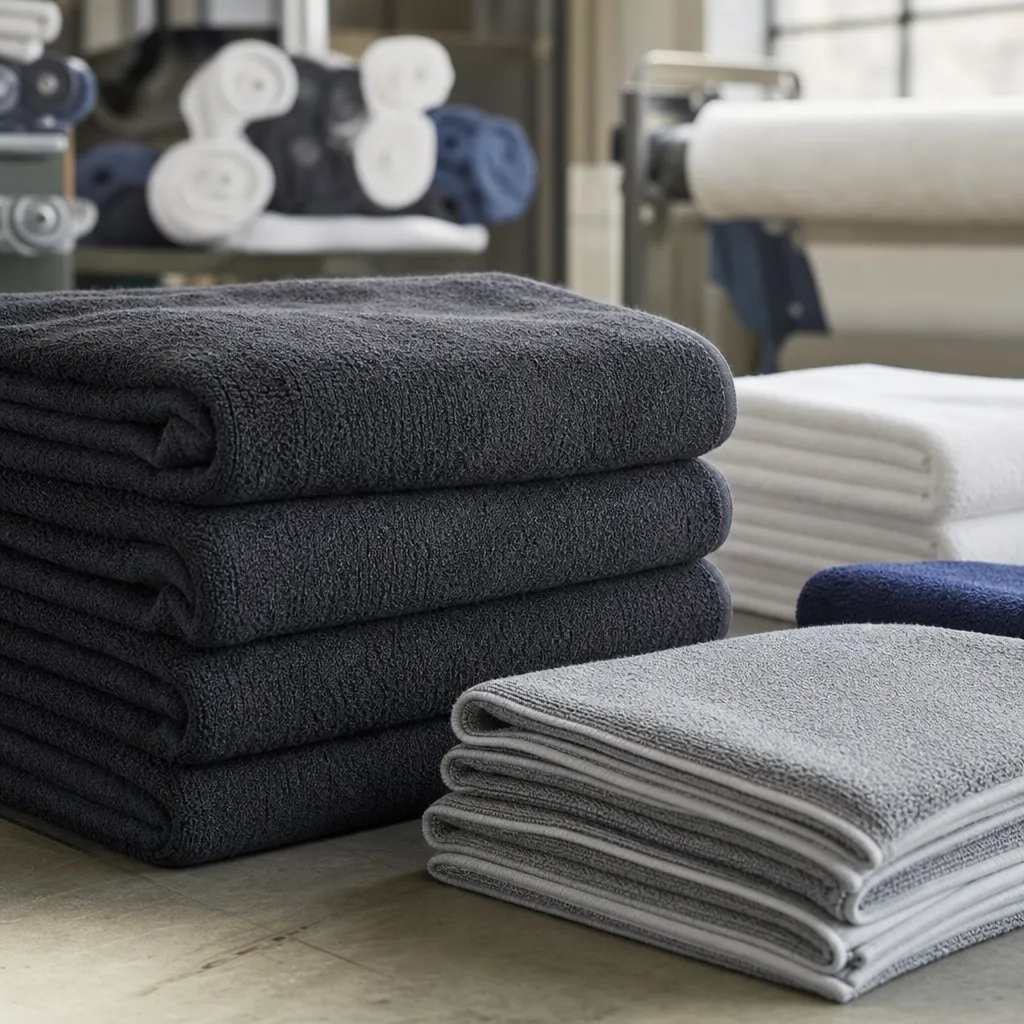
Why Bath Towels Enter Car Wash Programs
Car wash operators do not usually start by asking for bath towels. They ask for a towel that is large enough to pull water off a hood, soft enough for clear coat, heavy enough to survive alkaline detergent, and cheap enough to keep in rotation when towels disappear from the laundry cart. That combination often points toward a modified bath towel construction rather than a small detailing cloth.
For bulk bath towels used in car wash bays, the correct spec is not the same as a hotel guest towel. Hotels care about loft, hand-feel, and whiteness after guest laundry. Car wash teams care more about lint on glass, hem hardness on paint, color coding by work zone, and whether the towel still absorbs after 60 to 100 wash cycles with no fabric softener. We make both categories, but we quote them differently.
Our usual recommendation is a 420-520 GSM cotton terry towel for exterior drying and a separate microfiber item for final glass or black trim. Cotton terry can move a lot of water quickly, especially when the loop height is controlled and the pile is not overloaded with softener. Microfiber remains better for streak-free finishing, which is why mixed programs often perform better than one towel trying to do every task.
| Car wash use | Suggested towel | GSM range | Main risk if underspecified |
|---|---|---|---|
| Exterior first-pass drying | Cotton terry bath towel, low-lint finish | 420-520 GSM | Slow drying, lint drag, early thinning |
| Door jambs and wheels | Darker cotton terry or bar towel | 360-460 GSM | Oil staining moves into main drying towels |
| Final glass wipe | Split microfiber towel | 250-320 GSM | Streaks from cotton lint or silicone residue |
| Interior dash and trim | Microfiber or small cotton hand towel | 260-380 GSM | Cross-contamination from exterior chemicals |
Bulk Bath Towels: Spec Before Price
The phrase bulk bath towels covers too many products to quote responsibly without a short spec sheet. A 50 x 100 cm 430 GSM towel and a 70 x 140 cm 650 GSM bath sheet may both appear in supplier catalogs, but their cost, wash time, drying time, and storage volume are completely different. For car wash use, bigger is not automatically better. A towel that is too large becomes heavy when wet, slows staff movement, and increases dryer load weight.
We usually start with towel size, GSM, yarn type, color system, edge construction, and carton packing. Then we ask about laundry conditions. A tunnel wash using high-pH detergent and 70-80 C drying heat is tougher on cotton than a small shop washing at 45 C. If towels are laundered off-site, we also ask whether the laundry uses chlorine, oxygen bleach, or quaternary disinfectant. Those chemicals change the dye choice and the expected life.
- Size: 50 x 90 cm for quick bay handling, 50 x 100 cm for exterior drying, 60 x 120 cm only when staff prefer a larger pull towel.
- GSM: 420-520 GSM for cotton terry drying towels; below 380 GSM usually feels cheap after 20-30 commercial washes.
- Yarn: 16s or 21s ring-spun cotton is common; open-end yarn lowers price but sheds more lint in early cycles.
- Color: grey, navy, forest green, and tan hide stains better than white, but dark shades need stronger rubbing fastness control.
- Edge: low-profile lock stitch or tucked hem is safer around painted panels than a bulky border with hard seam ridges.
For private-label or multi-site programs, our MOQ is 500 pcs per design per color. That minimum applies whether the towel is plain, woven-label, embroidery-marked, or packed by station color. For chains ordering 3,000-20,000 pcs, we can hold the core yarn and dyed shade as a repeat program so a reorder does not drift visually from the first shipment.
Cotton Terry vs Microfiber in a Wash Bay
We do not try to make cotton do microfiber's job. Cotton terry bath towels are strong for bulk water removal because the loop pile gives a large absorbent surface. Microfiber is stronger for picking up film, wax residue, and the last fine moisture on mirrors or glass. A practical car wash towel program uses cotton for the wet work and microfiber for finish work.
The failure mode we see most often is not tearing. It is contamination. A towel used once on tire dressing can leave silicone marks on a windshield three wash cycles later. A cotton towel that has been softened with cationic fabric softener may feel nice in the hand but absorb less water and smear on glass. For this reason, we recommend color-coded rotation and laundry rules more strongly than chasing the highest GSM.
| Material | Best use | Typical unit price at 5,000 pcs | Practical note |
|---|---|---|---|
| Cotton terry, 50 x 100 cm, 450 GSM | Exterior drying | USD 1.28-1.65 | High water pickup, needs lint control before use |
| Cotton terry, 40 x 80 cm, 400 GSM | Door jambs, wheels, lower panels | USD 0.72-0.98 | Good for color-coded dirty zones |
| Microfiber, 40 x 40 cm, 300 GSM | Glass and interior finish | USD 0.38-0.62 | Lower water capacity but better streak control |
| Microfiber waffle, 50 x 80 cm, 360 GSM | Final drying and detail work | USD 1.05-1.48 | Works well for premium detail packages |
A good cost-per-use example from a recent quote: a 50 x 100 cm 455 GSM cotton towel landed at USD 1.47 per piece for 6,000 pcs. In the buyer's laundry test, it stayed usable through 82 wash cycles before the pile became too flat for drying work. That is about 1.8 cents per use before freight and laundry cost. A cheaper 355 GSM towel at USD 0.96 failed their absorbency check after 31 cycles, or 3.1 cents per use. The cheaper towel looked attractive on the first purchase order and became more expensive in rotation.
The Lint Problem Is Made in Finishing
Lint is where bath towels for car wash use need different factory handling. Cotton terry naturally releases short fibers after weaving. If the towel is sheared poorly, washed too lightly, or packed without enough shake-out, those fibers show up as white dust on glass and black paint. Buyers often blame the cotton grade, but finishing is usually the larger factor.
In our mill, low-lint car wash towels receive a heavier post-weave washing sequence than ordinary promotional towels. We run a controlled scouring wash, tumble extraction, and visual lint check under dark-surface inspection. For dark dyed towels, we also check dry and wet rubbing fastness under ISO 105-X12 because navy or black towels can transfer color when the pile is still carrying loose dye. For repeated laundering, we reference ISO 6330 wash procedures and adapt the cycle to the buyer's commercial laundry conditions.
- We weave the terry with a moderate loop height instead of a tall luxury pile that snags easily.
- We scour and rinse to remove spinning oil, loose fiber, and excess softener residue.
- We tumble before final inspection so weak fibers release at the mill, not in the buyer's first wash bay.
- We inspect against dark panels for lint and against white panels for dye or oil marks.
- We pack by color and station label so dirty-zone towels do not mix with exterior drying towels.
One construction quirk matters here: a towel with a decorative dobby border can trap lint and grit along the border line. That looks normal for a hotel towel, but in a car wash it can drag residue across a painted surface. For drying towels, we prefer a plain terry field with a narrow hem. If a logo is required, a woven label or small corner embroidery is usually safer than a large border design.
Color Coding and Dye Fastness
Color coding is not decoration in this category. It is process control. We see the cleanest programs use one shade for paint drying, one for wheels and lower body, one for interiors, and one for rejected towels that should not return to customer-facing work. The towel itself becomes part of the training system.
For car wash bath towels, reactive dye is usually the right choice for cotton because it gives better wash fastness than direct dye at commercial laundry temperatures. Dark towels still need testing. We normally target color fastness to washing at grade 4 or above under ISO 105-C06 for medium shades, and wet rubbing fastness grade 3-4 or above under ISO 105-X12 depending on color depth. Very deep navy and black shades cost slightly more because they require more dye, longer rinsing, and stricter wastewater handling.
- Grey: good general drying color, hides mild staining, lower dye-bleed risk than deep navy.
- Blue: common for exterior drying, but medium blue is safer than very dark navy for wet rubbing.
- Green: useful for interior or membership-tier coding and less common in retail towel theft.
- Tan: hides dust and light soil but can look old faster under oil contamination.
- White: easiest to bleach and inspect, but stains quickly and may look poor in open bay storage.
We avoid heavy silicone softeners for these programs. They create a smooth retail hand-feel but reduce absorbency and can leave a film during glass work. A hydrophilic softener is more appropriate when the towel must drink water quickly. If the buyer wants a very soft first touch for a premium hand-dry service, we make a sample both ways and test absorbency after three washes, not just out of the carton.
Pricing Bands for Car Wash Buyers
Below are realistic FOB China price bands for OEM bulk bath towels used in car wash operations. Prices move with cotton yarn, dye depth, exchange rate, and packing method, but these ranges are useful for budgeting. They assume plain towels without retail gift packaging and with standard export cartons.
| Spec | 500 pcs | 2,000 pcs | 10,000 pcs |
|---|---|---|---|
| 40 x 80 cm, 380 GSM, cotton terry | USD 0.88-1.12 | USD 0.74-0.94 | USD 0.61-0.82 |
| 50 x 90 cm, 430 GSM, cotton terry | USD 1.32-1.68 | USD 1.14-1.42 | USD 0.98-1.23 |
| 50 x 100 cm, 460 GSM, low-lint cotton terry | USD 1.58-2.05 | USD 1.36-1.72 | USD 1.18-1.49 |
| 60 x 120 cm, 500 GSM, oversized drying towel | USD 2.55-3.35 | USD 2.22-2.86 | USD 1.96-2.48 |
For logo work, a small woven label usually adds USD 0.04-0.09 per towel depending on label size and order volume. Small corner embroidery can add USD 0.12-0.28, but we are careful with embroidery on car wash towels because dense stitches can become a hard patch. If branding is needed mainly for theft control, a woven label or color stripe is cheaper and safer than a large stitched logo.
Our certification base is OEKO-TEX Standard 100 Class I for product safety, BSCI for social compliance, and ISO 9001 for quality management. Car wash buyers sometimes assume these only matter for baby or hotel goods. We see them as risk controls: dye chemistry, documented inspection, and traceable production batches matter when towels are used daily by staff and handled in bulk.
Sampling, Testing, and Production Timing
A towel that feels right once is not approved. For car wash programs, we ask buyers to run a minimum five-wash trial before signing off. The test should include the same detergent, drying temperature, and staff handling used in the real operation. If the towel will touch coated vehicles, wrap films, or black trim, test it on those surfaces before volume production.
| Stage | Typical timing | What we check |
|---|---|---|
| Spec confirmation | 1-2 days | Size, GSM, color, packing, label, target wash life |
| Lab dip for dyed towel | 4-7 days | Shade approval, wet rubbing, wash fastness |
| Pre-production sample | 7-12 days | Loop height, hem feel, lint release, absorbency |
| Bulk production | 22-35 days | Weaving, dyeing, finishing, inspection, packing |
| Sea freight preparation | 3-6 days | Carton marks, booking, export documents |
- Absorbency check: time how quickly a measured water amount disappears into the pile after three wash cycles.
- Lint check: wipe a black acrylic panel and a mirror after the towel has been tumble dried.
- Hem abrasion check: rub the towel edge across a painted test panel under hand pressure.
- Shrinkage check: measure length and width after five washes; cotton terry commonly shrinks 4-8 percent if not controlled.
- Sorting check: confirm staff can identify towel colors quickly under bay lighting.
The most useful feedback from buyers is specific: "lint on glass after dryer cycle," "navy transfers on wet white vinyl," or "hem feels hard on ceramic-coated hood." Those comments let us adjust finishing, dye depth, or edge construction. A general note like "make it better quality" does not tell the production team which variable to change.
Packing and Rotation Planning
Car wash towels are operational inventory, so carton planning matters. A 50 x 100 cm 460 GSM towel weighs about 230 g before packaging. A carton of 50 pcs is roughly 11.5 kg net, plus carton weight. That is manageable for staff and efficient for warehouse counting. Larger 60 x 120 cm towels may need 30 pcs per carton to keep cartons under practical lifting weight.
For multi-site buyers, we can pack by branch, color, or department. The cleanest replenishment model is to calculate towels by bay count and laundry frequency. A five-bay site washing once per day may need 300-500 exterior drying towels in circulation, depending on vehicle volume and loss rate. A tunnel wash with heavy weekend traffic may need two to three times that quantity to avoid using damp towels before laundry catches up.
- Set one towel color per task before ordering, not after the first carton arrives.
- Keep wheel and lower-panel towels out of the paint-drying group from day one.
- Wash new cotton towels before service to remove loose fiber and improve absorbency.
- Do not use fabric softener if the towel must absorb water or touch glass.
- Retire towels to dirty-zone work before they become thin enough to scratch or shed.
If the order ships by sea, most programs fit well into LCL or mixed container freight. Air freight is possible for urgent site openings, but towels are bulky and freight cost can exceed the product cost on low-value items. We usually suggest air shipping only the first operating stock and sending the balance by sea. For freight planning, our article on container vs air freight towel orders gives the numbers in more detail.
What to Put in the Tech Pack
A clear towel tech pack saves both sides time. For car wash use, the tech pack should describe the work station and laundry environment, not only the towel dimensions. The same 450 GSM towel may be correct for hand drying but wrong for wheel cleaning if the color, hem, or packing is not planned around the process.
- Target use: exterior drying, wheel bay, interior wipe, glass finish, or customer handoff.
- Size tolerance: for example, 50 x 100 cm with acceptable shrinkage after five washes.
- GSM target and tolerance: for example, 460 GSM plus or minus 5 percent.
- Yarn and construction: ring-spun cotton terry, low-lint finish, plain field, narrow hem.
- Color standard: Pantone reference or approved lab dip, plus fastness requirement.
- Branding: woven label, corner embroidery, color stripe, or no logo.
- Packing: pieces per polybag, pieces per carton, carton marks by site or department.
Related reads: for building a quote-ready spec, start with build towel tech pack that mills can quote. For material selection, compare microfiber vs cotton towel comparison and our custom microfiber towels wholesale guide.
Related reads: if your program includes finishing towels or detailing cloths, see auto detailing microfiber towel program. For shade control across repeat orders, Pantone color matching custom towels explains lab dips, tolerance, and approval notes.
How We Quote a Repeat Program
For a first order, we quote against the confirmed spec and MOQ of 500 pcs per design per color. For a repeat chain program, we prefer a 6- or 12-month forecast because yarn booking and dye planning reduce shade drift and unit cost. A buyer ordering 800 pcs every month often pays more than a buyer booking 4,800 pcs in two scheduled deliveries, even if the annual quantity is similar.
We also ask about loss rate. Car wash towels disappear, get contaminated, and move between stations. If the actual monthly loss is 6 percent, a 1,000-piece site needs 60 replacement towels per month before normal wear is counted. Planning that replenishment is cheaper than waiting until staff start using old wheel towels on paint because the drying shelf is empty.
The best bulk bath towels for this category are not the thickest or the cheapest. They are towels with controlled lint, stable dye, practical carton packing, and a wash-life target that matches the buyer's operation. That is the spec we can manufacture consistently in Gaoyang, with production records under ISO 9001 and compliance documents ready when the buyer needs them.
Quote Car Wash Towels With Factory Specs
Send your target size, GSM, color plan, laundry conditions, and order volume. Our MOQ is 500 pcs per design per color. WhatsApp +86 13205717266 or email [email protected].
Request a quote →