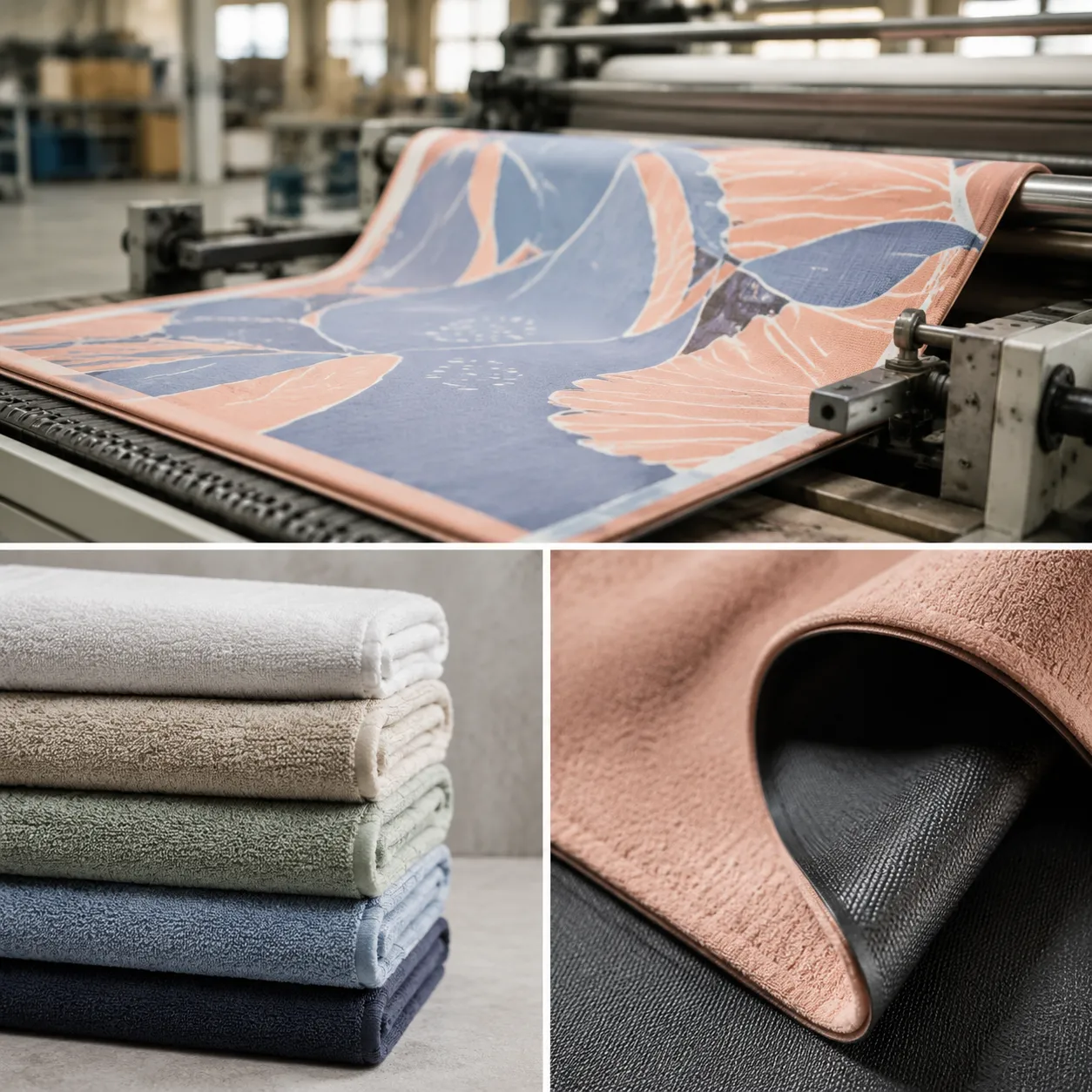
Start with the bag, not the logo
The best spec decision is usually made before artwork is discussed. We ask buyers four basic questions: who uses it, where it hangs, how dirty it gets, and whether it is a pro-shop item or an event giveaway. A caddie program at a private club needs a different build from a tournament registration gift. In practice, the first program leans toward absorbency, low lint and repeated laundering. The second often needs sharper logo impact at a lower unit price.
For most club and resort orders, the shape matters as much as the fabric. A tri-fold format around 40 × 60 cm open size is common because it clips neatly to the bag and presents the logo on the front fold. A full caddie towel around 50 × 100 cm works better for heavy-use bag service because players want separate zones for clubface, ball and hands. Those are not style choices only; they change yarn consumption, decoration area and carton count.
| Use case | Typical size | Construction | What buyers usually prioritize |
|---|---|---|---|
| Private club bag towel | 50 × 100 cm | 16s terry cotton, dobby border | Absorbency, low lint, repeated wash stability |
| Pro-shop logo item | 40 × 60 cm tri-fold | Waffle cotton or velour face | Front-facing branding and clean fold |
| Tournament gift | 30 × 50 cm or 40 × 60 cm | Cotton-poly blend or lightweight terry | Cost control and fast production |
| Resort golf fleet towel | 45 × 76 cm | Combed cotton terry | Soft hand, hook performance, reorder consistency |
The fabric choice decides whether players keep using it
Buyers often compare decoration first, but the main complaint we see is simpler: the towel does not clean the club well, or it dries too slowly after morning dew. For golf, the three most workable constructions are cotton terry, cotton waffle and microfiber waffle. Each has a different place.
- Cotton terry works best for classic club and caddie towels. We usually quote 380-520 GSM depending on size and logo method. It feels familiar, absorbs well and launders reliably.
- Cotton waffle gives a cleaner face for embroidery or woven labels and hangs lighter on the bag. Typical working range is 300-390 GSM. It dries faster than terry but does not feel as plush.
- Microfiber waffle is chosen when buyers want sharp print, lower weight and strong soil pickup on clubheads. Common range is 220-320 GSM. It can work well, but brand teams should confirm handfeel expectations because some golfers still prefer cotton.
For cotton programs, we normally steer buyers toward ring-spun combed yarn for retail and club use. Open-end cotton can save money on promotional orders, but the surface gets rougher faster and lint release is harder to control. On waffle constructions, pick count consistency matters. If the waffle cells collapse unevenly after dyeing, the folded face looks warped even when the towel remains within size tolerance.
Two technical details matter here. First, terry golf towels with a center-grommet attachment need a reinforced ground weave at the hole area; otherwise the eyelet may hold while the surrounding base fabric distorts. Second, waffle golf towels printed dark black or navy should be checked for logo bridge-over, where print ink sits on the waffle peaks and leaves lighter voids in the valleys. That issue is specific to this construction and should be reviewed on bulk pre-production samples, not just artwork proofs.
| Construction | Working GSM | Best use | Common risk if underspecified |
|---|---|---|---|
| Cotton terry | 380-520 | Club, caddie, resort fleet | Heavy shrinkage and loop snagging |
| Cotton waffle | 300-390 | Pro-shop retail, cleaner logo face | Uneven cell definition after dyeing |
| Microfiber waffle | 220-320 | Event, printed logo, lighter bag weight | Handfeel mismatch for traditional golf buyers |
| Velour/terry combo | 360-440 | Retail gift item | Face crush reducing absorbency on logo side |
Logo method should follow the construction
This is where many RFQs become messy. Buyers send one artwork file and ask for embroidery, print and jacquard pricing on the same towel body. In reality, different constructions make different methods viable. If you force the wrong pairing, either the logo looks weak or the towel stops performing like a towel.
Embroidery remains the safest choice for cotton club programs with modest logo size. On a 40 × 60 cm tri-fold towel, we usually keep the stitched area around 7-10 cm wide for a chest-style logo. Larger coverage stiffens the panel and can tunnel the face after washing. For full-coverage branding, woven jacquard or print is more appropriate.
- Embroidery suits club crests, initials and straightforward marks. Best on terry with border placement or on flatter waffle faces.
- Jacquard weaving works when the logo is part of the towel identity and quantity is high enough to justify loom setup. It gives the cleanest integrated look but needs simplified artwork and color discipline.
- Sublimation or digital print belongs mainly on microfiber, not on standard cotton terry. If a buyer wants photo detail, microfiber is the realistic route.
We test embroidery durability using a home-laundering sequence aligned with ISO 6330, then assess appearance change, edge puckering and thread integrity after the agreed cycle count. For colorfastness, a practical baseline for dyed cotton golf towels is ISO 105-C06 for washing and ISO 105-X12 for crocking, because golf users handle the towel repeatedly with sunscreen, grass moisture and glove friction. These are not abstract lab references. They directly predict complaints such as dye rub onto white gloves or logo thread fuzzing on the fold line.
Related reads: if decoration is still the open question, compare methods in embroidery vs. sublimation vs. jacquard and review color control in Pantone color matching for custom towels.
Attachment hardware causes more claims than buyers expect
A golf towel is not finished when the sewing is done. The hook, grommet or carabiner changes how the towel hangs and how fast it gets damaged. We see repeated failures when hardware is treated as an afterthought.
- For tri-fold towels, center-top grommet placement keeps the fold balanced. If the hole is even 12-15 mm off center, the front panel twists and the logo will not face outward on the bag.
- For larger caddie towels, a side loop or webbing tab often performs better than a center eyelet because the user drapes and rotates the towel more during play.
- Metal clips should be checked for plating stability in damp storage. Cheap clips can stain pale cotton around the attachment point before the towel is even issued.
One golf-specific defect we watch closely is grommet bite-through. On lighter waffle towels, a sharp-edged eyelet can cut the yarn pack over time, especially when the towel swings against the bag during cart use. We reduce that risk by matching inner-eyelet diameter to fabric thickness and by using reinforcement behind the grommet zone where needed. Another issue is fold-memory distortion on tri-fold towels: if the strap or hook is sewn after folding alignment drifts, the towel hangs crooked even though each panel measures correctly when flat.
| Attachment type | Best for | Pros | Watch-outs |
|---|---|---|---|
| Brass or plated eyelet + hook | Tri-fold club towel | Clean retail look, easy bag clip | Hole-zone distortion on lighter waffle bodies |
| Sewn webbing loop | Larger caddie towel | Less fabric stress, easy replacement | Loop color matching and bartack strength |
| Carabiner clip | Event and promo towel | Fast use, familiar hardware | More noise on bag, cheaper clips mark fabric |
| Corner loop only | Service towel fleets | Lowest hardware cost | Less front-facing logo presentation |
Where the FOB price actually moves
For golf programs, buyers usually focus too hard on the base towel and miss the effect of logo count, fold format and hardware packing. The attachment set, carding, polybag choice and barcode work can move landed cost more than a 20 GSM shift in the fabric.
Below are realistic FOB China ranges we are quoting in mid-2026 for standard programs at our MOQ of 500 pcs per design per color. Final numbers depend on yarn market, logo method and packout, but these are workable planning bands.
| Spec example | Qty 500 | Qty 2,000 | Qty 5,000+ |
|---|---|---|---|
| 40 × 60 cm tri-fold cotton terry, 420 GSM, 1 embroidery, hook set | USD 2.08-2.54 | USD 1.62-2.01 | USD 1.38-1.74 |
| 40 × 60 cm cotton waffle, 340 GSM, 1 embroidery, eyelet + clip | USD 1.92-2.36 | USD 1.49-1.88 | USD 1.29-1.62 |
| 50 × 100 cm cotton terry caddie towel, 460 GSM, woven label + loop | USD 3.26-4.08 | USD 2.71-3.42 | USD 2.34-2.96 |
| 40 × 60 cm microfiber waffle, 260 GSM, full print, carabiner | USD 1.36-1.78 | USD 1.08-1.42 | USD 0.94-1.23 |
Retail packout can add another USD 0.18-0.46 depending on hangtag, belly band, barcode sticker, insert card and individual bag. If a buyer wants mixed logo variants below MOQ, cost jumps quickly because setup labor is spread over fewer pieces. We generally advise clubs to keep one towel body and one hardware set, then vary only the crest thread color or woven label if they need light segmentation.
Sampling and bulk timing in a normal order window
Lead time becomes tight when buyers attach the towel order to tournament calendars. The squeeze usually happens in sampling, not in bulk sewing. Hardware confirmation, embroidery file cleanup and color approval eat more days than expected.
- Artwork review and quotation: 1-3 days
- Lab dip or color confirmation for dyed cotton: 4-6 days
- Proto or decoration mock-up sample: 5-8 days
- Pre-production sample with approved hardware and packaging: 7-10 days
- Bulk production after approval and deposit: 18-30 days
- Final inspection and export booking: 3-5 days
If the order uses custom-dyed webbing, a non-stock carabiner color, or jacquard weaving, add time. Jacquard artwork separation alone can push the front end by another 4-7 days because the logo has to be rebuilt for loom readability. For seasonal events, we tell buyers to count backward from the in-hands date, not the ship date. That sounds obvious, but many club teams still approve a sample after the freight decision should already have been made.
Related reads: for production calendar planning, see container vs. air freight for towel orders and build a towel tech pack that mills can quote.
What we inspect before a golf towel order leaves the factory
A passable home-towel inspection is not enough here because golf towels are displayed hanging, clipped, folded and handled with equipment. We inspect them the way the end user sees them.
- Check finished size after washing and after folding, not flat only. A towel can meet size spec but still present badly once tri-folded.
- Verify logo orientation against the hang direction. We still catch upside-down embroidery approvals from buyer artwork files every season.
- Test attachment alignment by hanging a sample on a bag or fixture. This quickly exposes off-center hardware or strap torque.
- Review shade continuity under daylight and store light. Deep greens and navies can shift visibly between towel body and sewn loop.
- Run absorbency and hand-cleaning checks on the final fabric, especially on velour or heavily printed surfaces.
For measurement and workmanship, we put agreed tolerances directly in the purchase order instead of hiding them in email chains. Realistic working tolerances for cotton golf towels depend on construction and wash finish, so they should be negotiated per item. We avoid publishing one generic number because a 50 × 100 cm terry caddie towel and a 40 × 60 cm waffle tri-fold do not behave the same after finishing. That is also why we use pre-production sample signoff as the visual standard for fold line, logo position and hang balance.
Certification-wise, buyers usually ask for OEKO-TEX 100 Class I and BSCI, and we also work under ISO 9001 quality management. If your club or brand has fiber-content claims on packaging, make sure those claims match both the testable composition and the sewn label. That sounds basic, but mixed-material attachment parts often create labeling errors in retail packouts.
Three specs we often push buyers to rewrite
Some RFQs look complete but still produce avoidable problems. These are the three lines we revise most often before quoting.
- "Golf towel with hook" is not enough. State whether you want eyelet + clip, sewn loop, or carabiner, and confirm finish color.
- "Logo about 10 cm" is incomplete. Specify placement from edge, orientation when hanging, and whether front fold presentation matters.
- "Cotton towel 400 GSM" is still vague. Confirm construction, yarn type and whether GSM is before or after wash finish.
If a buyer sends us a one-line request for a custom golf towels 2026 buyer guide type program, we can still quote, but the range will be wide and the sample loop gets longer. Cleaner specifications shorten cost negotiation and reduce the chance of approving a towel that looks right in a photo but performs badly on the course.
A workable buying path for clubs and golf brands
For most orders, the most stable route is simple. First, choose the use case and towel shape. Second, match the fabric to that use. Third, pick the logo method that suits the fabric instead of forcing one artwork process onto every option. Fourth, lock hardware and packout before the final sample. That order of decisions saves time because each later choice depends on the one before it.
Buyers managing broader resort or club linen programs may also want to compare this item with adjacent programs such as country club golf towel programs, hotel towel sourcing, and private-label vs. white-label towel programs. If MOQ flexibility is the main concern, negotiate towel MOQ without killing margin is the more useful read than another generic product round-up.
Need a custom golf towel quote with real specs?
Send size, construction, logo method, attachment and target quantity. We will quote workable FOB ranges, sample timing and any risk points before you place the PO. MOQ is 500 pcs per design per color. WhatsApp: +86 13205717266 | Email: [email protected]
Request quote →