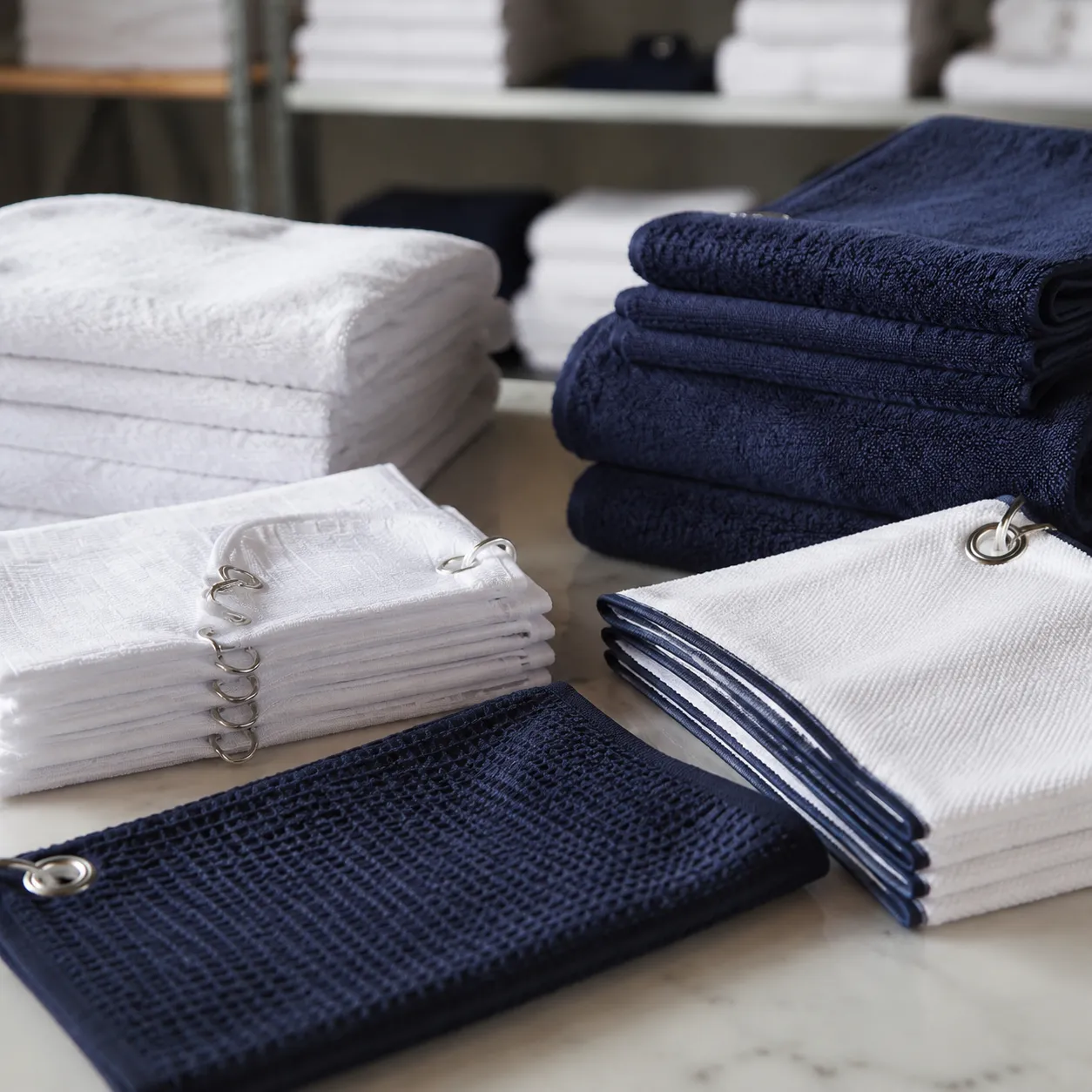
Start with the laundry environment, not the artwork
A monogram on a bath towel behaves differently in a boutique gift line than it does in a hotel spa shop. If the towel will see consumer home washing at 40°C, we can run softer pile, lighter underlay, and finer lettering. If it will be washed in a commercial tunnel or washer-extractor at 60-75°C, tumble dried hard, and sometimes pressed in stacks while still warm, we spec the embroidery more conservatively. That means larger letter height, lower stitch density in satin areas, and firmer cutaway backing so the pile does not collapse unevenly.
For most bath applications, we keep the monogram in the dobby border or a low-pile decorative panel rather than in the full terry field. Embroidering directly into high loop terry is possible, but the registration is less clean and the thread tends to sink unless we add a water-soluble topping film during stitching. That is a real process step, not a showroom detail: without topping, curved serif edges often look broken after the first wash.
| Use case | Typical base towel | Embroidery zone | Wash assumption |
|---|---|---|---|
| Hotel retail gift shop | 100% cotton, 520-620 GSM | Dobby border or velour panel | Home wash 40-60°C |
| Luxury DTC monogram set | Combed cotton, 560-680 GSM | Border panel | Home wash 40°C |
| Spa resale with back-of-house laundering | Cotton terry, 500-580 GSM | Reinforced border area | Commercial wash 60-70°C |
| Promotional premium gifting | Cotton terry, 450-520 GSM | Border panel | Mixed consumer use |
The towel construction decides whether the monogram sits cleanly
In this monogram bath towels 2026 buyer guide, the first spec line we check is not font. It is border construction. A good embroidery towel usually has one of three setups: a woven dobby border around 7-9 cm high, a sheared velour header, or a framed low-loop panel built into the loom plan. All three give the needle a flatter ground. Full lofty loops are attractive in a plain bath towel, but once a monogram is added, loop recovery around the stitched area can become uneven.
We usually recommend 16/s to 21/s ring-spun cotton for the pile yarn on monogram bath towels, depending on the hand feel target and GSM. Zero-twist styles can work for retail, but the pile is easier to snag around a dense logo and the border can distort more after wash. For hotel-adjacent programs, combed ring-spun cotton is safer. If the towel includes a header panel, we often reduce local pile bulk there by using a shorter loop or sheared face so the embroidery machine can hold tension consistently across the width.
- Best embroidery surface: dobby border, velour header, or low-loop woven panel
- Higher-risk surface: full high-pile terry with long loops above 5.5 mm
- Safer towel range for stable embroidery: 500-620 GSM
- Retail-only soft hand option: zero-twist or low-twist pile, but test wash distortion first
Monogram size, stitch count, and needle choice are where costs move
Small initials look simple on paper, but they are often the most expensive version per square centimeter because buyers try to keep thin strokes crisp. On towels, overly fine detail turns into thread mass. For bath towels, we normally keep monogram height around 45-85 mm. Below that, the outline gets lost in the texture unless we increase density too much. Above 100 mm, the logo starts to dominate the towel and stitch time rises quickly.
Needle selection matters. We usually run 75/11 embroidery needles for finer polyester thread on flatter panels, and 80/12 when the base is denser or the border weave is tighter. On heavier terry borders with metallic accents or thicker thread, 90/14 may be necessary, but we avoid that unless the artwork forces it because larger penetration can leave more visible needle points after repeated washing. Typical monogram programs sit around 4,800-9,500 stitches per towel. Dense crest-style monograms can pass 12,000 stitches, which is where you begin to see hand-feel stiffening unless the towel header is engineered for it.
| Monogram format | Typical size | Stitch count range | Machine note |
|---|---|---|---|
| Single serif initial | 50-60 mm high | 4,800-6,200 | 75/11 needle, light underlay |
| Two-letter intertwined monogram | 55-75 mm high | 6,200-8,400 | 80/12 needle, tighter registration |
| Three-letter classic monogram | 65-85 mm high | 7,800-10,500 | Cutaway backing recommended |
| Crest plus initials | 80-100 mm high | 10,500-14,500 | Longer run time, higher reject risk |
Backing weight is the hidden line item buyers miss
If you ask why one sample lies smooth and another tents upward around the embroidery after laundering, the backing is usually the answer. For bath towels, we use soft cutaway backing far more often than tear-away. Tear-away is faster to clean up, but on thick cotton terry it gives less long-term support. After ten or twenty washes, the stitched area begins to pull inward and the pile around the monogram wrinkles.
Common backing weights in our programs are 35 gsm, 50 gsm, and 65 gsm cutaway. A single elegant initial on a flat border may hold on 35 gsm. A denser interlocked monogram usually needs 50 gsm. Heavier crest work on a 580+ GSM towel may require 65 gsm, sometimes layered with a light topping film to control pile rise while stitching. This is one reason a quote can move by a few tenths of a dollar even when the towel body stays unchanged.
- 35 gsm cutaway: light single-letter monograms on flat borders
- 50 gsm cutaway: our most common choice for hotel retail and private-label bath sets
- 65 gsm cutaway: dense crest shapes, high stitch fill areas, or heavier towel grounds
- Water-soluble topping film: useful on terry surfaces to stop thread sink and broken edges
What actually fails after wash testing
The most common complaints are easy to predict before bulk. First is puckering around the monogram after laundering. That comes from too much stitch density, weak backing, or poor hoop tension during embroidery. Second is thread fuzzing or sheen loss, especially on low-grade rayon threads exposed to alkaline commercial wash chemistry. Third is border torque: the towel body remains square, but the header panel twists slightly because embroidery tension was not balanced.
We normally check monogram bath towels with a wash sequence that reflects end use rather than a generic lab-only standard. A practical internal benchmark is 5 home-laundry cycles for retail approval or 10 commercial-style cycles for hospitality-adjacent programs, then visual grading for puckering, edge clarity, and hand-feel. For harsher testing, we may run ISO 6330 domestic laundering conditions and check dimensional change, then add colorfastness to washing under ISO 105-C06. If the monogram thread is dark navy, black, or deep red on white cotton, we pay close attention to staining risk on the ground after wash.
| Failure mode | Likely cause | Prevention step |
|---|---|---|
| Puckering around initials | Backing too light or stitch density too high | Move to 50-65 gsm cutaway and reduce fill density |
| Thread sinks into pile | Embroidery on high loops without topping | Add water-soluble topping film or shift logo to panel |
| Border twisting | Uneven embroidery tension across header | Balance underlay and test on full-width sample |
| Thread sheen loss after laundry | Wrong thread type for wash chemistry | Use colorfast polyester embroidery thread and wash-trial approval |
Price bands: where the monogram cost really comes from
Buyers often ask for one number for embroidered bath towels, but the towel body and the stitch file move independently. A 540 GSM combed cotton bath towel with a modest one-letter monogram is not priced like a 620 GSM towel carrying a three-letter intertwined design with metallic trim. Run time per head, thread consumption, trimming labor, backing consumption, and reject allowance all affect the embroidery add-on.
For workable planning, here are current FOB China ranges we use for 70x140 cm bath towels in standard solid shades, assuming OEKO-TEX compliant materials, export packing, and bulk embroidery placed in the border area. MOQ at our mill remains 500 pcs per design per color, but monogram setup is more economical from 1,000 pcs upward.
| Volume | Base towel spec | Monogram type | FOB unit price |
|---|---|---|---|
| 500 pcs | 520 GSM combed cotton | Single-letter, 5k-6k stitches | USD 4.18-4.76 |
| 1,000 pcs | 560 GSM combed cotton | Two-letter, 6k-8k stitches | USD 4.62-5.28 |
| 3,000 pcs | 580 GSM combed cotton | Three-letter, 8k-10k stitches | USD 4.95-5.74 |
| 5,000 pcs | 620 GSM combed cotton | Crest style, 10k-14k stitches | USD 5.68-6.84 |
If you try to push a dense monogram onto a cheaper 430-460 GSM towel to save cost, the result often looks worse and does not truly save money after rejects. We would rather remove stitch complexity than underbuild the ground fabric. For cost-per-use, a towel that keeps shape through 35 home cycles will usually outperform a cheaper towel that puckers visibly before cycle 12.
Approval sequence that keeps bulk out of trouble
The cleanest orders follow a short, disciplined path. We do not need six rounds if the buyer signs off the right points in order. What matters is separating towel approval from embroidery approval, then combining them on a final pre-production sample.
- Approve the base towel first: size, GSM tolerance, color, border construction, and hand feel.
- Approve embroidery artwork second: letterform, thread colors, position from edge, and finished size in millimeters.
- Run a strike-off on the actual towel construction, not on swatch fabric from another style.
- Wash-test the embroidered sample under the intended care condition.
- Lock a pre-production sample with photo, stitch count, backing weight, and placement measurement.
- Start bulk only after sample signoff and PO detail match.
Placement mistakes are common. We ask buyers to specify distance from the bottom hem and side edge, not just “center in border.” A difference of 12 mm can look off once the towel is folded for retail display. If the set includes face towel, hand towel, and bath towel, the monogram scale should also be proportional across sizes rather than copied at one absolute dimension.
Lead time is usually embroidery capacity, not weaving
Plain towel weaving and dyeing are predictable. Embroidery is where the calendar gets tight, especially before holiday retail windows. A fresh monogram program typically needs 3-5 days for quote and artwork review, 7-10 days for sample towel making and embroidery strike-off, then around 22-32 days for bulk production after approval depending on order size, thread color count, and whether cartons need private-label inserts or barcode work.
As a practical range, 1,000 embroidered bath towels can often ship in about 28-34 days from sample approval. A 5,000-piece mixed-size towel set with multiple initials or carton-level retail packing may need 38-46 days. If your order ships near a peak embroidery slot, reserve capacity earlier than you would for plain terry. Related reads: build-towel-tech-pack-that-mills-can-quote, pantone-color-matching-custom-towels, and container-vs-air-freight-towel-orders.
The PO fields we need to quote and run correctly
A monogram bath towel order goes smoother when the PO or tech pack contains the technical fields that drive embroidery setup. Missing one of them can lead to sample drift or a requote.
- Towel size and finished GSM tolerance
- Fiber content and yarn style, such as combed cotton or zero-twist blend
- Border construction and exact embroidery placement zone
- Monogram artwork in vector format plus final size in millimeters
- Embroidery thread type and colors, preferably Pantone reference
- Expected stitch count range or approval sample reference
- Backing type and weight if already agreed
- Wash-care assumption: home retail or commercial laundry
For buyers building a wider branded towel line, it helps to align this with the same format used in monogrammed-bath-towels-luxury-brand-guide, towel-gsm-decision-framework, and combed-vs-zero-twist-cotton-explained. If your order is hospitality-facing, the base towel planning in hotel-towel-sourcing-guide-2026 is also useful before you finalize decoration.
What we recommend for most buyers in 2026
If you need a safe starting point, we would build the first run around a 560-600 GSM combed cotton bath towel, 70x140 cm, with a woven dobby border around 8 cm high, a two-letter or three-letter monogram sized 60-75 mm high, polyester embroidery thread, and 50 gsm cutaway backing. That combination holds shape well, prices reasonably, and avoids the overbuilt stiffness that comes from crest-heavy designs.
If you want a softer retail hand, we can shift to a sheared header panel and a slightly loftier body, but we would still insist on a real wash trial before bulk. Certifications available include OEKO-TEX 100 Class I, BSCI, and ISO 9001. Our MOQ is 500 pcs per design per color. For quoting, sample planning, or artwork review, contact us at [email protected] or WhatsApp +86 13205717266.
Need a monogram bath towel quote reviewed by the mill
Send the artwork, target GSM, towel size, and wash-use scenario. We will mark the risky spec lines before sampling.
Request Quote →