Start with the pouch, not the logo
The smallest mistake in this category is reviewing decoration in isolation. These towels are usually folded into amenity kits, crew comfort packs, or short-haul refresh sets, so the logo method has to work inside a very tight format. A 25×25 cm terry square at 320-380 GSM behaves differently from a 30×30 cm low-pile velour face, and both behave differently again once they are folded four times and inserted into a zipper pouch. If the decoration creates bulk, puckering, or hard handfeel, the kit line slows down and the towel stops feeling like part of a clean onboard program.
For airline amenity work, we usually review four practical variables before we discuss color: folded thickness, face clarity after compression, lint behavior, and whether the decorated area distorts after one home-laundry simulation plus one compression cycle. That second point matters more than many buyers expect. A logo can look crisp straight off embroidery or print, then lose definition after the towel is folded, pressed in transit, and reopened by the passenger.
| Program type | Typical towel size | Common base construction | What decoration must avoid |
|---|---|---|---|
| Economy amenity kit | 25×25 cm | 1-side velour / 1-side terry, 320-360 GSM | Added bulk that prevents compact folding |
| Business class refresh kit | 30×30 cm | Combed cotton terry, 360-420 GSM | Abrasion marks on face after pouch friction |
| Premium cabin set | 30×30 cm or 32×32 cm | Jacquard-capable terry, 380-450 GSM | Logo drift, skewed placement, heavy edge feel |
| Crew utility towel | 30×30 cm | Plain terry, 340-400 GSM | Decoration that cracks or sheds after repeat wash |
The four methods that actually belong on the shortlist
We do not put every decoration process into every quotation. For this product, the realistic shortlist is embroidery, jacquard weaving, velour reactive printing, and sewn label branding. Screen print can work on some cotton faces, but on compact towels for airline kits it often loses to velour print on appearance or to jacquard on total program stability. Heat transfer is usually the wrong answer for cotton terry because the patch area can stiffen the face and create a plastic touch that feels out of place in an onboard amenity set.
- Embroidery works best when the logo is small, placement is fixed, and the buyer accepts some back-side show-through or an added backing layer.
- Jacquard weaving works when the logo is part of the towel itself and the order volume is high enough to justify loom setup and design clean-up.
- Reactive print on velour face works for cleaner artwork, softer touch, and multi-color branding, but it needs the right pile finish and stronger shade control.
- Sewn label branding is the low-risk option for very small logos, regulatory text, or dual-brand programs where the towel face should stay plain.
Embroidery is strongest on perceived value, weakest on distortion control
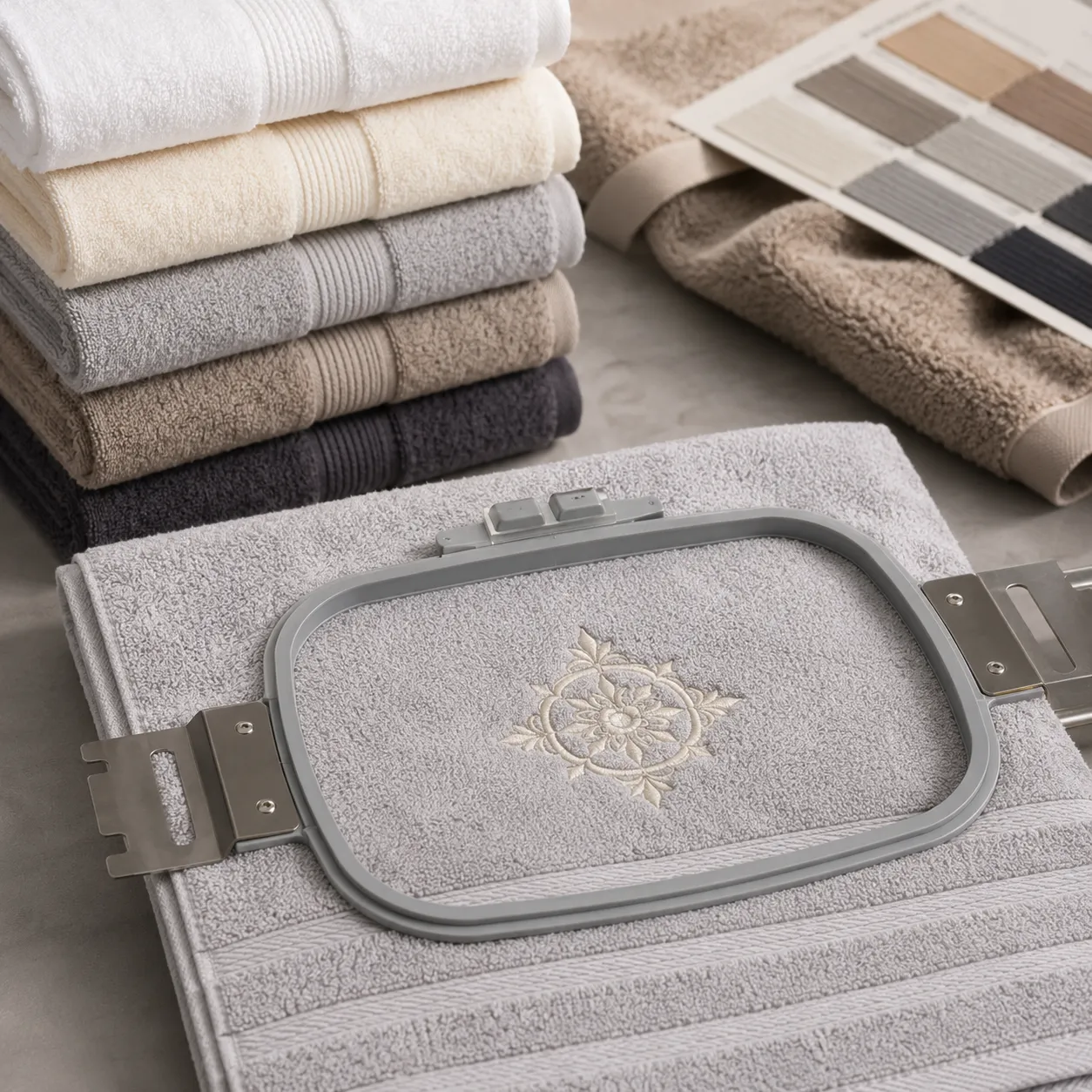
Embroidery is often the first request from premium cabin teams because it signals permanence. On a bath towel, that instinct can be right. On a small airline cloth, it needs caution. The logo area is physically small, the towel weight is light, and the fabric is frequently under 400 GSM. Dense stitching can pull the ground fabric, especially on loop terry with softer yarn twist. The result is a shallow bowl effect around the emblem, which becomes obvious after folding.
We usually keep embroidered airline logos below about 55 mm width unless the artwork is very open. Satin stitch columns that look elegant on paper can become too dense on a 16s/1 or 21s/2 cotton ground. Under wash testing, the issue is not usually color loss first; it is shape stability. We check this with dimensional change after laundering based on ISO 6330, and we also inspect puckering visually after drying. If the buyer wants a crest with fine internal lines, we often rebuild the artwork to reduce stitch count instead of enlarging it.
| Embroidery checkpoint | Recommended range | Buyer risk if ignored |
|---|---|---|
| Logo width | 35-55 mm | Large motifs pull small towels out of square |
| Stitch density | 0.35-0.45 mm fill logic depending on artwork | Dense fills create stiffness and tunneling |
| Placement from hem | 18-28 mm | Too close to hem causes uneven fold line |
| Backing choice | Soft cut-away or water-soluble, program dependent | Wrong backing leaves scratchy feel or poor wash stability |
On pricing, a 25×25 cm combed cotton towel with a small 1-color embroidery usually lands around USD 0.74-0.96 per piece at 8,000-15,000 pieces, depending on stitch count and pack method. A larger crest with metallic-look thread effects or high-fill areas can move that to USD 1.02-1.21. MOQ is still 500 pieces per design and per color at mill level, but embroidery thread changes, placement templates, and slower sewing throughput make very fragmented airline programs inefficient below roughly 3,000 pieces per artwork.
Jacquard wins when the logo should feel native to the towel
If the brand identity can tolerate a woven interpretation rather than a sharp printed emblem, jacquard is usually the cleanest technical answer. There is no added layer on top of the fabric. The logo sits in the construction, so there is no stitch drag and no print film. For repeated programs, especially lounge or business-class kits with annual replenishment, that stability matters. We see fewer complaints on handfeel and fewer surprises after compression in transit.
The limitation is artwork language. Small text, thin strokes, and detailed aircraft silhouettes do not convert well unless the towel face is sized generously and the pattern is simplified. Buyers sometimes send brand book files that are perfect for paper, terrible for loop geometry. Jacquard needs contrast blocks, not hairlines. We normally map the logo to the loop repeat and decide whether the face should be high-low terry, sheared velour contrast, or a flat woven border panel. That mapping step is where many sampling rounds are either saved or wasted.
- Best for repeat airline programs above about 6,000-10,000 pieces per design.
- Works well when the logo can be interpreted in 2 colors rather than full-spectrum artwork.
- Keeps the towel face soft because there is no embroidery mass or print coating.
- Needs earlier artwork cleanup than other methods, especially for letters under 5 mm height.
| Jacquard program factor | Typical result | Comment |
|---|---|---|
| Visual sharpness | Medium | Cleaner from distance than at close inspection |
| Handfeel | Soft | Usually the best onboard touch among logoed options |
| Sampling lead time | 9-14 days | Depends on graphing and loom plan |
| FOB range at 10,000+ pcs | USD 0.69-0.88 | Varies by yarn count, colors, and packing style |
Reactive print gives the cleanest artwork, but only on the right face
For airline brands with multi-color identity systems, reactive printing on a sheared cotton velour face is often the best-looking route. It reproduces curves, softer gradients, and small type far better than jacquard, and it keeps the front face flatter than embroidery. The problem is that buyers sometimes request it on the wrong ground fabric. A lofty terry face will blur edges because the pile is not level enough. If we quote print, we usually move the construction toward one-side velour, one-side terry, often around 340-380 GSM for compact kits.
The key technical detail here is not just colorfastness; it is pile definition after printing and washing. We look at colorfastness to washing under ISO 105-C06, but we also inspect whether the printed face develops a frosted appearance once the cut pile is rubbed during handling. Dark navy logos on light grounds are especially sensitive. If the amenity pouch has a zipper pull or metal slider, that friction can mark the printed face during transit unless inner polybagging is specified.
Cost sits in the middle. At 12,000 pieces, a 30×30 cm printed velour towel for an airline kit may run around USD 0.78-0.93 depending on number of print colors, face prep, and individual bagging. The hidden cost is sampling discipline. A print strike-off that looks excellent on one lab-prepared panel can mislead the buyer if bulk pile height and shearing standard are not locked in. We therefore tie bulk approval to the exact face finish, not just the Pantone target. That avoids the common dispute where the shade is correct but the logo edge looks softer than the approved sample.
Sewn labels are not glamorous, but they solve real airline constraints
There are programs where the towel itself should remain understated and the brand mark only needs to be visible at unpacking. In those cases, a side label or corner label is often the most disciplined choice. This is common in dual-logo kits, licensed collaborations, or route-specific bundles where the SKU count is high and direct decoration on the towel would create too many separate production lots.
A woven damask label or satin label keeps the base towel universal. The same white or charcoal towel can be used across several airline kit variants, while only the label changes. That reduces slow-moving inventory risk. It also protects touch, because the face of the towel remains plain. We normally keep folded labels narrow and place them into the side seam or near the hem so they do not interfere with wiping performance.
- Useful for multi-SKU programs where artwork changes faster than towel color.
- Helps when procurement wants one greige or dyed base towel across several regional launches.
- Usually the lowest technical risk on wash performance if the label edge and attachment are controlled.
- Not ideal if the buyer expects the logo to read clearly from a distance once the towel is unfolded.
| Label option | Best use case | FOB impact |
|---|---|---|
| Side seam woven label | High-SKU amenity programs | Typically +USD 0.05-0.09 |
| Corner satin label | Soft branding with care text | Typically +USD 0.04-0.07 |
| Loop label for hanging | Crew or lounge utility towel | Typically +USD 0.06-0.10 |
| Main face plain with label only | Minimalist premium kits | Often lower than direct logo methods overall |
What usually fails in sample approval
The failed sample is rarely the one with the worst artwork. It is usually the one that passed too quickly. In this category, we see four repeat failure modes: the logo was approved at an unrealistic scale, the buyer approved a hand-made mockup rather than production-finished fabric, the towel was evaluated flat instead of folded into final kit format, or the decoration was checked without a wash-and-repack trial.
- Approve the towel after one full fold sequence into the actual pouch dimensions.
- Check the logo again after one wash cycle and one tumble or line-dry condition matched to program intent.
- Confirm placement from hem with a measured tolerance, usually ±5 mm is realistic for small goods.
- Review the reverse side for scratch, show-through, or backing visibility before signing bulk.
Embroidery backing exposure is a common complaint from premium airline buyers because the towel may be used on face or hands. Printed velour more often fails on shade or pile clarity. Jacquard more often fails on logo simplification, where the brand team feels the symbol became too blocky. These are different risks, which is why a real airline amenity towel logo decoration comparison should finish with a method fit, not with a generic ranking table.
How we match method to airline program type
Short-haul economy kits usually reward compact packing, low SKU friction, and acceptable branding at controlled cost. Business class programs usually care more about touch and visual neatness after unboxing. Limited-edition route launches often care most about artwork flexibility because the branding window is short. Those three realities push decoration decisions in different directions.
| Program scenario | Best-fit method | Reason |
|---|---|---|
| Short-haul economy amenity pack | Sewn label or simple jacquard | Controls cost and keeps folding stable |
| Business class refresh towel | Jacquard or light embroidery | Better handfeel and more elevated presentation |
| Seasonal brand collaboration | Reactive print on velour face | Handles graphic artwork and color variation |
| Crew comfort or utility issue | Embroidery or label | Durability and easier stock separation |
If a buyer asks us for a single answer, we usually narrow it this way: choose jacquard for long-run softness and repeatability, embroidery for small premium marks with disciplined artwork, print for stronger graphic identity, and labels for SKU-heavy operational programs. That is less dramatic than saying one method is best. It is also how onboard textile programs actually stay under control.
Lead times, MOQ splits, and where cost really moves
Decoration choice changes the production calendar more than many sourcing teams expect. A plain airline towel body can move quickly once yarn, shade, and pack-out are locked. Decoration adds a different bottleneck depending on method. Embroidery capacity is tied to machine time. Jacquard depends on graphing and loom allocation. Printing depends on face prep, screen or artwork setup, and drying stability. Labels seem simple, but custom weaving plus sewing insertion still needs coordination with finishing and packing.
- Sampling: 5-7 days for label mockups, 7-10 days for embroidery samples, 9-14 days for jacquard, 8-12 days for printed velour strike-off plus sewn sample.
- Bulk production: usually 18-28 days after approval for simpler label or embroidery programs, 22-35 days for jacquard or printed constructions.
- MOQ: mill MOQ remains 500 pieces per design per color, but efficient pricing normally starts higher once decoration setup is considered.
- Freight planning: because these pieces ship inside kits or as compact accessories, carton density is good, but decoration damage in compression must still be checked before booking.
For buyers building the wider specification, build-towel-tech-pack-that-mills-can-quote.html helps prevent missing line items, and pantone-color-matching-custom-towels.html is useful if brand color accuracy is strict. If your team is still deciding whether the towel should carry the branding at all, embroidery-vs-sublimation-vs-jacquard.html and private-label-vs-white-label-towel-programs.html give broader context.
The buyer-side conclusion
The right decoration method for this product is the one that still looks intentional after folding, compression, handling, and a realistic wash check. That tends to eliminate decorative choices faster than mood boards do. For most recurring airline programs, jacquard or a well-managed label solution gives the lowest operational friction. For premium marks on a restrained design, embroidery works if stitch density and placement are kept under control. For graphic identity that really needs color and edge clarity, printed velour is the stronger route, provided the base fabric is built for it.
If you are quoting several options to internal stakeholders, ask each supplier to show the logo on the exact finished towel size, with the exact fold, pack method, and decoration placement you plan to buy. That one discipline removes a large share of avoidable resampling. Related reads: how-to-read-oeko-tex-certificate.html, negotiate-towel-moq-without-killing-margin.html, and container-vs-air-freight-towel-orders.html.
Need a decoration recommendation for an airline kit?
Send us the towel size, target artwork, kit pouch dimensions, and annual volume. We can advise which method is commercially and technically realistic, quote MOQ 500 pcs per design per color, and map sample-to-bulk timing. WhatsApp +86 13205717266 or email [email protected].
Request a Quote →