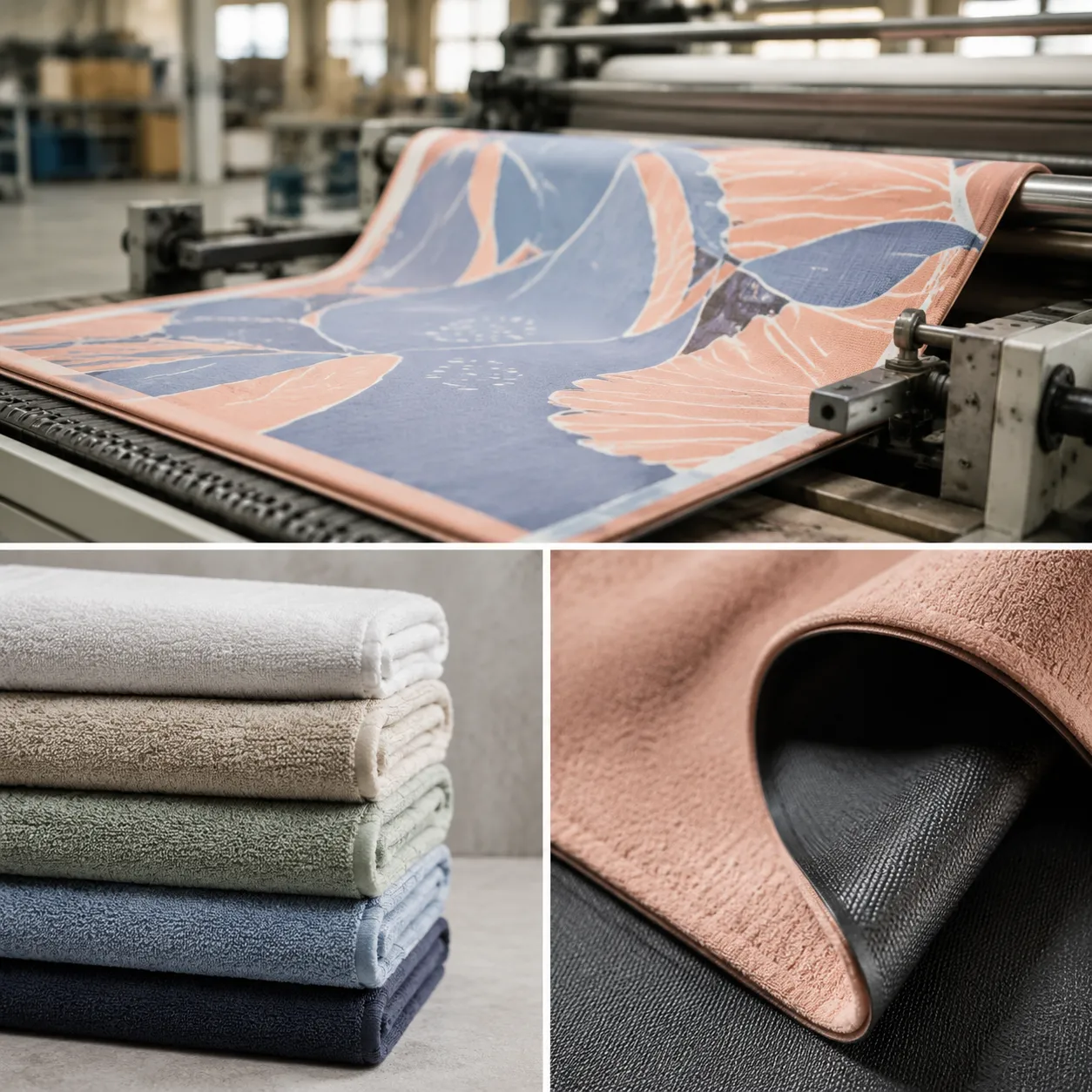
Start with the job, not the artwork
The first decision is what the cloth must do in use. A cloth for eyewear, a towel for car drying, and a screen-cleaning wipe can all be made from polyester-polyamide microfiber, but the knit, pile height, edge finish, and weight should be different. If the end use is vague, factories fill the gaps with whatever is easiest to quote, and buyers end up comparing numbers that are not really comparable.
For most OEM programs, we ask for five basics before we quote: end use, finished size tolerance, target hand feel, decoration method, and wash expectation. A 230 GSM suede lens cloth with hot-cut edges behaves very differently from a 340 GSM short-pile warp knit cloth for electronics or a 420 GSM coral fleece cloth for detailing kits. If you only ask for “microfiber cloth, custom logo,” the supplier has too much room to substitute.
| End use | Typical construction | Usual GSM | Common risk if underspecified |
|---|---|---|---|
| Eyewear / screens | Suede or fine flat knit | 180-240 GSM | Drag marks, weak print definition |
| Household cleaning | Short-pile warp knit | 260-320 GSM | Poor soil pickup, edge distortion |
| Automotive interior / glass | Tight terry or waffle microfiber | 280-360 GSM | Lint on glass, streaking |
| Absorbent detailing | Coral fleece or twisted microfiber | 380-600 GSM | False GSM claims, heavy shedding |
- If the cloth touches glass or glossy screens, prioritize low-lint construction and clean edge sealing.
- If it must survive repeated laundering, specify wash cycles and test standard before sampling.
- If it will be sold retail, packaging and barcode layout should be approved with the fabric sample, not after bulk starts.
The three spec lines that change performance fastest
Buyers usually spend too much time on color and too little on fiber ratio, knit, and edge treatment. Those three lines change cleaning performance faster than almost anything else. For most cleaning cloth programs, the workable fiber ratio sits around 80/20 or 85/15 polyester/polyamide. Dropping the polyamide content can save a few cents, but pickup and softness usually fall with it, especially on glass and polished surfaces.
Knit structure matters just as much. Warp knit is more stable in shape and usually performs better where buyers want cleaner cutting, flatter branding panels, and less edge roll. Weft knit can feel softer in some hands, but it distorts more easily after washing if the finishing is inconsistent. Edge treatment is the third line item buyers miss. Overlock edges are economical, laser-cut edges look neat on suede cloths, and ultrasonic cutting helps on some edgeless programs, but not every fabric responds equally. On the wrong construction, ultrasonic sealing can harden the edge and create drag on coated surfaces.
| Spec line | Better for | Typical buyer mistake | What to write in PO or tech pack |
|---|---|---|---|
| Fiber ratio | Softness and absorbency | Accepting 'microfiber' with no ratio stated | 80/20 PES/PA ±2% |
| Knit type | Shape stability and cleaning feel | Comparing warp and weft as if equal | Warp knit short pile, one-side brushed |
| Edge finish | Durability and scratch safety | Approving sample without wash trial | Ultrasonic cut or overlock thread color confirmed |
How we separate look-alike samples in the lab
This is where many sourcing teams save time and lose money. Two cloths can feel similar in hand on day one. After testing, the differences show up quickly. For microfiber, we normally care about mass consistency, dimensional stability, colorfastness, absorbency, and lint behavior. A useful lab sequence is GSM check, cut-edge review, wash test, crocking, then practical wipe test on the target surface.
The two named checks we rely on most for early screening are ISO 6330 for domestic washing procedure and ISO 5077 for dimensional change after washing and drying. For color transfer, especially on dark navy, black, and saturated red promotional programs, ISO 105-X12 crocking is important because logos often pass appearance review but fail on actual rubbing. For glass cloths, we also run a simple in-house streak test under angled light after wiping a degreased pane. That test is not glamorous, but it catches finishing problems that certificates do not.
- Check actual GSM on conditioned fabric, not only supplier claim from greige stage.
- Measure shrinkage both lengthwise and widthwise after the agreed wash cycle.
- Review edge hardness by hand on glossy acrylic or coated plastic if the cloth is sold for delicate surfaces.
- Compare lint release after first wash and after cut-edge abrasion, not only before washing.
Common failure modes we see in bulk orders
Microfiber defects are often subtle until goods reach the market. One common issue is split inconsistency. The cloth still looks acceptable, but it stops gripping dust well because the filament splitting is weak or uneven. Another is pile direction shading. On darker colors, panels appear mismatched carton to carton because the brushing direction changed during finishing. Buyers sometimes call this a dye lot issue when it is actually nap orientation.
Another defect mode is edge curl after heat cutting. If the knife temperature or line speed is wrong, the sealed edge pulls inward after washing. We also watch for silicone-heavy softener finishing. It gives a pleasant first touch for sales samples, but it can reduce absorbency on household cleaning programs. On printed suede cloths, we also check for ghosting around fine logo lines because overpressure during transfer can blur edges on lightweight fabric.
| Failure mode | Where it appears | Likely cause | How to prevent it |
|---|---|---|---|
| Edge curl | Edgeless cloth after wash | Excess heat during cutting | Approve post-wash sample, not only ex-factory sample |
| Low grab / poor pickup | Dusting and glass use | Weak split quality or low PA ratio | Specify ratio and run practical wipe test |
| Streaking | Glass and screens | Heavy softener finish or wrong knit | Ban excessive softener, test on real surface |
| Panel shading | Dark cloths in packed lots | Pile direction variation | Set brushing direction standard in finishing |
Pricing only makes sense when the assumptions are visible
The editor was right to be hard on vague pricing. A useful quote must show construction, size, GSM, edge style, print method, and pack-out. Otherwise one supplier is quoting a 200 GSM suede cloth and another is quoting a 320 GSM knit wipe, and the buyer sees only a unit price gap. Below are realistic FOB China ranges we would expect in 2026 for common OEM microfiber programs, based on our 500-piece MOQ per design and per color.
| Spec assumption | 500 pcs | 2,000 pcs | 10,000 pcs | Notes |
|---|---|---|---|---|
| 15x18 cm suede cloth, 190-210 GSM, 1c transfer logo, OPP bag | USD 0.28-0.39 | USD 0.17-0.25 | USD 0.11-0.16 | Common for eyewear or promo inserts |
| 30x30 cm warp knit cloth, 280-300 GSM, overlock edge, 1c print | USD 0.74-0.96 | USD 0.48-0.66 | USD 0.33-0.46 | Stable choice for general cleaning |
| 40x40 cm short-pile cloth, 320-340 GSM, edgeless ultrasonic, full print | USD 1.02-1.34 | USD 0.71-0.92 | USD 0.52-0.69 | Higher finishing control needed |
| 40x60 cm coral fleece cloth, 420-450 GSM, woven label, retail band | USD 1.68-2.18 | USD 1.18-1.56 | USD 0.92-1.24 | For absorbent kits, not ideal for glass |
The price spread inside each row usually comes from four variables: polyamide level, edge process loss, print coverage, and packaging labor. A full-bleed sublimation face on a 40x40 cm cloth adds more than a small corner logo because transfer paper, alignment time, and reject exposure all rise together. An edgeless ultrasonic finish also sounds simple on paper, but on unstable fabric it raises defect risk and sorting time.
- Ask whether pricing is FOB China, EXW, or landed; buyers still lose time on this every month.
- Confirm if the quote includes test cost, custom insert card, barcode sticker, and spare quantity.
- If comparing two offers more than 18% apart, ask for the actual fiber ratio and finished weight used in each quote.
Lead time depends more on finish and pack-out than on sewing
Microfiber cloth orders are often thought of as fast because the items are small. Sometimes they are. Sometimes they are delayed by artwork approval, transfer paper queue, or packaging assembly rather than fabric production. For stock greige plus standard dye shades, a simple cloth can move quickly. For custom Pantone matching, retail header cards, multilingual inserts, and barcode-managed assortments, the calendar stretches.
| Stage | Typical days | What can slow it down |
|---|---|---|
| Quote and spec confirmation | 2-4 days | Missing end use, no agreed edge style |
| Lab dip or print strike-off | 4-7 days | Dark color matching, fine logo lines |
| Pre-production sample | 5-9 days | Retail packaging approval cycle |
| Bulk production | 18-28 days | Full-print queue, rework from edge sealing |
| Final inspection and dispatch | 3-5 days | AQL hold, carton marking revisions |
For buyers who are still shaping the product, we recommend freezing the technical lines first and leaving only artwork positioning open. That shortens the loop. If both fabric construction and decoration are still moving at the same time, every new sample restarts approval risk.
MOQ strategy that does not distort the product
Our standard MOQ is 500 pieces per design per color. For microfiber cloths, that is usually workable, but buyers run into trouble when they split too many colors or sizes into one launch. A 3,000-piece order divided across six shades, three slogans, and two pack formats stops behaving like a 3,000-piece order. It behaves like many small runs, and the unit cost rises accordingly.
There are smarter ways to hold MOQ without overcomplicating production. Keep one fabric color and vary the print. Keep one size and vary the insert card. Keep one sewing or edge process across the line. The more common parts you preserve, the more stable the production and the cleaner the pricing.
- Fix one base fabric spec before discussing color assortment.
- Limit launch pack-outs to one main format if the order is under 5,000 pieces.
- Use the same edge construction across colorways unless there is a technical reason not to.
- If testing a new SKU, spend the budget on better construction rather than too many variants.
If you are planning your first custom microfiber cloth program, build-towel-tech-pack-that-mills-can-quote.html is the best place to tighten your RFQ, and negotiate-towel-moq-without-killing-margin.html explains where MOQ flexibility is real and where it is not.
What certifications matter and what they do not prove
For this category, buyers usually ask for OEKO-TEX first, especially where the cloth touches skin, face, eyewear, or baby-related retail channels. We can produce to OEKO-TEX Standard 100 Class I requirements, and many buyers also ask for BSCI and ISO 9001 because they want chemical control plus process control. Those are sensible requests.
What these documents do not prove is cleaning performance. A certificate will not tell you whether a glass cloth streaks or whether an edgeless wipe curls after three laundering cycles. Treat certifications as a gate, not as product validation. Product validation still needs a signed sample, a clear tolerance sheet, and at least one wash-and-use trial on the real target surface.
- Use OEKO-TEX Standard 100 Class I for chemical compliance screening.
- Use BSCI for social compliance review of the manufacturing site.
- Use ISO 9001 as evidence the mill has controlled procedures, not as proof the cloth fits your application.
If your team needs help reading supplier paperwork, how-to-read-oeko-tex-certificate.html covers the document checks buyers should make before approving bulk.
The short checklist we wish more buyers used
Before you place the PO, the cleanest version of this microfiber cloth 2026 buyer guide is a one-page control list. It prevents most avoidable resets in sampling and bulk production.
- State end use clearly: screen, glass, household, auto interior, or retail promo.
- Lock the fabric construction: suede, warp knit, waffle, coral fleece, or other named build.
- Write fiber ratio and GSM tolerance into the PO.
- Approve edge finish after wash, not only before wash.
- Name the test methods required: ISO 6330, ISO 5077, and crocking where relevant.
- Confirm packaging level: bulk pack, OPP bag, insert card, belly band, or retail box.
- Match the quote basis across suppliers before comparing unit prices.
For broader material decisions, microfiber-vs-cotton-towel-comparison.html helps teams that are still deciding between synthetics and cotton, and container-vs-air-freight-towel-orders.html is useful once timing and shipping mode become the next constraint.
Need a microfiber cloth quote with real assumptions?
Send us size, GSM target, construction, artwork method, packaging, and required tests. We will quote against a defined spec, not a vague product name. MOQ is 500 pcs per design per color. Contact us at [email protected] or WhatsApp +86 13205717266.
Request Quote →