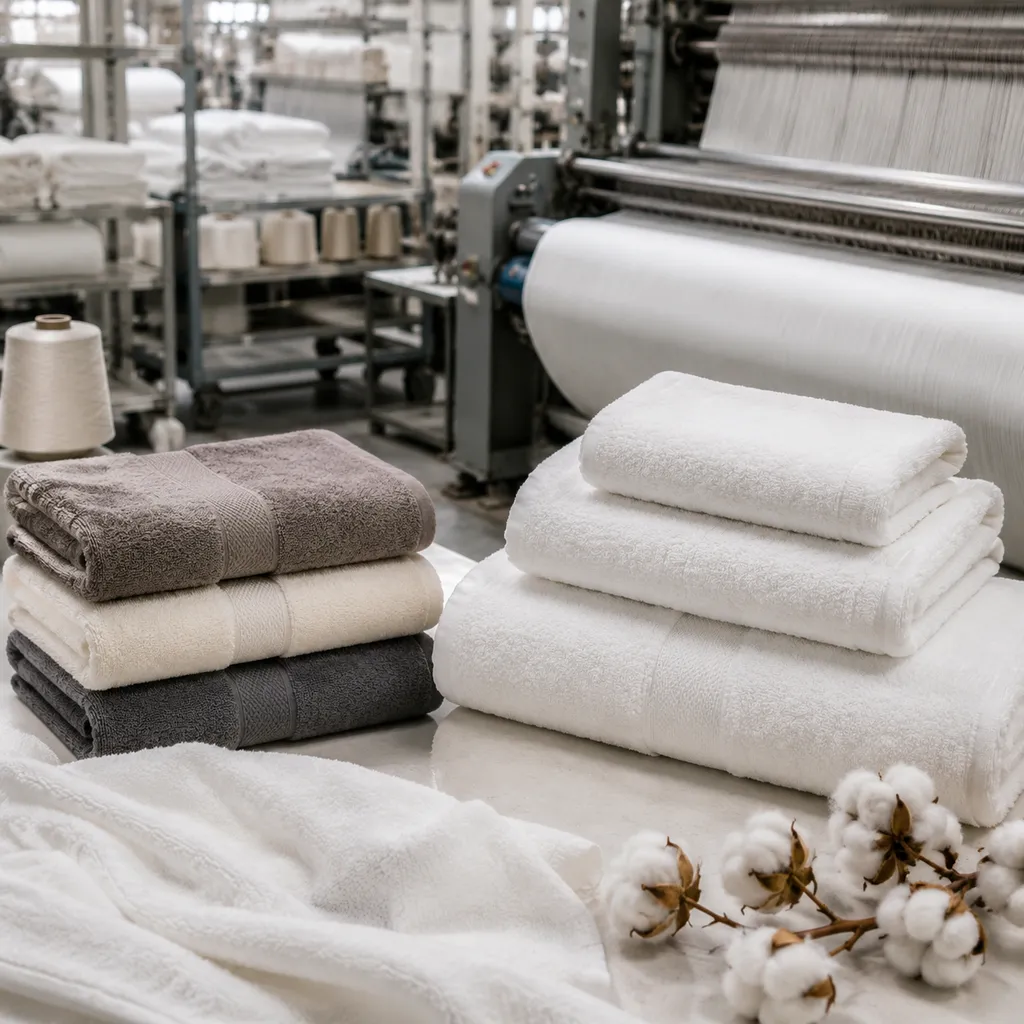
Why a hotel bath towel factory audit checklist matters
A bath towel for hotel use is not just a cotton rectangle. It has to survive flatwork feeders, guest laundering, chlorine drift in some properties, and repeated drying cycles without turning thin at the edges. When a buyer skips the factory audit, the usual loss is not the first sample; it is the second and third replenishment when shade drift, loop pull, or carton short-pack starts showing up.
We audit mills for the same reason hotel groups audit laundry plants: process stability matters more than a perfect one-off. A factory that can make 600 GSM on paper is not automatically a factory that can keep warp tension, pile height, and shrinkage inside band over a 20-day bulk run.
| Audit area | What we want to see | Why it matters |
|---|---|---|
| Spinning and yarn control | Consistent yarn count, twist, and lot traceability | Reduces weak pile loops and uneven absorbency |
| Weaving and finishing | Controlled pile density, shearing, and hem sewing | Prevents edge waviness and snags after wash |
| Dyeing and shade control | Recorded lab dips and lot segregation | Limits shade mismatch across cartons |
| Packing and export | Carton counts, polybag spec, pallet mark control | Stops shortage claims and freight disputes |
Start with the production flow, not the sales pitch
A good factory tour starts at the warping and weaving line, not the showroom. We want to know whether the mill is running own looms, how many are active on hotel towel constructions, and whether the same line is used for both white institutional goods and dyed private-label orders. Shared lines are fine if the cleaning and lot-separation discipline is real; they are a problem if the team treats every order as interchangeable.
- Ask for the current loom schedule by construction: terry, dobby border, rib border, or zero-twist variants.
- Confirm whether bleaching and dyeing are in-house or subcontracted.
- Check if hotel orders are stored by lot and by buyer colorway, not only by purchase order.
- Look for humidity control in yarn and greige storage, especially in monsoon months.
- Request the actual daily output for the towel width and GSM you need, not the factory's total output.
For a hotel program, we prefer mills that can show a stable run rate of at least 4,000 to 8,000 pcs per day on the target construction, because that tells us the line is already tuned. If a supplier says they can do 30,000 pcs per day, we still ask for the number on your exact spec, not the building's headline capacity.
The audit questions that expose real capacity
Capacity is not only machines. It is also the number of trained operators, the maintenance rhythm, and how often the mill changes yarn or border programs. A factory with too many changeovers tends to create more size drift and more shade variation, especially on hotel orders that split white, ivory, and light gray across the same booking.
| Question | Strong answer | Red flag |
|---|---|---|
| How many hotel bath towel orders run concurrently? | Two to four, with line separation and lot labeling | Eight or more without dedicated QC checkpoints |
| Who signs off the first 50 pcs? | QC plus production supervisor and merchandiser | Only sales staff or only line workers |
| What is the rework rate on terry towels? | Below 3% on stable programs | No recorded rework data |
| How long is the bulk lead time? | 25 to 35 days after approval for a standard hotel towel order | Lead time changes every week |
If the mill cannot answer those questions cleanly, it usually cannot control the boring parts either: hem tension, carton counts, and finish shrinkage. That is why this audit checklist is less about impressing a visitor and more about finding process memory.
Inspect the QC points that matter for hotel use
Hotel towels fail in predictable ways. Loop pulls often start at the cutting and shearing stage. Hem puckering comes from poor sewing tension. Shade variation comes from mixing yarn lots or rushing the bleaching batch. The audit should ask where each of those risks is checked, who records it, and whether the record is kept long enough to trace a complaint back to a loom shift.
- Verify incoming yarn inspection for count, twist, and contamination.
- Check inline pile height control after weaving and before shearing.
- Review hem stitch density and bartack consistency on sample pieces.
- Ask how the factory handles metal detection or foreign fiber contamination.
- Confirm AQL or equivalent inspection criteria for bulk packing.
A factory that does not measure pile loss, hem skew, and shade banding is asking the buyer to discover the problem after the container lands.
Two topic-specific details we always look for: first, whether the mill records shearing blade change intervals, because dull blades create fuzzy pile and uneven surface handfeel; second, whether the finishing line notes tumble-dry shrinkage separately from wash shrinkage, because some hotel laundries use hotter drying profiles than home textiles. Those two records tell us more than a polished sample room.
Audit the lab, not just the showroom
A showroom can hide a lot. A lab cannot. For hotel bath towels, we want in-house or closely managed testing for absorbency, dimensional change, colorfastness, and breaking strength. A supplier should be able to show actual test reports, not only certificates on a wall.
| Test item | Typical standard or method | What we check |
|---|---|---|
| Absorbency | Drop test or water absorption timing | Water uptake stays consistent across lots |
| Dimensional stability | Wash and dry cycle measurement | Shrinkage remains within agreed tolerance |
| Colorfastness | ISO 105 wash and crocking references | No excessive bleeding or rubbing transfer |
| Strength | Tensile or seam strength review | Hems do not fail under laundry stress |
If a factory says it passes tests but cannot identify the method, the lab name, or the date of the latest report, treat that as missing data. For compliance, we also ask for valid OEKO-TEX Standard 100 Class I documentation when the buyer needs skin-contact assurance, plus a current BSCI or equivalent social compliance audit and ISO 9001 process control evidence. Certificates are not a substitute for process control, but they do narrow the risk.
What to verify on certifications and traceability
For hotel programs, compliance is only useful if it is traceable to the exact factory site and the exact production period. We ask whether the certificate covers the actual dyeing, weaving, and finishing site, or only a head office entity. That distinction matters when the PO is large enough to split production across facilities.
- Match the certificate holder name to the shipping factory name.
- Check validity dates and scope, not just the logo.
- Ask for lot traceability from yarn receipt to packed carton.
- Confirm whether subcontracting is allowed and disclosed.
- Review social compliance records for overtime, fire exits, and machine guarding.
If a supplier is audited under ISO 9001, we look for a change-control record: when they altered yarn vendor, finishing temperature, or packaging material, did they log it? That is the simplest way to see whether the system is real. A mill with no change-control discipline tends to surprise buyers with silent spec drift.
Use this checklist on the factory floor
We keep the field audit practical. Walk the line, pull random pieces, and compare them to the approved sample. If you can, inspect at least three points in the process: greige, post-finish, and packed carton. That gives you a chance to catch problems before they disappear under polybags and outer cartons.
- Confirm yarn lot separation and raw material storage cleanliness.
- Check loom maintenance logs and active machine count.
- Pull random towels from the line and inspect loop uniformity and hem symmetry.
- Review lab records for shrinkage, absorbency, and colorfastness.
- Open finished cartons and count pack ratios, size labels, and barcode accuracy.
- Ask how complaints are traced and whether corrective actions are documented.
| Check point | Pass condition | Fail condition |
|---|---|---|
| Loop surface | Even pile, no bald streaks | Patchy pile or obvious tension marks |
| Hems | Straight, tight, no puckering | Wavy edges or loose corners |
| Packing | Correct counts and labels | Mixed sizes, wrong SKUs, shortage risk |
| Traceability | Lot code on cartons and records | No link between bulk and production lot |
For hotel buyers, the best audit outcome is not a perfect factory. It is a factory that knows where its weak points are and has routines to control them. That usually produces better replenishment than a flashy vendor that overpromises on speed and underdocuments every step.
Pricing tells you whether the audit is believable
A supplier's pricing often reveals whether the factory really owns the process. For a standard 450 to 550 GSM hotel bath towel, our FOB China range is often around USD 1.72 to 2.45 per piece at 1,000 to 3,000 pcs, and roughly USD 1.48 to 2.05 at 10,000 pcs and above, depending on yarn quality, border style, and packaging. If a quote comes in far below that, the audit should become more skeptical, not less.
| Order tier | Typical FOB range per piece | What usually changes |
|---|---|---|
| 1,000 to 3,000 pcs | USD 1.72 to 2.45 | Higher setup burden, smaller dye lots |
| 5,000 to 9,000 pcs | USD 1.55 to 2.22 | Better loom utilization and packing efficiency |
| 10,000 pcs+ | USD 1.48 to 2.05 | Lower conversion cost if spec is stable |
A cheap towel can be expensive in use. If a hotel burns through replacement stock because the pile loses body after repeated laundering, the real cost is not the first invoice. A towel that lasts 15 more wash cycles can easily beat a lower unit price by reducing replenishment frequency, housekeeping complaints, and guest-room inconsistency. That is the cost-per-use lens the factory audit should support.
Timing, MOQ, and export readiness
The audit is also about whether the factory can actually ship on time. For a straightforward hotel bath towel program, we usually expect 30 to 40 days for bulk production after sample approval, with another 5 to 10 days for cartonization, booking, and export paperwork depending on destination and season. MOQ is commonly 500 pcs per design or color, though a buyer can usually negotiate better structure once the first run is proven.
| Item | Typical range | Buyer note |
|---|---|---|
| MOQ | 500 pcs per design/color | Lower MOQs usually carry higher unit cost |
| Bulk production | 30 to 40 days | Depends on yarn availability and loom load |
| Final inspection to ship | 3 to 7 days | Add time for rework or packing corrections |
| Export docs | 1 to 3 days | Longer if the buyer needs special labeling |
We also check whether the factory can handle carton marks, polybag warnings, and pallet labels without confusion. That matters more than most buyers think, especially when towels ship alongside hotel robes or other linen programs. If export packaging is sloppy, the factory is not really ready for program business.
Related reads
If you are building a larger program, these guides connect naturally to a factory audit: hotel towel sourcing guide, hotel towels wholesale supplier guide, how to read an OEKO-TEX certificate, building hotel towels brand specs, and setting up a hotel linen program roadmap.
For construction and quality context, it also helps to compare against towel GSM decision framework and combed vs zero-twist cotton explained before you audit the mill, because the factory can only be judged fairly against the spec you actually need.
Request a factory audit review
Send us your supplier list, spec sheet, or audit photos. We can help you separate a stable hotel towel mill from a risky quote before you place bulk.
Get a Quote →