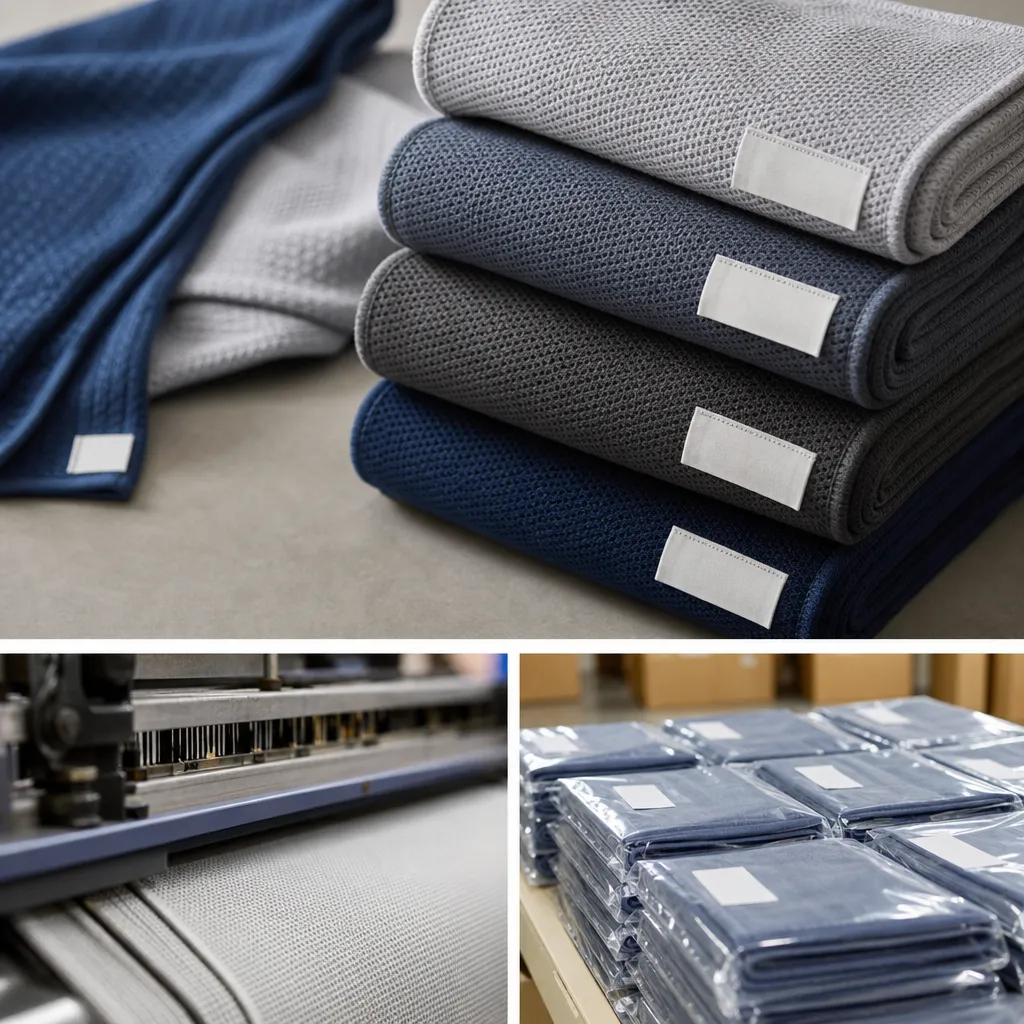
The Neck Use Case Is Different From A Gym Towel
A gym towel can be judged by sweat pickup and wash durability. A neck cooling towel has a narrower job: it must wet quickly, hold enough water for evaporation, stay comfortable when folded, and avoid feeling heavy on the collarbone. That changes the fabric weight, edge construction, label position, and even the way we pack it.
For cooling towels for neck, we normally start at 85-145 GSM microfiber or knit polyester. Below 75 GSM, the towel packs small but loses useful moisture too fast in outdoor heat. Above 160 GSM, buyers often like the hand feel at approval stage, but users complain that the towel becomes rope-like when twisted and wet.
| Use case | Common size | Practical GSM | Typical dry weight | Factory note |
|---|---|---|---|---|
| Road race giveaway | 30 x 80 cm | 85-105 GSM | 20-25 g | Low freight cost, best for short events |
| Golf or tennis club | 30 x 100 cm | 100-125 GSM | 30-38 g | More coverage without feeling bulky |
| Workwear heat program | 32 x 110 cm | 120-145 GSM | 42-51 g | Better wet retention for longer shifts |
| Retail sport accessory | 35 x 100 cm | 115-150 GSM | 40-53 g | Allows nicer pouch and branded header card |
The numbers look small, but a 10 g dry-weight change is noticeable after the towel is soaked and wrung. On a neck product, we prefer to solve comfort with knit structure and fiber split rather than simply adding mass.
Cooling Towels for Neck: The Spec That Actually Works
The most stable construction we run is an evaporative cooling knit made from 80-85% polyester and 15-20% polyamide, usually in a fine interlock or mesh-like knit. Polyester gives quick drying and shape stability; polyamide improves water pickup. Some buyers ask for 100% polyester to reduce cost, and it can work for a single promotional event, but it usually has weaker wet hand feel and less consistent cooling after the first wring.
We test an evaporative cooling towel differently from a bath towel. Absorbency by sink time alone is not enough. We wet the sample at 20-22°C water temperature, wring by roller to a repeatable wet pickup target, then record surface temperature drop over 10 minutes at 28-32°C ambient temperature and 45-60% relative humidity. In that condition, a workable microfiber cooling towel usually shows a 6-10°C surface drop in the first 90 seconds and keeps a 3-5°C difference for 8-12 minutes. In very humid air above 75% RH, the perceived cooling can fall by 30-45% because evaporation slows.
- Fiber split: 80/20 polyester-polyamide gives stronger water pickup; 85/15 is slightly cheaper and still stable for event programs.
- Knit openness: too closed and it feels wet rather than cool; too open and it dries before the user finishes a set, hole, or work cycle.
- Edge stretch: the edge must follow the knit. A rigid tape edge can curl after washing and rub the neck.
- Dye behavior: bright orange, red, and navy need stricter crocking checks because the towel is often used wet against pale shirts.
A Small Towel Still Needs Real Testing
Bulk buyers sometimes treat custom cooling towels as low-risk because the unit price is small. In our QC room, the opposite is true. Small towels have less tolerance for uneven knitting, shade variation, odor after packing, and edge distortion. A 4 mm banana curve is barely noticed on a bath towel, but on a 30 cm wide neck towel it can make the piece twist when worn.
Our standard test set includes ISO 105-C06 washing color fastness, ISO 105-X12 rubbing fastness, ISO 105-E04 perspiration fastness, dimensional change after washing, and a wet pickup check. For skin-contact programs, we recommend OEKO-TEX Standard 100 Class I or Class II depending on the buyer's market requirement. We also produce under ISO 9001 process control and BSCI-audited social compliance.
| QC item | Target we use for approval | Why it matters on neck products |
|---|---|---|
| Color fastness to rubbing | Dry 4+, wet 3-4 minimum on dark shades | Wet towels touch collars, caps, and event shirts |
| Dimensional change after 3 washes | Within +/-5% for length and width | Prevents curling and uneven stacking |
| Surface cooling check | Record drop at 90 sec and 10 min | Shows performance beyond the first cold touch |
| Odor after sealed packing | No sour or solvent odor after 48 hours sealed | Towels are often packed in PVC or PE pouches |
| Needle and edge inspection | No skipped stitches over 20 cm sample length | Skipped overlock stitches open quickly when users snap the towel |
Odor risk has a simple cause: microfiber with residual moisture or insufficient post-dye rinse can smell sour after it sits in a sealed pouch for two to four weeks. We control this with final moisture checks before packing, a full dry-down after dyeing, and random sealed-bag retention samples. Antimicrobial finishes can be added, but we do not recommend using them as a shortcut for poor drying or poor rinse control.
Logo Method Changes The Feel More Than Buyers Expect
Decoration looks easy because the towel is flat, but the neck position makes stiffness obvious. A large plastisol transfer can sit like a patch against the skin. Heavy embroidery can pull the knit and create a raised area that rubs during running or cycling. For most promotional cooling towels, we steer buyers toward sublimation, disperse print, small woven labels, or a narrow heat-transfer mark near one corner.
| Decoration method | Best for | Limit we suggest | Typical add-on |
|---|---|---|---|
| Sublimation print | Full-surface graphics on white polyester-rich fabric | Best on light base; color shifts on off-white or tinted fabric | USD 0.10-0.24 per pc |
| Disperse print | Repeat logos or solid brand patterns | Needs lab dip and strike-off for dark shades | USD 0.08-0.18 per pc |
| Small heat transfer | Event logo or sponsor mark | Keep under 45 x 70 mm for neck comfort | USD 0.06-0.16 per pc |
| Woven label | Retail or club branding | Place at short edge, not center neck area | USD 0.04-0.11 per pc |
| Embroidery | High-end club sets in small logos | Under 4,000 stitches; avoid dense fills | USD 0.18-0.45 per pc |
For color-critical brand programs, we do not drop a color guide link as a formality. Cooling towel fabric is usually synthetic and often printed by disperse or sublimation route, so a Pantone TCX or TPX reference behaves differently than cotton terry. We first match the closest lab dip or strike-off under D65 light, then check wet crocking because the product is used damp. Buyers planning multi-SKU color systems can compare this with our notes on Pantone color matching for custom towels, but the approval standard should be set on the actual cooling fabric, not on paper.
Cost Bands We See In Current OEM Orders
The cheapest quote usually comes from very light 100% polyester fabric, narrow size, thin polybag, and one-color print. That can be acceptable for a charity walk or one-day sampling program. For athletic retail, hotel wellness kits, or industrial heat-safety use, the saving is often false because the product loses shape faster and feels less useful after the first few uses.
| Order volume | Basic event spec | Balanced brand spec | Retail or heat-safety spec |
|---|---|---|---|
| 500-999 pcs | USD 0.72-0.98 | USD 1.05-1.38 | USD 1.42-1.95 |
| 1,000-2,999 pcs | USD 0.58-0.82 | USD 0.88-1.18 | USD 1.20-1.66 |
| 3,000-9,999 pcs | USD 0.46-0.69 | USD 0.72-1.02 | USD 1.02-1.44 |
| 10,000+ pcs | USD 0.38-0.58 | USD 0.61-0.88 | USD 0.88-1.25 |
These are FOB China bands for normal 30-35 cm width and 80-110 cm length, excluding unusually complex packaging. A carabiner tube, zip pouch, printed instruction card, barcode label, and carton drop-test requirement can add USD 0.12-0.42 per set. Antimicrobial treatment, where legally and commercially appropriate, usually adds USD 0.06-0.14 per piece plus test cost. We quote it separately because the claim language and destination-country compliance need to be checked before production.
For a towel worn on skin, a lower piece price is only useful if the user keeps it around the neck after the first five minutes.
Construction Details That Prevent Complaints
Two defect modes show up often in neck towel programs: edge waving and center-line distortion. Edge waving comes from overlock tension that is too tight for a stretchy knit. Center-line distortion comes from fabric roll tension during cutting, especially when the roll relaxes after spreading. We rest the fabric before cutting and set overlock tension after checking wet samples, not only dry panels.
- Confirm fabric composition and finished GSM with a pre-production swatch.
- Approve size after washing, not only at fresh-cut measurement.
- Check logo placement on a person or mannequin neck position.
- Wet and wring the sample before judging edge feel.
- Approve retail pouch size after the towel has been folded by production staff, not by a sample-room specialist.
Packaging also affects user experience. A towel packed too tightly in a round tube may look compact but develop fold memory. For retail, a flat zipper pouch or lightly rolled mesh bag is usually cleaner. For race kits, bulk folding in 100-piece inner cartons saves labor and avoids single-use packaging waste.
MOQ, Sampling, And Production Timing
Our MOQ is 500 pcs per design per color. That is realistic for a first club, event, or DTC test order. Below 500 pcs, dyeing, cutting, print setup, packaging material, and QC records still take the same coordination time, so the unit price rises sharply. If a buyer needs multiple sponsor logos, we often recommend one towel color and separate small transfer marks rather than many towel colors at low quantity.
| Stage | Normal timing | Notes |
|---|---|---|
| Spec confirmation | 1-3 days | Size, GSM, fabric, logo, packing, compliance requirements |
| Lab dip or print strike-off | 4-7 days | Longer for dark shades or full-surface artwork |
| Physical sample | 5-9 days | Add 2-3 days for custom pouch or barcode label |
| Bulk production | 18-28 days | After sample and deposit approval |
| Final inspection and packing | 2-4 days | AQL check, carton marks, moisture check |
| Sea or air dispatch prep | 1-3 days | Depends on forwarder booking and destination documents |
For repeat orders, we can often shorten the sample stage if the fabric and decoration route are unchanged. For new retail packaging, we keep the sample step because pouch size, folded thickness, and barcode position are easy places to make expensive small mistakes.
How To Brief The Mill Without Over-Specifying
A useful brief for a neck cooling towel should include the wearing situation, target retail or landed cost, expected wash count, logo method preference, destination market, and packing requirement. We do not need a 20-page document at the first discussion, but we do need enough information to avoid quoting a towel that is technically possible and commercially wrong.
- For events: tell us whether the towel is handed out dry, pre-wetted, or packed in a race bag for later use.
- For gyms and clubs: specify wash process, because hot tumble drying can shorten the life of lightweight synthetic knits.
- For outdoor workers: give the intended shift length and whether the towel will be worn under a helmet, collar, or high-vis vest.
- For retail: share folded package dimensions and barcode rules before sample making.
If the project sits between sport and promotional use, our custom microfiber towels wholesale guide gives useful background on synthetic towel sourcing. For buyers comparing neck towels with conventional sweat towels, why gym towels fail after 50 washes explains wash-life issues that also apply to lightweight knits.
Where This Product Fits In A Towel Program
Cooling towels are not replacements for terry towels. They belong in hot-weather activation kits, gym reception counters, tournament bags, resort wellness amenities, and employer heat-stress programs. A hotel may use cotton terry for rooms and spa, then add a neck towel for outdoor yoga or poolside activities. A golf club may keep terry cart towels while using evaporative towels for summer tournaments.
- Use cotton terry when absorbency and laundering are the main jobs.
- Use microfiber cooling knit when evaporation, light weight, and neck comfort are the main jobs.
- Use waffle or hammam styles when the buyer wants a natural-fiber look more than a cooling function.
- Use a branded pouch only when the towel will be carried or retailed; otherwise bulk packing may be cleaner.
Related reads: compare synthetic and cotton behavior in microfiber vs cotton towel comparison, build a quote-ready document with how to build a towel tech pack, and review MOQ trade-offs in negotiate towel MOQ without killing margin. For product-line planning, our fitness range is also listed under /products.html#gym.
Our Factory Position On Cheap Neck Towels
We can make a low-cost neck cooling towel, but we prefer to name what is being removed: polyamide content, fabric weight, pouch quality, testing, or print complexity. Those choices may be fine for a one-day giveaway. They are not fine for a retail accessory that must survive repeated washing or for a heat-safety program where the user depends on the towel during a long shift.
A realistic first order for cooling towels for neck is 1,000-3,000 pcs in one size, one base shade, and one decoration route. That quantity gives enough room for proper fabric purchase, controlled cutting, inspection, and stable packing without forcing the buyer into a container-sized commitment. We usually recommend approving one performance sample and one packed sample before bulk production.
LUMA & CO. TEXTILE has produced towels since 2007 with a 220-person team in Gaoyang, Zhejiang, supplying more than 80 brand clients across 47 countries. Our annual towel output is about 2.4 million pieces, with OEKO-TEX Standard 100, BSCI, and ISO 9001 systems supporting bulk production. For custom cooling towels, the practical starting point remains MOQ 500 pcs per design per color.
Quote A Neck Cooling Towel Program
Send size, GSM target, logo artwork, packing plan, destination market, and order quantity. We will reply with fabric options, realistic FOB pricing, sample timing, and QC notes. WhatsApp: +86 13205717266. Email: [email protected].
Request OEM Quote →