Start with the towel construction, not the logo
For auto drying towels, decoration choices are constrained by fabric mechanics. A 70/30 polyester-polyamide warp knit at 900-1300 GSM behaves very differently from a 320 GSM suede microfiber or a 380 GSM waffle weave. On high-pile twisted-loop drying towels, anything placed on the wiping face can create drag points, reduce absorbency in that zone, or leave a harder hand that detailers will notice immediately.
We usually separate these products into three construction families before discussing branding. First is twisted-loop drying towels, commonly 800-1300 GSM, where loops stand tall and move water fast. Second is coral fleece or plush pile, usually 500-900 GSM, which gives a softer hand but can show logo compression. Third is low-pile suede or waffle microfiber, usually 280-420 GSM, where printing is much easier because the surface is flatter.
- If the wiping face touches painted panels, we avoid bulky decoration in that contact zone.
- If the towel is sold in retail packs, branded hem tape, wash labels, and header cards often do more work than a large face logo.
- If the end user is a detailing studio, a corner mark or edge logo is usually safer than center placement.
Our short answer in any car drying microfiber towel logo decoration comparison
For plush and twisted-loop drying towels, the best-performing branding is usually a woven label sewn into the hem, a printed satin care label, or a logo on the packaging rather than on the wiping field. For low-pile microfiber, dye sublimation or screen print can work well, depending on artwork and color count. Embroidery is possible, but only in restricted zones and only when the buyer accepts more needle marks, slower sewing, and a stiffer spot.
| Method | Best towel type | Main risk | Typical MOQ |
|---|---|---|---|
| Woven label in hem | Twisted loop, plush, waffle | Label placement irritation if too large | 1,500 pcs |
| Satin care label print | All microfiber types | Branding visibility is lower | 1,000 pcs |
| Dye sublimation | Suede, waffle, low-pile knit | Not suitable on very fluffy pile | 500 pcs per design |
| Screen print | Low-pile microfiber | Ink hand can stiffen the area | 1,000 pcs per colorway |
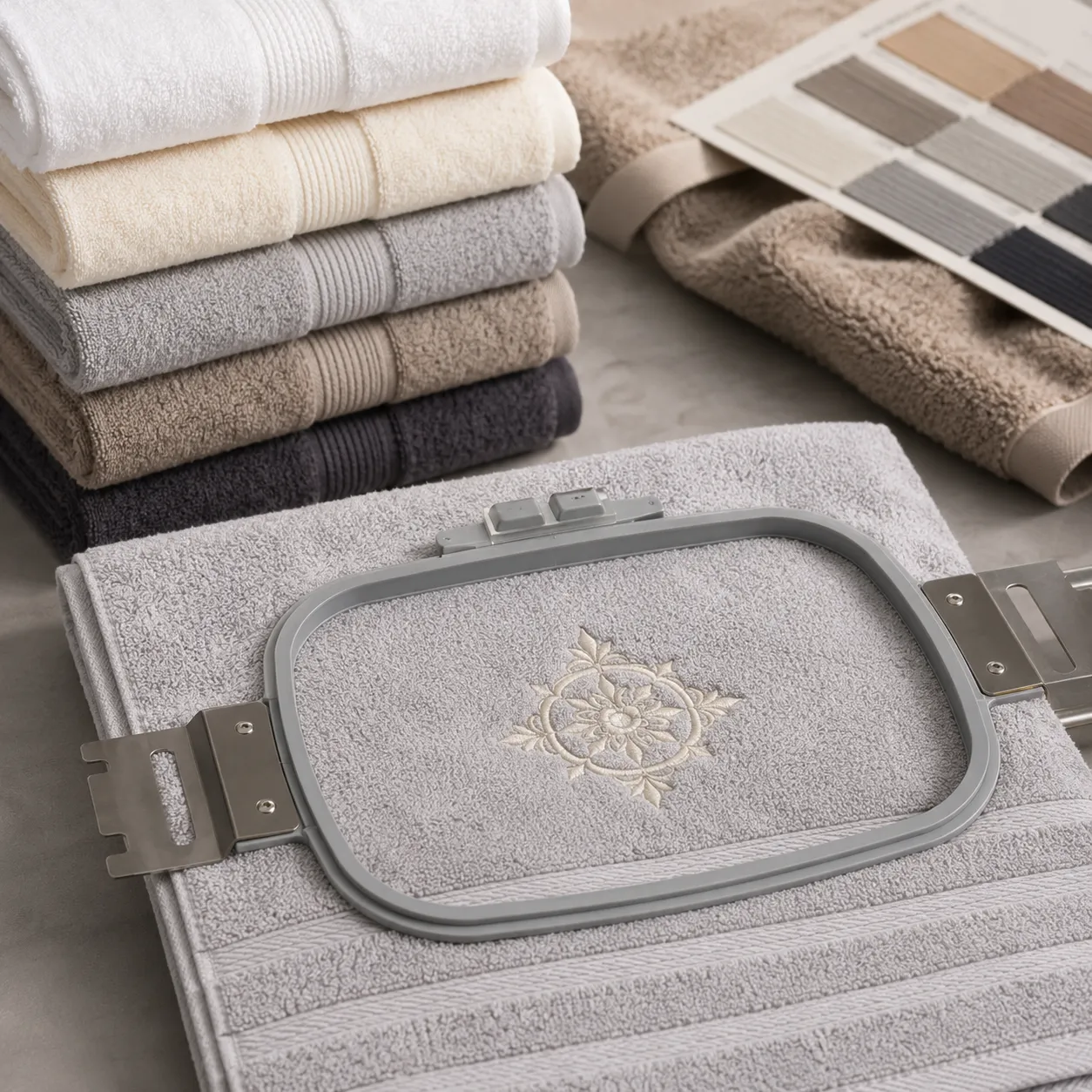
| Embroidery | Corner or band only | Needle holes and surface distortion | 500 pcs per design |
| Jacquard woven border | Special border constructions | Not practical for thick drying pile body | 3,000 pcs |
Why embroidery is usually the wrong choice on thick drying towels
Buyers often ask for embroidery because it looks durable and familiar. On microfiber car drying towels, that logic breaks down fast. Embroidery penetrates the base with repeated needle punches, and on a 1000 GSM twisted-loop structure the stitches sink unevenly while backing material adds stiffness. If the logo sits on the towel body instead of a corner tab, the area can become less paint-safe.
Two construction details matter here. First, twisted-loop towels have long untwisted loops that can snag around dense stitch columns. Second, many drying towels use a hidden lock-edge or microfiber binding that already creates thickness at the perimeter; adding embroidery too close to that seam can cause puckering after wash. In our line, we normally keep embroidery at least 18 mm away from the binding seam and we prefer stitch counts below about 7,500 on a corner placement.
- Best use: small corner logo on towels above 40x40 cm where the corner can stay off the main wiping path.
- Not recommended: large chest-style logo across the center panel of a plush drying towel.
- Wash performance: good thread retention if digitized correctly, but the hand feel remains harder than fabric-only branding.
| Embroidery factor | Practical range | What happens if pushed too far |
|---|---|---|
| Logo width | 35-85 mm | Larger logos sink and distort pile |
| Placement from edge | 18-30 mm | Closer placement can pucker the binding |
| Stitch density | 0.38-0.42 mm fill spacing | Higher density creates a boardy patch |
| Bulk add-on cost | USD 0.21-0.46/pc | Complex logos exceed value on entry SKUs |
Dye sublimation works well, but only on the right microfiber surface
Sublimation gives the cleanest result for gradients, halftones, and multi-color brand graphics. It is excellent on suede, low-pile waffle, and short-nap microfiber because the transfer paper meets a relatively even surface. On high-pile drying towels, the image loses edge definition because the pile tips receive heat unevenly and the valleys remain lighter. That is why a photo-quality logo on a fluffy 1100 GSM towel usually disappoints at sample stage.
The process detail buyers should know is that sublimation requires polyester-rich face exposure and heat pressure control. If the towel has a very plush pile, pressing can flatten the hand in the printed zone. We test this by checking both image sharpness and capillary pickup after print. A towel can look good on the sample table but show slower water spread in a simple drop test on the decorated area.
- Use sublimation on 280-400 GSM suede or waffle microfiber for full-face branding.
- Use it on one side only if the other side remains the functional drying face.
- Ask for a post-print crocking and wash review, not just artwork approval.
| Sublimation item | Typical result | Factory note |
|---|---|---|
| Artwork detail | Very high | Fine text under 2.2 mm still needs testing |
| Color range | Unlimited CMYK feel | Neon Pantone shades are approximate |
| FOB add-on | USD 0.17-0.39/pc | Depends on coverage and panel size |
| Sampling time | 4-6 days | Fastest method for artwork-heavy launches |
Screen print can be cleaner than buyers expect on low-pile towels
For simple one- or two-color branding, screen print is still relevant. It is often cheaper than sublimation on repeat programs with stable artwork, especially where the logo is small and placed near the hem. We use low-build ink systems and keep the print area compact so the towel does not develop a rubbery zone.
This method is not universal. On thick coral fleece or twisted loop, ink bridges over the pile rather than anchoring evenly. After repeated use, the print can show fractured edges because the microfiber surface flexes. On flatter waffle constructions, however, print registration is much more stable. We usually run a tape adhesion check after cure and then confirm appearance again after 10 home-laundry cycles.
- Best use: bold spot logo, one or two colors, low-pile microfiber.
- Weak point: hand feel becomes less soft in the printed zone.
- Commercial fit: value-focused private label lines and event packs.
The methods that buyers forget: labels, hem tape, and packaging
For many detailing brands, the smartest branding is not on the wiping face at all. A woven damask label sewn into the hem, a branded elastic belly band, or a printed wash label can preserve towel performance and still give clear brand identity. On a 60x90 cm twisted-loop towel, a 55x18 mm side label is often more useful than a front logo because the user sees it when unfolding, but it never drags across clear coat.
We also use custom edge tape on some programs. If the towel is bound with suede piping or microfiber overlock plus satin edge, the tape can carry a repeated logo mark. This is not a fit for every SKU because edge printing tolerances depend on tape width and seam allowance, but on mid-volume runs it gives a cleaner brand signature than embroidery.
| Indirect branding method | Performance impact | Typical add-on FOB | MOQ |
|---|---|---|---|
| Printed satin care label | None on wiping face | USD 0.03-0.06/pc | 1,000 pcs |
| Woven hem label | Very low if placed correctly | USD 0.05-0.09/pc | 1,500 pcs |
| Branded belly band | None | USD 0.08-0.18/set | 1,000 sets |
| Custom edge tape | Low | USD 0.11-0.24/pc | 2,000 pcs |
Cost and lead time by decoration method
Decoration cost moves less with GSM than buyers expect and more with setup, labor touchpoints, and defect risk. A 500-piece low-pile sublimated towel can be faster than a 500-piece embroidered high-pile towel because the sewing bottleneck is different. For reference, our base MOQ stays at 500 pcs per design per color, but some branding components such as woven labels or custom tape have their own practical thresholds.
| Method | Sampling | Bulk lead time | Typical FOB add-on at 3,000 pcs |
|---|---|---|---|
| Embroidery | 5-7 days | 22-30 days | USD 0.24-0.34/pc |
| Sublimation | 4-6 days | 18-24 days | USD 0.19-0.29/pc |
| Screen print | 6-8 days | 20-26 days | USD 0.12-0.22/pc |
| Woven hem label | 7-9 days | 20-28 days | USD 0.05-0.07/pc |
| Custom edge tape | 8-10 days | 24-32 days | USD 0.14-0.20/pc |
For a realistic towel body price, a 40x60 cm 600 GSM low-pile drying towel might land around USD 0.88-1.16 FOB China at 3,000 pcs before packaging, while a 60x90 cm 1050 GSM twisted-loop drying towel might sit around USD 3.05-4.10 FOB depending on blend ratio, edge finish, and color. Decoration should be judged as a percentage of the base SKU and against return risk, not as an isolated cents-per-piece line.
How we test logo durability on microfiber before bulk approval
For this category, we care about both branding retention and paint-safe function. We run decoration review alongside fabric checks rather than treating it as an artwork-only approval. For wash durability, our internal baseline is based on ISO 6330 domestic washing procedures, followed by visual comparison and seam review. For color transfer risk, we use ISO 105-C06 for colorfastness to washing where relevant to printed applications.
Two checks are especially specific to drying towels. One is pile recovery after heat decoration: if the logo area stays visibly crushed after rest and wash, that method is wrong for the fabric. The second is edge drag review on glossy panel test surfaces. We do not claim a lab standard for paint scratching from a logo alone, but we can compare decorated and undecorated samples under identical handling and reject methods that create obvious friction points.
- Approve the base towel first: blend ratio, GSM, size, edge, absorbency.
- Approve the logo method second on the exact same construction, not on a substitute sample.
- Wash decorated samples at least 5 cycles before signoff for launch orders.
- Record placement tolerance in millimeters so bulk sewing operators have a fixed reference.
Related reads: If you are still deciding the fabric platform, compare auto-detailing-microfiber-towel-program.html, microfiber-vs-cotton-towel-comparison.html, and build-towel-tech-pack-that-mills-can-quote.html.
What we usually recommend by buyer type
Detailing distributors, DTC brands, car wash chains, and promotional importers do not need the same logo solution. A detailing brand selling to enthusiasts usually cares more about glide and finish safety than front-face branding. A promo buyer often prioritizes logo visibility and launch speed. We steer the method based on channel, not just on artwork.
- DTC detailing brands: twisted-loop towel plus woven hem label or custom belly band.
- Retail accessory brands: low-pile waffle or suede towel plus sublimation for strong shelf presence.
- Car wash chains: simple woven label and carton labeling for lower replacement cost.
- Event or giveaway programs: screen print on lower-pile microfiber if wipe performance is secondary.
If you are supplying ../industries/auto-detailing-towels.html, the common mistake is to over-brand the towel face and under-spec the edge. On drying towels, an 8 mm satin-bound edge, a hidden edge, or a microfiber-covered border will affect end-user feedback more than a larger logo.
The RFQ details that prevent expensive sample loops
A usable RFQ for this product needs more than "add logo". We need towel construction, pile type, blend, finished size, target GSM, edge finish, logo dimensions, placement, expected wash cycles, and the sales channel. Without that, the first sample often answers the wrong question.
- Base spec: size, GSM, composition, color, edge construction, target use.
- Decoration spec: method preference, logo file type, dimensions, placement drawing.
- Commercial spec: MOQ split, packaging style, barcode, country of sale.
- Compliance spec: OEKO-TEX 100 Class I expectation, BSCI and ISO 9001 document needs.
We are OEKO-TEX 100 Class I, BSCI, and ISO 9001 certified, and our standard MOQ is 500 pcs per design per color. On decoration-heavy microfiber programs, the cleanest route is usually one pilot sample, one corrected counter-sample if needed, then bulk after signed placement approval. That usually keeps development within 9-14 days and bulk production within 18-32 days depending on method.
Related reads: For adjacent branding decisions, see embroidery-vs-sublimation-vs-jacquard.html, pantone-color-matching-custom-towels.html, and custom-microfiber-towels-wholesale-guide.html.
Need a car drying microfiber towel logo review?
Send us the towel construction, logo file, target price, and sales channel. We can tell you quickly which decoration methods will hold up in bulk and which ones will create avoidable claims. Contact us at [email protected] or WhatsApp +86 13205717266.
Request a Quote →