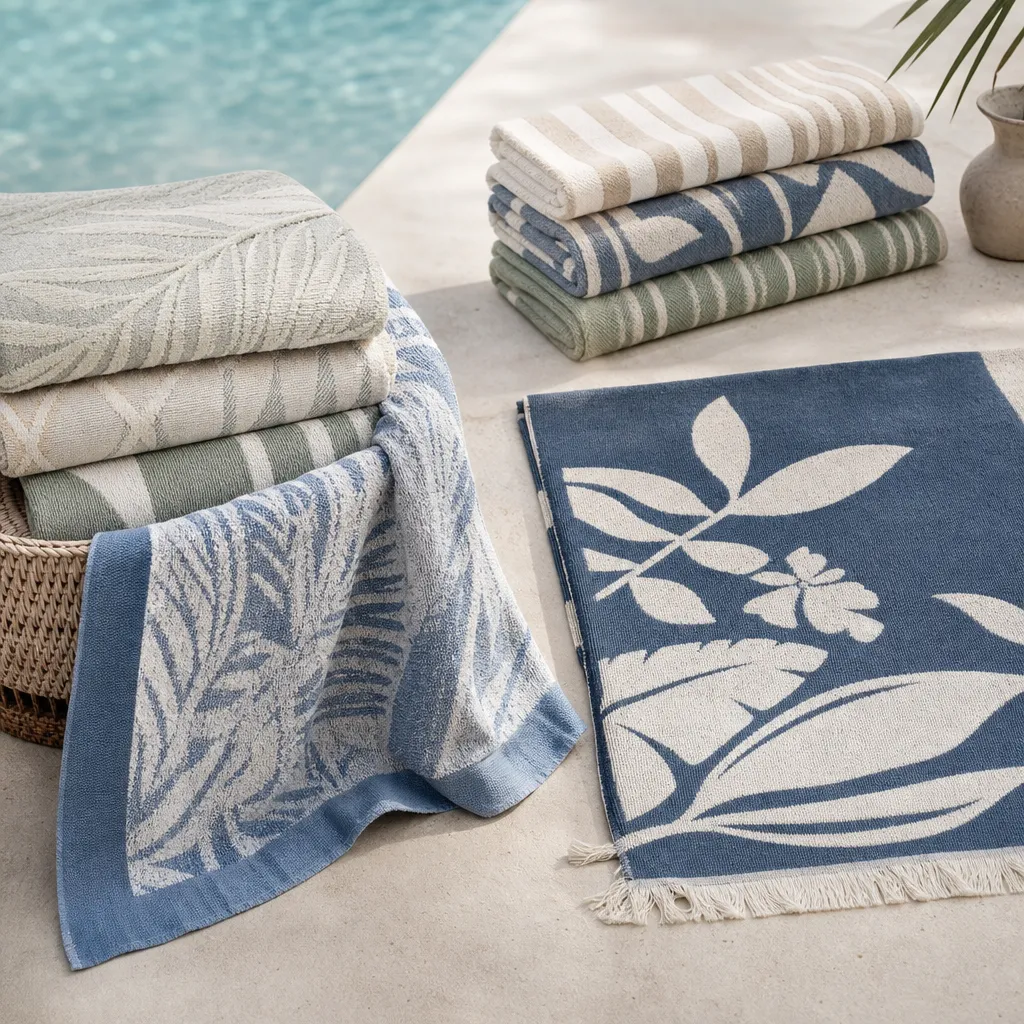
Start with the artwork behavior, not the towel name
On the factory floor, “designer” is not a quality grade. It usually means the buyer needs controlled color, an intentional hand feel, a retail-ready label package, and decoration that still looks deliberate after sun, salt water, sunscreen, and repeated laundering. For beach programs, that pushes us to make the artwork decision before we lock GSM, yarn count, or edge finishing.
A beach towel has a larger visual field than a bath towel. A 90 × 170 cm towel gives almost 1.5 square meters of visible canvas, so small artwork issues become obvious: a stripe that bows 12 mm across the width, a logo that sinks into loop pile, or a border that does not align at the hem. These are not rare defects. They are usually specification gaps.
For designer beach towels, we normally separate the brief into three artwork routes: yarn-dyed jacquard, reactive print on velour, and piece-dyed towel with localized decoration. Each route has a different tolerance. Jacquard handles geometry and repeat patterns well. Reactive print handles gradients and illustrations better. Embroidery works for a crest or monogram, but it is not the right method for covering a towel face.
| Artwork route | Best use | Factory constraint | Typical base GSM |
|---|---|---|---|
| Yarn-dyed jacquard | Two-sided pattern, geometric layout, tone-on-tone branding | Fine lines below 3.5 mm can close after washing; each color needs dyed yarn planning | 420-560 GSM |
| Reactive print on sheared velour | Illustration, photographic motifs, watercolor, multi-color retail artwork | Print face is flatter; reverse side usually remains loop terry and lighter in visual impact | 360-500 GSM |
| Piece-dyed with embroidery or woven patch | Minimal resort crest, club logo, capsule collection | Decoration area should stay away from fold lines and high-abrasion seating zones | 450-650 GSM |
| Hammam flat weave with yarn dye | Lightweight fashion towel, beach club retail, travel towel | Less plush absorption; fringe tension must be checked after tumble drying | 240-380 GSM |
Where designer beach towels go wrong in sampling
Most sample failures are not caused by poor production. They happen because the drawing was prepared for a flat screen, not for terry cloth. Terry has pile height, yarn twist, shrinkage, and face direction. A logo that looks sharp in a PDF may blur on 8/1 cotton loops. A four-color stripe may look clean in Illustrator but develop “stair steps” in jacquard if the repeat does not match the loom setting.
- Over-thin lines: In jacquard, we prefer key artwork strokes of 4 mm or wider. Below that, pile movement and washing can make the line appear broken.
- Border drift: Large beach towels shrink more in length than width. If the border sits too close to the hem, a normal 5-7% length shrinkage can make the design look uneven.
- Wrong print face: Reactive printing on unsheared loop terry gives softer definition. For retail illustration work, we usually shear the print face to velour before printing.
- Embroidery puckering: Dense embroidery on a soft 450 GSM towel can pull the corner unless we add backing and reduce stitch density. For a 65 mm logo, 7,000-11,000 stitches is often enough; 18,000 stitches may look heavy and stiff.
- Color mismatch under sunlight: Beach towels are judged outdoors. We review lab dips under D65 light and, for resort orders, also check the visual shift under warm indoor light because retail shelves and pool decks tell different stories.
For custom beach towel design, we ask for editable vector files for logos, a repeatable artwork tile if the pattern is woven, and Pantone TCX or TPX references where possible. For printed beach towels, we also request the original high-resolution raster art at 150-300 dpi at final size. Upscaling a small JPEG is one of the fastest ways to create a sample that cannot be approved.
Choosing between print, jacquard, and embroidery
Decoration is a cost driver, but it also changes the towel itself. A yarn-dyed jacquard towel is built from colored yarns, so the design is part of the fabric. It feels like terry because it is terry. A reactive printed velour towel starts as a woven towel, then the face is sheared, printed, steamed, washed, and softened. That route gives artwork freedom, but the sheared face feels smoother and slightly less lofty than unsheared loop terry.
Embroidery is different again. It adds a separate thread structure on top of the towel. We use it carefully on beach towels because guests sit and lie on them. A beautiful crest in the lower right corner is fine. A thick embroidered slogan across the center is uncomfortable and tends to trap sand.
| Method | Color capability | Hand feel | Minimum practical detail | Best order type |
|---|---|---|---|---|
| Jacquard weave | Usually 2-4 yarn colors for cost-efficient programs | Plush, textured, design visible through the pile | 3.5-5 mm depending on pile height | Resort beach towels, club programs, repeat retail SKU |
| Reactive print on velour | High color count, gradients, illustrated art | Smooth face, loop reverse, good drape | 1-2 mm if artwork and fabric preparation are correct | Fashion capsule, artist collaboration, full-face print |
| Sublimation on microfiber | Full color and sharp edges | Thin, fast dry, less cotton-like | Below 1 mm is possible on proper microfiber | Travel towel, promo, compact beach kits |
| Embroidery | Thread colors usually 1-8 per logo | Raised and localized | Small text should stay above 5 mm cap height | Monogram, private club crest, boutique hotel gift |
We make both cotton and microfiber programs, but we do not pretend they serve the same buyer. If the buyer wants a luxury beach towels wholesale program for a five-star resort, cotton velour or jacquard is usually the better fit. If the buyer wants compact packing, quick drying, and bright all-over graphics, microfiber may be more rational. We compare these trade-offs in more depth in microfiber vs cotton towel comparison.
GSM and size: the retail look versus laundry reality
For beach towels, bigger is not automatically better. A 100 × 180 cm towel at high GSM looks generous on a lounger, but it also increases carton volume, drying time, freight cost, and laundry energy. We often see buyers spec a towel for showroom appeal, then discover that housekeeping or retail fulfillment has to handle the weight every day.
Our common OEM beach towel range is 360-650 GSM. Below 360 GSM, cotton towels can feel thin unless the product is intentionally hammam or travel-oriented. Above 650 GSM, the towel can feel substantial, but drying time and carton weight start to matter. For poolside hotel and beach club use, 430-520 GSM often gives the best balance of feel, drying, and replacement cost.
| Use case | Typical size | Recommended GSM | Approx. finished weight | Comment from production |
|---|---|---|---|---|
| Retail fashion beach towel | 80 × 160 cm | 380-460 GSM | 490-590 g | Good for folded shelf presentation and parcel shipping |
| Resort lounger towel | 90 × 170 cm | 450-540 GSM | 690-825 g | Covers standard loungers without excessive laundry weight |
| Oversized cabana towel | 100 × 180 cm | 500-620 GSM | 900-1,115 g | Strong visual impact; carton and drying costs rise quickly |
| Hammam-style beach towel | 90 × 180 cm | 260-340 GSM | 420-550 g | Fast drying and compact, but not a plush terry experience |
| Kids or gift set towel | 70 × 140 cm | 350-430 GSM | 345-425 g | Works for retail bundles and lower freight weight |
For beach club operators, we normally advise against chasing the heaviest towel unless it is a paid retail item. A 100 × 180 cm towel at 600 GSM can be more than twice the cotton mass of a 75 × 150 cm midweight towel. If the towel is washed 70-100 times per season, the real cost includes detergent load, drying time, and reject rate, not just FOB price.
Designer beach towels need tighter color control
Designer beach towels often carry seasonal palettes, capsule colors, or brand identity colors. That means color approval cannot be handled casually. We use lab dips for yarn-dyed and piece-dyed towels, strike-offs for printed towels, and a pre-production sample after bulk material is confirmed. A lab dip approved on paper does not guarantee the same visual result on velour pile.
For cotton towel dyeing and printing, we work with OEKO-TEX Standard 100 Class I compliant inputs where requested, and we maintain mill quality systems under ISO 9001. Our buyers often request BSCI documentation for social compliance. These certificates do not replace product testing, but they help procurement teams screen the supplier before sampling.
- Colorfastness to washing: We reference ISO 105-C06 for domestic and commercial wash behavior, especially for dark navy, black, and saturated red.
- Colorfastness to rubbing: ISO 105-X12 helps catch crocking risk on deep reactive shades and yarn-dyed stripes.
- Dimensional stability: We measure shrinkage after wash and tumble dry. Beach towels with wide borders must be checked both lengthwise and widthwise.
- Absorbency and softener balance: Too much softener can make a towel feel good in the sample room but slow absorption. We check water uptake after finishing, not only before.
- Sunscreen contact risk: Mineral sunscreen can leave white residue on dark towels. It is a use condition, not always a dye failure, so dark resort programs need laundering instructions.
For printed beach towels, the most overlooked step is post-print washing. After reactive printing, the towel is steamed to fix dye, washed to remove unfixed color, then dried and softened. If the washing step is rushed, the first customer laundry may release excess dye. That is why a printed towel sample should be evaluated after one wash, not only fresh from the sample room.
Edge finishing, labels, and packaging are part of the design
A buyer may spend three weeks refining the artwork, then approve a generic hem and label. On a beach towel, that is a mistake. The edge is visible when the towel is folded on a shelf, stacked on a pool cart, or draped over a cabana chair. Edge construction also affects durability because beach towels are pulled, shaken, and dragged more than hotel bath towels.
Our usual beach towel edge options are double-needle hem, dobby border, jacquard border, fringed hammam end, or bound edge for selected microfiber styles. For cotton terry, a 2.0-3.0 cm hem is common. If the towel has a printed face, we need to decide whether the print bleeds close to the hem or stops before the sewing line. Printing too close to a bulky folded hem can create uneven color at the edge.
- Confirm final folded presentation: flat retail fold, roll with belly band, or stacked operational fold.
- Place the main label where it will not irritate the user when lying on the towel. For resort towels, we usually keep labels near the short-end hem.
- Set care label language before production. Export orders often need English plus the destination market language.
- Decide whether barcode stickers go on polybags, belly bands, or carton labels. Changing this after packing causes avoidable rework.
- Approve the master carton weight. For large cotton towels, we try to keep cartons practical for warehouse handling, often below 18-22 kg gross weight.
For a retail program, packaging can add USD 0.12-0.55 per piece depending on belly band paper, hangtag, cotton drawstring bag, barcode sticker, and individual polybag. For resort operational towels, we usually keep packaging simpler: bulk pack by color and size, with clear carton marks and inner bundles if the property needs department allocation.
MOQ, pricing, and what changes the quote
Our standard MOQ is 500 pcs per design per color. For yarn-dyed jacquard, the practical MOQ may be higher if there are custom-dyed yarns and multiple colors. For reactive printed velour, 500 pcs can work for many designs, but sampling and screen or digital setup costs depend on artwork. We prefer to quote after seeing the actual file because a simple two-color border and a full-face illustrated print are not the same product.
| Specification example | 500-999 pcs | 1,000-2,999 pcs | 3,000-7,999 pcs | Main cost driver |
|---|---|---|---|---|
| 80 × 160 cm, 420 GSM reactive printed velour | USD 4.65-6.20 | USD 4.10-5.45 | USD 3.62-4.85 | Printing process, shearing loss, artwork coverage |
| 90 × 170 cm, 500 GSM yarn-dyed jacquard | USD 6.25-8.10 | USD 5.55-7.25 | USD 4.92-6.45 | Dyed yarn, loom time, pattern complexity |
| 100 × 180 cm, 560 GSM cotton velour with embroidered crest | USD 8.40-11.30 | USD 7.55-9.85 | USD 6.70-8.80 | Cotton weight, embroidery stitches, carton volume |
| 90 × 180 cm, 300 GSM hammam yarn-dyed stripe | USD 3.85-5.35 | USD 3.32-4.65 | USD 2.95-4.10 | Yarn count, fringe finishing, washing shrinkage control |
| 75 × 150 cm, 380 GSM piece-dyed with woven patch | USD 3.10-4.45 | USD 2.72-3.88 | USD 2.38-3.35 | Patch MOQ, dye lot, sewing labor |
These are realistic FOB China bands for OEM discussion, not a blind quotation. Cotton market movement, exchange rate, packaging, inspection requirement, and destination compliance can shift the final number. Air freight can also erase savings on a low-cost towel if the program is late. For logistics planning, see container vs air freight towel orders.
A cheap towel may still be expensive in use. For example, one beach club asked us to compare a 330 GSM printed towel at USD 2.95 with a 470 GSM jacquard towel at USD 5.35. The lower-cost towel looked acceptable before washing, but after 28 commercial wash cycles it had more edge twist and a thinner hand. If the cheaper towel is replaced after one short season while the jacquard survives two, the cost per issued towel day can move from roughly USD 0.041 to USD 0.029 for the better towel, even before laundry complaints are counted.
Sampling and production timing we can actually hold
A realistic development calendar protects both sides. We are a 220-employee mill in Gaoyang, Zhejiang, operating since 2007, and we produce about 2.4 million towels per year for more than 80 brand clients across 47 countries. Even with that capacity, custom development still needs sequencing: yarn, dyeing, weaving, shearing, printing, sewing, washing, inspection, and packing cannot all happen in the same week.
- Artwork review and quote: 1-3 working days after receiving size, GSM, method, quantity, and packaging brief.
- Lab dip or yarn color preparation: 4-7 days for common colors; longer for difficult saturated shades.
- Strike-off or first sample: 7-15 days for print, 12-20 days for jacquard depending on loom setup.
- Sample revision: 5-12 days if artwork or color changes are material, not just label placement.
- Bulk production: 25-45 days after deposit and approval, depending on quantity and process.
- Final inspection and export packing: 2-5 days, including carton marking and buyer-specific checks.
For a resort opening or summer retail drop, we recommend starting 75-110 days before the required ship date. Buyers sometimes try to compress the calendar by skipping a strike-off. We push back on that for designer beach towels because the first production lot is not the place to discover that the sand-colored background prints too warm or that the jacquard logo loses its negative space.
Related reads: for broader bulk beach planning, see beach towels in bulk buyer's guide and beach club resort towel program. For size decisions before artwork starts, use towel sizes dimensions complete guide.
Inspection points before cartons leave the mill
Beach towel inspection has to cover both textile performance and visual layout. We inspect incoming yarn or fabric, in-line sewing, finished measurements, shade consistency, weight, absorbency, and packing. For artwork-heavy towels, we add design placement checks because a 15 mm misalignment may be acceptable on a plain towel but visible on a framed stripe or border motif.
- Measure finished size after conditioning, not while the towel is still hot from drying.
- Check GSM from actual finished weight and area, then compare to agreed tolerance, usually ±5% for standard programs.
- Review shade lot separation under D65 light, especially for navy, coral, turquoise, and sand beige.
- Pull-test sewn labels and patches so they do not detach after the first commercial wash.
- Inspect hems for skipped stitches, loose thread tails, and torque. Long beach towels show twisting more clearly than small hand towels.
- Open packed cartons during pre-shipment inspection to verify barcode, belly band direction, polybag warning text, and carton marks.
For AQL, many buyers use general inspection levels under ISO 2859-1. The exact AQL depends on the contract, but common consumer textile programs use stricter limits for critical defects and more flexible limits for minor loose threads. We prefer to define critical defects in the tech pack: wrong artwork, wrong size, severe shade mismatch, broken seam, contamination, and unsafe foreign matter should never be treated as ordinary cosmetic issues.
Related reads: if your design includes multiple decoration methods, compare routes in embroidery vs sublimation vs jacquard. If your procurement team needs a better RFQ package, use build towel tech pack that mills can quote. For certification review, see how to read OEKO-TEX certificate.
What to send us for a clean OEM quote
A clean brief saves days. If you only send “designer beach towels, best price,” we have to guess the size, construction, artwork route, cotton grade, packaging, and testing level. The first quote will be too broad to use. If you send the items below, we can usually return a narrower specification and price band within 1-3 working days.
- Target size and GSM, or the current towel sample weight if you are matching an existing SKU.
- Artwork file in AI, PDF, PSD, or high-resolution TIFF, with Pantone references if available.
- Preferred method: jacquard, reactive print, sublimation microfiber, embroidery, patch, or open to factory recommendation.
- Use case: resort pool issue, beach club retail, DTC e-commerce, yacht amenity, event gift, or hotel shop.
- Packaging requirement: bulk pack, individual polybag, belly band, hangtag, barcode, carton limit, or plastic-free option.
- Compliance requirement: OEKO-TEX Standard 100 Class I, BSCI, ISO 9001 documentation, or buyer-specific restricted substance list.
- Order quantity by design and color. Our MOQ is 500 pcs per design per color.
We manufacture OEM towels in China with vertical control over yarn selection, weaving, dyeing coordination, decoration, sewing, inspection, and export packing. For beach programs, that control matters because artwork, fabric, and finishing have to be developed together. Contact us on WhatsApp at +86 13205717266 or email [email protected] with your artwork and target quantity.
Build a designer beach towel spec
Send us the artwork, size, GSM target, quantity, and packaging plan. We will review the right construction route and quote from 500 pcs per design per color.
Request OEM quote →