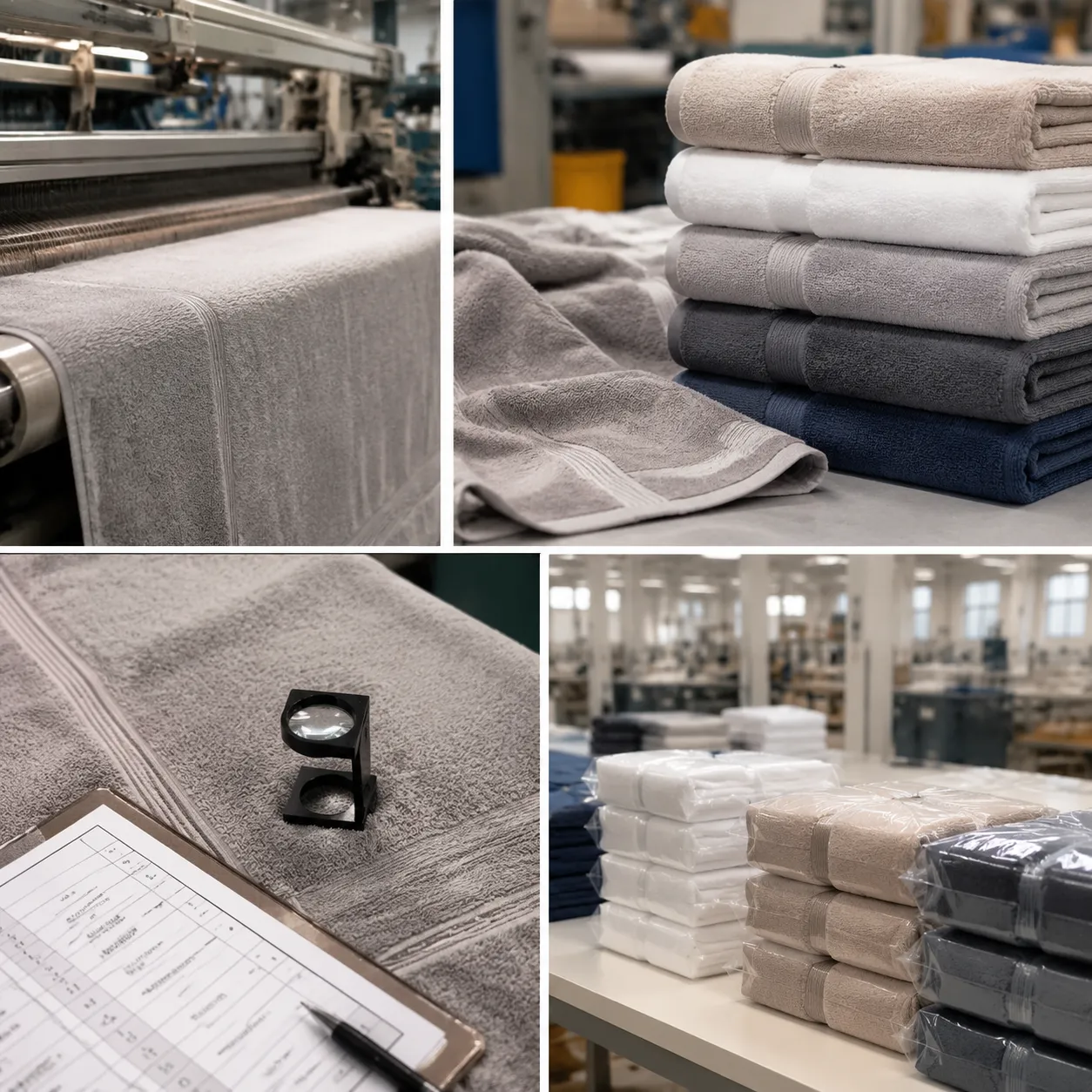
Start with the set, not the showroom
A private label towel set is not one SKU. It is usually a coordinated group of pieces, often a bath towel, hand towel, and washcloth, sometimes with bath sheet or guest towel additions. The audit has to begin by confirming that the factory already runs similar set programs at the same construction level, because a mill that can weave a solid single towel may still struggle with color matching across three sizes and one pantone target.
When we audit for a set program, we first ask for a live production reference: current loom width, dyehouse batch size, and whether the packing line can keep the bath towel and hand towel in the same carton without mix-ups. If the seller cannot show a recent set order with finished goods photos, carton labels, and shade band records, that is already a warning sign. For buyers comparing suppliers, private label vs white label towel programs is a useful companion read.
| Common set piece | Typical finished GSM range | What can go wrong |
|---|---|---|
| Bath towel | 450-650 GSM | Edge twisting, shade drift, lint shedding |
| Hand towel | 350-500 GSM | Loose hem, skew after wash, uneven pile |
| Washcloth | 300-450 GSM | Corner curl, inconsistent cut size, weak absorbency |
| Bath sheet or oversized piece | 500-700 GSM | Long drying time, carton overfill, freight penalty |
For a practical sourcing baseline, private label towel set factory audit checklist work is most useful when the factory is already certified to OEKO-TEX Standard 100 Class I, BSCI, and ISO 9001. Those certificates do not guarantee a good towel set, but they do tell us the site understands traceability, social compliance, and documented process control. If you want a deeper read on certificate scope, how to read Oeko-Tex certificate helps separate the paper from the actual mill.
Check the process flow from yarn to carton
A towel set factory should be able to walk you through one uninterrupted route: yarn receiving, warping, weaving or knitting, dyeing, cutting, hemming, trimming, inspection, folding, polybagging, carton packing, and export palletization. If any step is outsourced without clear records, you lose control over shade, contamination, and delivery timing.
We care especially about three process points. First, whether the factory segregates white, light, and dark yarn storage so lint and cross-dye contamination do not creep in. Second, whether the cutting and hemming area uses size templates, because bath towels and hand towels can drift by 1.5 to 3 cm if operators work by eye. Third, whether the packing team uses scan-to-carton matching or manual count sheets; manual counts are where mixed sets usually slip through.
| Audit point | What to ask | What a solid answer looks like |
|---|---|---|
| Yarn storage | How are colors and lots separated? | Racked by shade family with lot tags and FIFO rotation |
| Weaving/knitting | What is the loom or machine width for the target set? | Enough width to hold size tolerance with minimal trim waste |
| Hemming | How do you control stitch density and corner tuck? | SOP with needle count, thread type, and line checks |
| Packing | How are set pieces matched? | Carton-level SKU scan, count sheet, and final weight check |
If the factory talks only about output volume and not process control, we usually ask to see the in-line inspection sheet. A good towel set line records warp break rate, stitch skip count, and shade deviation by batch. These are not fancy metrics; they are the difference between a coordinated set and a mixed shipment that looks fine until the first laundry cycle.
Private label towel set factory audit checklist
This is the part buyers often want in a neat box, but the factory audit is strongest when it follows the product risk. For a towel set, the risks are not abstract. They are measurement drift, absorbency inconsistency, shade mismatch across pieces, and carton packing errors that break the set on arrival.
| Checklist area | Pass standard | Red flag |
|---|---|---|
| Spec match | All set pieces share the approved construction and label system | Bath towel approved, hand towel and washcloth still open |
| Dimensional control | Finished sizes within agreed tolerance after first wash | Pieces cut differently by operator or shift |
| Color control | Lab dip and bulk match accepted under daylight and D65 | Bath towel darker than the hand towel in the same set |
| Absorbency | Water uptake consistent across the full set | Washcloth absorbs fast, bath towel beads water |
| Packing accuracy | Zero mixed-SKU cartons in pilot packout | Manual sorting with no scan or label reconciliation |
- Ask for a set-level tech pack, not separate piece sheets.
- Verify whether the factory uses one shade master across the full set.
- Confirm the label content: fiber content, country of origin, and care text.
- Check that the carton marks list piece count, piece mix, and color code.
- Request a pilot packout with random opening of at least 10 cartons.
One practical detail buyers miss is pile direction consistency. On a terry towel set, the nap can reflect light differently if the factory cuts and folds pieces in a mixed orientation. That may sound minor, but under retail lighting it can make a single set look like three different shades. Another common issue is twisted edges after wash, which often comes from uneven tension at hemming rather than from the yarn itself.
Audit the lab tests that actually matter
A clean certificate folder is not enough. For towel sets, we want test reports tied to the exact construction and color family. The factory should know which tests were run internally, which were sent to a third-party lab, and which were done only for the initial sample.
| Test or check | Why it matters for towel sets | What to verify |
|---|---|---|
| Dimensional stability | Keeps the set pieces aligned after wash | Shrinkage on each SKU, not just the bath towel |
| Colorfastness to washing | Prevents one piece from fading faster | Wash result for all colors in the set |
| Colorfastness to rubbing | Reduces crocking on skin and packaging | Dry and wet rub results for darker shades |
| Tensile / seam strength | Protects hems and hanging loops | Stitch failure after laundering and tumble dry |
| Absorbency / wicking | Confirms the set performs like a towel | Time-to-wet-out or water uptake method stated |
For scope, we do not treat every lab claim as equal. OEKO-TEX Standard 100 Class I speaks to restricted substances and skin-safety thresholds. BSCI speaks to social compliance. ISO 9001 speaks to documented quality systems. None of them replaces a towel-specific wash test or a packed-carton check. Buyers who need to understand factory paperwork can pair this article with sustainable towel buyer checklist 2026 and towel GSM decision framework.
- Ask for bulk lab reports, not only pre-production sample reports.
- Confirm whether the test specimen came from the same bulk dye lot.
- Check whether the result was measured after one wash or five wash cycles.
- Verify that the factory can repeat the same result on a second pull sample.
Price tells you the operating discipline
An audit is not complete if we ignore cost structure, because price often reveals how the factory is really running. For a coordinated towel set, the bath towel usually drives the cotton and dye cost, but the hand towel and washcloth often absorb the labor burden because smaller pieces need more handling per kilogram. A supplier that quotes too low may be cutting on yarn count, towel density, or packing labor.
| Order tier | Typical FOB China price band per 3-piece set | What that usually means |
|---|---|---|
| 500-1,000 sets | USD 6.80-9.40 | Higher setup cost, tighter fabric margin, more manual packing |
| 1,000-3,000 sets | USD 5.60-7.80 | More stable dye lot planning and better carton efficiency |
| 3,000-8,000 sets | USD 4.70-6.60 | Better loom utilization and lower unit sewing cost |
| 8,000+ sets | USD 4.10-5.90 | Usually requires repeat color, simplified pack format, and firm forecast |
These are scope-based bands for a conventional 3-piece cotton set around mid-weight terry, not luxury zero-twist, not jacquard, and not gift-boxed retail packaging. Add embroidery, custom hangtags, or rigid carton sets and the number moves up fast. If someone offers a beautifully boxed set below the bottom band, we would check whether the towel weight is overstated, whether the hand towel is a narrower cut, or whether the supplier is leaving out carton and shrink wrap cost.
- Custom embroidery usually adds a visible labor premium per set.
- Gift cartons can add more cost than the thread on lighter sets.
- Mixed-color packs increase pick-and-pack time and error risk.
- A lower quote can still become the expensive quote if the return rate rises.
If you want a cost-only comparison, hotel towel bulk pricing model 2026 and small run towel costing framework give a good reference point, but for a private label set the audit question is whether the quoted price matches the process discipline you need.
Packing and labeling decide whether the set survives export
Many towel set disputes begin after the goods are already packed. The carton might contain the right total quantity, yet the wrong assortment ratio, a missing hangtag, or a care label that does not match the approved artwork. That is why packout needs the same attention as weaving.
- Open sample cartons from different stack positions, not only the top layer.
- Count each piece by SKU and color against the packing list.
- Check polybag sealing, barcode placement, and master carton marks.
- Weigh random cartons to catch missing pieces or hidden substitutions.
- Photograph the final packed set before pallet wrap.
| Packing control | Why it matters | Factory evidence to request |
|---|---|---|
| Set ratio control | Prevents missing pieces in mixed cartons | Pilot carton photos and count sheet |
| Barcode discipline | Reduces warehouse receiving errors | Label sample with readable SKU code |
| Carton strength | Protects bulk shipment | ECT or compression spec from carton supplier |
| Pallet wrap | Prevents moisture and crush damage | Pallet standard and wrap layer count |
We also ask whether the factory does a final metal check on packed cartons if the set includes hooks, clips, or sewn-in tags with hard components. For export lanes with humidity swings, the factory should store cartons off the floor and away from wall condensation. That is a small detail until cartons arrive soft, swollen, and impossible to stack cleanly.
Lead time should be tied to the actual bottleneck
A reliable lead time is usually built from the slowest real step, not the optimistic sales promise. For a towel set, that bottleneck is often dyeing and shade approval if the color is custom, or weaving capacity if the order includes a heavy bath towel with a full matching assortment.
| Stage | Typical days | What can extend it |
|---|---|---|
| Lab dip and color approval | 4-7 days | Multiple rounds, unclear Pantone target |
| Yarn and greige preparation | 5-9 days | Imported yarn, backlog at spinning mill |
| Production and sewing | 12-22 days | Peak season, machine downtime, complex set mix |
| Final inspection and packing | 3-5 days | Mixed cartons, rework, label changes |
| Ocean freight booking and loading | 7-14 days | Space tightness, cut-off delays |
For many private label towel sets, the realistic total from approved sample to ready-to-ship bulk is about 28 to 45 days if the construction is standard and the color is already established. Custom colors, special packaging, or unusually dense terry can push that longer. If a supplier quotes two weeks end-to-end for a new set, we ask which step they are skipping, because no one shortens dye curing, sewing, and inspection without paying somewhere else.
If you are planning a new program with a retailer or hotel group, setting up hotel linen program 90 day roadmap is helpful even outside hospitality because the sequence of approval, pilot, and reorder logic is similar.
Red flags we treat as stop signals
Some issues are fixable. Some mean you should pause before issuing a deposit. A factory audit should separate the two.
- The mill cannot show matching bulk and sample yarn records.
- The QA manager is absent and the sales team answers every technical question.
- Certificates are present but the names, dates, or scope codes do not match the factory site.
- Sample towels look acceptable, but finished measurements are inconsistent by piece.
- The supplier refuses a carton open-up or random weight check before shipment.
A second warning is when the factory cannot explain what happens after a defect is found. Good sites have a rework path: isolate the lot, mark the affected cartons, and record the corrective action. Weak sites just say they will be careful next time. That is not a corrective action; it is a hope.
A buyer-side audit sequence that keeps the order honest
If we were auditing this program for a brand, we would keep the visit simple and practical. First, verify the live line against the tech pack. Second, open recent production records for a similar towel set. Third, inspect the packout discipline. Fourth, review test reports and certificate scope. Fifth, ask for a quote breakdown that shows the real cost drivers instead of one blended number.
- Review the approved tech pack and set ratio.
- Walk the production floor and compare with the spec.
- Pull a recent bulk order and inspect seams, size, and color.
- Open cartons and confirm assortment, labels, and packing accuracy.
- Request a corrected quote if any process gap changes the cost basis.
The final decision is not just whether the factory can make towels. It is whether this factory can make your exact set repeatedly, under the same shade, same size, and same packing rules, without needing a rescue at the warehouse. That is the standard we apply before we recommend moving to bulk.
Related reads: custom beach towel technical data sheet, build towel tech pack that mills can quote, and negotiate towel MOQ without killing margin.
Related reads: how to read Oeko-Tex certificate, private label vs white label towel programs, and hotel towel sourcing guide 2026.
Request a factory audit with us
Send your set spec, target GSM, color count, and carton plan. We can review the line risks, confirm MOQ from 500 pcs per design per color, and quote with realistic lead times. We work to OEKO-TEX 100 Class I, BSCI, and ISO 9001 controls, and bulk sets usually ship in 28-45 days after sample approval depending on color and packing complexity. WhatsApp +86 13205717266 or email [email protected].
Get a Quote →