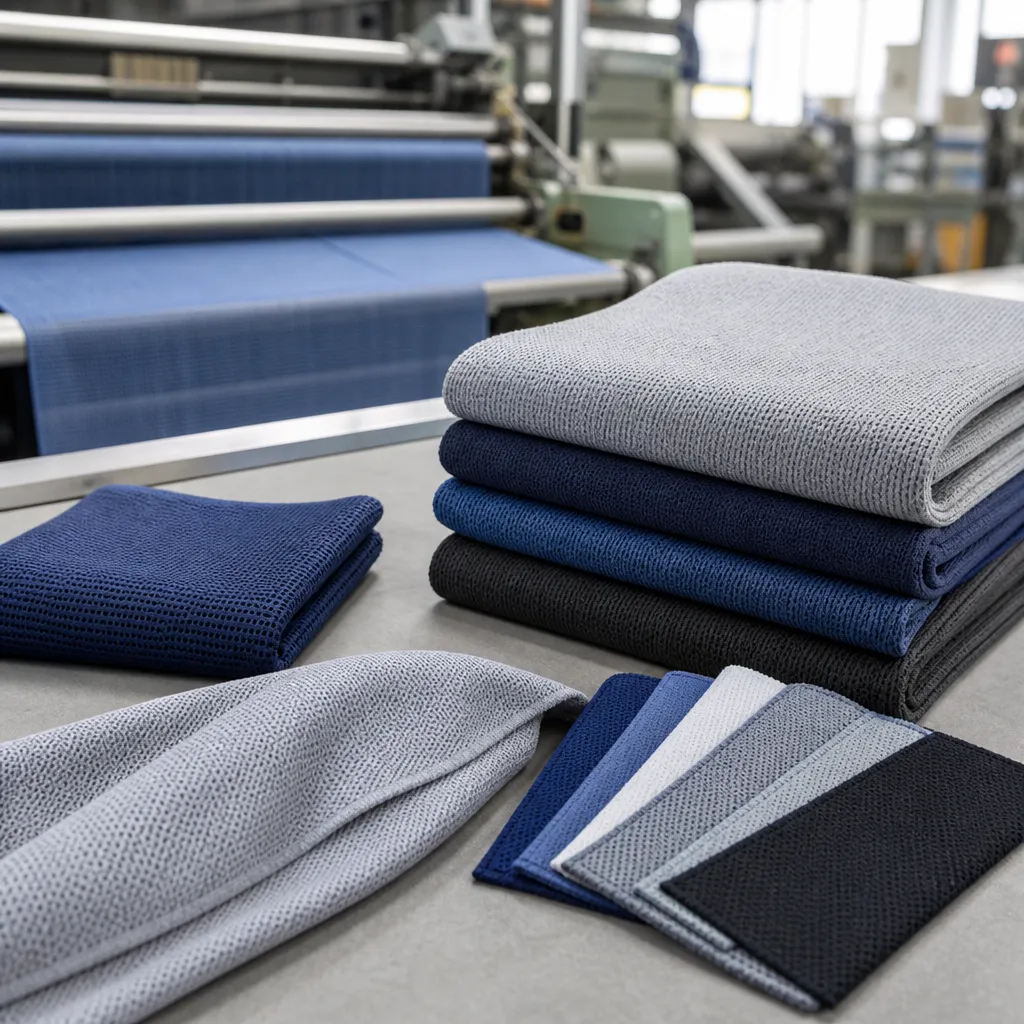
The Small Order Problem Buyers Underestimate
Cleaning microfiber looks easy on a spreadsheet because the unit price is low. In the factory, the order is controlled by yarn procurement, knitting width, dye vat loading, cutting layout, edging speed, and packing labor. A 30 x 30 cm cloth at 220 GSM and a 40 x 40 cm cloth at 320 GSM may both be called cleaning towels, but they behave like different products in costing.
Our normal OEM MOQ is 500 pcs per design per color. For microfiber cleaning cloths, that number is technically possible, but not always efficient. The practical efficiency point usually starts at 2,000-3,000 pcs per color for dyed polyester-polyamide fabric, and 5,000 pcs per color when the buyer wants exact Pantone dyeing, private-label insert cards, barcodes, and separate retail cartons.
The reason is not a sales rule. A 500 pc color run can be swallowed by fixed setup work: lab dip approval, dye machine cleaning, cone thread change, label setup, edge tape matching, and inspection documentation. If the buyer splits 3,000 pcs across eight colors, the line spends more time changing than sewing.
| Order Pattern | Factory Impact | Typical Result |
|---|---|---|
| 500 pcs x 1 color | Can run as a sample-scale bulk lot if fabric is available | Highest unit cost, useful for launch testing |
| 1,000 pcs x 3 colors | Three dye or fabric allocations for modest volume | Often quoted, but color split raises price |
| 3,000 pcs x 2 colors | Better cutting and packing rhythm | Reasonable first OEM order |
| 10,000 pcs x 4 colors | Enough volume to absorb lab, setup, and carton work | Stable price and easier reorder planning |
Microfiber Towels for Cleaning MOQ and Pricing: What We Actually Cost
Microfiber towels for cleaning MOQ and pricing depends first on weight and construction, then on how many times the factory must stop and reset. A buyer comparing quotes should ask whether the price is based on ready-greige stock, custom-dyed fabric, or finished goods inventory. Those are not the same commercial situation.
For OEM production in our mill, most general cleaning cloths sit between 200 and 350 GSM. Low-lint glass cloths may use 180-230 GSM waffle or fish-scale knit. Auto-detailing and household polishing cloths are usually 300-450 GSM, sometimes higher for twisted-loop drying towels. The higher GSM does not only add fiber weight; it slows drying, changes carton cube, and may require stronger edge stitching to prevent curling after repeated wash cycles.
| Spec Type | Common Size | GSM Range | FOB China Band at 3,000 pcs | FOB China Band at 10,000 pcs |
|---|---|---|---|---|
| Basic multi-purpose cloth | 30 x 30 cm | 200-240 GSM | USD 0.24-0.36/pc | USD 0.18-0.29/pc |
| Household cleaning cloth | 40 x 40 cm | 260-320 GSM | USD 0.48-0.72/pc | USD 0.39-0.58/pc |
| Glass or screen cloth | 35 x 35 cm | 180-230 GSM | USD 0.34-0.55/pc | USD 0.27-0.44/pc |
| Auto detailing towel | 40 x 60 cm | 350-450 GSM | USD 1.05-1.62/pc | USD 0.86-1.34/pc |
| Retail 3-pack with insert card | 30 x 30 cm | 220-280 GSM | USD 0.92-1.35/set | USD 0.76-1.08/set |
These FOB bands assume normal polyester-polyamide microfiber, machine hemming, export carton packing, and BSCI/ISO 9001 factory documentation. They do not include ocean freight, import duty, Amazon FBA prep, or destination warehouse handling. Exact pricing moves with RMB yarn cost, exchange rate, dyeing surcharge, packaging format, and inspection requirement.
Where the MOQ Threshold Comes From
A useful MOQ discussion starts with the fabric roll, not with the finished towel count. If a 40 x 40 cm cloth is cut from 170 cm usable fabric width, the marker plan controls waste. For example, four pieces across gives 160 cm used width before allowance. If the cloth has rounded corners or contrast edge tape, usable yield drops again.
Dyeing is the second threshold. A dye house may accept a small lot, but the cost per kilogram rises when the vat is underloaded. A 40 x 40 cm cloth at 300 GSM weighs about 48 g before edging and packing. A 1,000 pc color lot is roughly 48 kg of face fabric, before cutting loss. That is a small dye load, so the dye surcharge can be visible in the unit price.
- 500 pcs per design per color: workable for trial orders when we can use available fabric colors, but private packaging is usually inefficient.
- 1,500-2,000 pcs per color: enough for basic OEM labels and export cartons without distorting the price too much.
- 3,000-5,000 pcs per color: the range where custom colors, woven labels, and controlled carton packing start to make sense.
- 10,000 pcs and above: better buying power on fabric, edge thread, insert cards, and printed cartons; also easier to schedule inline QC.
Buyers sometimes ask us to keep the total quantity high but divide it into many colors: 12,000 pcs total across 12 shades. That still behaves like twelve small color lots. A more stable launch plan is 12,000 pcs across three or four colors, then expand the palette after sell-through data is available.
Fiber Split, GSM, and Edge Finish Change the Price
The most common cleaning microfiber is 80/20 polyester-polyamide. A 70/30 split feels softer and absorbs faster, but the polyamide content costs more. For glass, screen, and stainless-steel cleaning, we also check whether the buyer wants a flat weave, fish-scale texture, suede finish, or terry loop. Each construction wipes differently.
A towel that passes for kitchen counters may leave lint on black glass. A cloth that is excellent for mirrors may feel too thin for janitorial work. We run absorbency checks using a timed droplet method and visual streak review on glass panels. For colorfastness, we use ISO 105-C06 washing and ISO 105-X12 rubbing as standard references when the buyer requires formal test reporting.
| Cost Driver | Lower Cost Choice | Higher Cost Choice | Buyer Risk if Chosen Poorly |
|---|---|---|---|
| Fiber split | 80/20 polyester-polyamide | 70/30 polyester-polyamide | Lower absorption or higher price than expected |
| GSM | 200-240 GSM | 320-450 GSM | Thin cloth may fail hand-feel; heavy cloth raises freight cube |
| Edge finish | Same-color overlock | Ultrasonic cut or contrast binding | Fraying, curling, or higher sewing labor |
| Texture | Plain terry | Fish-scale, waffle, suede, twisted loop | Wrong texture can streak glass or trap debris |
| Packaging | Bulk polybag | Retail sleeve, belly band, barcode carton | Packing labor can exceed sewing labor on small orders |
Edge finish deserves special attention. Cheap overlock using weak thread can unravel at the corner after 15-20 industrial washes. For retail cleaning kits, we normally recommend a dense overlock or ultrasonic edge depending on the cloth type. Ultrasonic edges look clean on certain flat microfiber, but they can feel sharp on thicker terry if the buyer expects a soft hand.
A Quote Needs These Lines, Not a Guess
A clear RFQ protects both sides. If the buyer sends only a photo and says "microfiber cloth, cheapest price," the factory has to assume too much. The result may be a quote that is cheap but not comparable with the next supplier's quote.
- Confirm use case: glass, kitchen, janitorial, electronics, auto detailing, hospitality room cleaning, or retail household pack.
- Specify size, tolerance, and GSM, for example 40 x 40 cm +/- 1 cm at 300 GSM +/- 5%.
- Choose construction: terry, waffle, suede, fish-scale, pearl knit, or twisted loop.
- List colors by Pantone TCX/TPG or provide physical swatches if exact matching matters.
- State logo method, label type, pack ratio, barcode rules, and carton marks.
- Request test standards: OEKO-TEX Standard 100 Class I, ISO 105-C06, ISO 105-X12, dimensional stability after washing, and AQL level.
- Give target volume per color, delivery port, and whether price should be FOB Ningbo/Shanghai, CIF, or DDP.
For buyers new to technical packs, our article on building a towel tech pack that mills can quote is useful. For direct comparison between fiber families, read microfiber vs cotton towel comparison before locking the material.
Wash Results We Use Before Recommending a Spec
A cleaning cloth is judged after use, not in the sample room. We normally run internal wash checks before bulk approval when the order has private-label risk or repeat program potential. For most microfiber cleaning towels, buyers should define the expected wash life in realistic terms: household laundering, commercial laundry, or solvent-heavy detailing work.
As a working benchmark, a 300 GSM 80/20 terry cleaning cloth with proper overlock should show no open seams after 30 household wash cycles at 40 C. In a harsher commercial wash at 60 C with alkaline detergent, color shade change and edge curling become more visible. For auto-detailing towels exposed to wax and polish residue, performance depends heavily on the user's washing chemistry; fabric softener can reduce absorbency even when the towel itself is correctly made.
- Dimensional stability: we measure shrinkage after washing; microfiber usually stays within 3-5% if heat setting is controlled.
- Lint review: black glass or polished tile makes lint and streaking easier to see than white paper inspection.
- Corner strength: seam failure often begins where the overlock turns, so we pull and rub the corners after washing.
- Color migration: dark red, black, and navy cloths should be checked against light-color packing materials after humidity exposure.
For formal shipments, inspection can use ANSI/ASQ Z1.4 sampling with AQL 2.5 for major defects and 4.0 for minor defects, adjusted by buyer requirement. Common major defects include oil stains, mixed GSM, broken stitching, wrong color, missing barcode, and carton quantity shortage.
How Packaging Moves the Unit Price
Packaging can move the quote more than buyers expect because cleaning cloths are light. A printed belly band, individual opp bag, folded insert card, barcode sticker, and inner carton may add USD 0.05-0.18 per piece depending on volume and labor flow. For a low-cost 30 x 30 cm cloth, that can be a large share of the landed cost.
| Packout | Best Use | Typical Added FOB Cost | MOQ Note |
|---|---|---|---|
| Bulk 50 pcs/polybag | Janitorial, hotel housekeeping, wholesale refill | USD 0.01-0.03/pc | Works from 500 pcs per color |
| 10 pcs inner bag | B2B distributor cartons | USD 0.02-0.05/pc | Efficient from 2,000 pcs per color |
| 3-pack retail sleeve | DTC household cleaning set | USD 0.08-0.16/set | Card printing usually needs 3,000-5,000 sets |
| Individual barcode bag | Marketplace fulfillment | USD 0.06-0.14/pc | Labor and scanning checks must be planned |
| Printed color box | Retail shelf program | USD 0.18-0.42/box | Better above 5,000 boxes per artwork |
Carton planning also affects freight. A 40 x 40 cm, 320 GSM cloth packed 100 pcs per carton can be dense, but retail sleeves create air space. For ocean shipping, cube may become the limiting factor before weight. For air freight, the same retail packaging can push chargeable weight above the actual weight because couriers calculate by volume.
Production Calendar From Sample to Shipment
A clean OEM order does not need a long calendar, but it does need decision discipline. The fastest projects are those with approved fabric, standard colors, and bulk packaging. The slowest are small orders with many Pantone shades, new labels, printed boxes, and repeated sample changes.
- RFQ review and first costing: 1-3 working days if the spec is complete.
- Lab dip or fabric color selection: 5-8 days for custom dye, faster if stock color is accepted.
- Proto sample: 5-10 days depending on edge finish, label, and packaging mockup.
- Buyer approval and deposit: usually 2-5 days, longer if several departments sign off.
- Bulk fabric knitting or allocation and dyeing: 10-18 days for normal microfiber programs.
- Cutting, sewing, inspection, and packing: 7-14 days depending on volume and packout.
- Pre-shipment inspection and booking: 3-7 days before vessel or courier handover.
For a 10,000 pc cleaning cloth order with two colors and bulk packing, 25-35 days after sample approval is realistic. For a retail set with four colors, insert cards, carton artwork, and barcode verification, 38-50 days is more honest. Peak season before back-to-school, Black Friday, or hospitality replenishment can add 7-12 days if packaging suppliers are loaded.
Freight planning should be part of the first quote, not a final week decision. Our logistics notes in container vs air freight towel orders explain why low unit-value towels often punish late air upgrades.
Compliance and Factory Documentation Buyers Should Ask For
For cleaning cloths used in homes, hotels, gyms, or automotive kits, buyers commonly ask for OEKO-TEX Standard 100. We hold OEKO-TEX 100 Class I, BSCI, and ISO 9001 certification, and we keep lot records for yarn, dyeing, cutting, sewing, and packing. If a distributor serves EU or US retail accounts, documentation may be as important as the fabric itself.
- OEKO-TEX Standard 100 Class I: chemical safety reference, especially useful for household and baby-adjacent cleaning categories.
- BSCI: social compliance audit requested by many European retailers and brand groups.
- ISO 9001: quality management system; it does not guarantee every towel is perfect, but it supports traceability and corrective action.
- Test reports: colorfastness, rubbing, absorbency, dimensional stability, and pH value when required by the buyer's market.
Buyers should check certificate validity, holder name, product scope, and test class. The guide how to read an OEKO-TEX certificate covers the common mistakes we see when procurement teams compare supplier documents.
A Practical Cost-per-Use Check
Unit price matters, but cleaning towels are bought for repeated use. Consider two 40 x 40 cm cloths for a hotel housekeeping program. A 240 GSM cloth at USD 0.41 may survive 18 commercial wash cycles before the corners curl and the cloth is downgraded to back-of-house use. A 310 GSM cloth at USD 0.57 with stronger overlock may reach 42 wash cycles under the same laundry method. The first costs about USD 0.023 per wash cycle; the second costs about USD 0.014 per wash cycle.
That example is not a universal rule. If the towel is used for one-time event cleanup, the cheaper cloth may be correct. If it is sold as a retail reusable product or used by housekeeping staff every day, the stronger spec usually wins on complaints and replacement rate.
- Choose lower GSM when the cloth is promotional, disposable-adjacent, or bundled as a low-cost add-on.
- Choose mid GSM when the towel must handle household counters, appliances, and general dusting.
- Choose higher GSM for auto detailing, commercial cleaning carts, or retail products where hand-feel drives reviews.
- Do not pay for 70/30 fiber split unless absorbency and softness are part of the product promise.
Related reads: custom microfiber towels wholesale guide, auto-detailing microfiber towel program, and microfiber cloth sourcing specs cover adjacent decisions for larger programs.
What We Need to Quote Cleanly
For microfiber towels for cleaning MOQ and pricing, a serious quote can be built from eight lines: size, GSM, fiber split, texture, color count, edge finish, packaging, and annual volume. If any of those are missing, the price may look attractive but fail during sampling or inspection.
Our factory has 220 employees and has produced OEM towels since 2007 for 80+ brand clients across 47 countries. Annual output is about 2.4M towels across cotton, microfiber, jacquard, embroidery, hotel, beach, gym, and cleaning programs. Standard MOQ remains 500 pcs per design per color, but for cleaning microfiber we will always show the buyer where the price becomes efficient rather than hiding the setup cost inside a vague quote.
For product range context, see our microfiber towel category, gym and sweat towel specs, and auto detailing towel notes. We can quote FOB Ningbo or Shanghai and support third-party inspection before shipment.
Build a cleaning microfiber quote
Send size, GSM, fiber split, colors, packout, and target quantity. We will return MOQ options, FOB bands, sample timing, and QC checkpoints.
Request a quote →