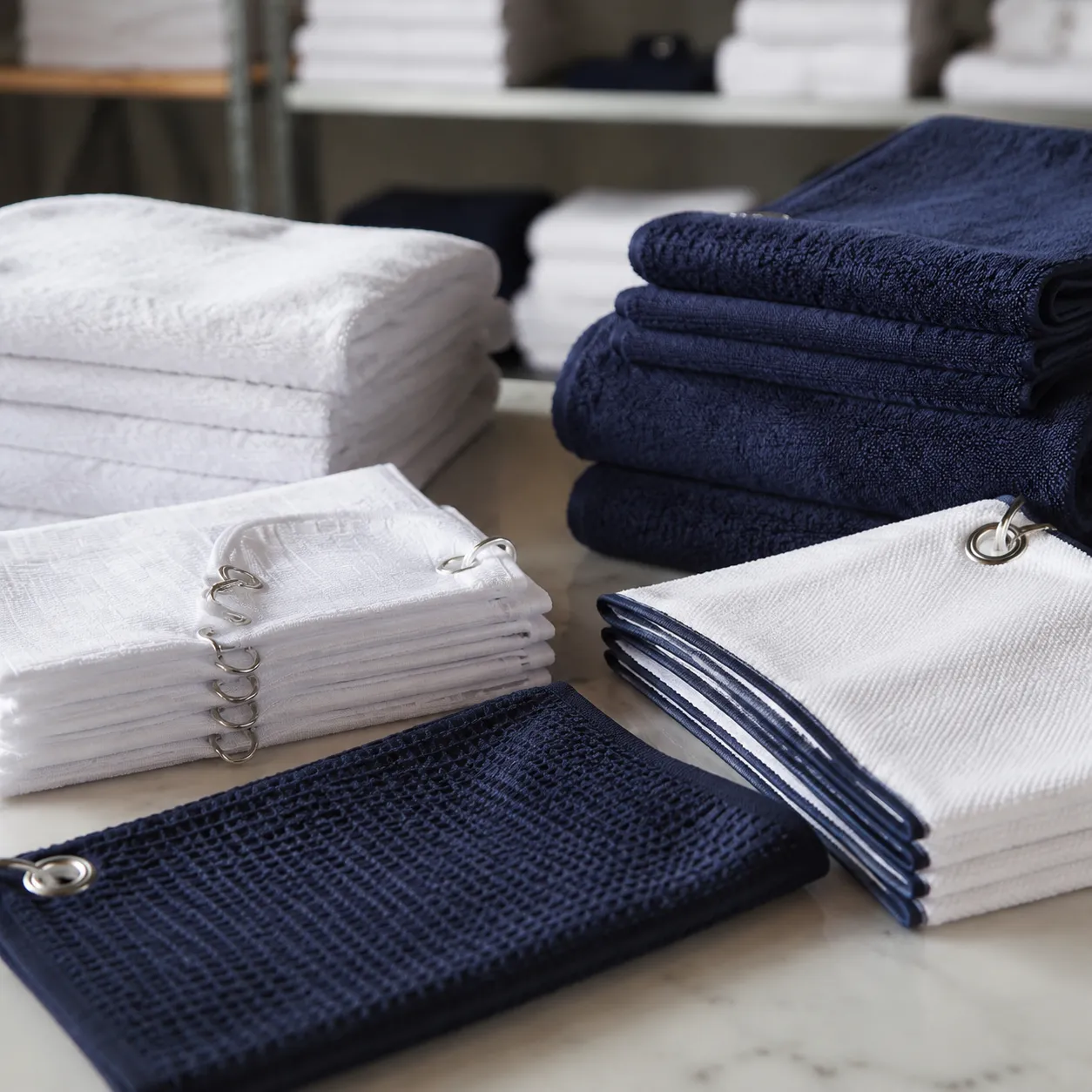
Start with the base towel, not the letters
The embroidery file is usually not what breaks the program. The base construction does. For bath towels with monograms, we first check three lines on the spec sheet: face area available for stitching, pile height, and border structure. A 520-580 GSM ring-spun cotton terry with a stable dobby or plain hem normally behaves better than an ultra-lofty zero-twist towel if the brand wants initials near the lower panel. Zero-twist feels soft in hand, but the longer, more open pile can swallow small serif details and show flattening around dense stitch zones after wash testing.
For hotel groups and premium retail brands, we commonly build embroidered bath towels in 70 x 140 cm, 76 x 142 cm, and 80 x 150 cm. If the monogram sits above the bottom hem, we prefer at least 9 cm of cleaner visual field between the motif and the hem fold. If the towel has a framed dobby border, we ask for the exact border height before digitizing, because a 6 cm border and an 8 cm border create very different placement options.
| Base towel construction | What we watch | Best use |
|---|---|---|
| 520-560 GSM ring-spun terry | Balanced absorbency and stitch stability | Hotels, spas, classic retail |
| 580-650 GSM combed terry | Good for larger crest marks if pile is sheared in logo area | Luxury programs, gifting |
| Zero-twist 550-700 GSM | Soft handfeel but pile displacement is more visible around embroidery | Retail first, not heavy institutional laundry |
| Low-twist with satin border | Border puckering risk if monogram is too close to seam build-up | Boutique hospitality |
Where monogram bath towels 2026 buyer guide projects usually fail
We see the same technical mistakes more often than design mistakes. One is placing the mark too low, so the hoop catches the border transition and creates distortion after steaming. Another is asking for very thin script at under 28 mm letter height on high-pile terry. The pile rises between stitches and makes the letters look fuzzy even when the embroidery itself is clean.
- Monogram too close to hem seam: fabric feeds unevenly in hooping and the logo line tilts 2-4 mm from left to right.
- Small serif fonts on unsheared terry: edge sharpness disappears after the first wash because loops rebound around the thread.
- Heavy fill stitch crest on 500 GSM towel: backside thread mass stiffens one panel and creates handfeel mismatch.
- Dark navy thread on optic white towel without wash test: crocking risk is low if thread is sound, but detergent optical brightener changes visual contrast after repeated laundries.
- No approval for backing type: tear-away, heat-soluble topping, and water-soluble topping each leave different visual results on terry.
Two process details matter here. First, on terry we often use a water-soluble topping during embroidery to keep loops down and preserve edge definition; buyers rarely ask about it, but it makes a visible difference on script initials. Second, for larger emblems we sometimes shear or carve the embroidery window before stitching on selected retail programs, which improves logo clarity but changes handfeel and should be signed off deliberately.
The monogram itself: letter height, stitch count, and thread choice
A buyer does not need to become a digitizer, but a few embroidery numbers help avoid endless sample rounds. On bath towels, simple initials at 35-55 mm letter height usually land around 4,500-8,500 stitches depending on font. A dense crest with fill areas can reach 14,000-22,000 stitches fast, and that is where terry deformation starts to show if the base is light or the logo area is small.
| Monogram style | Typical size | Approx. stitch range | Factory note |
|---|---|---|---|
| Two initials, block font | 40 x 35 mm | 4,800-6,200 | Stable on most 520+ GSM terry |
| Three-letter classic monogram | 55 x 50 mm | 6,500-9,400 | Needs spacing tuned for pile recovery |
| Small spa wordmark | 85 x 20 mm | 5,200-7,800 | Works better in satin + running stitch mix |
| Crest with outline and fill | 95 x 75 mm | 14,500-21,500 | Sample on exact base towel before PO |
Thread matters too. We typically recommend 120D/2 viscose rayon for a softer luster on boutique hospitality orders and 120D/2 polyester thread when buyers expect stronger resistance to chlorine residue, aggressive laundering, or repeated tumble drying. If the towel program is for resort spas using essential oils and warmer cabinets, polyester thread usually gives fewer complaints about sheen shift over time.
Placement rules that should be on the PO, not buried in artwork email
Placement disputes waste time because everyone measures from a different point. We write placement from the finished hem edge after sewing, not from greige cut panel size. For a bath towel, the common monogram zone is centered 10-16 cm above the bottom hem. For left-corner personalization on retail sets, we state both horizontal offset from side hem and vertical offset from bottom hem after final hemming tolerance.
- Define whether placement is measured on finished towel dimensions or pre-sew panel dimensions.
- State if the logo is centered on full towel width or centered within the decorative border field.
- Add allowable placement tolerance, typically ±5 mm for standard embroidery and tighter only if the motif is small.
- Reference a photo markup in the tech pack so the QA team can inspect against the same visual standard.
If your brand is still developing the spec sheet, build-towel-tech-pack-that-mills-can-quote.html and towel-sizes-dimensions-complete-guide.html help align dimensions, placement language, and tolerance fields before sampling.
Laundry is the real approval gate
A showroom sample can look clean and still fail in use. For embroidered bath towels, we prefer a short laundry validation before bulk approval: 5 wash / tumble cycles for retail gift programs and 10 cycles for hospitality programs that will enter regular linen rotation. We are looking at more than colorfastness. The key checks are thread pull, towel panel skew after washing, puckering around the motif, and whether the embroidery area dries harder than the surrounding terry.
- Check dimensional change after washing against ISO 5077 or internal wash shrink protocol.
- Check colorfastness to washing under ISO 105-C06 on the dyed ground fabric and the embroidery thread combination.
- Check pile recovery visually after tumble dry; monogram edges can look buried even when stitches are intact.
- Check back appearance because some luxury buyers reject dense thread nests visible through thinner towels.
For resort and hotel buyers, this is where fabric choice and decoration choice connect. If laundry life matters more than ornamental detail, a simpler monogram stitched in a cleaner zone often outperforms a large badge-style crest. We cover the broader durability side in why-gym-towels-fail-after-50-washes.html, and the certification reading piece at how-to-read-oeko-tex-certificate.html is useful when compliance documentation is part of onboarding.
What the price actually moves on embroidered bath towel orders
Pricing on monogram programs is not one line item. The FOB result moves with towel weight, yarn grade, logo stitch count, thread color count, and whether the order is one repeating logo or many individual names. We do not quote personalization the same way we quote one hotel monogram repeated across 4,000 pieces. Name-level variable data slows machine planning, trims line balancing, and final packing checks.
| Program type | Qty | Indicative FOB USD/pc | What is included |
|---|---|---|---|
| Standard white bath towel, one repeated 2-letter mark, 540 GSM, 70 x 140 cm | 1,000 pcs | 4.10-5.05 | Towel, embroidery, export packing |
| Combed cotton bath towel, repeating 3-letter monogram, 600 GSM, 76 x 142 cm | 3,000 pcs | 4.85-6.20 | Higher yarn cost, larger motif |
| Luxury retail towel, crest embroidery, 620 GSM, 80 x 150 cm | 1,200 pcs | 6.40-8.30 | Heavier base and high stitch count |
| Individually named bath towels, mixed names, 560 GSM, 70 x 140 cm | 800 pcs | 5.60-7.10 | Variable setup and sorting labor |
Those are practical working bands for OEM planning, not universal market promises. If cotton costs move or the design requires special packaging, the number shifts. MOQ at our mill is 500 pcs per design per color, but for individualized names the commercial logic depends on how many unique names sit inside that lot. Fifty names across 500 towels is manageable. Three hundred names across 500 towels creates avoidable sorting and replacement risk.
Sampling and bulk timing buyers should reserve on the calendar
Embroidery programs slow down when the team approves towel fabric first and logo details two weeks later. We run faster when towel, Pantone target, thread color, and placement are approved as one package. For a straightforward order with stock white base and one monogram, the timeline is shorter than buyers expect. For dyed-to-match programs, lab dips and ground fabric approval take the longest.
| Stage | Typical days | What delays it |
|---|---|---|
| Artwork review and digitizing | 2-4 days | Missing vector file or unclear letter spacing |
| Prototype embroidery on towel sample | 4-7 days | Base towel not confirmed, thread color revisions |
| Dyed base lab dip approval if custom color | 5-8 days | Pantone tolerance debate, absorbent finish effect |
| Bulk production after approvals | 18-32 days | Multiple SKUs, name sorting, peak season loading |
| Sea transit after ex-factory | 22-38 days | Destination port and booking window |
If the order is tied to a hotel opening or holiday gifting date, pad time for one remake round. It is usually not the towel body that triggers it; it is monogram scale, thread tone, or placement that gets corrected. For shipping mode decisions, container-vs-air-freight-towel-orders.html is the right companion read.
A cleaner RFQ gets a better sample on the first round
The fastest RFQs are not the longest. They answer the questions the sample room would otherwise send back by email. If you are buying for a hotel, spa, or private-label set, we suggest locking the towel body and embroidery field in one document rather than sending artwork to one supplier and fabric notes to another.
- Finished towel size and GSM target
- Cotton type: ring-spun, combed, low-twist, or zero-twist
- Ground color and whether color must match Pantone or an existing towel set
- Monogram artwork file plus target width and height in mm
- Placement from finished hem edges with tolerance
- Embroidery thread preference: rayon or polyester
- Wash approval standard: retail hand wash expectation or institutional laundry expectation
- Packing format: single polybag, ribbon wrap, gift box, or bulk carton pack
Related reads: monogrammed-bath-towels-luxury-brand-guide.html, embroidery-vs-sublimation-vs-jacquard.html, and pantone-color-matching-custom-towels.html.
What we would sign off before deposit
Before bulk, we want one approved towel sample carrying the actual monogram, one written spec sheet, and one packing note tied to the PO. On monogram programs, verbal approvals create expensive ambiguity. A buyer may mean "soft handfeel" while QC needs a measurable rule such as "no backing show-through on face side at 50 cm viewing distance" or "logo centered 120 mm above bottom hem, tolerance ±5 mm."
A good monogram towel order is usually boring in production. The logo has already been simplified for terry, the placement is measured from the finished hem, and the laundry trial has removed surprises.
We manufacture under OEKO-TEX Standard 100 Class I, BSCI, and ISO 9001 systems, which helps when brand compliance teams need test records and process traceability attached to the towel file. But certification does not replace sample discipline. It only makes the control points easier to document.
Related reads: hotel-towel-sourcing-guide-2026.html and negotiate-towel-moq-without-killing-margin.html. Buyers comparing broader bath programs can also review /products.html#hotel.
Need a monogram towel sample plan?
Send the towel size, GSM target, artwork, placement, and expected order volume. We can map the likely stitch range, sample route, MOQ split, and production timing before you place deposit. WhatsApp +86 13205717266 or email [email protected].
Request a quote →