Start with the fabric, not the artwork
Most travel towels in this category are not interchangeable bases. The logo method behaves differently on 200-230 GSM suede microfiber, 250-300 GSM waffle microfiber, and 320-360 GSM terry microfiber. On a quick-dry item, buyers usually want low pack size and short evaporation time, so the common base is 88% polyester / 12% polyamide or 85% polyester / 15% polyamide, warp knit, dyed white for full print or piece dyed for sewn-on branding.
For this article we are comparing four methods we quote most often for travel programs: all-over sublimation, screen print on dyed base, embroidery, and woven or printed label insertion. We excluded jacquard because true jacquard is not the practical route for lightweight microfiber travel towels; the pile is too shallow and the weight penalty works against the product brief.
| Base construction | Typical GSM | Best logo methods | Methods we usually discourage |
|---|---|---|---|
| Suede microfiber, short nap, white base | 200-230 | Sublimation, edge label | Large embroidery, heavy screen ink |
| Waffle microfiber, cell texture | 250-300 | Sublimation, small embroidery, corner label | Fine-line screen print over deep cells |
| Microfiber terry, loop/brush face | 320-360 | Embroidery, patch, label | Photo sublimation with tight detail |
The four methods in a quick dry travel towel logo decoration comparison
Here is the short version from our sample room and bulk claims data. If the towel itself is the billboard, use sublimation. If the brand mark is small and you need a cleaner retail look, use a label or a compact embroidery position. If you want a simple one-color mark on a dark dyed base, screen print can work, but only if you accept a measurable drying penalty and stricter wash testing.
| Method | Visual effect | Drying impact | Bulk defect rate we watch | Placement tolerance |
|---|---|---|---|---|
| Sublimation | Full-color, photo detail, edge-to-edge possible | +2% to +5% vs undecorated control | 1.4% major print defects | ±6 mm cut-to-print registration |
| Screen print | Solid logo on dyed base | +9% to +14% due to ink film | 2.7% cracking or off-position print | ±5 mm print placement |
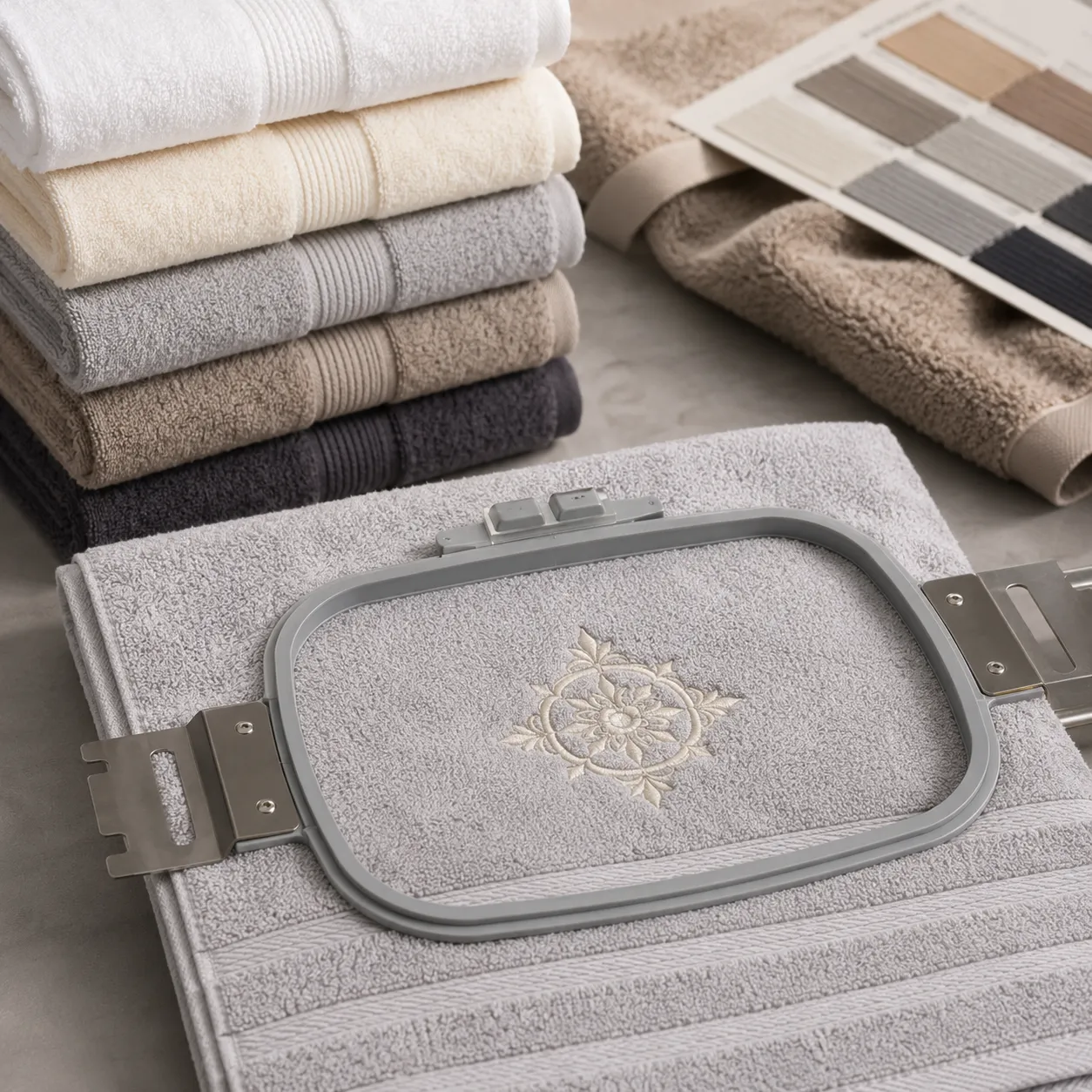
| Embroidery | Raised stitched mark, retail look | +4% to +8% local dry slowdown at stitched zone | 3.1% puckering or thread ends | ±4 mm hoop placement |
| Woven/printed label | Low-profile branding | Negligible on body; local seam weight only | 0.8% skewed or loose label | ±3 mm seam insertion |
Wash durability data that actually changes the decision
We test decorated travel towels against internal wash-and-dry sequences built around ISO 6330 domestic laundering and appearance grading against ISO 7768 references. For logo adhesion or image stability on microfiber, we also review color change and staining under ISO 105-C06, plus dimensional change after laundering because skew on a light towel makes logos look crooked even when the print itself is sound.
On a recent 210 GSM suede microfiber program, sublimation retained edge sharpness best after 30 wash cycles at 40°C and tumble dry low. We measured average image density loss at 4.2% with no handfeel penalty. Screen print on an equivalent navy base showed visible edge fracture starting around cycle 18 on fold lines where customers pack the towel into a pouch. Embroidery survived color-wise, but the problem was not thread fading; it was puckering after repeated drying because the face cloth relaxed at a different rate than the backing stabilizer.
| Method | Wash sequence used | Main pass/fail point | What usually fails first |
|---|---|---|---|
| Sublimation | 30 cycles, ISO 6330 4N, low tumble | Image clarity and shade drift under ISO 105-C06 | Registration shift from panel cutting, not ink loss |
| Screen print | 20 cycles, 40°C, line dry and tumble split | Crack resistance on folded areas | Ink film fracture and tacky hand on over-cure |
| Embroidery | 25 cycles, 40°C, low tumble | Pucker grade and thread snagging | Needle-cut loops and halo distortion around dense fill |
| Woven/printed label | 25 cycles, seam stress pull plus wash | Seam security and corner curl | Label edge fray or seam torque |
- For sublimation we monitor transfer temperature window tightly; at 196-202°C we get full dye migration without glazing the microfiber face.
- For embroidery on suede microfiber we reduce stitch density and switch to a finer underlay; otherwise the logo area dries noticeably slower after laundering.
- For screen print we test both line dry and tumble dry because tumble heat accelerates cracking on thicker white inks.
- For labels we check bartack bite depth because thin microfiber selvages can tear if the needle perforation line is too close to the edge.
Drying performance: where branding can quietly ruin the product brief
A travel towel is purchased for packability and quick evaporation. Decoration that traps moisture, stiffens the panel, or blocks capillary movement directly hurts the reason the item exists. We run side-by-side hang-dry checks in a controlled room at 24°C and 50% RH after standard saturation and spin extraction. We record time to reach 10% residual moisture.
On one 75 × 150 cm waffle microfiber towel, the undecorated control reached target dryness in 92 minutes. The same towel with a 28 × 18 cm screen print reached it in 104 minutes. A sublimated version with full-surface artwork reached 95 minutes because the dye becomes part of the fiber rather than sitting on top. A chest-corner embroidery logo with 8,600 stitches did not move whole-towel dry time much, but the stitched zone remained cool and damp for another 11 minutes, which matters if the towel is packed while still slightly wet.
| Method | Test towel | Time to 10% residual moisture | Buyer implication |
|---|---|---|---|
| No decoration | 75 × 150 cm, 270 GSM waffle microfiber | 92 min | Baseline |
| Sublimation full print | Same base | 95 min | Best option for graphic-led travel programs |
| Screen print 28 × 18 cm | Same base | 104 min | Accept only for simple logos and lower performance claims |
| Embroidery 8,600 stitches | Same base | 94 min overall / stitched zone +11 min | Fine for retail branding, not ideal for pouch-pack damp handling |
| Corner label 35 × 55 mm | Same base | 93 min | Lowest performance interference |
Placement tolerance is not a small issue on lightweight towels
Travel towels move more than cotton terry during cutting and sewing. Lightweight microfiber can skew after heat setting, especially on wide printed panels. That means your logo approval should specify tolerance by method, not just 'centered'. For sublimation, the critical point is print-to-cut registration. For embroidery, it is hoop stability on a stretchy face. For labels, it is insertion angle at the hem.
- Center-front sublimation artwork on a cut-sew towel: we normally hold ±6 mm if the artwork bleeds beyond trim and the hem turn is fixed in the marker.
- Embroidery at one corner on suede microfiber: ±4 mm is realistic if the blank is pre-blocked and hooped with temporary spray, not pinned loose.
- Fold-over woven label in side seam: ±3 mm is realistic, but only if the hem width is constant; variable fold depth will make the label appear higher or lower.
- Screen print on finished towel: ±5 mm is achievable, but stretch variation can distort circles into slight ovals on softer bases.
One defect buyers often misread is apparent off-center branding caused by torque after hemming. The logo was printed correctly, but the body spiraled 7-9 mm after wash. If you do not include skew allowance and post-wash appearance criteria in the approval file, the argument starts too late, after goods arrive.
Cost deltas by method, with volume and rework risk
Decoration cost on travel towels is not just the line-item add-on. Rework probability matters because these are often seasonal or event-linked orders with narrow launch windows. Below are realistic FOB adders we see on 80 × 130 cm microfiber travel towels, based on our current quoting range for 3,000, 10,000, and 25,000 pieces. These are decoration adders over a plain towel, not full product price.
| Method | 3,000 pcs | 10,000 pcs | 25,000 pcs | Cost risk note |
|---|---|---|---|---|
| Sublimation full coverage | USD 0.56-0.74 | USD 0.39-0.52 | USD 0.31-0.43 | Low rework if artwork and panel size are locked early |
| Screen print one-color | USD 0.28-0.41 | USD 0.19-0.30 | USD 0.14-0.24 | Cheap on paper, but higher fallout on curing and crack claims |
| Embroidery up to 9k stitches | USD 0.48-0.67 | USD 0.36-0.54 | USD 0.29-0.45 | Higher labor variance; density changes sew time fast |
| Woven or printed label | USD 0.07-0.13 | USD 0.05-0.09 | USD 0.04-0.07 | Lowest risk if branding can stay small |
The cheapest visual option is not always the cheapest shipped option. We have seen buyers choose screen print to save USD 0.12 per piece against sublimation, then lose the saving through claim reserve because the logo cracked after retail customers tumble dried the towel hotter than the care label allowed. On lightweight travel items, returns are often driven by feel and function, not by catastrophic breakage.
Defect patterns by method: what shows up in final inspection
A stronger quick dry travel towel logo decoration comparison needs defect language, not just preference language. In our final inspection records, each method fails differently. That matters because some faults are visible at AQL check, while others only appear after laundering or pouch packing.
- Sublimation: ghosting at panel edges, blurred fine type under 1.2 mm stroke width, and white grin-through where hem fold pulls the print off register.
- Screen print: pinholes over waffle cells, cure imbalance causing sticky hand, and hinge cracking on repeated fold lines.
- Embroidery: tunneling under satin columns, backing show-through on thin suede face, and needle heat marks if machine speed is pushed.
- Label insertion: twisted side seam, label curl after wash, and scratchy edge complaints when heat-cut labels are too stiff.
Our rolling twelve-month data on microfiber travel towel decoration runs shows major defect containment before packing at 98.6% for sublimation, 97.3% for screen print, 96.9% for embroidery, and 99.2% for label programs. Embroidery looks premium in a photo, but it is the least forgiving method on very light quick-dry bases.
Method choice by selling channel
Different channels tolerate different compromises. Retail outdoor brands usually accept full-print sublimation because graphics sell the item and the performance stays intact. Hotel excursion programs and cruise gift shops often prefer a small woven label or modest embroidery because the towel needs a cleaner, quieter brand signal. Event giveaways skew toward screen print only if the towel is positioned as a low-price promo item rather than a technical travel accessory.
- Choose sublimation if the front of the towel is the design surface and color storytelling is part of the SKU.
- Choose a woven or printed label if you want the towel to stay function-first and keep branding secondary.
- Choose embroidery only on slightly heavier waffle or terry microfiber and keep the logo compact.
- Choose screen print only when the art is simple, the logo area is limited, and you can accept a slower dry panel.
Related reads: embroidery vs sublimation vs jacquard, custom microfiber towels wholesale guide, and microfiber vs cotton towel comparison.
What to lock in your tech pack before sampling
The sample goes faster when the decoration brief is measurable. On travel towels, we suggest approving the base fabric first, then the logo method, then the folding and pouch interaction. A logo that looks acceptable flat on the table may crease badly once the towel is rolled tight and inserted into a silicone strap or mesh pouch.
- State fabric construction, not only 'microfiber': for example 220 GSM suede microfiber, 88/12 blend, white printable base.
- Set maximum logo size in mm and placement from two edges, not from the visual center only.
- For embroidery, specify stitch count cap and backing type; this avoids a denser remake that changes handfeel.
- For sublimation, state whether artwork bleeds through hem turn and whether face/back shade difference is acceptable.
- For screen print, define acceptable crack grade after washing and whether line-dry or tumble-dry use is the benchmark.
If your team is still building the RFQ file, build towel tech pack that mills can quote is the right prep step. If color approval is the pain point, Pantone color matching custom towels covers where print expectations go wrong.
Our practical recommendation
For most brands buying this category, the answer is straightforward. If you need artwork-led branding and want to preserve quick-dry performance, use sublimation on a white suede or waffle microfiber base. If you want restrained branding with minimal risk, use a woven or printed seam label. Use embroidery only when the logo is small and the base is stable enough to carry stitches. Use screen print carefully, because its low unit add-on can become expensive once drying slowdown, cracking claims, and cure variability enter the picture.
That is the core of a useful quick dry travel towel logo decoration comparison: not which method looks nicest in a first sample, but which one keeps the towel drying fast, folding cleanly, and surviving wash with the least argument later.
Related reads: why gym towels fail after 50 washes, towel GSM decision framework, and container vs air freight towel orders.
Need a decoration trial plan before bulk?
Send the towel size, base fabric, logo artwork, target wash count, and sales channel. We can quote the method options, expected tolerances, and sample route. MOQ is 500 pcs per design per color. Contact us at [email protected] or WhatsApp +86 13205717266.
Request a decoration quote →