The calendar starts with the decoration method, not the ship date
For this category, the first planning question is whether the towel is printed microfiber, solid-dyed knit, or a microfiber top with anti-slip silicone dots on the back. Each route creates a different critical path. A full-bleed printed face needs artwork separation, strike-off review, and shade tolerance approval. A gripper-backed mat towel adds one more risk point: dot placement stability after curing and washing. If the buyer starts by asking only for ETD, we usually have to unwind the conversation and rebuild the schedule from the construction up.
| Construction route | Typical use case | Main timing risk | Bulk production window |
|---|---|---|---|
| 200-230 GSM printed suede microfiber, no dots | Studio promo, travel, retail bundle | Artwork cleanup and strike-off approval | 18-24 days |
| 240-280 GSM printed microfiber with silicone dots | Hot yoga mat cover | Dot registration, curing, wash retest | 24-32 days |
| 280-320 GSM yarn-dyed or solid-dyed microfiber blend | Higher absorbency studio towel | Color approval and knitting queue | 20-28 days |
On a 5,000-piece run, we commonly see FOB pricing at USD 2.18-2.74 for a plain printed piece around 61 x 183 cm, depending on GSM, edge finish, and packing. Add silicone dots and the same order often moves to USD 2.63-3.28 because the back application, curing pass, and extra QC slow the line. At 20,000 pieces, that spread narrows, but the process sequence does not change.
- If the towel sits on the mat, ask whether you need silicone at all; many studio programs can avoid 4-6 production days by dropping grip dots.
- If the design includes fine lines under 1.2 mm, we ask buyers to approve a print tolerance before sampling; otherwise the first strike-off becomes a design debate, not a color check.
- If retail wants hanger cards or belly bands, lock barcode placement before bulk cutting. Reworking packaging after production is a real delay, not an admin detail.
Where yoga towel lead-time and logistics usually break down
The weak points are predictable. We see them across private-label studio brands and distributor orders. They are rarely dramatic factory failures; more often they are small decisions left open too long, which then stop the whole order because the next step cannot be booked.
- Buyer sends only a reference photo, without flat artwork, dimensions, or fabric side confirmation.
- Sampling starts before pack method is agreed, then folded size changes and carton quantity must be recalculated.
- Silicone-dot artwork is approved visually but not tested against wash migration, so the sample has to be remade.
- Booking assumes sea freight, then launch timing tightens and the carton footprint is too dense for cost-effective air shipment.
- Receiving warehouse asks for outer-carton labels, FNSKU, or split packing after goods are already in final cartons.
One specific issue on mat towels is back-side silicone bleed. If curing temperature or dwell time is off, the dots can flatten and leave a slight tack on stacked pieces. We check this after curing and again after 24-hour rest before final packing. Another category-specific issue is edge torque on long narrow towels: if tenter setting and cutting alignment are not controlled, the towel can skew after wash and no longer sit straight on the mat. Those are not generic towel problems; they matter here because users notice fit immediately in class.
A workable order map for studio launches
For buyers asking us to hit a fixed campaign date, we normally back-plan in seven blocks. This works better than quoting one total lead time because it shows which approvals are movable and which are hard stops.
| Stage | What we need from buyer | Typical days |
|---|---|---|
| RFQ review | Size, GSM target, artwork, pack method, destination | 1-3 days |
| Sampling file check | Editable artwork, Pantone references, grip layout if applicable | 2-4 days |
| Prototype or strike-off | Printed face, sew construction, optional dot trial | 5-8 days |
| Buyer approval | Comment round and signoff | 3-6 days |
| Bulk material prep | Fabric booking, printing plan, trim prep | 4-7 days |
| Bulk production | Cutting, sewing, printing or dot curing, inspection | 12-20 days |
| Packing and dispatch | Carton sealing, booking, truck to port | 3-5 days |
That means a straightforward custom order can move from approved files to cargo-ready in about 27-39 days. A gripper-backed program with two sample rounds can easily run 35-48 days before vessel departure. For replenishment on an already-approved spec, we can trim that materially because artwork, labeling, and carton math are already stable.
Sampling decisions that save a week later
We prefer buyers to spend one extra day on the pre-production sample rather than lose six days in bulk. The sample should answer operational questions, not just visual ones. For a yoga towel, that means checking fold size, mat coverage, print side orientation, and whether the absorbent face behaves the same after one wash as it did fresh off the line.
- Approve the towel with a measured tolerance, for example 61 x 183 cm ±3% after washing, not only a nominal size.
- If silicone dots are used, request a small wash report that notes dot adhesion after 5 cycles and visual shift across the back grid.
- Specify the edge finish clearly: overlock, hemmed edge, or rounded corners. Rounded corners look cleaner at retail but add sewing time and template control.
- State whether the logo should read correctly when the towel is placed lengthwise on the mat; this avoids upside-down pack presentation.
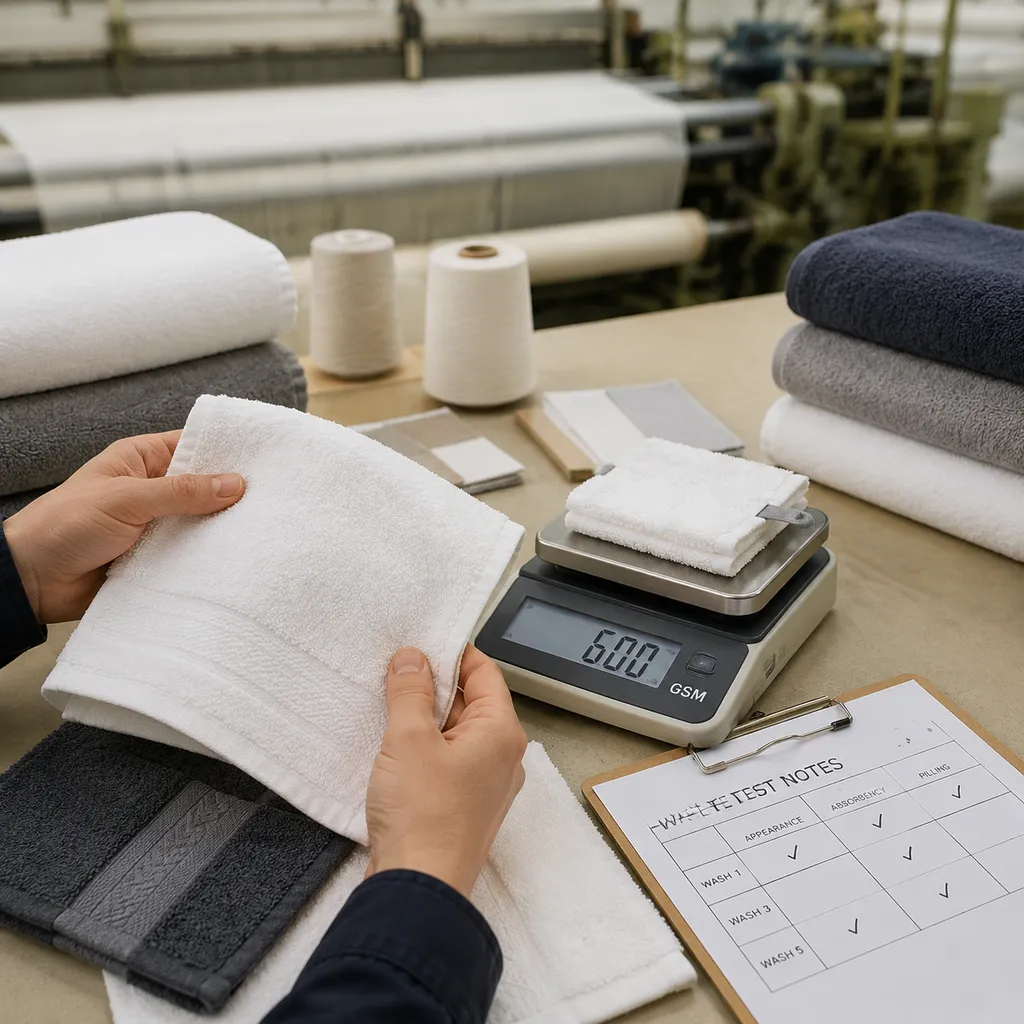
For internal testing we often use a basic wash and appearance sequence before bulk release: dimensional stability check after domestic wash conditions, color migration review on the printed face, and manual peel observation on the silicone field. If a buyer has its own protocol, we align to that early. If not, we still recommend recording the sample result in the approval sheet so bulk disputes stay factual.
Freight choice changes the packaging spec more than buyers expect
In yoga towel lead-time and logistics, freight is not just a booking decision made at the end. Air and sea favor different pack formats. A thick retail box can look good on shelf and still work badly in air cargo because volumetric weight punishes low-density packing. Sea freight is more forgiving, but large cartons create warehouse handling complaints and higher damage rates on long domestic legs.
| Freight mode | Best fit order profile | Transit planning | Packaging note |
|---|---|---|---|
| Express air | Urgent sample top-up or launch rescue under 800 pcs | 4-9 days door-to-door | Use compact flat-fold or polybag only |
| Air freight | Mid-size launch 1,000-4,000 pcs with firm retail date | 8-14 days airport or door service | Keep carton cube tight; avoid gift boxes |
| Sea freight LCL/FCL | Standard seasonal orders above 5,000 pcs | 22-38 days depending on lane | Most flexible on shelf packaging and inserts |
A recent studio-style program illustrates the math. A 3,600-piece printed microfiber order packed in simple OPP bags fit into export cartons at 40 pieces per carton and stayed within a practical airfreight cube. The landed premium over sea was painful but manageable for a launch. The same order packed in individual folding cartons increased outer-carton count sharply and pushed freight cost per piece high enough to erase margin on the first drop. The product did not change; packaging did.
Carton planning for long, narrow towels
This category creates awkward carton geometry. A full-length mat towel is not heavy, but it is long once folded, especially if a paper insert or band keeps the retail face visible. Poor carton planning leads to crushed corners, messy receipt photos, and chargebacks from marketplaces or 3PLs.
- For bulk studio replenishment, we usually recommend flat-fold plus belly band or polybag rather than rigid display carton.
- Keep master carton gross weight in a manageable range, commonly around 9.5-13.5 kg, so warehouse handling stays simple.
- If the towel includes silicone dots, avoid over-compression in the carton right after production; a short rest period helps prevent surface marking.
- For mixed-color assortments, confirm inner-pack ratio before bulk. Re-sorting finished towels on the packing line is slow and error-prone.
If you need Amazon-style labeling, retail barcode panels, or country-of-origin placement, write those directly into the PO appendix. We have seen buyers send compliant artwork but omit the exact placement rule, which forces a late manual relabel step. That is avoidable.
What lead times look like at different order sizes
Volume helps on unit cost more than it helps on pure calendar days. The reason is simple: printing capacity, sewing balance, and curing time still need to be scheduled in sequence. A bigger order may get better raw-material economics, but it also needs more line time and usually more careful booking.
| Order size | Indicative FOB band | Cargo-ready timing after approval | Best planning note |
|---|---|---|---|
| 500-1,000 pcs | USD 3.42-4.36 | 22-30 days | Works for spec validation; freight cost per piece is high |
| 3,000-6,000 pcs | USD 2.28-3.08 | 27-38 days | Most balanced range for private-label launch |
| 10,000-25,000 pcs | USD 1.96-2.71 | 31-45 days | Book vessel space earlier and freeze assortment sooner |
Our MOQ is 500 pieces per design per color, but that is a commercial minimum, not proof that 500 pieces is the most efficient order size. For yoga mat towels with custom print and branded packaging, buyers usually reach a more stable landed cost once they get above roughly 3,000 pieces per design. Below that, packaging and approval overhead stay too visible in the unit economics.
Certifications and compliance should be checked before booking bulk materials
For studio, wellness, and retail programs, compliance questions tend to arrive late even though they affect material booking. If the buyer requires OEKO-TEX Standard 100 Class I alignment, or retailer documentation tied to social compliance, we need to confirm that before fabric and print inputs are locked. We operate with OEKO-TEX 100 Class I, BSCI, and ISO 9001, but the buyer still needs the paperwork trail matched to the exact program, especially if packaging components come from a nominated source.
This matters even more on gripper-backed products. Buyers sometimes assume the microfiber face is the only compliance point, while the silicone application is ignored until the final audit file. That is late. If your QA team wants supporting declarations for all components, ask for them during sampling, not after balance payment.
Related reads: if your team is still building the RFQ file, start with build-towel-tech-pack-that-mills-can-quote.html and towel-sizes-dimensions-complete-guide.html. If compliance review sits with another department, how-to-read-oeko-tex-certificate.html helps them verify the paperwork faster.
Two buyer scenarios we push in opposite directions
Not every order should be rushed. We usually advise differently depending on what the towel is for and what failure would cost the buyer.
If the order supports a hard retail launch, we protect the date first and simplify the pack. If the order supports a long studio program, we protect the repeatability first and spend more time locking the spec.
Scenario one is a launch bundle for a new yoga accessory line. Here, we often recommend one approved print, one fold method, one barcode standard, and air freight only if the launch margin can absorb it. Scenario two is a studio replenishment program with regular repeats. In that case, it is worth taking longer on the first order to fix absorbency expectations, dot pattern, carton count, and receiving labels because those decisions will save friction across every reorder.
- Launch-date orders benefit from fewer variants and less decorative packaging.
- Repeat programs benefit from stronger documentation and a signed carton standard.
- If the buyer plans seasonal artwork rotations, keep the base construction unchanged so only print files move.
- If the first order is a market test, do not over-engineer the insert packout. Learn sell-through first.
The information we need before we can quote yoga towel lead-time and logistics cleanly
A reliable schedule starts with a cleaner RFQ. The buyers who get the most accurate timeline from us usually send one page that answers the production questions upfront. That lets us quote realistic days instead of wide ranges that do not help anyone plan.
- Finished size, target GSM, and whether the towel is plain microfiber, printed, or gripper-backed.
- Artwork file type, Pantone references if relevant, and whether the print should bleed to edge.
- Packaging method: loose bulk, polybag, belly band, hanger, or retail box.
- Destination, required incoterm, and whether the deadline is ex-factory, FOB, or arrival date.
- Compliance documents required for the product and packaging components.
- Assortment split by color or design, if the order is not single-SKU.
Related reads: for MOQ trade-offs see negotiate-towel-moq-without-killing-margin.html. For freight mode selection, container-vs-air-freight-towel-orders.html is the right next step. If your program sits closer to a finished studio kit, the sector view on ../industries/yoga-pilates-towels.html may help your merchandising team align the range.
Need a realistic towel timeline before you place the PO?
Send the size, construction, artwork, pack method, target quantity, and ship-to country. We will map the sample path, bulk days, and freight options around your actual program. MOQ is 500 pcs per design per color. Contact us at [email protected] or WhatsApp +86 13205717266.
Request a quote →