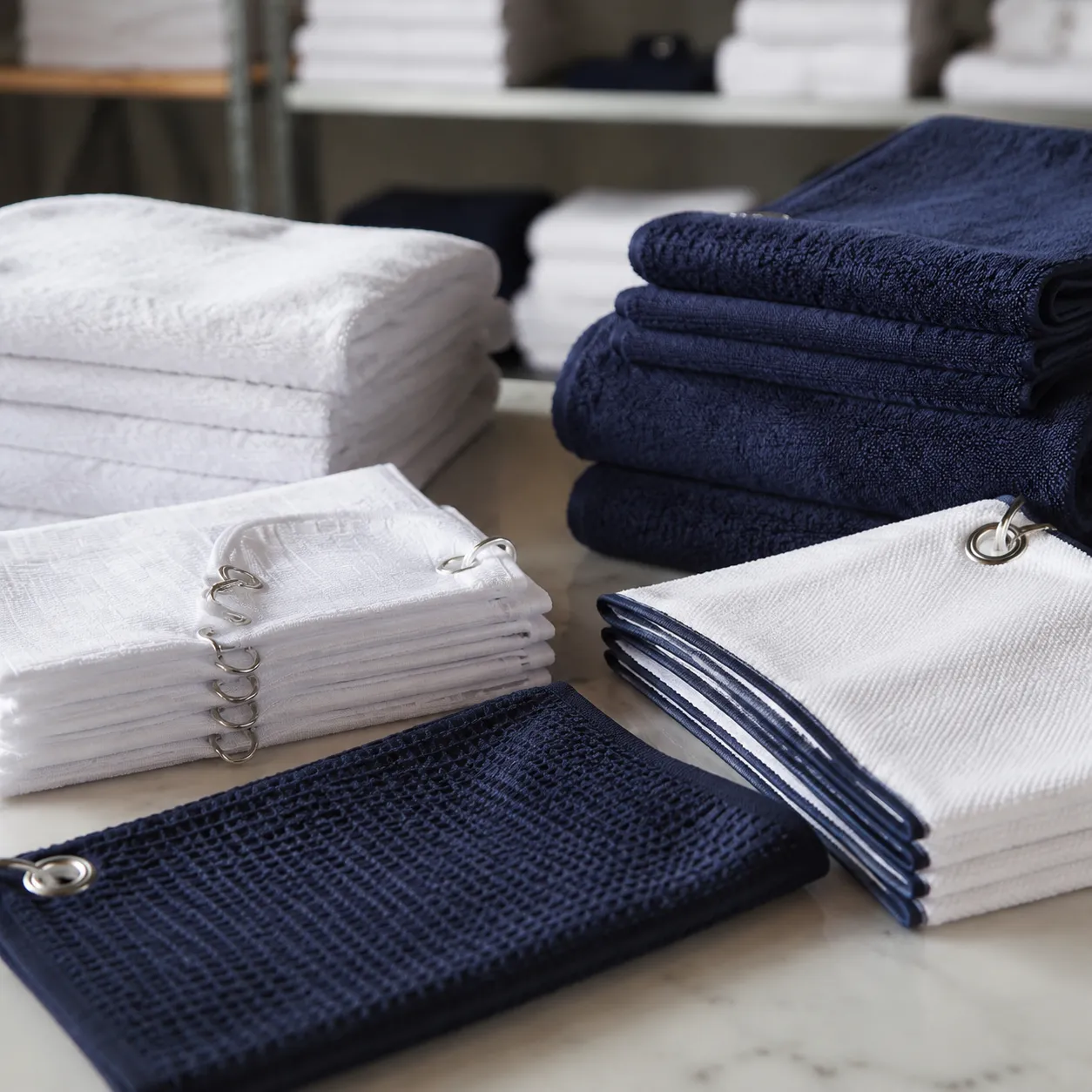
Start with the use case, not the artwork
Rally towels are not judged like bath towels. They are waved in air, photographed under stadium lights, packed tightly for event setup, and often handed out in one short window. That changes how we compare decoration methods. On this category, buyers usually care about four things first: front-face logo impact from 10 to 30 meters away, final unit cost at volume, production speed, and whether the towel still absorbs enough sweat or condensation to feel like a textile rather than a flyer.
For most programs, the base fabric is a terry or velour terry rally towel in the 280-380 GSM range. Common finished sizes are 30×50 cm, 35×55 cm, and 38×63 cm. Our MOQ is 500 pcs per design per color, but decoration choice changes whether that MOQ is realistic for the budget. A promotional rally towel logo decoration comparison only makes sense if we judge each method against the actual event plan: one-game giveaway, playoff run, sponsor-funded activation, or multi-season retail add-on.
| Typical method | Best base fabric | Visual effect | Best order profile |
|---|---|---|---|
| Screen print | Velour cotton or cotton-rich terry | Bold flat logo on surface | 5,000-50,000 pcs event giveaway |
| Reactive or pigment print | Velour face with terry back | Larger artwork coverage | Mid-volume promo with graphic emphasis |
| Sublimation | 100% polyester microfiber | Full-color high resolution | Sponsor graphics, gradients, photo art |
| Jacquard weave | Cotton terry woven logo | Logo built into towel structure | Higher-value club merch or repeat programs |
| Embroidery | Dense terry, usually smaller area | Raised stitched logo | Low-volume premium commemorative runs |
Why screen print still wins many promotional orders
If the logo is one or two spot colors and the goal is cost control, screen print is still the workhorse. On a 350 GSM cotton velour rally towel, the sheared face gives the ink a flatter landing area than loop terry, so edges look sharper. That is why we often steer stadium buyers away from trying to print directly onto unsheared loop pile unless they accept a softer outline.
The main factory detail buyers should know is that screen print on towels behaves differently from print on T-shirts. Terry loops create micro-highs and lows, so we usually adjust mesh count and ink deposit to avoid broken coverage on solid blocks. If the logo has fine reverse text below 3 mm stroke width, we often widen the negative spaces before sampling. Otherwise, lint migration and pile direction can close up the letters after the first wash.
- Best for sponsor logos, team marks, simple slogans, and high-contrast art
- Works most cleanly on sheared velour face; less clean on open loop terry
- Usually 1-3 spot colors; halftones are possible but need art simplification
- Fastest setup for repeat programs once screens are approved
| Order volume | Screen print FOB China | Sample time | Bulk lead time |
|---|---|---|---|
| 500-1,999 pcs | USD 0.86-1.28/pc | 5-7 days | 18-24 days |
| 2,000-9,999 pcs | USD 0.63-0.98/pc | 5-7 days | 20-28 days |
| 10,000-30,000 pcs | USD 0.49-0.79/pc | 4-6 days | 25-35 days |
| 30,000+ pcs | USD 0.44-0.68/pc | 4-6 days | 28-40 days |
For wash testing, we normally review colorfastness to washing against ISO 105-C06 and rubbing against ISO 105-X12. On promotional towels, many buyers only ask whether the print survives a few home washes. We still recommend at least a 5-cycle internal wash review before bulk, because under-cured print can crack along fold lines after cartons sit in summer heat.
Where sublimation is strong — and where it is the wrong tool
Sublimation gives the cleanest gradients, photographic art, and sponsor-heavy layouts, but it belongs on polyester microfiber, not on standard cotton rally towels. We see confusion here every season. Buyers send cotton references and ask for photo-quality print. That combination does not work. If the visual concept requires a full-bleed crowd graphic, neon fade, or QR-heavy sponsor panel, we switch the construction to microfiber and build the towel around the print process.
The trade-off is feel. A sublimated microfiber rally towel can be light, fast to print, and visually sharp, but it does not wave or absorb like a compact cotton terry towel. It also photographs flatter, which some teams like and some do not. In a true promotional rally towel logo decoration comparison, sublimation is usually the visual winner and the tactile compromise.
- Best for full-color gradients, mascot illustrations, and all-over sponsor layouts
- Requires polyester face, commonly 200-260 GSM microfiber knit
- No separate screen charges for multi-color artwork
- Not ideal if the buyer wants classic terry handfeel or heavier stadium-wave motion
| Construction | Print capability | FOB China | Wash risk |
|---|---|---|---|
| 200-220 GSM microfiber | Photo print edge to edge | USD 0.58-0.88/pc at 3,000 pcs | Low image fade if transfer is stable |
| 230-260 GSM microfiber | Richer body and drape | USD 0.74-1.02/pc at 3,000 pcs | Low image fade, slightly longer drying time |
| Cotton terry | Not suitable for sublimation | N/A | Method mismatch |
A process point specific to sublimation: we watch heat-calendar pressure and transfer dwell time closely on rally towels with hemmed edges. If edge binding is already sewn before transfer, differential shrinkage can pull the panel slightly off square. For cleaner geometry on sponsor grids, we prefer print-before-final-hem sequencing.
Jacquard makes the towel feel more valuable than its price
Jacquard is the method we suggest when the towel should look less disposable. Instead of adding a surface logo, the artwork is woven into the fabric structure. For club stores, season-ticket packages, and sponsor gifts where the towel may live longer than one event, jacquard often gives the best cost-per-use even though the opening price is higher than a simple print run.
There are limits. Jacquard does not reproduce tiny legal text well, and color count is restrained by the weave setup. But block lettering, stripes, checkerboards, and repeat emblems work very well. On a 330-420 GSM cotton terry rally towel, woven contrast also remains legible after repeated laundry because there is no ink layer to crack or stiffen.
If the logo has to read from the upper deck and survive a season of fan use, jacquard often beats a complicated print file.
| Order profile | Jacquard FOB China | Development need | Best for |
|---|---|---|---|
| 500-1,499 pcs | USD 1.36-1.92/pc | Artwork conversion to weave graph | Premium commemorative runs |
| 1,500-4,999 pcs | USD 1.02-1.48/pc | Yarn color approval | Club programs and sponsor gifts |
| 5,000-20,000 pcs | USD 0.84-1.24/pc | Weave card confirmation | Retail plus event crossover |
| 20,000+ pcs | USD 0.76-1.08/pc | Repeat production efficient | Large seasonal programs |
Two technical details matter here. First, long float areas in the weave can snag when towels are waved against railings or seat hardware, so we often rebalance the draft to shorten floats. Second, if a buyer wants a white ground with saturated contrast, we may use optical brightener carefully but still keep the article within OEKO-TEX 100 Class I requirements where requested. Certifications such as OEKO-TEX 100 Class I, BSCI, and ISO 9001 are available across these programs, but the fiber and dye route still need to match the chosen method.
Embroidery looks good on sample boards more than on mass giveaway towels
We do embroidery on towels every week, but for rally towels it is usually the wrong answer unless the order is a premium small run. Stitching adds hand cost, slows output, and creates puckering risk on lighter ground fabric. A 30×50 cm rally towel at 300 GSM does not give the needle bed much stability, especially when the logo is placed too near the hem.
If the buyer still wants embroidery, we usually increase fabric body, add temporary backing during stitching, and cap logo size. Satin stitch on open loops can sink unevenly, so we sometimes shear the placement area or shift to a denser velour face. For event towels under tight deadlines, embroidery can become the bottleneck because machine hours scale less efficiently than print runs.
- Best for commemorative VIP packs, golf-style crossover merch, or club shop programs
- Poor fit for 10,000-piece one-day stadium giveaway orders
- Risk points: puckering, backside thread show, slower packing flow
- Use only when the raised stitched look is central to the product concept
The base fabric decides more than most buyers expect
Artwork approval is important, but the logo method only performs as well as the base construction allows. A promotional rally towel logo decoration comparison should always include the face finish, pile type, and hem style. We commonly see buyers approve art first, then switch from velour to loop terry to save a few cents. That one change can blur print edges and alter the perceived value more than the decoration itself.
- For clean print edges, choose a sheared velour face.
- For soft absorbency and woven logo options, choose standard terry.
- For photo print, move to polyester microfiber instead of forcing cotton to do the wrong job.
- For square event folding, keep shrinkage tolerance realistic and confirm hem turn-back width in the tech pack.
Typical rally towel constructions we quote are 16s single-ply cotton terry, 21s cotton velour-terry, and 75D/144F polyester microfiber knit depending on decoration route. If the towel is packed for seat drops, a narrower hem such as 1.2 cm often folds cleaner than a bulky 1.8 cm turn-back. That sounds small, but on 25,000 pieces it affects stacking height, carton count, and how flat the logo presents when fans first open the towel.
What usually fails first in event-driven logo programs
The biggest problems are rarely dramatic defects. They are specification mismatches that only show up when 8,000 towels are already in cartons. On printed rally towels, the common issues are fuzzy small text, color shift under LED stadium lighting, and logos placed too close to hems so they look off-center after final pressing. On jacquard towels, the issue is usually over-detailed artwork that had no business being woven in the first place.
- Screen print failure mode: heavy ink laydown makes the towel feel boardy and reduces absorbency on the logo zone
- Sublimation failure mode: buyer expects cotton handfeel from a polyester article
- Jacquard failure mode: sponsor marks with fine outlines disappear in weave translation
- Embroidery failure mode: logo distortion on light GSM fabric after hooping and wash relaxation
To prevent this, we like to sign off on a pre-production sample with final artwork scale, exact fabric, exact hem, and folding method. For color-sensitive programs, we compare against Pantone references under D65 light. For wash review, even promo goods should have a simple internal benchmark. A towel that looks acceptable only before wash is not a cost saving if the team shop has returns after one weekend.
How we advise buyers by budget tier
Not every rally towel order should use the same method. If the budget is under USD 0.70 landed-factory target, we usually simplify the art and push toward a lighter cotton screen print or microfiber sublimation depending on the visual requirement. Between roughly USD 0.80 and USD 1.20 FOB China, buyers have room to improve handfeel, edge finish, and towel weight. Above that, jacquard starts to make more sense if the order has multi-use value.
| Budget goal | Recommended route | Why | Watch-out |
|---|---|---|---|
| Entry promo | 1-color screen print on 280-320 GSM velour | Lowest cost on classic towel base | Avoid small details |
| Mid-tier event | 2-color screen print or heavier sublimated microfiber | Better impact without big setup jump | Confirm tactile expectations |
| Club merch crossover | Jacquard cotton terry | Higher perceived value and wash life | Need weave-friendly art |
| VIP or commemorative | Embroidery or jacquard with hangtag packout | Presentation-led product | Longer production window |
Related reads: if you are still setting the underlying fabric, review towel-gsm-decision-framework.html, build-towel-tech-pack-that-mills-can-quote.html, and pantone-color-matching-custom-towels.html.
A practical sourcing checklist before you approve artwork
- State the event date and in-warehouse date separately; decoration choice depends on the true deadline.
- Specify whether the towel is giveaway-only, retail-capable, or both.
- Send vector artwork and note minimum readable text size.
- Confirm cotton terry, velour terry, or microfiber before discussing print sharpness.
- Approve logo placement from hem edges in millimeters, not just visually.
- Request one wash-tested pre-production sample on final construction.
- Lock packout method early if the towels are seat-dropped, polybagged, or belly-banded.
Related reads: for broader event sourcing context, see hidden-cost-cheap-promotional-towels.html, negotiate-towel-moq-without-killing-margin.html, and container-vs-air-freight-towel-orders.html. If your program crosses into sponsor merchandise, our ../industries/airbnb-vacation-rental-towels.html page is less relevant than direct stadium promo planning, but it shows how packout assumptions change end use.
Our mill-side conclusion on promotional rally towel logo decoration comparison
For most stadium giveaways, screen print on cotton velour remains the best balance of cost, speed, and recognizable towel feel. For graphic-heavy sponsor art, sublimation wins on image quality but requires a microfiber construction and a buyer who accepts that change. For programs that should feel more permanent, jacquard is usually the strongest answer. Embroidery has its place, but mainly for small premium runs rather than mass event distribution.
We produce around 2.4 million towels annually and quote these programs directly from the mill floor, so we prefer to resolve the method choice before sampling starts. That saves both time and avoidable remake cost. Our MOQ is 500 pcs per design per color, and standard sampling usually takes 5-7 days, with bulk production commonly 18-40 days depending on method, volume, and packaging complexity. We can supply under OEKO-TEX 100 Class I, BSCI, and ISO 9001 frameworks when the project requires them.
Compare rally towel logo methods with actual costs
Send us your artwork, target quantity, event date, and preferred towel size. We will recommend the right decoration route with realistic FOB pricing and lead time from our Gaoyang mill.
Request a quote via [email protected] or WhatsApp +86 13205717266 →