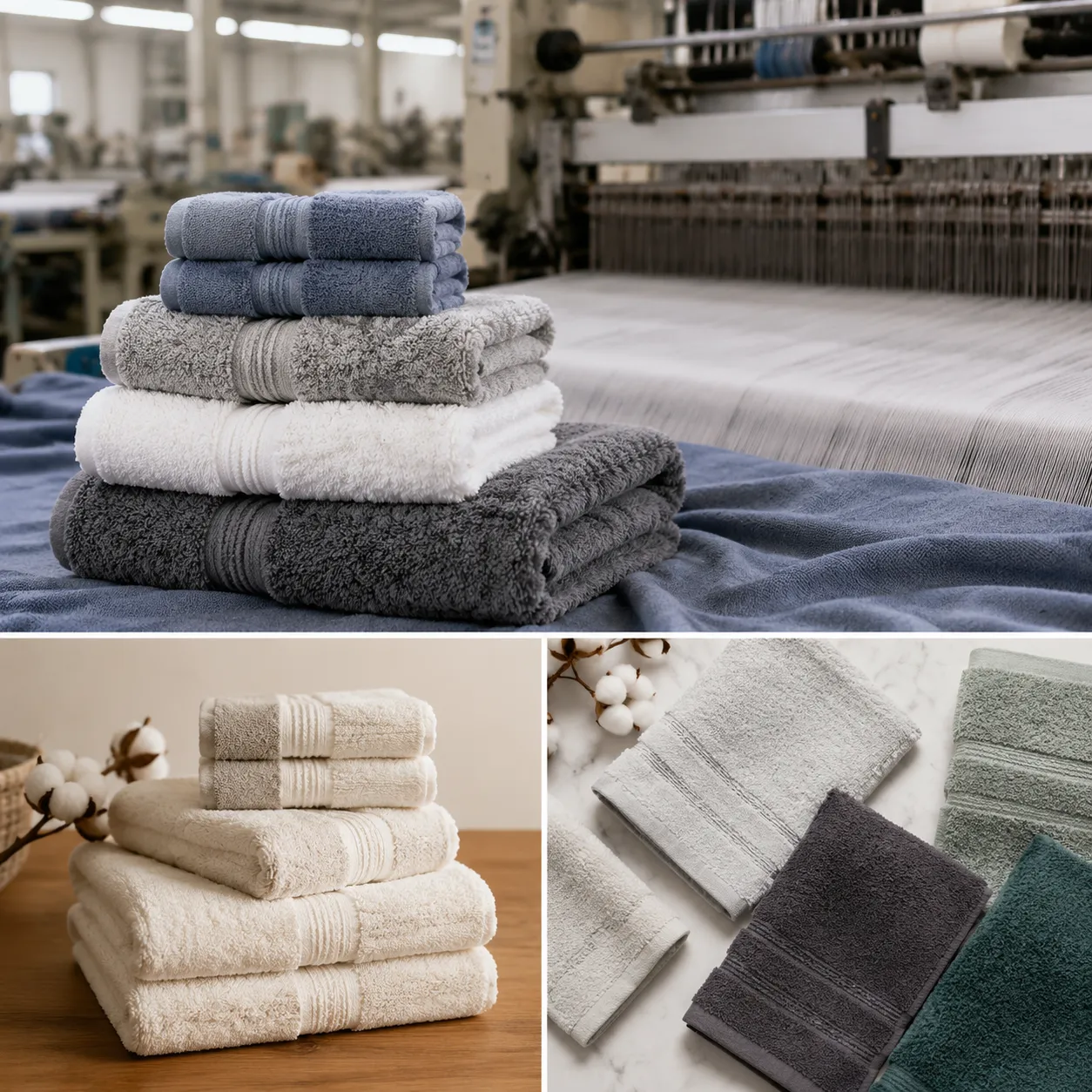
Start with the set architecture, not the headline MOQ
The fastest way to overpay is to ask for one MOQ number before the set is defined. A private label towel set usually mixes at least two or three pieces, and each piece can pull a different production path. A bath towel, hand towel, and washcloth set behaves very differently from a two-piece spa set or a gym bundle with one terry towel and one microfiber face cloth.
For a factory quote, we first break the set into construction blocks: yarn type, pile height, border style, label method, and pack format. A 650 GSM bath towel with dobby border, a 500 GSM hand towel with woven edge, and a 380 GSM washcloth with hemstitched edge do not share the same machine time or finishing loss. That is why a useful private label towel set MOQ negotiation guide starts with the BOM, not with a guess.
| Set type | Typical structure | MOQ pressure point | Factory-side note |
|---|---|---|---|
| Hotel bath set | Bath + hand + washcloth | Bath towel dye lot | Heavier piece drives loom and drying time |
| Spa set | Bath sheet + hand towel | Border finish | Wide borders slow sewing and inspection |
| Retail gift set | 2-3 pieces + printed box | Packaging insert | Box and insert often set the floor |
| Fitness set | Hand towel + sweat towel | Color split | Too many colors fragment dye batches |
What actually sets the MOQ in a towel set
The number on the quote usually comes from one of five constraints: yarn allocation, dye house batch size, sewing line changeover, packaging run, or carton loading efficiency. Buyers often focus on the sewing line because it feels visible, but dyeing and finishing are where small orders get expensive. If a color needs 180 kg of yarn to run cleanly through the dye house, a 300-piece set may be physically possible but financially awkward.
- Yarn dye lots need enough weight to avoid shade drift between pieces.
- Border or dobby pattern changes require loom setup and sampling waste.
- Custom labels, swing tickets, and belly bands have their own print MOQ.
- Gift boxes need a separate carton or box-run quantity, even when towels are ready.
- Vacuum pack or ribbon wrap can raise pack labor more than the towel itself.
A good negotiation starts by separating what must be fixed from what can be flexible. Color can often be shared across all pieces in the set. Packaging can sometimes stay plain for the first run. Embroidery can be placed only on the bath towel instead of every piece. Each of those decisions lowers the friction without reducing the perceived value of the set.
| Cost driver | Low-MOQ choice | Effect on MOQ | Effect on unit cost |
|---|---|---|---|
| Colorway | One shared shade across set | Lowest | Best for first run |
| Decoration | One logo position only | Low | Keeps setup simple |
| Packaging | Plain polybag + label | Very low | Cuts print and carton complexity |
| Gift packaging | Rigid box with insert | High | Raises the practical floor fast |
The size split that protects margin
A towel set is rarely sold as equal units. The bath towel carries the value story, the hand towel carries frequency of use, and the washcloth or face cloth fills the entry price. If you ask for the same MOQ across all sizes, you usually push the factory into excess stock on the smaller pieces. That becomes a hidden problem when the re-order lands and one size is still sitting in cartons.
We prefer buyers to decide the size split before they negotiate the total MOQ. For example, a 1,200-set launch can be built as 1,200 bath towels, 1,200 hand towels, and 2,400 washcloths if the washcloth is the unit that gets used fastest. That kind of split makes more sense than forcing a 1:1:1 balance that does not match store sell-through or hotel usage.
| Common set split | Where it works | Risk if ignored |
|---|---|---|
| 1:1:1 | Gift retail and bridal bundles | Washcloths may run out too slowly |
| 1:1:2 | Hotels and spa amenity programs | Bath towels may overhang stock |
| 1:2:2 | Family or value packs | Hand towels may become the bottleneck |
| 2:2:4 | Mixed-channel private label | Packaging and carton math need attention |
Private label towel set MOQ negotiation guide: the factory-side levers
The cleanest negotiation is not “please lower the MOQ.” It is “which spec choices allow the same output with less setup waste?” That shift matters because the mill can usually support lower quantities when the order is simplified in the right places. The buyer keeps the brand story. The factory keeps the line stable.
- Hold one base color across every piece in the set.
- Limit decoration to one towel or one placement.
- Use the same cotton basis across the set instead of mixing blends.
- Keep the packaging simple in the first run.
- Approve a lab-dip or strike-off quickly so the line does not sit idle.
There is a real difference between a low MOQ that is viable and a low MOQ that is just a quote headline. A 500-set launch with one bath towel, one hand towel, and one washcloth in a single shade can work cleanly. A 500-set launch with two towel colors, three embroidery positions, and printed rigid packaging is where the real cost jumps. The negotiation should push complexity out of the first order, not pretend it disappears.
If the first run has to prove the design, the packaging, and the color all at once, the factory will price the risk into the quote.
Where the price tiers usually land
MOQ and price move together. Once the set gets smaller, the dye bath, setup, and inspection costs are spread across fewer pieces. That is why a buyer who saves 8% on MOQ but loses 14% on unit cost often ends up with a worse gross margin. The right question is whether the lower start quantity protects sell-through more than it hurts landed cost.
| Launch quantity | Typical towel-set build | USD/unit range | Comment |
|---|---|---|---|
| 500-799 sets | Simple 2-3 piece set, one color, plain pack | 6.90-9.80 | Best when testing demand |
| 800-1,999 sets | Single logo, one shared shade, standard carton | 5.80-8.40 | Most balanced first-order band |
| 2,000-4,999 sets | Shared colorways with limited pack variation | 4.60-6.90 | Better absorb setup cost |
| 5,000+ sets | Multi-color program with controlled packaging | 3.90-6.10 | Useful once reorders are proven |
Those bands change with GSM, border complexity, yarn quality, and packaging, but they are realistic for private label programs. A 620 GSM bath towel set with standard hem and woven label will sit above a 450 GSM value set. A box-packed retail set can be more expensive than the towel itself if the box is short-run printed. For buyers, the right negotiation move is to simplify the first purchase order and reserve the fuller packaging for the second order.
Sample order rules that keep the bulk MOQ honest
Sampling is where set programs often drift off-track. A buyer approves one bath towel sample, then adds a different hand towel finish, then asks for a box mockup, and suddenly the bulk quote no longer matches the approved sample. We treat the sample as a controlled version of the production plan, not as a free design playground.
- Approve one final size chart for the full set before strike-off.
- Match the sample yarn count, GSM, and border width to bulk intent.
- Confirm embroidery placement on the exact towel size it will appear on.
- Lock packaging dimensions before cartons are priced.
- Ask for a cut-and-sew sample if the set has special hemming or appliqué.
Two details matter a lot in towel-set sampling. First, the cut-edge shrinkage after the first wash can change the hand feel more than the buyer expects, especially on open-end value yarns. Second, the folded pack height must be checked against carton inner dimensions, because a soft set that looks compact on a table may balloon once wrapped and barcoded. That is why sample approval has to include both the textile and the packout.
Lead time: the version that actually reaches the dock
A credible lead-time plan has to name the bottleneck. For a plain private label towel set, we usually need 28-38 days after lab-dip or artwork approval. If the order includes custom yarn-dyed borders, embroidery, or printed gift packaging, the timeline commonly stretches to 42-55 days. That is production time, not sailing time.
| Program type | Production time | Main bottleneck | Buyer action |
|---|---|---|---|
| Plain 2-3 piece set | 28-38 days | Greige inventory and finishing | Approve colors fast |
| Embroidered set | 35-48 days | Needle setup and thread matching | Freeze artwork early |
| Box-packed retail set | 40-55 days | Packaging print and assembly | Confirm dieline before bulk |
| Mixed-color reorder | 38-60 days | Dye house queue | Consolidate colors |
If the program is export-bound, add transit separately. Ocean freight usually matters more than the towel sewing line once the set is packed. Buyers who mix up production days and shipping days end up thinking the factory missed the promise when the real delay is a late carton decision or a vessel booking gap. For a tighter logistics comparison, see container vs air freight towel orders.
Set-specific failure modes to avoid in the first PO
A towel-set order breaks in ways that single towels do not. Mixed sizes can shrink unevenly if the fibers, loop density, or finishing are not aligned. A heavy bath towel paired with a lighter hand towel may feel mismatched in the buyer’s hand after the first wash. The set can also fail visually when the logo thread looks right on the bath towel but too dense on the washcloth.
- Dye shade variation between sizes because each piece was run in a separate batch.
- Decorative stitching puckering on smaller towels with shorter seam allowance.
- Carton compression marks on lofty pile towels packed too tight.
- Label placement drifting across sizes because the fold spec changed late.
- Retail set imbalance when one piece sells faster and the bundle loses perceived value.
One practical fix is to keep the same cotton foundation across the set and vary only the size and decoration. Another is to use the bath towel as the design carrier and keep smaller pieces plain or lightly branded. That protects the set identity without forcing every component to carry the same production burden. When the first order is a test, controlled simplicity beats decorative overload.
Documents to lock before you negotiate the final MOQ
The best MOQ conversations happen after the buyer has a tidy tech pack. A loose brief leads to a loose quote, and then everyone spends time re-labelling “change requests” as if they were surprises. For towel sets, the document set should capture the exact commercial and production decisions that affect the minimum.
- Set composition by size and GSM.
- Decoration method and placement per piece.
- Color reference, Pantone or fabric standard, for each shade.
- Packaging format, barcode position, and carton count.
- Required certifications, such as OEKO-TEX Standard 100 Class I, BSCI, and ISO 9001 if the program needs audited supply.
If you need a deeper template for the order brief, use build towel tech pack that mills can quote and how to read oeko-tex certificate. The better the paperwork, the more likely the factory can hold the MOQ down without adding margin for uncertainty.
A practical negotiation example
A resort brand once wanted a three-piece launch: bath towel, hand towel, and washcloth, all in one muted green shade, with a woven label and a simple kraft sleeve. Their first ask was 300 sets. That quantity was tight for the dye run, but workable if we reduced the packaging complexity and kept the towel spec aligned across the set. By moving the logo off the washcloth and using one shared color, the program became feasible at 500 sets instead of forcing separate low runs for each size.
| Line item | Original ask | Adjusted plan | Why it worked |
|---|---|---|---|
| Set quantity | 300 sets | 500 sets | Matched the dye and finishing batch better |
| Decoration | Logo on every piece | Logo on bath towel only | Cut setup and stitch time |
| Packaging | Printed sleeve plus insert | Plain sleeve with sticker | Reduced print MOQ |
| Color | Two shades | One shade | Avoided split dye lots |
The lesson was simple: the lowest MOQ was not the real target. The real target was a first order that could be packed, shipped, and reordered without stranded stock. That is the only version of MOQ that helps the buyer build a private label program instead of just buying one expensive shipment.
Related reads
If you are building a wider towel program, these pieces help with the next decisions: negotiate towel MOQ without killing margin, private label vs white label towel programs, and towel GSM decision framework. For retail bundles, towel sizes dimensions complete guide is also useful.
For category-specific planning, compare hotel towel sourcing guide 2026, spa towels need different cotton than hotel, and microfiber vs cotton towel comparison before locking the line plan.
Request a towel set MOQ quote
Send your set composition, target quantity, packaging plan, and decoration details. We will price the real production floor, not a placeholder number. MOQ starts at 500 pcs per design or per color. OEKO-TEX 100 Class I, BSCI, ISO 9001. WhatsApp +86 13205717266 or email [email protected].
Get a Quote →