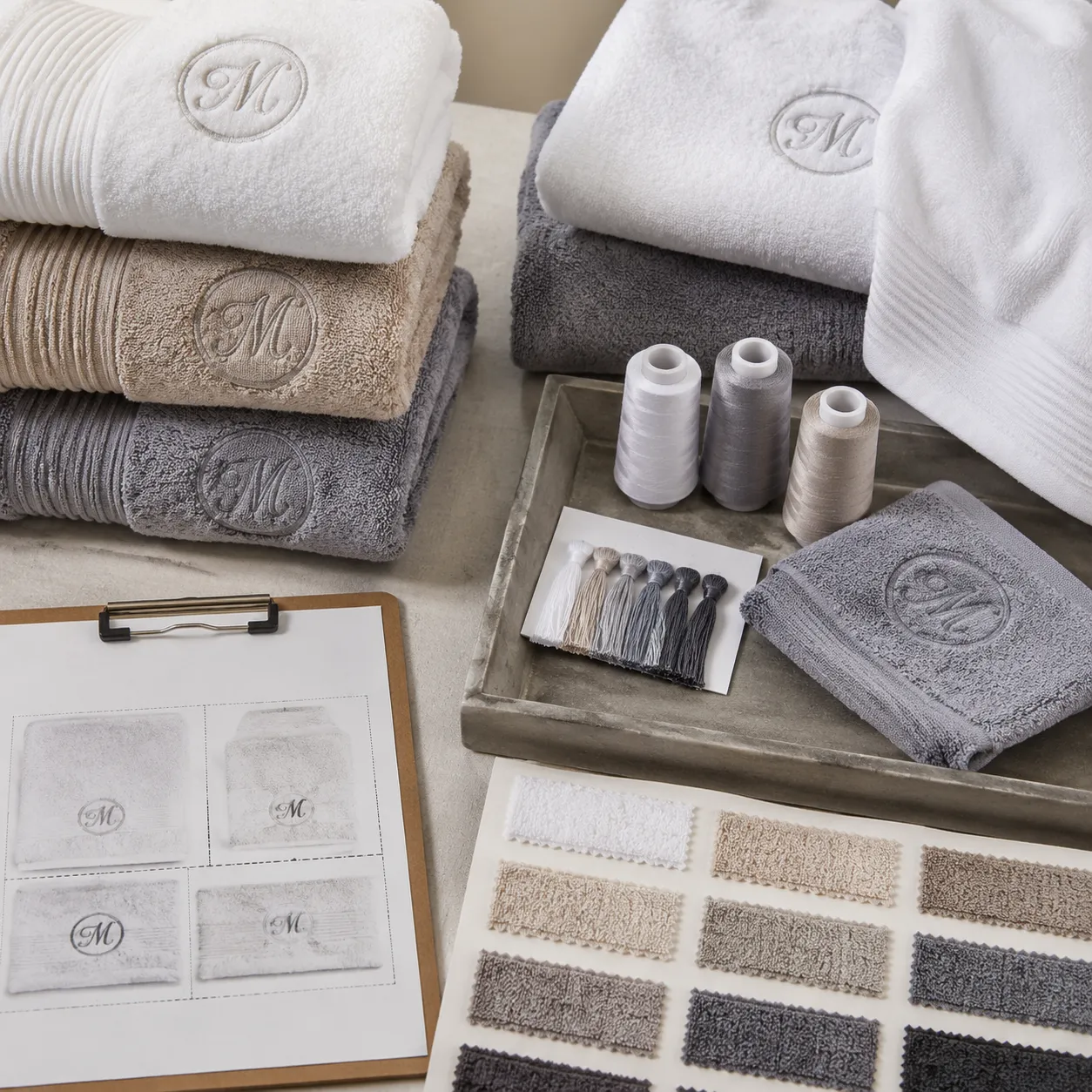
What buyers usually want to approve first
When a hotel, spa, or private-label brand asks for monogrammed bath towels sample approval process, they usually care about three things first: does the logo sit where the guest expects it, does the stitch look crisp, and does the towel still feel soft enough to use. We agree with that order, but we add one more layer: can the decoration survive real laundering without distortion. A sample that passes visual review but fails after three washes will create rework, delays, and avoidable claims.
| Approval item | What we check | Typical fail mode |
|---|---|---|
| Placement | Distance from edge and centerline | Logo sits too low or too close to hem |
| Embroidery build | Stitch density, underlay, pull direction | Puckering on terry loops |
| Thread | Shade match and wash behavior | Color shift after chlorine or alkaline wash |
| Towel body | GSM, pile height, shrinkage | Logo distorts after first shrink |
| Packout | Fold, insert card, label | Sample looks fine but bulk pack changes presentation |
Monogrammed bath towels sample approval process: the first submit
We start with a blank production-style towel, not a presentation-only piece. If the body construction is different from bulk, the sample is misleading. For monogrammed bath towels sample approval process, we want the same yarn type, same GSM, same hem style, and the same embroidery backing that the bulk order will use. Otherwise the sample may approve a decoration that cannot be repeated at scale.
- Use the actual towel size and GSM intended for bulk, such as 500 GSM, 560 GSM, or 620 GSM depending on the brand position.
- Confirm whether the monogram is single-color satin stitch, filled block lettering, or a stitched outline with a denser border.
- Provide vector artwork or a clean stitch file, because low-resolution artwork causes inconsistent satin columns and jagged edges.
- Specify if the monogram is centered, offset near the hem, or placed above the decorative border line.
The quickest sample approvals happen when the buyer sends a simple spec sheet with towel size, color, thread code, logo size in millimeters, and final use case. For example, a spa buyer may want a 60 x 120 cm hand towel with a 45 mm initial set, while a hotel brand may prefer a 75 mm emblem on a bath towel. Those are different stitch loads and should not be treated as the same approval.
Placement rules that keep bulk from drifting
Placement sounds easy until the towel is folded, laundered, and packed. On terry, even a 3 to 5 mm shift is visible. We set the embroidery frame against fixed reference points: hem edge, side seam, and the towel centerline. For branded bath towels, we also confirm which side the guest sees first after folding, because the logo can land under the fold if the folder spec is not aligned with decoration placement.
| Placement point | Common target | Why it matters |
|---|---|---|
| Lower hem monogram | 40-60 mm above hem | Leaves room for fold and avoids seam interference |
| Center monogram | Centered on width axis | Best for retail and gift sets |
| Corner mark | 30-50 mm from corner | Useful when towel will be folded for stack display |
| Border-adjacent | Above jacquard or dobby border | Needs extra attention to avoid border thickening |
If the sample only looks good on one towel size, it is not approved yet. We need the placement to work on the production size, not just the demo piece.
Thread, stabilizer, and stitch density are not cosmetic details
Thread choice changes hand-feel more than buyers expect. A dense monogram with heavy backing can make a soft towel feel stiff in a small area, especially on 500-550 GSM terry. We usually test the balance between appearance and drape by changing stitch density in small steps rather than chasing the densest possible fill. On looped terry, too much density can also create a shine ring around the monogram where the pile is flattened.
| Decoration variable | Typical working range | Risk if pushed too far |
|---|---|---|
| Satin stitch density | 0.35-0.45 mm | Thread tunnels and puckering |
| Fill stitch density | 0.40-0.50 mm | Logo becomes heavy and board-like |
| Backing | Tear-away or cut-away by fabric | Residual stiffness or clean-edge instability |
| Thread weight | 40 wt polyester or viscose depending on brief | Thicker thread can distort fine initials |
For wash durability, polyester embroidery thread is usually more stable than decorative rayon in hotel use, especially when the laundry line includes hot drying and repeated alkaline detergent exposure. If the brand wants a softer sheen or a gift-box look, we can still use rayon for lower-wash retail programs, but we state that tradeoff in the sample approval notes. That way the buyer signs off on the real use case, not just the look on day one.
How we test a monogram sample before sign-off
Our approval check is practical. We inspect the sample on the table, then after a controlled wash cycle, then after drying and re-folding. A decorative sample that passes only the first check is not enough. For hospitality and spa orders, we look for thread bleed, loop snags, edge curl around the embroidery field, and any rise in shrink mismatch between embroidered and non-embroidered areas.
- Measure the logo size, placement, and symmetry against the tech pack.
- Run a wash test at a typical laundry profile, then air dry or tumble dry according to the buyer's use case.
- Inspect puckering, thread sheen change, and any distortion of the towel hem after drying.
- Confirm the fold line still lands correctly for shelf display and cart delivery.
- Approve the final reference sample with signed notes and retained swatches.
| Test item | Typical method | What we reject |
|---|---|---|
| Wash resistance | 5-cycle internal wash check | Thread fuzzing, unraveling, or color loss |
| Shrink observation | Pre/post measurement | Logo migrating off-center after shrink |
| Hand-feel check | Manual squeeze and fold test | Embroidery area becomes board-stiff |
| Visual symmetry | Grid ruler measurement | Initials tilt or spacing drifts |
One detail many buyers overlook is towel pile direction. If the pile is brushed one way, the embroidery can catch light differently from left to right, making identical initials look uneven in photos. That matters for retail packs and gift sets. We note the pile direction on the approved sample so the bulk line can keep the same orientation during finishing and folding.
Sample approval timing, MOQ, and pricing bands
The approval process should be fast, but not rushed. A simple monogram on an existing towel body can move quickly; a custom towel color, border, and thread combination takes longer because each variable can affect the final look. Our normal sampling schedule for monogrammed bath towels is 7-12 days for first embroidery samples, then 5-7 days for revision samples if only stitch or placement changes are needed. If the buyer changes towel construction, allow more time.
| Order tier | Sample logic | Indicative FOB unit price |
|---|---|---|
| 500-999 pcs | Small run, more manual handling | USD 3.10-4.20 per towel |
| 1,000-2,999 pcs | Better spread of embroidery setup cost | USD 2.45-3.35 per towel |
| 3,000-9,999 pcs | Main bulk band for many hotel and gift programs | USD 1.95-2.85 per towel |
| 10,000+ pcs | Highest efficiency on stable specs | USD 1.70-2.45 per towel |
These are realistic embroidery-heavy bath towel ranges for a standard cotton program, not luxury retail shelf prices. If someone asks us to hit a very low price with a dense monogram on a heavy towel, we usually explain the cost per use instead of chasing a false target. A towel that lasts 90-120 washes with a stable logo is usually cheaper to operate than one that looks cheaper but gets replaced early.
- MOQ: 500 pcs per design per color for most monogrammed bath towel programs.
- Sample lead time: 7-12 days for first approval, 5-7 days for minor corrections.
- Bulk production after approval: usually 25-35 days depending on yarn, dyeing, and finishing queue.
- Standard export carton planning should be frozen after sample sign-off to avoid label and packing rework.
Where monogrammed bath towels fail in real production
We also watch for needle heat on dense embroidery fields. On some darker shades, excessive needle penetration can leave tiny shiny marks around the stitches, especially if the backing is too aggressive. On white and pale towels, a poor thread shade match is obvious immediately, but on mid-tone colors the mismatch often shows only under daylight. That is why we compare the sample under neutral light, not only under workshop LEDs.
| Failure mode | What causes it | How we prevent it |
|---|---|---|
| Puckering | Too much density or weak stabilizer | Reduce fill, change backing, rebalance hoop tension |
| Logo drift after wash | Shrink mismatch between body and decoration area | Prewash test fabric and lock placement allowance |
| Thread shading error | Wrong cone or dye lot | Approve against physical thread card, not screen image |
| Stiff hand-feel | Overbuilt embroidery block | Lighten fill or reduce logo footprint |
What we need from buyers to approve faster
The cleanest approvals happen when the buyer sends fewer assumptions and more measurable detail. A clear monogram brief saves days of back-and-forth. We do not need a long brand story; we need the technical inputs that let us build the sample correctly the first time.
- Final towel size and target GSM.
- Preferred yarn type if already selected, such as combed cotton or ring-spun cotton.
- Logo artwork in vector format, plus exact monogram height and width in millimeters.
- Thread color reference, ideally physical Pantone or thread card code.
- Placement sketch showing front view, fold line, and hem reference.
- Expected wash route: hotel laundry, home wash, spa rotation, or retail gifting.
If the program also needs packaging, label copy, or gift ribbon, we want that in the same approval round. Decoration and packout influence each other. A monogrammed bath towel that is perfect in loose form can still fail the shelf presentation if the fold is too tight or the hangtag covers part of the initials. That is especially true for hotel amenity sets and branded retail bundles.
Related reads
If you are building a wider bath program, these articles help with the surrounding decisions: how to read OEKO-TEX for chemical compliance, towel GSM decision framework for body weight selection, build towel tech pack that mills can quote for cleaner submissions, and pantone color matching custom towels when your monogram thread must match a brand palette. For larger hospitality rollouts, also see setting up hotel linen program 90 day roadmap and hotel towel sourcing guide 2026.
For buyers comparing decoration methods, embroidery vs sublimation vs jacquard is useful when deciding whether the monogram should be stitched, woven, or printed. If your program extends beyond bath towels into coordinated gift sets, monogrammed bath towels luxury brand guide can help align the decoration with a broader product story.
A practical approval checklist we use at the mill
- Confirm the sample uses the same towel body as bulk, not a substitute blank.
- Check logo placement against hem and centerline with a ruler, not visually only.
- Review thread color under neutral light and keep the physical approval swatch.
- Wash the sample using the intended laundry route before final sign-off.
- Record the approved stitch density, backing type, and fold method for production repetition.
For most monogrammed bath towel programs, the fastest path is a disciplined one: approve the body first, then the decoration build, then the wash result. That sequence reduces surprises later and gives both sides a stable reference for bulk. If the buyer wants a second sample, we usually revise only one variable at a time so the result stays readable.
Request a monogrammed bath towels sample review
Send your artwork, towel size, color target, and wash route. We will confirm placement, stitch build, MOQ, and timing before bulk.
Get Quote →