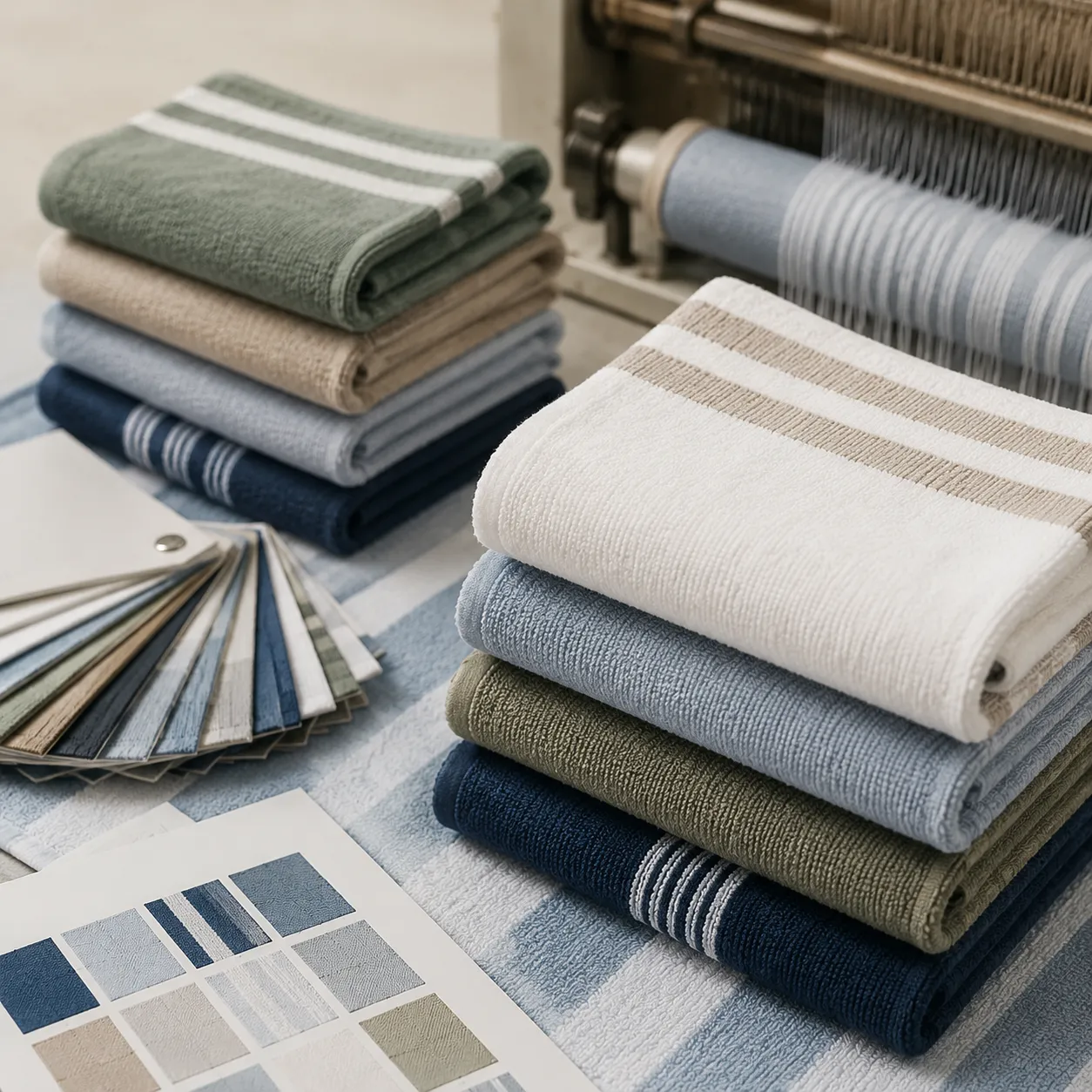
Start with the base towel, because embroidery sits on top of that cost
For hand towels, the logo is rarely the largest cost line. The fabric body is. On a 40 x 76 cm towel, moving from 420 GSM ring-spun cotton to 550 GSM combed cotton shifts yarn consumption enough that the decoration percentage changes even if the monogram stays identical. Buyers sometimes compare two quotes with the same initials and assume the embroidery charge moved; in reality, the ground towel changed first.
| Base spec | Typical weight/pc | FOB China towel only at 1,500 pcs | Notes |
|---|---|---|---|
| 420 GSM, 16s single yarn, dobby border | 129-136 g | USD 0.68-0.82 | Entry hotel or event gifting |
| 480 GSM, 16s/21s cotton, plain border | 147-154 g | USD 0.81-0.97 | Most balanced for monogram programs |
| 520 GSM, combed cotton, cam border | 159-167 g | USD 0.96-1.16 | Better face for denser stitching |
| 560 GSM, combed cotton, low-twist face | 171-180 g | USD 1.14-1.36 | Soft handfeel, but embroidery pull needs tighter control |
The construction matters because embroidery adds local stress. A soft low-twist face can look excellent in retail gifting, but if the underlay is too aggressive the monogram area cups after washing. On a firmer 480-520 GSM ground, we usually get a flatter finish with less backing show-through. That is one reason we often push brand buyers away from the softest towel in the range when the monogram must sit close to the hem.
A practical monogram hand towels cost breakdown by order size
Below is the range we see most often for a 40 x 76 cm cotton hand towel with a 45-60 mm embroidered monogram placed above the border. These figures assume OEKO-TEX 100 Class I compliant materials, standard export polybag packing by dozen, and one embroidery position. They do not include duty, destination inland freight, or branded retail gift box packaging.
| Order volume | 420-480 GSM | 500-560 GSM | What drives the range |
|---|---|---|---|
| 500 pcs | USD 1.28-1.74 | USD 1.53-2.05 | Sampling amortization, lower embroidery efficiency, MOQ pressure |
| 1,500 pcs | USD 0.99-1.36 | USD 1.21-1.61 | Better thread utilization and line balancing |
| 3,000 pcs | USD 0.90-1.25 | USD 1.11-1.49 | Stable production rhythm, lower wastage |
| 8,000 pcs | USD 0.84-1.16 | USD 1.03-1.40 | Best spread of setup cost across cartons |
Our factory MOQ is 500 pcs per design per color, but that is a technical minimum, not always an economical one. At 500 pcs, you are paying for digitizing, thread setup, pre-production strike-off, hooping loss, and operator changeover across too few units. For hospitality groups rolling out across several properties, 1,500-3,000 pcs is where embroidered hand towel pricing starts to settle into a useful band.
What the embroidery line actually adds
Embroidery cost is not a flat logo fee. We price it from stitch count, thread colors, machine speed, rejection risk, and backing requirement. A simple serif initial at 6,500 stitches runs very differently from a crowned monogram with satin columns, tiny inner angles, and 13,800 stitches. The second file slows the head speed and raises thread break frequency, especially on dark reactive-dyed grounds where needle heat is less forgiving.
- Digitizing for a clean monogram file: usually USD 28-55 once per artwork
- Embroidery run charge for 6,000-8,000 stitches: usually USD 0.15-0.24 per towel
- Embroidery run charge for 9,000-12,000 stitches: usually USD 0.22-0.34 per towel
- Second thread color on the same monogram: typically adds USD 0.03-0.07 per towel
- Water-soluble topping or extra backing on plush face: typically adds USD 0.02-0.05 per towel
Two factory details matter here. First, we usually run 75D/2 rayon embroidery thread for a brighter monogram on gift-oriented programs, but for institutional laundering we may switch to polyester thread because it holds shade more steadily through repeated peroxide or alkali exposure. Second, towel pile height changes readability. On higher loops, we often add a topping film during stitching so the letters do not sink into the face. That is a real consumable and a real labor step, not a vague surcharge.
Placement can create hidden rejection cost
The cheapest logo location is the one the operator can hoop consistently. Buyers sometimes request a monogram 12 mm above a dobby border because it looks tidy on a render. In sewing reality, that position creates drift risk: one towel may read balanced, the next may ride into the border, and the next may sit high because the hem thickness pushes the frame differently.
| Placement option | Cost effect | Typical risk |
|---|---|---|
| Centered above plain border, 25-35 mm clearance | Lowest | Best repeatability |
| Near dobby or cam border, under 18 mm clearance | Adds 3-6% | Visible placement variation |
| Corner monogram on folded display face | Adds 5-9% | Hooping time rises |
| Oversized crest over pile field | Adds 10-18% | More puckering and slower run speed |
If you want consistent placement, specify the measurement from finished hem after wash allowance, not from greige cut panel. We use a placement template during pre-production, but even then the towel must be stabilized after dyeing, drying, and shearing. On hand towels, a 4 mm shift is visible much sooner than on bath sheets because the decoration occupies more of the visible face area.
The cost range changes with the monogram style, not only the letter count
A single initial can cost more than a three-letter set if the artwork is dense. Buyers looking at custom monogram towel cost should separate style families before asking for one quote. We generally group them this way during RFQ so the commercial discussion matches production reality.
- Clean block or serif initial, 1 color, 5,500-7,500 stitches: lowest cost and fastest approvals.
- Two-letter interlock, 1-2 colors, 7,500-10,500 stitches: common for boutiques and clubs.
- Script monogram with overlaps and flourishes, 9,500-13,500 stitches: more editing and more wash-risk if columns are too narrow.
- Crest with initials, wreath, or crown, 12,000-18,000 stitches: best handled as a separate program because the rejection profile is different.
Script styles cause more revisions than buyers expect. Fine terminals that look elegant on screen may disappear into terry loops or fray after repeated laundering. We usually thicken those paths in digitizing and reduce unnecessary direction changes, otherwise the sample passes visually but becomes noisy after wash test. That adjustment protects the program, but it can nudge stitch count upward by 6-12%.
Testing and compliance lines buyers should price in early
For monogram hand towels shipping into hospitality, baby, or retail channels with compliance requirements, testing is rarely a rounding error. OEKO-TEX 100 Class I, BSCI, and ISO 9001 are factory-level signals, but the article itself still needs material control and wash validation. On embroidered programs, we watch both the ground fabric and the stitched area.
- Colorfastness to washing: ISO 105-C06, usually checked after the agreed domestic or institutional cycle
- Colorfastness to rubbing on the embroidered area: ISO 105-X12, because thread abrasion can differ from the towel body
- Dimensional change after laundering: ISO 5077 or buyer equivalent method
- Needle detection or metal control step if required by retailer protocol
- AQL final inspection, commonly 2.5 major / 4.0 minor for export programs
A claim like "tested to 50 washes" means little unless the chemistry and temperature are defined. For a hotel hand towel, we often run internal laundry simulation closer to 60 C with alkaline detergent and tumble dry exposure, because that is where puckering, thread fuzzing, and edge distortion show up. If the buyer uses chlorine-heavy processing, we flag rayon thread immediately and discuss polyester thread before sampling.
Lead time is usually lost between sample approval and line booking
The base towel may weave and dye smoothly, but embroidered programs get delayed when the monogram file is approved too late for machine booking. We normally quote 3-5 days for digitizing and strike-off, 5-7 days for hand towel sampling if base yarn is available, and 18-30 days for bulk after approvals and deposit. Tight calendars are possible, but only when artwork, Pantone references, and final placement are locked early.
| Stage | Typical days | Where delays happen |
|---|---|---|
| Artwork review and digitizing | 3-5 | Unreadable thin strokes, unclear monogram size |
| Lab dip or thread shade matching | 2-4 | Brand color not mapped to nearest embroidery thread |
| Sample towel making | 5-7 | Base spec changed after first sample |
| Bulk weaving, dyeing, sewing | 12-18 | Color queue and finishing load |
| Bulk embroidery and packing | 6-10 | Late file approval or machine allocation conflict |
If you need several initials across the same towel spec, group them intelligently. A set of four monograms in one thread color is easier to schedule than four initials each with different thread shades and gift box names. This is where buyers accidentally add ten days without adding much consumer value.
Where buyers overspend on small programs
The most expensive towel is often the one engineered like a luxury retail gift but ordered like a test run. We see this pattern in spa boutiques, wedding hospitality, and limited property openings: 500 pcs, 560 GSM combed cotton, custom thread shade, monogram near border, branded ribbon, and individual gift sleeves. Each line is reasonable alone. Together they create a unit cost that surprises the buyer.
A recent comparison from our quoting desk illustrates the point. Program A was 500 pcs at 520 GSM with a 10,200-stitch two-letter monogram, one thread color, standard carton pack. FOB landed at about USD 1.74 per piece. Program B was 2,500 pcs at 480 GSM with a 7,100-stitch single initial and the same towel size; that quote sat around USD 1.08. The second program was not "cheap." It simply removed low-efficiency choices that the end user would barely notice in daily use.
- Use one base towel across several properties before changing pile or border styling
- Keep the monogram under roughly 60 mm unless the design needs heraldic detail
- Choose one or two thread shades that align with stock embroidery cones
- Save rigid gift packaging for DTC or event units, not all operational stock
Related reads: build-towel-tech-pack-that-mills-can-quote, pantone-color-matching-custom-towels, and negotiate-towel-moq-without-killing-margin.
What to put on the RFQ so the quote is usable the first time
If the RFQ only says "white hand towel with monogram," every mill has to guess. That guess shows up later as quote drift or sample revisions. A complete hand towel embroidery cost quote needs the towel spec and the decoration spec together.
- Finished size, target GSM, cotton type, border construction, and target finished weight
- Ground color and whether optical white or reactive shade is required
- Monogram artwork in vector or sharp reference image
- Decoration size in millimeters and placement from finished hem
- Thread color count and Pantone reference if exact branding matters
- Packing method, barcode or care label needs, and destination country
- Planned order split by color or initials so MOQ can be checked early
One small but important point: if the monogram is personalized by guest name or room identity, that is no longer standard bulk embroidery. Variable-name production changes handling, sorting, and packing logic. The towel itself may cost the same, but the fulfillment labor does not.
Related reads: monogrammed-bath-towels-luxury-brand-guide, hotel-towel-sourcing-guide-2026, and how-to-read-oeko-tex-certificate. You can also review our relevant product categories at /products.html#hand and for hospitality programs at ../industries/airbnb-vacation-rental-towels.html.
Our working benchmark for quoting monogram programs
For most B2B buyers, the stable middle ground is a 480-520 GSM cotton hand towel, 40 x 76 cm, one-position embroidery, 6,500-10,000 stitches, and volume above 1,500 pcs. That is usually where appearance, laundry performance, and FOB cost meet without forcing artificial savings or unnecessary decoration complexity. If the use case is heavy institutional washing, we will usually recommend a tighter face construction and polyester embroidery thread. If the use case is boutique gifting, we may accept a softer pile and rayon thread, but we will state the wash-risk assumptions clearly in the quote.
We are a 220-employee towel mill in Gaoyang, Zhejiang, producing about 2.4 million towels annually for 80+ brand clients across 47 countries. Our MOQ is 500 pcs per design per color, and we work under OEKO-TEX 100 Class I, BSCI, and ISO 9001 systems. For a quote that actually matches production reality, send the towel spec, monogram file, order quantity, and destination market to [email protected] or WhatsApp +86 13205717266.
Request a monogram towel quote
Send your towel spec, monogram artwork, quantity split, and target ship date. We will quote the base towel, embroidery, sampling, and lead time separately.
Get a Quote →