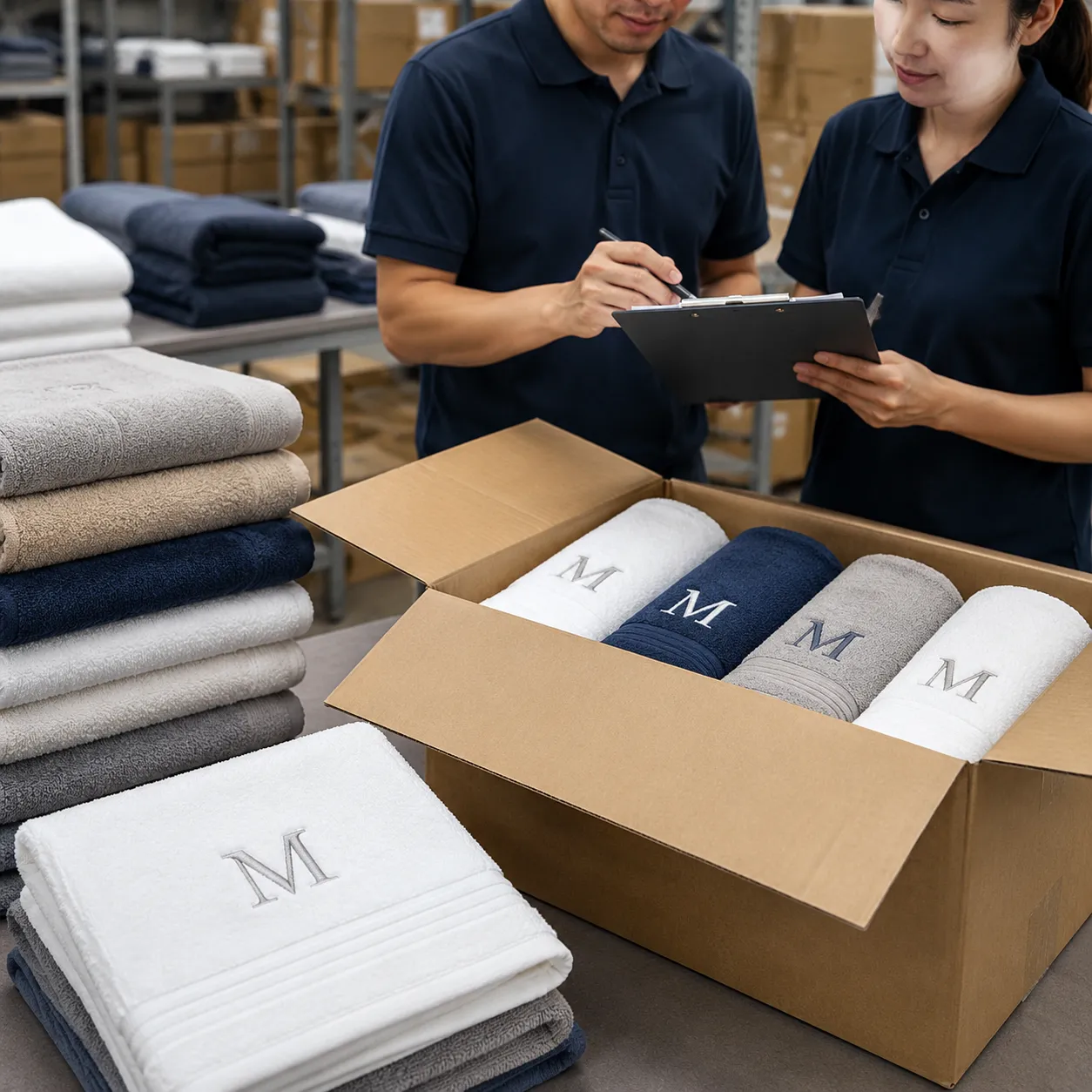
Why carton planning starts before embroidery
For monogrammed bath towels, packing cannot be left until the end of production. The embroidery adds thread mass, raised surface height, and a compression point that behaves differently from plain terry. If the towel is folded with the monogram facing the outer carton wall, the stitch can flatten, snag, or leave a pressure mark after 24-35 days in ocean transit.
We plan the carton at tech-pack stage, not during final packing. For hotel bath towels in the 500-700 GSM range, the same carton may hold 18, 20, or 24 pieces depending on towel size, border width, embroidery position, fold method, and whether each piece needs a belly band or inner polybag. A 650 GSM towel with a dense satin-stitch crest may need one fewer layer per carton than the same towel with a small corner monogram.
Our factory MOQ is 500 pcs per design and per color. At that scale, carton mistakes are expensive because a 500-piece order may only produce 20-30 export cartons; one wrong label format or over-compressed carton affects a large share of the shipment. At 8,000-20,000 pcs, the risk shifts toward container loading efficiency and carton stacking strength.
| Spec point | Plain bath towel risk | Monogrammed bath towel risk | Factory control |
|---|---|---|---|
| Fold direction | Cosmetic crease only | Embroidery flattened or rubbed | Monogram folded inward with terry buffer |
| Carton fill | Slight bulge acceptable for some buyers | Bulge can distort stitch and label scan angle | Compression limit checked before sealing |
| Carton marking | SKU mismatch | Room program, logo color, or initials mixed | Carton label matched to packing list line |
| Moisture | General mildew risk | Thread and dense pile hold moisture longer | Needlepoint area checked after drying and conditioning |
Monogrammed bath towels export carton checklist
This is the checklist we use before sealing export cartons for embroidered hotel and retail bath programs. Buyers can copy the logic into their QC inspection sheet, especially when the goods are moving by sea freight or into a 3PL warehouse that requires carton-level receiving.
- Confirm the approved towel spec: size, GSM, color, yarn, border, embroidery artwork, stitch count, and logo placement.
- Check towels are fully dried and conditioned after washing, dyeing, finishing, and embroidery trimming; terry should not feel cool or damp at the fold.
- Fold the towel so the monogram faces inward or sits between terry layers, not directly against corrugated board.
- Use the approved inner pack: bulk stack, individual polybag, paper belly band, retail sleeve, or hotel linen bundle.
- Run a carton fill test with the final product, not a pre-embroidery towel, then record pieces per carton and gross weight.
- Apply export carton markings on two long sides unless the buyer requires four-side labels for automated receiving.
- Match every carton label against the packing list: PO, SKU, color, size, quantity, carton number, country of origin, and gross/net weight.
- Seal using the agreed tape width and method, then check carton edges for bowing before palletizing or floor loading.
For a first production run, we prefer to photograph one open carton and one sealed carton before mass packing. This is a simple step, but it catches wrong fold direction, missing desiccant, incorrect export carton markings, and label placement that may fail a warehouse scan.
Carton size, CBM, and towel carton weight
The carton size should be driven by the towel and the logistics route, not by whichever carton is cheapest in the warehouse. Bath towels are soft goods, but high-GSM terry becomes heavy quickly. A carton that looks efficient on paper can become hard to handle, fail a drop test, or create container dead space.
For export bath towel programs, we usually keep gross carton weight between 13 kg and 21 kg. Below that, freight cost per towel rises. Above that, manual handling becomes rougher, cartons deform more easily, and some hotel distribution centers complain about safety limits. For air freight, we also check volumetric weight because towels are bulky even when compressed.
| Typical towel spec | Suggested packout | Approx. carton size | Gross weight range | Use case |
|---|---|---|---|---|
| 70 x 140 cm, 520 GSM, small corner monogram | 20 pcs/ctn | 58 x 39 x 46 cm | 15.8-17.4 kg | Standard hotel replenishment |
| 76 x 152 cm, 600 GSM, center border crest | 16 pcs/ctn | 62 x 42 x 48 cm | 17.2-19.6 kg | Resort bath towel with larger logo |
| 80 x 160 cm, 680 GSM, dense spa monogram | 12 pcs/ctn | 64 x 43 x 45 cm | 16.9-19.1 kg | Luxury suite or spa program |
| 70 x 140 cm, 450 GSM, retail sleeve | 18 pcs/ctn | 60 x 40 x 50 cm | 14.2-16.0 kg | DTC or gift pack order |
These figures are working ranges, not fixed rules. A thick dobby border, long pile, or high thread density embroidery changes the stack height. We always do a carton trial using finished towels because pre-production samples often relax differently after bulk dyeing and tumble drying.
- CBM control: a carton of 58 x 39 x 46 cm is about 0.104 CBM before pallet allowance.
- Weight control: gross weight includes towel, polybag, carton, tape, labels, and desiccant if used.
- Handling control: cartons over 22 kg often receive more corner impact during warehouse transfer.
- Scan control: carton labels should sit on a flat panel, not across a crease or tape seam.
Protecting embroidery inside the carton
Embroidery damage usually happens after sewing, not during sewing. The common defect modes are thread abrasion at the carton wall, crushed satin stitch, lint trapped inside dense letters, and backing paper residue showing through the pile. For monogrammed bath towels, we ask packing staff to inspect the stitched zone again after final thread trimming, not only at the embroidery machine.
Our embroidery QC references ISO 105-C06 for domestic and commercial laundering colorfastness where relevant, and we check appearance after wash cycles using an internal rating sheet for thread fuzzing, loop pull, and logo distortion. For towel performance, our QC team also works under ISO 9001 procedures, with lot traceability from yarn batch to packing list. OEKO-TEX Standard 100 Class I applies to approved materials and dyes when the buyer specifies baby-safe or skin-contact compliance.
| Packing choice | Best for | Risk to watch | Factory recommendation |
|---|---|---|---|
| Bulk folded stacks | Hotel back-of-house linen | Logo-to-logo friction if stacked wrong | Alternate fold direction by layer |
| Individual clear polybag | Retail, gifting, 3PL receiving | Moisture trapped if towels are not conditioned | Use only after moisture check |
| Paper belly band | Boutique hotel or retail display | Band edge can press into embroidery | Place band away from monogram |
| Inner master poly liner | Humid routes or mixed container loading | Condensation if container has temperature swing | Use with desiccant and dry cartons |
For dense embroidery above 9,000 stitches, we avoid placing the stitched face against plastic under high compression because plastic can polish the raised thread surface. A terry-to-thread fold is usually safer. If the monogram uses metallic thread, we test abrasion more carefully because metallic yarn is less forgiving than polyester embroidery thread.
Carton board strength and drop test details
A carton for towels does not need the same board as ceramic goods, but it must survive compression, humidity, and repeated handling. For most bath towel exports, we use 5-ply corrugated board with 170-200 gsm liner depending on carton size and gross weight. Small cartons under 14 kg may pass with a lighter board; large cartons for 600-700 GSM towels should not.
For carton drop evaluation, we reference the logic of ISTA 1A for packaged products up to 68 kg, adjusted to soft goods. We do not pretend towels break like electronics, but the carton still needs edge integrity. A failed edge crush can create carton collapse in the lower container rows, and that pressure transfers into the towel stack.
- Corner drop: check whether the carton corner opens or crushes deeply enough to expose towels.
- Edge drop: confirm the long edge does not split along the tape line.
- Face drop: inspect whether towel stacks shift and press embroidery into the carton panel.
- Compression check: stack test sample cartons for 24 hours when the order will be palletized or floor loaded high.
- Tape adhesion: test tape after cartons sit in a humid packing area, not only immediately after sealing.
For export carton markings, we prefer black print or white label stock with barcode contrast that passes warehouse scanning from 45-60 cm. Buyers using Amazon, hotel procurement portals, or cruise-line receiving systems should send label templates before bulk packing. Changing labels after cartons are sealed adds 1-3 working days and usually creates a mismatch risk.
Moisture control before sealing
Towels can feel dry by hand and still carry too much retained moisture inside the pile or embroidery zone. This matters for monogrammed bath towels because backing, dense thread, and thick terry slow down moisture release. If the order leaves Ningbo or Shanghai during humid months, we treat moisture control as a packing specification, not a nice extra.
Our production flow includes drying, conditioning, embroidery, trimming, final inspection, and packing. After embroidery, towels may absorb workshop humidity while waiting for packing. We spot-check with a textile moisture meter and compare readings from plain terry, border area, and embroidered area. If the embroidered area reads materially higher, we do not seal the cartons immediately.
| Control point | Target or range | Why it matters | Action if outside range |
|---|---|---|---|
| Packing room RH | Below 65% preferred | Reduces mildew and carton softening | Delay packing or run dehumidifier |
| Towel moisture spot check | Usually 6-9% depending on fiber and finish | High readings increase odor risk | Recondition before packing |
| Carton storage before loading | Off floor, away from exterior wall | Prevents carton wicking moisture | Use pallets or dunnage |
| Desiccant use | Route-dependent, often 2-4 units per carton | Helps long humid ocean routes | Add only after buyer approval |
We also avoid sealing freshly steamed or pressed retail packs too quickly. If a buyer asks for individual polybag packout, the towel must be stable before bagging. A polybag makes the pack look clean, but it can trap moisture if the factory rushes the final step.
Packing list and warehouse receiving fields
The best carton is still a problem if the packing list cannot be received cleanly. For monogrammed programs, mistakes often happen where one towel body color has multiple thread colors, or one hotel group orders the same base towel for different properties. Carton numbering must follow the buyer's receiving logic, not only our factory's production sequence.
- PO number and buyer SKU exactly as issued on the purchase order.
- Towel size in centimeters and inches if the destination warehouse uses imperial dimensions.
- Body color, Pantone reference where applicable, and embroidery thread color code.
- Monogram position such as lower center, corner, dobby border, or opposite label side.
- Pieces per carton, carton number sequence, total cartons, net weight, gross weight, and CBM.
- Country of origin, care label language, and any hotel property code or department code.
We recommend carton numbers like 1/168, 2/168, and so on, instead of only carton ID codes. It helps forwarders and hotel receiving teams spot a missing carton quickly. If the buyer needs mixed-SKU cartons, we mark them clearly because mixed cartons slow QC inspection and warehouse put-away.
Related reads: for decoration decisions before packing, see Embroidery vs Sublimation vs Jacquard and Monogrammed Bath Towels Luxury Brand Guide. For building the specification before carton trials, use Build a Towel Tech Pack That Mills Can Quote.
Pricing impact of better export packing
Better packing is not free, but poor packing costs more once the goods are in transit. For a 70 x 140 cm bath towel at 540-620 GSM with one embroidered logo, FOB pricing typically sits around USD 4.65-7.40 per piece depending on yarn, GSM, dye color, logo stitch count, and order volume. Carton upgrades, inner bags, barcode labels, and desiccant usually add cents, not dollars, but they must be quoted clearly.
| Order volume | FOB unit price range | Packing cost included | Possible add-ons |
|---|---|---|---|
| 500-999 pcs | USD 6.20-8.80/pc | Standard 5-ply carton, bulk fold, export mark | Individual polybag USD 0.06-0.11/pc |
| 1,000-2,999 pcs | USD 5.35-7.60/pc | Carton trial, carton labels, standard tape sealing | Barcode label set USD 0.03-0.07/pc |
| 3,000-7,999 pcs | USD 4.95-6.95/pc | Optimized packout and carton numbering | Desiccant USD 0.04-0.10/pc equivalent |
| 8,000+ pcs | USD 4.55-6.45/pc | Container loading plan and pre-shipment pack photos | Palletization quoted by route |
A realistic example: one resort buyer wanted 24 pcs per carton for a 76 x 152 cm, 610 GSM bath towel with a 7,400-stitch crest. The carton looked efficient at first, but gross weight reached 25.6 kg and the side panels bowed after one day. We changed to 18 pcs per carton, which increased carton count by 33%, but reduced crushed embroidery complaints and kept gross weight near 19.4 kg. The extra carton and freight impact was about USD 0.18 per towel on that shipment; replacing damaged towels at the destination would have been over USD 9 per piece including inland handling.
This is where we push back on overly cheap packing. A thinner carton may save USD 0.12-0.20 per carton, but if it carries 18 towels and fails in transit, the saving is less than USD 0.012 per towel. It is not worth risking a hotel opening order or a retail launch.
Production timing and inspection points
For a new monogrammed bath towel order, normal production timing is 30-45 days after sample approval and deposit. Repeat orders with the same yarn, body color, and embroidery file can often run in 24-35 days if greige stock and dye capacity are available. Export packing work happens in the final week, but the carton plan should be approved with the sample.
- Day 1-4: confirm PO, artwork, towel size, GSM, thread color, packaging method, and carton label template.
- Day 5-12: yarn preparation, weaving schedule, and lab dip or strike-off if color is new.
- Day 13-24: dyeing, washing, finishing, cutting, sewing, and embroidery setup.
- Day 25-32: bulk embroidery, trimming, needle inspection, fold trial, and carton packout confirmation.
- Day 33-40: final QC, carton sealing, carton marking, packing list issue, and forwarder booking.
- Day 41-45: buffer for rework, inspection hold, customs documents, or container loading window.
Our certifications are part of the control system: OEKO-TEX Standard 100 Class I for approved skin-contact materials, BSCI for social compliance, and ISO 9001 for documented quality management. Certificates do not replace carton inspection, but they give buyers a baseline for factory discipline and traceability.
Related reads: compare freight options in Container vs Air Freight Towel Orders, review MOQ logic in Negotiate Towel MOQ Without Killing Margin, and check towel weight decisions in Towel GSM Decision Framework.
What buyers should send before we quote
A clear carton brief helps us quote accurately and avoid changing the packout after goods are produced. For monogrammed bath towels export carton checklist work, we need both product information and warehouse requirements. If the receiving warehouse has strict label placement, barcode format, pallet height, or carton weight limits, send those before sampling.
- Towel size, GSM target, cotton type, border style, and expected wash life.
- Embroidery artwork, size in millimeters, stitch type preference, thread color, and placement diagram.
- Order quantity per design and per color; our MOQ is 500 pcs per design and per color.
- Packing method: bulk, individual polybag, belly band, retail sleeve, inner carton, or palletized shipment.
- Destination country, shipping method, warehouse routing guide, and carton label template if available.
- Required compliance: OEKO-TEX 100 Class I, BSCI, ISO 9001 documents, care labels, or language-specific marks.
We manufacture in Gaoyang, Zhejiang, with a 220-person team and annual towel output around 2.4 million pieces. Because we run weaving, dyeing coordination, embroidery, sewing, QC, and export packing as one program, we can adjust the carton plan before it becomes a shipping problem. For quotes or carton trial photos, contact us on WhatsApp at +86 13205717266 or email [email protected].
Need a carton-safe monogram towel spec?
Send us your towel size, GSM, embroidery file, order quantity, and warehouse packout rules. We will return a practical FOB quote with carton dimensions, weight, MOQ, and production timing.
Request a carton packout quote →