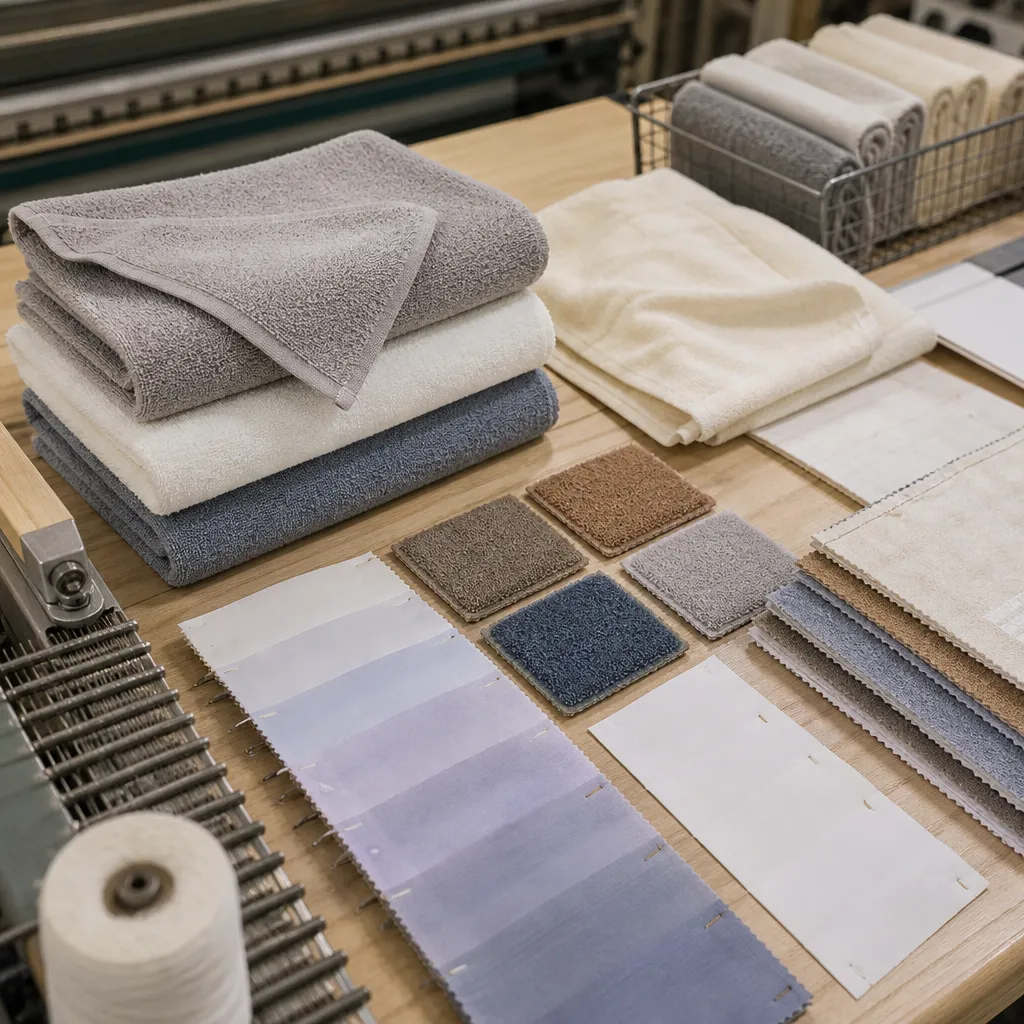
Where microfiber towels for body actually work
Body-use microfiber is useful when the buyer needs fast drying, low packed volume, and stable color at repeat wash cycles. We see it most often in gym shower towels, travel kits, beach pouches, swim teams, spa locker rooms, and promotional wellness sets. It is not a direct replacement for a 550 GSM cotton hotel bath towel. It solves a different problem: less weight in storage and laundry, quicker drying between uses, and lower freight cost per usable towel.
The construction we normally quote is 80/20 or 85/15 polyester-polyamide split microfiber, knitted or woven into a suede, waffle, or low-pile terry face. For skin contact, the split fiber process matters. If the filaments are not opened cleanly after dyeing and brushing, absorbency drops and the surface drags on wet skin. In our lab, we check capillary action with a vertical wicking strip and compare water drop absorption against AATCC 79 as a practical reference, even when the buyer does not request a formal third-party report.
For buyers coming from cotton, the first adjustment is GSM. A 300 GSM microfiber bath sheet does not feel like a 300 GSM cotton towel. Microfiber has a denser surface and lower weight for the same coverage area, so the better comparison is packed volume, drying time, and absorbency after 20-30 washes.
| Use case | Common size | Recommended GSM | Construction we usually suggest |
|---|---|---|---|
| Gym shower towel | 70 x 140 cm | 260-320 GSM | Suede or low-pile terry, overlocked edge |
| Travel bath towel | 80 x 160 cm | 220-280 GSM | Suede microfiber, compact pouch option |
| Swim or locker room towel | 75 x 150 cm | 300-360 GSM | Low-pile terry microfiber with bound edge |
| Spa body wrap towel | 90 x 170 cm | 280-340 GSM | Soft brushed face, snap or elastic optional |
| Beach quick-dry towel | 90 x 180 cm | 240-300 GSM | Printed suede microfiber with sand-release finish |
Choose the hand feel before choosing the print
For body towels, decoration should follow fabric selection. A towel that photographs well can still fail in use if the face feels too slick or if the printed side has low absorbency. Suede microfiber gives the sharpest sublimation print and packs very flat, but some buyers find it less towel-like than low-pile terry. Waffle microfiber has more texture and grip, but small artwork details soften because the surface is uneven.
- Suede microfiber: best for full-surface sublimation, travel towels, beach graphics, and compact towel kits. It dries quickly but needs a brushed finish for better skin feel.
- Low-pile microfiber terry: closer to a bath towel touch, stronger for gym shower programs, and less slippery when wet. Logo detail is less sharp than suede.
- Waffle microfiber: useful for spa, yoga, or travel because air channels help drying. Avoid very thin line art because the weave interrupts small details.
- Double-face construction: one printed suede side and one terry side can work for higher-end sets, but it raises sewing difficulty and unit weight.
A specific defect we watch on body towels is edge curl after tumble drying. Thin suede microfiber, especially below 230 GSM, can torque along the long side if the fabric was heat-set unevenly before cutting. We run a pre-production panel through wash and tumble cycles before approving bulk cutting. A 2 cm curl on a cleaning cloth may be acceptable; on a bath-size towel it looks cheap on the shelf and folds badly in retail packaging.
GSM, size, and finished weight math
Buyers often ask for the largest towel at the lowest GSM because the freight quote looks better. The risk is that the towel becomes clingy when wet and the edge seam feels heavier than the body fabric. For adult body use, we rarely recommend going below 240 GSM unless the product is clearly positioned as a compact travel towel.
A 76 x 152 cm towel at 280 GSM has a fabric weight of about 323 g before sewing, label, and packaging. After overlock thread, care label, hang loop, and a simple pouch, the packed unit normally lands around 345-365 g. That matters for carton planning: 100 pcs can be 36-39 kg gross depending on compression, which affects whether air freight makes sense for a launch order.
| Spec choice | Light travel program | Gym / swim program | Retail bath sheet program |
|---|---|---|---|
| Size range | 70 x 140 to 80 x 160 cm | 75 x 150 to 85 x 160 cm | 90 x 170 to 100 x 180 cm |
| GSM range | 220-270 GSM | 280-340 GSM | 320-380 GSM |
| Finished hand feel | Thin, compact, fast dry | Balanced absorbency and body feel | Fuller drape, higher perceived value |
| Typical packed thickness | 2.0-3.2 cm | 3.0-4.5 cm | 4.5-6.5 cm |
| Best packaging | Mesh pouch or paper band | Polybag, belly band, or pouch | Retail box, band, or drawstring bag |
For microfiber bath sheet programs, we ask buyers to confirm whether the towel will be used after a full shower, over a swimsuit, or as a mat-side sweat towel. These are different absorption loads. A compact travel towel can dry skin by spreading moisture through the fabric, but a locker room towel needs enough mass to hold water without feeling saturated after the first pass.
Absorbency is not only a fiber ratio issue
The usual microfiber blend is 80% polyester and 20% polyamide. More polyamide can improve softness and water uptake, so 85/15 is not automatically better for body towels. The fiber split, surface brushing, and softener choice after dyeing change the result more than the printed ratio in many low-cost offers.
- Confirm whether the yarn is split microfiber, not only fine-denier polyester marketed as microfiber.
- Ask for a water drop test video on the actual color or print base, because dark dye lots can absorb differently from white greige fabric.
- Wash the sample without fabric softener before judging absorbency. Silicone softeners can make a sample feel smooth but slow down wetting.
- Check both sides of the towel. Printed suede may dry skin differently from the reverse side, especially after sublimation heat pressing.
- Measure lint and surface shedding after three washes, because loose brushed fiber can cling to skin.
For routine OEM approval, we use internal checks plus buyer-selected third-party testing when needed. Common references include ISO 105-C06 for colorfastness to domestic laundering, ISO 105-X12 for rubbing, ISO 12945-2 for pilling behavior, and AATCC 135 for dimensional change after washing. For baby, spa, or sensitive-skin retail channels, OEKO-TEX Standard 100 Class I documentation is normally requested. Our mill maintains OEKO-TEX 100 Class I, BSCI, and ISO 9001 certification, but the buyer should still specify whether reports are needed for the exact production batch.
Decoration choices for body-use microfiber
Sublimation is the most common decoration because polyester accepts disperse dye well and the towel can carry edge-to-edge artwork. It works best on white or very light base fabric. If the buyer wants a navy towel with a white logo, sublimation is not the correct method; we would discuss woven jacquard, reactive printing on cotton, or a sewn patch depending on the end use.
- Sublimation print: strong for photo artwork, beach graphics, club patterns, and retail travel towels. Minimum line weight should be 0.35 mm on suede and wider on waffle.
- Embroidery: possible for corner logos, but dense stitches can pucker thin microfiber. We usually limit embroidery to 6,000-9,000 stitches on 260-320 GSM fabric.
- Heat-transfer label: useful for small brand marks, but the film must be soft and wash-tested so it does not crack after tumble drying.
- Jacquard microfiber: available for larger programs, but mold and yarn setup costs make it inefficient below several thousand pieces per design.
One construction quirk with sublimated quick dry body towels is print shade shift at the edge seam. If the towel is printed before cutting, the operator must align the cutting marker so the border does not disappear into the overlock. If the towel is cut first and then printed, white edge flash can appear after sewing. We solve this by adding 8-12 mm bleed on artwork and approving one full-size strike-off before bulk.
For artwork preparation, buyers can use the same discipline described in pantone color matching for custom towels and embroidery vs sublimation vs jacquard. The difference with microfiber is that sublimation color depends heavily on heat press temperature, fabric face, and pre-shrink setting, so a small hand sample is not enough for final approval on bath-size goods.
Price bands and what changes them
Our MOQ is 500 pcs per design per color for OEM microfiber body towels. At that level, the quote is still sensitive to artwork setup, fabric availability, and packaging. At 3,000 pcs and above, fabric knitting or weaving can be planned more efficiently, and carton packing can be optimized for sea freight.
| Order volume | Basic suede 70 x 140 cm | Gym terry 75 x 150 cm | Large printed 90 x 180 cm | Typical cost drivers |
|---|---|---|---|---|
| 500-999 pcs | USD 2.35-3.10 | USD 3.20-4.15 | USD 4.40-5.80 | Artwork setup, small dye lot, packaging labor |
| 1,000-2,999 pcs | USD 1.95-2.65 | USD 2.75-3.55 | USD 3.85-4.95 | Fabric yield, print coverage, edge sewing |
| 3,000-7,999 pcs | USD 1.62-2.20 | USD 2.38-3.05 | USD 3.35-4.35 | Greige booking, carton efficiency, label method |
| 8,000+ pcs | USD 1.38-1.92 | USD 2.08-2.72 | USD 2.95-3.90 | Continuous production, simplified packing, repeat artwork |
Cheap microfiber can look attractive in a spreadsheet, especially for event giveaways. We still push back when the fabric is too thin for body use. For example, a 200 GSM 75 x 150 cm towel may land around USD 1.48 at 5,000 pcs, while a 300 GSM low-pile version may be around USD 2.46. If the lighter towel survives 18 acceptable washes before edge distortion and the heavier one survives 55, the fabric cost per usable wash is about USD 0.082 versus USD 0.045. The lower unit price is not always the lower program cost.
Packaging can also move the quote more than buyers expect. A simple recyclable paper band may add USD 0.06-0.12. A mesh pouch with drawcord can add USD 0.18-0.36. A printed zipper pouch may add USD 0.42-0.75 depending on size and material. For DTC retail, better packaging may be justified; for gym replenishment, it is usually wasted money.
Sampling and production calendar
For a new body towel program, we separate fabric approval from decoration approval. That avoids the common mistake of approving a beautiful print on fabric that feels wrong after washing. Sampling time depends on whether we use stocked greige fabric or produce a custom GSM and texture.
| Stage | Normal timing | What buyer should approve | Risk if skipped |
|---|---|---|---|
| Spec confirmation | 1-3 days | Size, GSM, construction, packaging, compliance need | Quote changes after sampling |
| Lab dip or print strike-off | 5-9 days | Color, hand feel after heat setting, artwork scale | Bulk shade or print distortion |
| Full-size sample | 7-12 days | Edge sewing, label placement, folded size | Retail or locker-room fit problems |
| Bulk production | 22-35 days | Inline QC, packing method, carton marks | Late changes cause rework |
| Inspection and export documents | 3-6 days | AQL result, invoice, packing list, certificates | Shipment hold or customs delay |
Most repeat programs ship in 30-40 days after deposit and final artwork approval. First orders with custom fabric, third-party testing, or retail packaging are more realistic at 38-52 days. Air freight can save calendar time but often damages the cost logic of microfiber; for large bath sheet cartons, sea freight or rail plus local distribution is usually cleaner unless the launch date is fixed.
- For a gym chain opening date, lock towel size and GSM at least 45 days before required delivery.
- For resort or swim retail, approve the full-size sublimation sample before campaign photography.
- For Amazon or DTC bundles, confirm folded dimensions before box dieline approval.
- For spa locker rooms, test the towel with the actual laundry detergent and dryer setting used on site.
QC points we inspect before shipment
Body towels are handled differently from cleaning cloths in final inspection. We still check measurement tolerance, color, sewing, and stains, but we add skin-contact checks: rough seam points, sharp label corners, odor after drying, and loose fiber on the face. For bath-size microfiber, a small sewing defect becomes very visible because the towel is folded and unfolded in front of guests or retail customers.
Our standard measurement tolerance is usually +/-2 cm on length and width after finishing, unless the buyer specifies a tighter retail requirement. Weight tolerance is normally +/-5%. For inspection, we can work to ANSI/ASQ Z1.4 sampling with AQL levels agreed in the PO, commonly 2.5 for major defects and 4.0 for minor defects. ISO 9001 procedures guide our production records, but the acceptable quality limit should still be written into the tech pack.
- Check overlock density on long edges; loose thread can unzip after tumble drying.
- Rub dark prints with a white cotton cloth after washing to screen for transfer risk.
- Stretch the corner diagonally to see whether the binding twists or puckers.
- Smell the towel after sealed-bag storage for 24 hours; residual dye or softener odor is easier to catch before export.
- Compare carton gross weight against the packing list so freight billing does not surprise the buyer.
Related reads: buyers comparing microfiber against cotton should review microfiber vs cotton towel comparison and custom microfiber towels wholesale guide. For programs moving through clubs or fitness channels, sweat towels for gym spec guide is also useful.
What to put in the tech pack
A clear tech pack helps us quote quickly and prevents sample rounds that only discover missing information. For microfiber towels for body programs, we need more than length, width, and logo file. We need to know how the towel will be used, laundered, packed, and sold. A towel for a backpacking retailer and a towel for a spa changing room may share the same fabric family, but the pass-fail points are different.
- State the end use: shower, travel, swim, spa wrap, beach, or promotional wellness kit.
- Specify size in centimeters, GSM target, fabric face, and acceptable finished weight range.
- Provide artwork as AI, PDF, or high-resolution PSD with bleed and Pantone or LAB color references.
- List decoration method, label type, hang loop position, edge color, and packaging format.
- Confirm compliance needs: OEKO-TEX Standard 100 Class I, BSCI factory audit, ISO 9001 production records, or third-party wash testing.
- Set the delivery term, destination port, carton marking rule, and whether inspection is buyer-arranged or mill-arranged.
For a fuller template, see build a towel tech pack that mills can quote. If the program is near the lower order quantity, negotiate towel MOQ without killing margin explains why changing color count or packaging often helps more than pushing the factory for a symbolic discount.
LUMA & CO. TEXTILE has operated since 2007 with a 220-person team, about 2.4 million towels per year, and 80+ brand clients across 47 countries. For this category, our practical starting point is still simple: MOQ 500 pcs per design per color, quote the real fabric first, then build decoration and packaging around the use case.
Build a body microfiber spec that survives washing
Send size, GSM target, artwork, and expected use. We will reply with fabric options, USD price bands, sampling timing, and MOQ details. WhatsApp +86 13205717266 or email [email protected].
Request a quote →