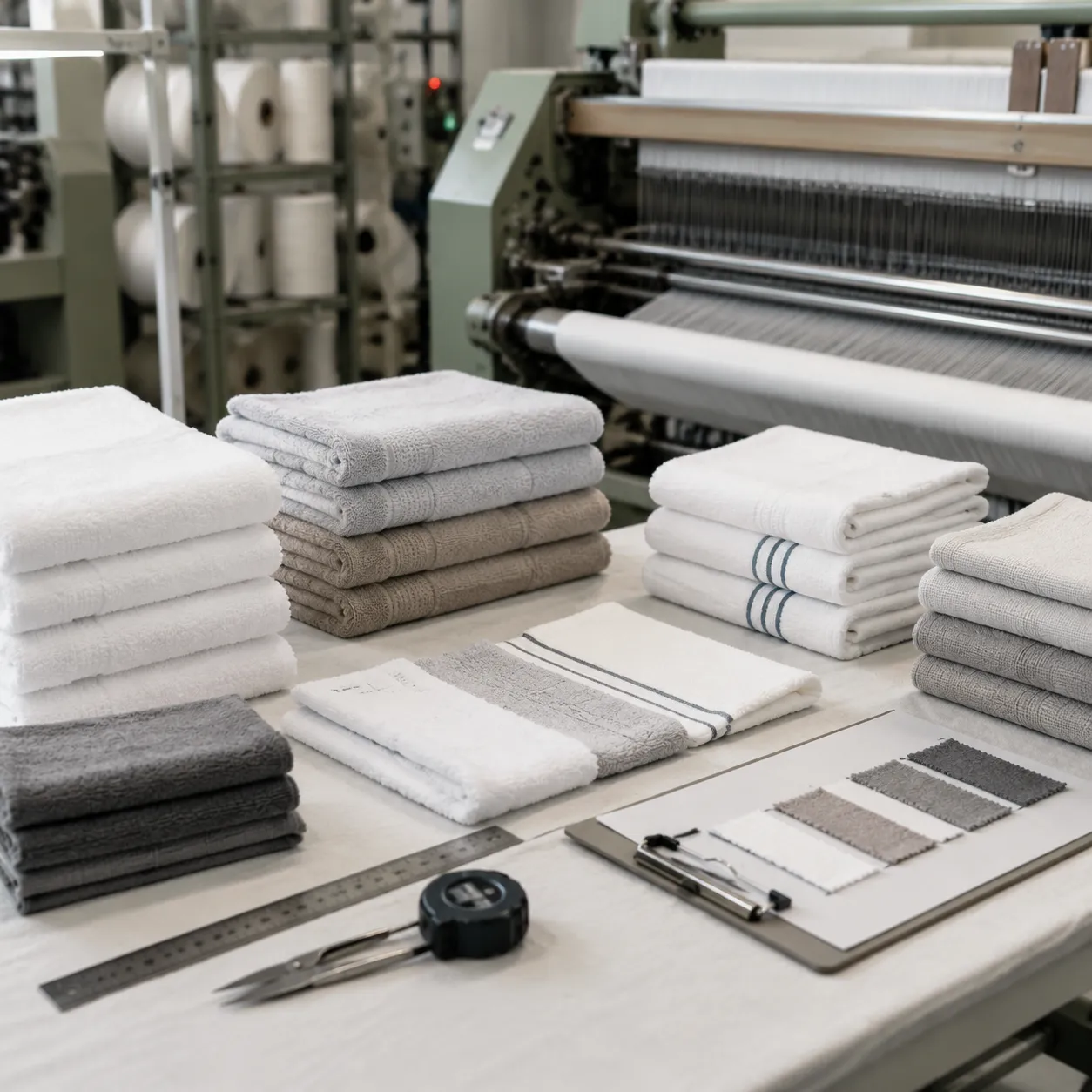
The first split is construction, because the defect pattern changes with it
Buyers often group all microfiber beach styles into one approval file. On the floor, that causes wrong acceptance calls. A 200-230 GSM suede-printed towel, a 250-300 GSM terry microfiber towel, and a cotton-backed printed towel do not fail in the same way. The inspection sheet should name the construction first, then assign test points and visual thresholds to that construction.
| Construction | Typical GSM | Main decoration | Frequent defect mode | Where we look first |
|---|---|---|---|---|
| Suede warp-knit microfiber | 200-230 | Full sublimation | Smile lines at fold, print haze, edge torque after wash | Face print, cut edge, corner squareness |
| Microfiber terry | 250-300 | Reactive solid or screen print panel | Uneven pile lay, shearing marks, lint pickup, heavy-to-light shade bands | Pile direction, side seam, panel join |
| Cotton-backed microfiber | 300-360 | Sublimated face with cotton loop back | Face/back lamination instability, differential shrinkage, curling edge | Bond stability, wash shrinkage, back-loop integrity |
| RPET microfiber suede | 190-220 | Full sublimation | Color migration sensitivity, lower bursting margin, needle heat shine | Dark solids, seam line, heat-set stability |
- If the base is warp knit suede, we pay extra attention to bowing, skew, and print registration drift because the smooth face makes small distortion visible.
- If the base is microfiber terry, we inspect under brushed and reverse pile direction; one viewing angle can hide streaking.
- If the style is cotton-backed, we require wash data before bulk release because face and back do not shrink at the same rate.
Set the sampling level before anyone opens cartons
For bulk inspection we prefer to agree the lot rule in the PO, not by email after production. For export towel orders in the 3,200 to 18,000 piece range, the cleanest setup is ANSI/ASQ Z1.4, General Inspection Level II, normal inspection, with AQL split by defect type. That is ordinary practice, but the useful part is how we adapt it for towel construction.
| Defect class | Recommended AQL | What belongs here | Why this threshold works |
|---|---|---|---|
| Critical | 0 | Wrong fiber content label, needle contamination, prohibited azo dyestuff failure, metal fragment, carton count mismatch tied to style code | No negotiation on safety or shipment identity |
| Major | 2.5 | Visible print ghosting in Zone A, size out of tolerance beyond agreed limit, open seam, obvious skew, severe shade difference within carton | These defects affect sell-through or first-use complaint rate |
| Minor | 4.0 | Loose thread tail under 15 mm, slight shade drift carton to carton, small face fluff outside logo field | These do not usually block use if kept controlled |
On one recent 6,400-piece beach club order, the sample size was 200 pieces under Level II. We pulled them across the beginning, middle, and end of packing, not from one finished pallet. That matters because microfiber print drift often tracks by print batch or heat-calendar window, not by random piece alone.
- Ask the factory to mark packing date, shift, and print batch on the outer carton record.
- Pull at least 30% of the sample from the final day of packing; rushed end-lot packing hides rework pieces.
- If the program mixes two sizes under one PO, inspect each size as a separate lot even if artwork is the same.
Use a simple zone map so logo arguments stop early
For beach towels with a full-face print, we divide the towel into usage zones during pre-production approval. Without a zone map, every print speck becomes a debate. With it, inspectors know which marks are shipment-stopping and which are acceptable outside the main viewing area.
| Zone | Location on towel | Visual priority | Typical acceptance rule |
|---|---|---|---|
| Zone A | Central artwork field, roughly 60% of visible face when towel is laid flat | Highest | No print void, no double image, no stain, no line defect over 8 mm |
| Zone B | Border band and side areas outside main motif | Medium | No repeated defect; isolated light speck only if under 3 mm and same color family |
| Zone C | Hem fold return, back face, care-label vicinity | Lower | Minor yarn tail or light back-face pressure mark acceptable if not visible at arm's length on face |
A workable example: on a 90 × 170 cm suede towel with a centered resort crest, we mark Zone A as the full crest plus 20 cm around it. A heat-press shadow on the back may pass in Zone C; the same shadow crossing the crest in Zone A is a major defect. We write that into the approval file with one marked photo, then train the line and the third-party inspector from the same image.
The wash protocol needs to match how microfiber beach towels are actually used
The editor was right to reject vague laundry advice. Microfiber for beach use sees sunscreen oil, salt, pool chemistry, sand abrasion, and low-temperature consumer washing. A realistic wash protocol should not copy a hotel cotton towel method line for line.
- Take 3 finished bulk pieces per colorway from sealed cartons, not salesman samples.
- Record pre-wash length, width, diagonal difference, and dry weight after 24 hours conditioning.
- Wash for 5 cycles at 40°C with neutral detergent, 4 g/L dosage, 30-minute main wash, no optical brightener.
- Dry at low tumble below 60°C exhaust or line dry, matching the care label you intend to print.
- After cycle 1 and cycle 5, reassess print clarity, edge torque, seam grin, size change, and handfeel drag.
- For sunscreen-risk programs, spot-apply common SPF lotion on one corner before cycle 5 to check for local shade change or hydrophobic patching.
For printed suede microfiber, we usually set these internal gates before bulk release: dimensional change within 3.0% in length and width, edge torque under 30 mm measured corner-to-corner deviation after laying flat, and no obvious face print fade when compared under D65 light to the sealed approval sample. For terry microfiber, we allow slightly more appearance variation in pile lay but tighter seam security because pile can hide openings until the first wash.
| Construction | After-wash shrinkage target | Appearance gate after 5 washes | Seam / edge gate |
|---|---|---|---|
| Suede warp-knit microfiber | Within 3.0% L/W | No visible print break at 1 meter under D65; no corner curl over 25 mm rise | No seam opening; edge wave controlled |
| Microfiber terry | Within 3.5% L/W | No pile crush lane wider than 10 mm through main face area | No skipped overlock, no exposed ground edge |
| Cotton-backed microfiber | Within 4.0% overall, but face/back differential tightly watched | No face bubbling or back shrink pull | No delamination look, no edge corkscrew twist |
What we check on the cutting table before final inspection starts
A lot of defects blamed on printing are actually set earlier. On microfiber beach towels, the cutting table tells us whether final inspection will be smooth or painful. We look at lay alignment, heat-knife cleanliness where used, and whether the nap direction stayed consistent on panelized goods.
- Diagonal pair measurement: if the two diagonals differ too much before hemming, the finished towel will skew after wash even when side seams look straight.
- Edge melt shine on synthetic-rich microfiber: too much cutter heat leaves a hard reflective edge that later feels sharp and can ripple inside overlock.
- Panel face direction: on terry microfiber with printed header panels, mismatched pile direction creates dark-light mismatch even in the same dye lot.
- Label placement spread: if care labels wander, retail folding becomes inconsistent and barcode placement can drift into the visible border.
The construction-specific quirk here is edge behavior. Warp-knit suede can look perfectly square on the table, then torque after wash if the relaxed fabric was forced during spreading. Terry microfiber has the opposite issue: it may look slightly uneven on table, yet wash out acceptably if the seam balance is good. That is why we record both dry-table dimensions and post-wash dimensions instead of relying on one checkpoint.
Common failure modes we actually see in printed microfiber beach towels
The highest complaint rates in this category are not dramatic defects. They are medium-visibility defects repeated across too many pieces. Repetition is what turns a tolerable issue into a rejected lot.
- Calendar shine bands: narrow glossy stripes caused by uneven heat-pressure during transfer. On dark navy or black artwork, these become visible at arm's length.
- Print ghosting: a faint double edge around lettering when transfer paper shifts slightly before full contact.
- Needle track grin: the seam line opens the printed face and exposes a paler line, common when stitch density is too low for a tightly tensioned hem.
- Edge corkscrew: one long side twists after wash because hem tension and fabric relaxation are not balanced.
- Sand-trap linting: on some brushed microfiber terry, loose cut fibers pick up debris and make the towel look used after one outing.
For these issues, we do not recommend broad statements like 'acceptable industry standard.' We put each one against a viewing rule: laid flat, face side up, at roughly 1 meter under daylight-equivalent lighting. If the defect is obvious there in Zone A, it is major. If it appears only when the fabric is stretched by hand or viewed from 20 cm, it usually drops to minor unless repeated.
The lab set that gives buyers evidence, not just opinions
A microfiber beach towels QC inspection guide should carry a short lab panel tied to the real risk of the style. For most export programs we recommend four baseline checks and one optional check depending on artwork and market.
| Test | Method reference | Why it matters here | Typical bulk gate |
|---|---|---|---|
| Colorfastness to washing | ISO 105-C06 | Checks print and ground stability after home laundering | Grade 4 or better on color change for key shades |
| Colorfastness to rubbing | ISO 105-X12 | Important for dark sublimation areas and folded retail packs | Dry 4 minimum; wet 3-4 minimum |
| Dimensional change after washing | ISO 5077 / ISO 6330 sequence | Confirms size retention and edge stability | Within agreed construction limit |
| Seam strength | ISO 13935-2 | Catches grin-line risk and hem failure | No seam failure below agreed load |
| Optional: colorfastness to seawater / chlorinated water | ISO 105-E02 / ISO 105-E03 | Useful for resort and pool-deck programs | No abnormal stain or obvious local shift |
We do not run the full panel on every reorder if the construction, printer, yarn source, and color family stay unchanged. But if the artwork moves into large dark solids, if RPET content changes, or if the sewing line changes hem setup, we recheck the panel because those shifts affect performance more than buyers expect.
A practical acceptance sheet by construction
One reason articles on this topic feel generic is they stop at 'inspect stitching, color, and size.' That does not help the person signing release. The release sheet should name measurable thresholds by construction.
- For suede warp-knit printed towels: size tolerance within ±2 cm on finished dimensions above 150 cm length; print registration drift no more than 2 mm on repeated border elements; no more than one isolated minor speck in Zone B; hem stitch balance even with no skipped section over 5 mm.
- For microfiber terry beach towels: finished GSM tolerance within about ±5% against sealed sample average; pile lay reasonably even with no shear lane crossing Zone A; overlock fully covering cut edge; no lint shed burst during first hand-shake test.
- For cotton-backed constructions: face print centered within ±1.5 cm; back loops intact with no bare ground strip; face and back shrinkage behavior visually compatible after five washes; no bubbling line along hem fold.
That last point matters. Cotton-backed styles can pass first inspection and still fail in the customer's first wash if the microfiber face and cotton loop back are not tension-balanced. We flag this risk at sample stage, not after vessel booking.
How we document a pre-shipment result so it is usable later
An inspection report should help the next reorder, not only release the current one. We keep the final record compact: lot size, sample size, defect summary by zone, dimensional averages, wash-test result, and 6-8 representative photos. More than that and teams stop reading it.
- Photograph one full laid-flat towel with the zone map overlay used in approval.
- Photograph any repeated defect with a ruler in frame and note carton numbers.
- Record actual measured averages for length, width, and weight from the sampled pieces.
- Attach the 5-wash comparison photo beside the sealed approval sample under the same light source.
- State the decision clearly: pass, pass with rework, or hold for 100% screening.
If the lot is borderline, the most useful corrective action is not a vague note to 'improve QC.' It is a containment step: for example, 100% flat-table screening of dark navy pieces from print batch B17, or re-hem on cartons packed during one shift where torque exceeded the agreed limit.
Related reads: if you are setting specs before inspection, start with build-towel-tech-pack-that-mills-can-quote and towel-gsm-decision-framework. If you are comparing material behavior, microfiber-vs-cotton-towel-comparison gives the broader trade-offs without mixing in decoration issues.
What to lock in before deposit so inspection is faster later
Most rejected towel inspections begin with an approval file that is too loose. Before deposit, we suggest locking seven items in one sheet: construction, finished size, GSM tolerance, edge finish, artwork scale, zone map, and wash protocol. That removes most of the arguments that show up at pre-shipment stage.
- State MOQ clearly: 500 pcs per design per color is our working minimum for custom production.
- For current China FOB planning on standard printed suede microfiber beach towels, small branded runs around 1,000-2,000 pcs typically need case-by-case quoting rather than a broad article price claim, because print coverage, packaging, and recycled content move the number materially.
- Allow 12-15 days for lab dips or print strike-off and sample sewing, then about 25-35 days for bulk after sample approval on straightforward orders; complex pack-outs or mixed constructions take longer.
- Require compliance paperwork up front: OEKO-TEX Standard 100 Class I, BSCI, and ISO 9001 records should match the supplying entity, not only the trading office name.
Related reads: for compliance review, how-to-read-oeko-tex-certificate is the one we send buyers most often. For shipment planning after QC release, container-vs-air-freight-towel-orders is the practical next step.
Need a microfiber beach towel QC sheet built around your spec?
Send the artwork, construction, target size, and market. We can mark the zone map, suggest wash gates, and quote against the approved build.
Request a quote →