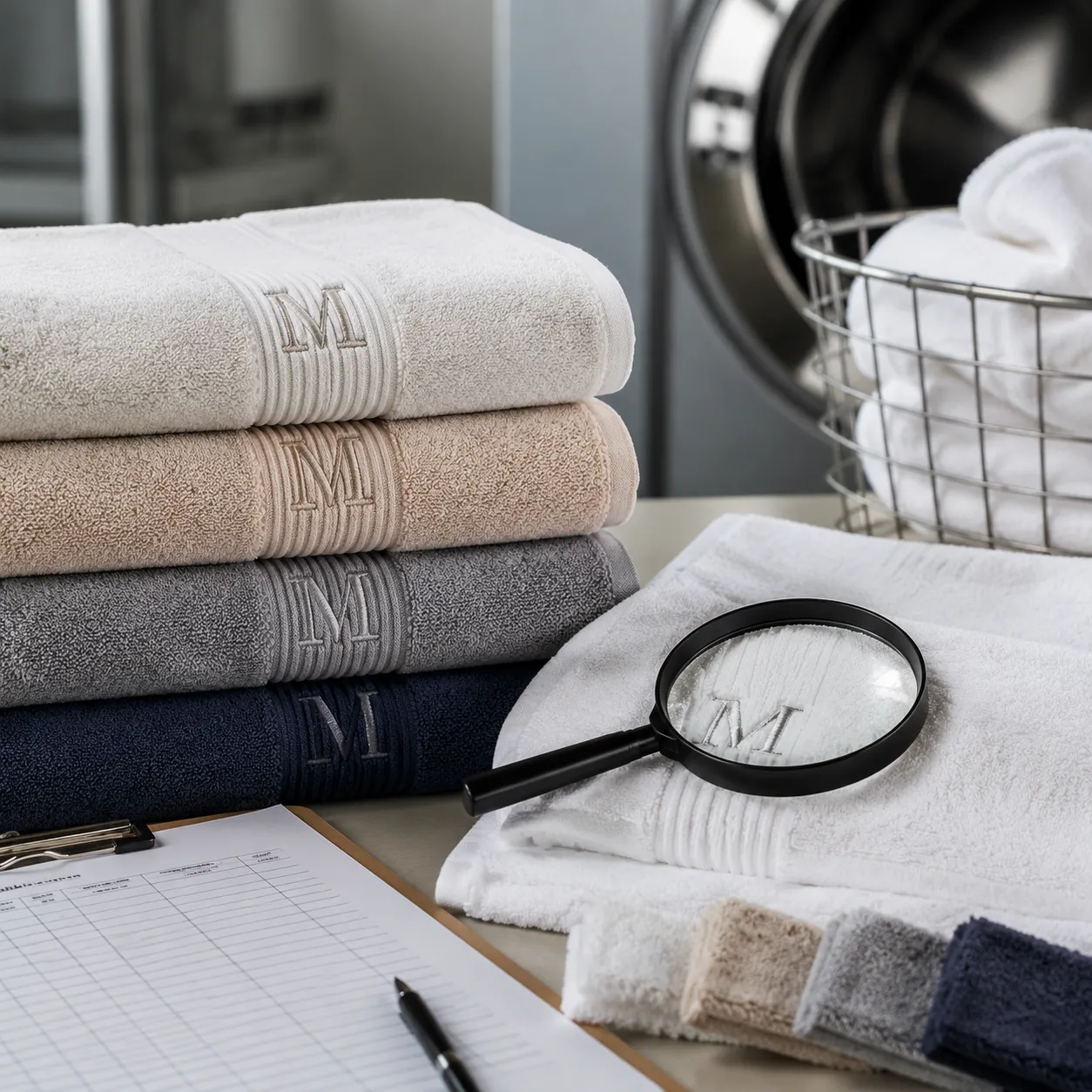
Start with the lot, not the handfeel
For luxury bath towels, the first mistake is approving by touch alone. A soft finish can hide low loop density, weak side hems, or a high softener add-on that washes away after the first few laundry cycles. We inspect the lot in the same sequence our QA team uses: confirm shipment identity, pull samples by carton position, check dimensions and mass, inspect pile formation under light, then send wash and colorfastness panels into the lab. The towel only counts as approved when all those steps agree with the signed spec.
| QC gate | What we verify | Typical acceptance point |
|---|---|---|
| Lot identity | PO number, color, size, carton count, barcode, country of origin mark | 100% document match before opening bulk |
| Visual construction | Pile coverage, shearing consistency, border symmetry, hems, loose ends | No critical defects; major/minor per AQL plan |
| Physical measurement | Size, weight, bow/skew, hem width | Within agreed tolerances after conditioning |
| Wash performance | Shrinkage, spirality, hand after wash, seam stability | Pass lab standard before release |
| Colorfastness | Washing, rubbing, perspiration if dyed dark | Grade agreed in tech pack, usually 4 min on key tests |
How we pull samples for a real inspection
We do not pick cartons from the front row and call it representative. On finished bath towel orders, we usually follow ANSI/ASQ Z1.4 single sampling, normal inspection, General Inspection Level II unless the buyer asks for a different plan. For a shipment of 12,000 pieces packed 24 per carton, that gives 500 cartons total. We draw cartons from the front, center, rear, top layer, and bottom layer of the palletized lot, because compression marks and shade drift often show differently across storage positions.
For the visual check, a practical working plan on that 12,000-piece lot is code letter L, sample size 200 pieces. At AQL 2.5 for major defects and 4.0 for minor defects, the acceptance and rejection numbers depend on the exact table revision you and the inspection company are using, so we record the table reference on the report rather than writing loose numbers from memory. What matters on the floor is discipline: random draw, sealed sample identity, and no carton substitution after defects are found.
- Condition measurement samples for at least 4 hours in a standard room close to 20 plus or minus 2 degrees C and 65 plus or minus 4 percent RH before size and mass checks.
- Open at least one inner stack from each selected carton, because top towels can look cleaner than middle-fold pieces.
- Keep wash-test retainers from the same carton numbers used in visual inspection so defect correlation is traceable.
- Photograph carton markings before opening; mixed production dates inside one PO are a common warning sign on outsourced overflow.
The defect map we use on best luxury bath towels QC inspection guide orders
Not every defect carries the same commercial risk. On luxury terry, we classify defects by whether the consumer sees them immediately, whether laundry will enlarge them, and whether they affect absorbency or pack presentation. A cut loop in the center panel is more serious than one buried near the tuck fold. A side hem with skipped stitches is worse than a slightly uneven pile lay because it opens further after commercial washing.
| Defect mode | How it shows up | How we score it |
|---|---|---|
| Bare ground / grin-through | Ground warp visible when pile is parted under angled light, often from low loop density or over-shearing | Major if obvious on face panel |
| High-low pile lane | Parallel streak from uneven pile height after shearing | Major when visible at 1 meter on light solids |
| Broken or pulled loop | Snagged loop standing above surface or missing loop spot | Minor if isolated at border, major in body panel |
| Skewed side hem | Body twists after folding flat; side seam tracks inward | Major if over agreed skew tolerance |
| Uneven border depth | Dobby or border panel differs left vs right | Minor to major depending on visibility |
| Oil mark / softener spot | Darker patch that resists wash-out or changes absorbency | Major |
| Needle damage at hem turn | Tiny puncture line that later tears at laundering | Major |
| Linting beyond norm | Excess loose fiber shed during shake or first wash | Major when tied to unstable yarn or weak shearing control |
Two defect modes are specific to this product class and get missed by general inspectors. First is shear shadow: the towel looks shade-banded even though dye is even, because the shearing cylinder took too much height from one lane. Second is border torque memory: the decorative border looks straight before wash, then pulls the body because the border construction and terry field recover differently. Both need flat-table inspection before and after wash; photos from hanging towels will not show them clearly.
Measurement conditions that actually matter
We measure luxury bath towels after conditioning, laid flat without stretching, on a hard table. Length is taken parallel to the selvedge from finished edge to finished edge. Width is taken at the midpoint and again 15 cm from each end if the towel looks bowed. On dense terry, a casual pull by the inspector can add 1.5 cm and hide under-spec cutting, so we train our team to smooth the body only once and then measure.
| Spec point | Typical luxury range | Practical tolerance we often see |
|---|---|---|
| Bath towel size | 70 x 140 cm to 80 x 160 cm | Usually plus or minus 2% after finishing, tighter if piece dyed after pre-shrink control |
| Face weight | 520 to 760 GSM | Bulk average within plus or minus 4%; no single piece below agreed floor |
| Hem width | 1.0 to 1.8 cm on side hem; 3.0 to 5.0 cm top and bottom hem | Plus or minus 0.2 cm on side hem |
| Bow / skew | Luxury solids should stay low for folded retail presentation | Often max 2.5% unless buyer sets tighter |
| Piece weight variance | Depends on size and GSM | Usually within plus or minus 5% piece to piece on the sample set |
If the program is sold into hotels, we also record folded stack height for a 10-piece set. It sounds minor, but over-bulky finishing creates warehouse and shelf-count errors. A 650 GSM towel with aggressive tumble loft can occupy nearly the same shelf cube as a cleaner 720 GSM construction if the loop is poorly set.
Wash testing: the conditions must be written down
A wash result without machine type, load ratio, detergent formula, and drying endpoint is not a result we can defend. For cotton bath towels, we usually run dimensional stability and appearance retention using a method aligned with AATCC 135 for home-laundering style evaluation, then add an internal institutional-laundry cycle when the buyer serves hotels or spas. White reactive-dyed or optical-brightened towels behave differently from vat-dyed dark shades, so the wash panel has to match the actual production colorway.
- Cut and seal three panels or use three full towels from the sampled lot, all traced to carton numbers.
- Record initial conditioned dimensions, piece weight, and visual notes on pile uniformity.
- Wash at 60 degrees C for hotel-use simulation or 40 degrees C for retail-home programs unless the care label states otherwise.
- Use a measured detergent dose and fixed load ratio; in our lab we do not mix towels with other fabric classes during approval testing.
- Tumble dry to consistent dry state, then recondition before final measurement and grading.
For shrinkage, we look at both average and spread. A lot averaging 4.2% length shrinkage may still be acceptable if the spec allows it, but if one towel moves 2.1% and another moves 6.0%, cutting and finishing control are unstable. On luxury bath towels, we also rub the washed face by hand and inspect for pile lean collapse. Some low-twist constructions feel rich before wash yet mat down badly after three cycles. That is a construction issue, not just a finishing issue.
If the supplier sends only one washed approval sample, ask whether it came from pilot production, bulk fabric, or a sales sample room. Those are not equivalent sources.
Colorfastness and whiteness checks for light and dark programs
Dark navy, charcoal, black, and saturated spa colors need a stricter review than white programs. We usually verify colorfastness to laundering with an AATCC 61 accelerated method for screening, then confirm against the buyer's required benchmark. Crocking is checked with AATCC 8, dry and wet. For white towels, the risk is different: not staining, but whiteness drift, yellowing after heat, and fluorescent whitening inconsistency from lot to lot.
- For dark shades, ask for wet crocking minimum grade 3-4 if the towel will contact skin when damp. Grade 2-3 is where complaints start.
- For white hotel programs, compare under D65 and TL84 light boxes. A towel can pass in daylight and still look greenish under corridor lighting.
- Run absorbency timing after finish cure if heavy silicone softener is used. We often use a simple drop test alongside formal lab work to catch hydrophobic finishing.
- Check color difference between body pile and border section separately; dobby borders can take dye differently because the structure is flatter and denser.
Seams, borders, and the places bulk failures usually start
Returns rarely begin in the center pile area. They begin at the hem turn, the corner miter, or the transition between the terry body and the woven border. During in-line QA we fold back the hem to look for raw edge capture, stitch balance, and needle heating marks. A glossy line along the hem on dark shades often means the needle ran hot enough to polish the yarn surface, which later weakens the seam.
On better bath towels, the corner must lie flat without dog-ear lift after washing. We inspect corner thickness because overstuffed miters crack in the tumbler. We also count stitches per inch or per 3 cm section, depending on the customer's standard. A side hem that looks neat at 8 stitches per inch may still be under-secured if the thread ticket and seam bite are too light for a 700 GSM body.
| Construction point | What we inspect | Typical risk if missed |
|---|---|---|
| Side hem bite | Needle penetration distance from edge, stitch density, thread tension | Hem opening after 10 to 20 commercial washes |
| Top/bottom hem turn | Raw edge fully enclosed, no tunneling, no seam grin | Edge fray and laundry tears |
| Border-to-body transition | Straightness, puckering, torque after wash | Twisted presentation and consumer complaints |
| Corner build | Miter bulk, stitch lock, flatness after wash | Corner blowout in tumble dry |
What goes into our QC report before we release a shipment
A useful report reads like a production record, not a brochure. We include carton count inspected, sampling table reference, exact defect photos with ruler or marker, conditioned measurements for each tested piece, wash recipe, machine model or lab method reference, and a clear pass/fail conclusion by category. If a lot is accepted with minor issues, the report states the concession and the corrective action for the next run.
- Front, back, border, hem, and close-up photos from the same sample ID.
- A defect tally sheet split into critical, major, and minor with actual counts.
- A measurement worksheet showing every sampled piece, not only averages.
- Lab pages for shrinkage and colorfastness attached as annexes.
- Carton packing verification: pieces per carton, net weight, gross weight, carton dimensions, and barcode readability.
We also log whether the order came from one loom group or multiple machine groups. If loom groups are mixed, stripiness and pile-height variation are more likely. That information helps explain borderline results and stops the same mixing problem on repeat orders.
Related reads: For the spec sheet that makes inspection easier, see build towel tech pack that mills can quote, towel GSM decision framework, and how to read OEKO-TEX certificate.
Price bands and lead times for luxury bath towel programs
Inspection requirements affect cost, but far less than rework and claims do. For a combed cotton bath towel in the 650 to 720 GSM range with dobby border, reactive dye, and export carton packing, FOB China pricing usually lands in the bands below. Zero-twist or low-twist constructions, double-shearing, and brand box packaging push the number up. A dedicated third-party pre-shipment inspection usually adds a few cents per piece when spread over a full lot, while an internal wash and colorfastness package adds more at sample stage than at bulk stage.
| Volume | Indicative FOB USD/pc | Typical production timing |
|---|---|---|
| 500 to 1,000 pcs per color | USD 4.85 to 6.40 | 30 to 38 days after approval |
| 1,200 to 3,000 pcs per color | USD 4.10 to 5.55 | 28 to 35 days |
| 5,000 to 12,000 pcs per color | USD 3.62 to 4.95 | 25 to 32 days |
| 20,000 pcs and above | USD 3.28 to 4.46 | 25 to 30 days with stable yarn booking |
Our MOQ remains 500 pieces per design per color, but that is a commercial minimum, not always the technical sweet spot. On luxury programs, small runs make shade continuity and carton efficiency harder. If a buyer tries to save USD 0.22 per piece by dropping GSM and simplifying hems, yet the towel loses shape after 18 hotel washes instead of lasting 42 washes, the cost per use goes up materially. On one recent hospitality model, a USD 3.54 towel used for 42 wash cycles came to roughly USD 0.084 per use, while a cheaper USD 3.09 towel retired after 19 cycles landed near USD 0.163 per use before freight and handling.
Related reads: For broader hospitality sourcing context, see hotel towel sourcing guide 2026, hotel towels wholesale supplier guide, and setting up hotel linen program 90-day roadmap.
The approval checklist we ask buyers to sign
Before bulk release, we want one signed page that prevents most arguments later. It should confirm approved size after wash, GSM tolerance basis, color standard, seam construction, packing method, and which lab methods govern disputes. Without that page, the factory, inspector, and buyer can all be looking at the same towel and applying different standards.
- Approve one sealed bulk standard towel tagged with date and PO.
- Lock the wash method and acceptance limits in writing.
- State the inspection plan: standard, level, and AQL.
- Confirm carton pack, inner poly requirement, barcode format, and shipping marks.
- Name the decision maker for concessions so approval does not stall on ship week.
If you are building a new bath program or trying to clean up claim rates from an existing supplier, send us the current spec, wash standard, and target price band. We can usually point out within one review whether the problem sits in yarn selection, loop geometry, shearing, or seam build. Contact us at [email protected] or WhatsApp +86 13205717266.
Need a QC-backed bath towel quote?
Send the target size, GSM, colorways, wash benchmark, and carton pack. We will quote against the actual inspection standard, not a generic towel brief.
Request a quote →