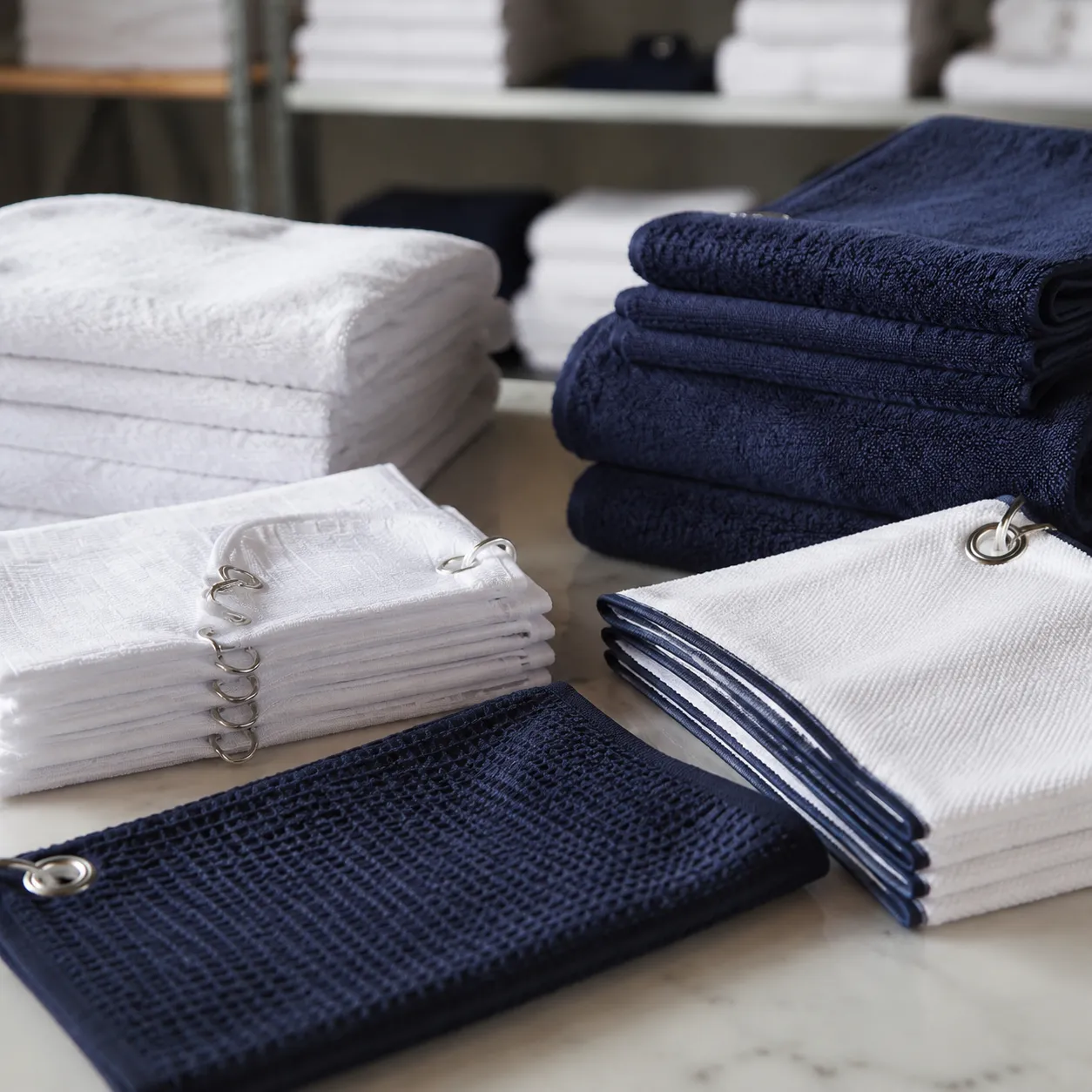
Start with the use case, not the crest
Most failed programs begin with artwork approval happening before towel construction is locked. That sequence creates avoidable problems because a monogram that looks clean on a 520 GSM dobby border towel may distort on a 720 GSM zero-twist bath sheet. For this reason, our first discussion is usually operational: guest room bath, spa suite, retail gift set, or branded residence inventory. Each one changes stitch density tolerance, acceptable hand feel, and rewash target.
For a hospitality buyer using the same SKU in daily laundry, we usually steer toward ring-spun or combed cotton terry with a stable border band for embroidery placement. If the brief is retail-first with softer loft and lower weekly wash counts, a higher-pile body can work, but the logo zone still needs a flatter ground. The fastest way to overspend is embroidering an unsuitable base towel and then paying for replacements after snagging, puckering, or guest complaints.
| End use | Recommended base | Best logo zone | Wash-life target |
|---|---|---|---|
| Upper-midscale hotel room | 16s ring-spun cotton, 550-620 GSM | Dobby border or hem panel | 70-100 industrial washes |
| Luxury hotel room | Combed cotton terry, 600-680 GSM | Woven border band | 60-90 industrial washes |
| Spa suite | Combed cotton, low-lint finish, 500-580 GSM | Bottom border, away from face zone | 50-80 washes with bleach control |
| Retail gift / residence | Softer loft terry, 620-760 GSM | Border or corner | 30-60 home washes |
Where monogram bath towels 2026 buyer guide projects usually go wrong
The common assumption is that embroidery is a decoration question. In production, it is a fabric-behavior question. Dense satin stitches compress pile unevenly. Needle penetration can break loops and expose the base, especially on plush constructions with weaker loop anchoring. If placement sits too close to the side hem, shrinkage during finishing can pull the towel off square and make the monogram look tilted even when the embroidery file was correct.
- A crest placed on open terry instead of a border band often shows pile show-through, where loops push into the lettering edges after wash.
- Heavy backing under a soft towel can create a boardy patch guests feel immediately when drying hands or face.
- Metallic thread on white hospitality towels often fails earlier because chlorine chemistry and tunnel dryers harden the thread surface.
- Very small serif letters under 5 mm cap height may fill in after laundering, especially on scripts with tight counters.
Two article-specific details matter here. First, we watch for tunneling around high-density fill areas after the wash simulation because the stitched zone shrinks differently from the terry field. Second, on some dobby-border constructions, the embroidery frame pressure can flatten the band so hard that the weave recovers unevenly; that leaves a visible hoop mark even after steaming. Both issues are preventable if the buyer asks for a pre-production washed sample, not only an unwashed strike-off.
Choose the decoration zone before you approve the towel body
For bath towels, the cleanest monogram area is usually the lower border, not the center field. Center-field embroidery adds visual impact on a hanger, but in real use it stiffens the most active drying area and increases abrasion on the stitched edge. Border placement also improves repeatability during sewing because operators can register from the woven band rather than from variable terry loft.
| Placement option | Visual effect | Production risk | Our usual advice |
|---|---|---|---|
| Lower dobby border | Formal hotel look | Low if band width is stable | Best for repeat programs |
| Corner above hem | Retail / residence friendly | Low to moderate | Good for initials and short names |
| Center lower body | Large branding effect | Moderate to high | Use only on tighter terry constructions |
| Full crest across border | Heritage / club styling | Moderate | Check stitch count and backing carefully |
- Lock towel dimensions and border width first.
- Confirm finished shrinkage tolerance after wash, not loom-state dimensions.
- Set logo size with actual sewn sample photos next to a ruler.
- Approve thread color under D65 lightbox or agreed lighting standard.
- Run one wash trial before PP sample signoff.
Thread, backing, and needle choices are what buyers rarely ask about
If you only ask the supplier for "embroidery included," you will get wide variation in results. We normally specify trilobal polyester embroidery thread for hospitality because it holds color better than rayon in repeated wet processing. Rayon can look richer on first presentation, but in bleach-managed or high-alkali laundry environments it loses appearance sooner. Thread ticket size, stitch density, and underlay type all affect how hard the logo feels on the towel.
Backing is equally important. Tear-away backing is fast, but on bath towels it can leave unstable edges around dense monograms. Cut-away or wash-away combinations are cleaner for complex crests, though they add labor and a small cost increase. Needle selection matters too. A ballpoint choice can preserve loops better on softer terry, while a sharper point may be required on tightly woven border panels. The right answer depends on the exact border construction, not a generic decoration rule.
| Component | Typical options | Where it works | Risk if chosen badly |
|---|---|---|---|
| Embroidery thread | Polyester 120D/2, rayon 120D/2 | Poly for hotel laundry, rayon for lower-wash retail sets | Fading, stiff hand, filament breakage |
| Backing | Tear-away, cut-away, wash-away combo | Cut-away for dense crests, combo for premium face | Puckering, rough reverse face |
| Needle | 75/11, 80/12, ballpoint variant | Depends on border weave and pile stability | Loop breakage, skipped stitches |
| Underlay | Edge run, zigzag, tatami support | Helps stabilize initials and filled crests | Logo sinks into pile or edges ripple |
What a proper wash-durability check should include
A standard certificate on the towel body does not prove the decorated area will survive hotel use. We ask buyers to separate fabric compliance from decoration durability. OEKO-TEX STANDARD 100 Class I covers harmful substance limits on the materials used, which is important for bath textiles touching skin, but it does not tell you whether the monogram edge will fray after repeated tunnel finishing. BSCI and ISO 9001 matter at factory-system level, yet neither replaces a wash protocol on the decorated article.
For hospitality programs, we usually run or recommend a combined review using ISO 6330 domestic washing as a controlled baseline sample test, then a customer-specific commercial laundry simulation if the chain has one. For color transfer and thread stability, ISO 105-C06 is a useful reference for colorfastness to laundering. For dimensional change on the towel body after washing and drying, ISO 5077 is relevant. In practical pass/fail terms, buyers often accept body shrinkage within 3% to 5% depending on size, but embroidery skew, border waviness, and edge abrasion need their own visual standard agreed in advance.
- Ask for before/after photos of the monogram from the same angle after wash 5, wash 20, and wash 50 if this is a hotel program.
- Require measurement of logo width and height drift after washing. A crest that narrows visibly may be over-tensioned.
- Check the reverse side for backing residue and scratchiness after laundering.
- Inspect for thread haloing on dark embroidery colors sewn onto white borders.
Related reads: if your team is still locking the towel body, start with build-towel-tech-pack-that-mills-can-quote and towel-gsm-decision-framework. If compliance review is part of vendor onboarding, how-to-read-oeko-tex-certificate is the right companion piece.
Price moves more with stitch count than with logo width
Buyers often compare two logos by physical size and assume cost should be similar. In embroidery, stitch count drives machine time. A 90 mm monogram with open satin letters may run cheaper than a 70 mm heraldic crest with dense fill, outline, and scrollwork. On bath towels, cost also changes with placement difficulty, stabilizer choice, re-hooping rate, and whether the reverse side needs cleanup for guest-facing use.
| Program example | Order qty | Spec snapshot | Indicative FOB China |
|---|---|---|---|
| Hotel initials on 600 GSM white bath towel | 1,000 pcs | 70x140 cm, 2-color initials on dobby band | USD 4.45-5.35/pc |
| Boutique crest on combed cotton bath towel | 3,000 pcs | 76x152 cm, 5-color crest, cut-away backing | USD 5.60-6.95/pc |
| Residence gift towel set, monogrammed | 2,000 sets | Bath + hand towel, gift band pack | USD 8.90-11.80/set |
| Spa white towel with tonal initials | 5,000 pcs | 70x140 cm, low-contrast single-color logo | USD 4.10-4.85/pc |
Those bands assume our MOQ of 500 pcs per design per color, standard export carton packing, and ordinary poly thread. If the buyer wants metallic detail, individual gift boxes, lower-yield cream shades, or mixed-size assortment packing, the FOB moves up. For a practical quote, we need towel size, GSM, yarn type, logo dimensions in millimeters, estimated stitch count or embroidery file, placement from hem, and target carton pack.
Lead time is usually lost in approvals, not embroidery itself
Embroidery sewing is not the slowest step. Waiting for artwork cleanup, lab dip confirmation, and post-wash sample approval usually causes the delay. If the body towel is already a running construction in the right shade, we can move quickly. If the buyer is developing a new border width specifically to fit a crest, sampling lengthens because weaving and finishing need to be aligned before decoration begins.
| Stage | Typical days | What must be approved |
|---|---|---|
| Artwork digitizing and layout | 2-4 days | Logo size, stitch route, placement drawing |
| Base towel sample / shade confirmation | 5-10 days | Color, border width, hand feel |
| Embroidered development sample | 4-7 days | Thread color, backing, visual finish |
| Washed PP sample | 5-8 days | Shrinkage, puckering, handle after wash |
| Bulk production | 22-35 days | Final PP signed, PO deposit received |
| Sea freight planning window | 14-35 days by lane | Carton marks, booking, destination rules |
For urgent launches, we sometimes reduce calendar time by using an existing greige or stock-dyed towel body and only developing the logo. That works for straightforward initials. It does not work well for crest-heavy programs where border geometry must match the artwork. If your team is balancing launch date against shipping mode, compare container-vs-air-freight-towel-orders before locking the PO.
What to put in the RFQ so mills can quote correctly
A usable RFQ for decorated bath towels is much more specific than "white 100% cotton with monogram." We can quote faster and with less revision when the brief defines both the towel and the logo behavior expected after washing.
- Finished size and tolerance, for example 70x140 cm ±3%
- Target GSM range, such as 580-620 GSM after finishing
- Cotton type and yarn preference, such as carded ring-spun or combed
- Border construction width in centimeters and whether embroidery sits fully inside it
- Logo artwork in vector plus target width/height in millimeters
- Thread colors by Pantone reference when applicable
- Required tests: ISO 105-C06, dimensional change check, buyer wash simulation
- Packout details: inner poly, sticker, barcode, carton quantity, carton gross weight limit
Related reads: buyers building a sourcing file usually pair this with pantone-color-matching-custom-towels and negotiate-towel-moq-without-killing-margin. If you are also comparing decoration routes, embroidery-vs-sublimation-vs-jacquard helps clarify where embroidery is worth the added cost.
Our practical recommendation for 2026 programs
For most hotel and branded residence orders, we would rather see a slightly simpler monogram on a more stable towel than an ornate crest on a lofty body that cannot support it. The best-performing runs in the last 12 months shared four traits: a defined border zone, polyester embroidery thread, a washed approval sample, and a written tolerance for post-wash appearance around the stitched area. That combination reduces disputes later because buyer and mill are signing off the same real-world condition.
If you are sourcing monogram bath towels 2026 buyer guide style for a live project, the fastest route is to send the tech pack, crest file, quantity split, and target wash-life so we can tell you early whether the towel body and logo are compatible. We manufacture in Gaoyang with MOQ 500 pcs per design per color, OEKO-TEX STANDARD 100 Class I materials available, BSCI-audited production, and ISO 9001 process control. Contact us at [email protected] or WhatsApp +86 13205717266 for a quote tied to your exact stitch count and towel construction.
Request a monogram towel quote
Send your logo file, towel specs, quantity, and wash target. We will quote the workable construction, decoration method, and lead time.
Get a Quote →