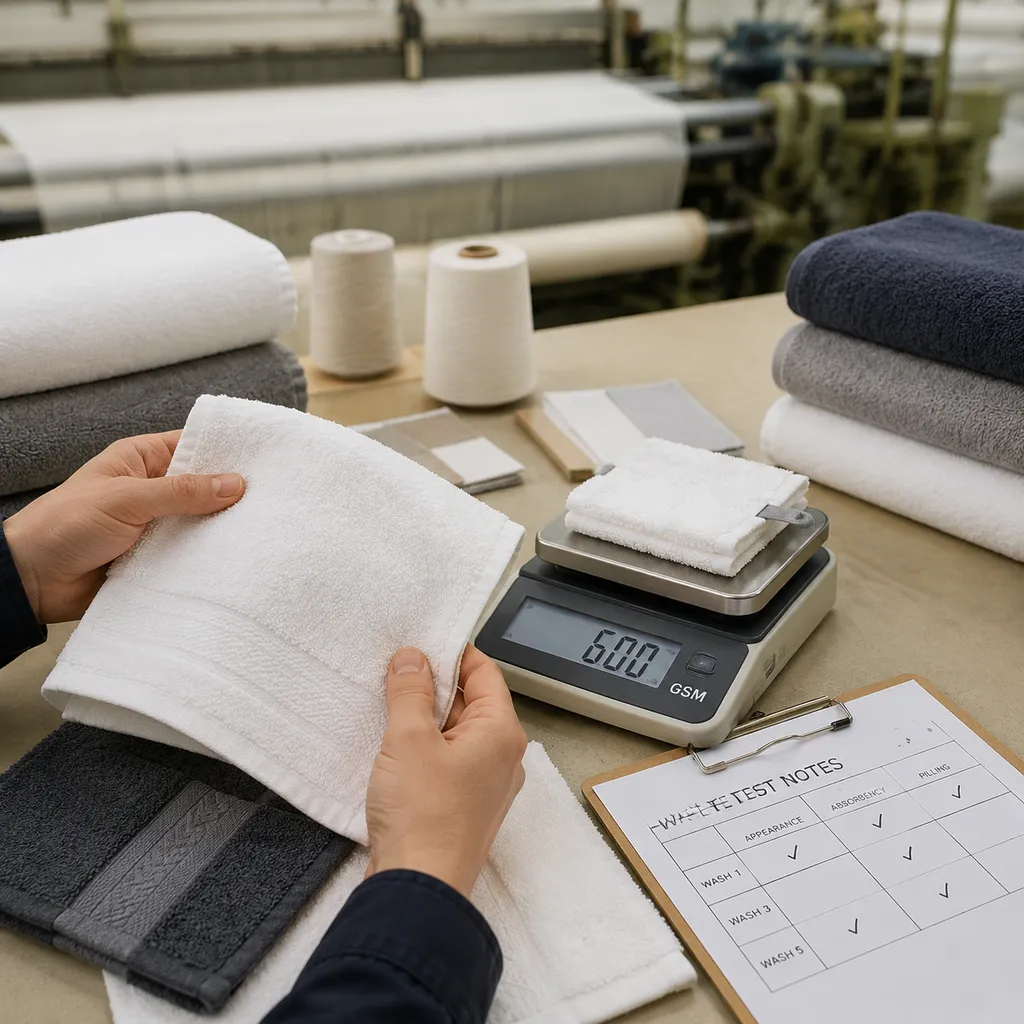
Why Sample Approval Fails Before Bulk Starts
Hotel bath towels are not difficult to manufacture, but they are easy to misapprove. A buyer may like the hand feel of a counter sample, the procurement team may approve the price, and housekeeping may only see the towel after the bulk shipment lands. By then, the factory has woven, dyed, hemmed, packed, and shipped thousands of pieces against a sample that nobody measured properly.
Inside our mill, we treat sampling as a control stage, not a sales stage. The approved sample becomes the production reference for yarn count, GSM, pile height, border construction, shrinkage allowance, carton packout, and logo placement if embroidery or woven branding is included. For hotel programs, we normally work in the 500-750 GSM range for bath towels, 400-550 GSM for hand towels, and 350-500 GSM for washcloths. If those numbers are not locked at sample signoff, bulk consistency becomes guesswork.
The first mistake is approving softness alone. A freshly finished towel can feel fuller because of softener and tumble drying, but after 15-25 industrial wash cycles the construction matters more than the first touch. We ask hotel buyers to approve the towel after controlled laundering, not only from the courier pouch.
| Approval item | What we record | Why it matters in bulk |
|---|---|---|
| Weight and GSM | Piece weight, calculated GSM, tolerance | Controls absorbency, freight weight, laundry cost |
| Size after wash | Length, width, shrinkage percentage | Prevents towels becoming too small for room standard |
| Pile and ground yarn | Yarn count, ring/combed/zero-twist selection | Locks hand feel and lint behavior |
| Border and hem | Border height, hem width, stitch density | Reduces edge waving and seam opening |
| Color and shade | Lab dip number or optical white standard | Prevents shade drift between replenishment lots |
Hotel Bath Towel Sample Approval Workflow
A workable hotel bath towel sample approval workflow has four gates: specification confirmation, development sample, wash-tested sample, and pre-production sample. We do not recommend jumping directly from a showroom sample to bulk purchase order unless the hotel is reordering an unchanged towel from the same mill and the same yarn program.
- Confirm the written spec: size, GSM, yarn, color, border, decoration, packaging, and certification requirement.
- Make a development sample or send a matched existing sample if the fabric construction already exists in our line.
- Run bulk towel sample testing for absorbency, shrinkage, colorfastness, lint, and seam strength.
- Revise the spec if housekeeping feedback shows the towel is too heavy, too slow to dry, or too thin after wash.
- Approve a pre-production towel sample from actual yarn, dye lot, border setup, label, and packing method.
- Keep one signed sample at the hotel side and one sealed reference sample in our QC room.
For a new white hotel bath towel without logo, the workflow can finish in 12-18 days after spec confirmation. For dyed colors, jacquard borders, or embroidery, allow 18-28 days. If the hotel requires OEKO-TEX 100 Class I documentation, BSCI audit files, ISO 9001 process records, or a third-party lab report, add 4-8 days depending on the test queue.
Our MOQ remains 500 pcs per design per color. For sample approval, we usually produce 2-6 pcs at development stage and 6-12 pcs for pre-production if the hotel wants housekeeping, laundry, and procurement to each keep a sample. A lower sample count saves little money and often slows decisions because the towel has to travel between departments.
Gate 1: Lock the Spec Before We Touch Yarn
The written spec is the cheapest place to fix a towel. If a buyer only says, "five-star bath towel, 70 by 140 cm, white," the mill still has to make decisions: 16s or 21s yarn, single or double ply ground, combed cotton or open-end cotton, dobby border or plain border, softener level, shrinkage target, and bale pack density. Each decision affects both price and laundry life.
For hotel bath towels, our common construction range is 30/2 or 21/2 ground yarn with 16s, 21s, or 32s pile yarn depending on GSM and hand feel target. Zero-twist cotton gives a loftier first touch, but it can lint more during the first 5-8 washes if the laundering process is aggressive. Combed ring-spun cotton is more stable for properties that outsource laundry to high-temperature tunnels.
- Room category: economy, upper-midscale, resort, spa suite, or executive floor.
- Laundry method: in-house washer-extractor, tunnel washer, outsourced commercial laundry, or mixed system.
- Target dry time: important for humid resorts and properties with limited towel inventory.
- Replacement cycle: 6 months, 9 months, 12 months, or usage-based linen rotation.
- Brand standard: plain white, color-coded floor program, woven border, embroidery, or private label packaging.
A proper hotel linen sample checklist should also include carton size and pack count. A towel that looks good in a showroom can become expensive if the carton cube is too large or the hotel receiving dock requires smaller handling units. For bath towels, we usually pack 20-40 pcs per export carton depending on GSM, compressed volume, and whether each towel is individually polybagged.
| Hotel use case | Typical bath towel spec | Factory comment |
|---|---|---|
| Limited-service hotel | 65×130 cm, 500-560 GSM, combed cotton | Balanced drying time and cost per occupied room |
| Urban four-star | 70×140 cm, 580-650 GSM, ring-spun cotton | Better hand feel without excessive laundry weight |
| Resort or spa room | 76×152 cm, 650-750 GSM, combed or zero-twist blend | Needs wash testing because drying time rises quickly |
| Executive floor | 70×140 cm or 75×150 cm, 620-700 GSM, embroidery optional | Logo position must avoid guest skin contact and border distortion |
Gate 2: Development Sample and Lab Dip
The development sample answers one question: are we close enough to the desired towel to invest in wash testing and pre-production setup? At this stage we may use available yarn and a near-matched border if the final construction is not yet on loom. We mark it clearly as a development sample so nobody mistakes it for bulk approval.
For white towels, the approval point is often whiteness and optical brightener level. Some hotels want a blue-white finish that looks crisp under bathroom LED lighting; others avoid heavy optical brightener because it can shift under warm spa lighting. For dyed hotel towels, we prepare lab dips against Pantone TCX, a physical swatch, or the hotel brand standard. A phone screen is not an acceptable shade standard.
We evaluate lab dips using a light box under D65 daylight and TL84 store light when requested. For colorfastness, hotel towels usually need ISO 105-C06 wash resistance and ISO 105-X12 rubbing performance. Dark spa colors and charcoal pool towels need more caution because loose surface dye can transfer during the first laundry cycles if rinsing is rushed.
- Approve color using a physical swatch or numbered lab dip, not a JPEG.
- Record the border width before washing because dobby borders can tighten differently than terry fields.
- Check hand feel after the towel rests for 24 hours; warm tumble finishing can temporarily inflate loft.
- Photograph the sample with a scale ruler and weight ticket beside it.
- Reject development samples that meet touch requirements but miss GSM by more than agreed tolerance.
Gate 3: Wash Test, Shrinkage, and GSM Verification
This is the stage where attractive samples either become hotel-ready or get redesigned. We condition samples for at least 24 hours in a standard textile environment before measurement, using ISO 139 principles where practical: 20°C and 65% relative humidity. Towels are hygroscopic, so a damp warehouse can change weight readings enough to create false confidence.
For bath towel gsm verification, we weigh each piece and calculate GSM from the measured size. Example: if a 68.8×137.6 cm sample weighs 590 g after conditioning, the calculated GSM is about 623. This is then compared with the contracted tolerance, often ±5% for hotel bulk. We also record post-wash size, because a towel can hit the weight target but shrink too aggressively.
Our internal hotel sample wash screen normally uses ISO 6330-style domestic cycles for early comparison, then we adjust if the buyer provides commercial laundry conditions. For hotel programs that will be washed at 70-85°C with alkaline detergent, we ask for at least 5 cycles before final hand-feel review. If the towel is for a resort with heavy sunscreen exposure, we may add a stain and rewash check because sunscreen residue can hold oil in high-pile towels.
| Test point | Typical approval range | Failure mode we watch |
|---|---|---|
| Dimensional change after 5 washes | Length -3% to -7%, width -2% to -6% | Towel becomes undersized for hotel standard |
| GSM tolerance | Within ±5% of signed spec | Bulk feels thinner or carton weight increases |
| Colorfastness to washing | ISO 105-C06 grade 4 or better for most hotel shades | Gray cast on white laundry or shade bleeding |
| Seam integrity | No open hem, skipped stitch, or thread unraveling | Edge failure after tunnel washing |
| Lint observation | Controlled lint after first 3-5 cycles | Guest complaints and laundry filter loading |
A small but important construction quirk: dobby borders can shrink less than the terry field, which creates rippling near the border after washing. If the border yarn tension is not balanced during weaving, the towel may pass visual inspection before wash but show a wavy header after the third cycle. This is one reason we never approve border-heavy hotel towels from an unwashed sample.
Gate 4: Pre-Production Sample Signoff
The pre-production towel sample is made from the intended bulk route: actual yarn type, approved dye recipe or whiteness finish, real border setup, final label, final embroidery file if used, and the correct folding and packing method. This is the sample that our QC team and the buyer should sign. It should not be replaced by a nicer showroom towel during negotiations.
If embroidery is included, we check stitch count, backing residue, thread color, placement from towel edge, and post-wash puckering. A dense logo placed too close to the dobby border can pull the terry field and cause a visible rectangle after laundering. For most hotel bath towels, we keep embroidery away from the main skin-contact area and use Madeira or equivalent polyester embroidery thread for chlorine and peroxide laundry resistance.
- Signed physical sample: one kept by buyer, one sealed at our factory QC desk.
- Measurement sheet: size, weight, GSM, shrinkage, pile direction, border width, hem width.
- Wash record: cycle count, water temperature, detergent type if supplied, drying method.
- Color reference: lab dip code, whiteness target, or approved physical shade card.
- Packing approval: carton quantity, inner polybag rule, barcode, shipping mark, and pallet preference.
For repeat hotel orders, we compare the new pre-production sample against the last signed reference sample and the current specification sheet. Cotton lot variation is normal, but hand feel, shade, and weight should stay inside the agreed tolerance. If the buyer changes laundry supplier, we recommend a small rewash approval even when the towel construction is unchanged.
Pricing and MOQ During Sampling
Sample approval has a cost, but poor approval costs more. A 620 GSM bath towel that dries 18 minutes slower per load can force a hotel laundry to run longer shifts, and a towel that loses 9% length after repeated washing may need early replacement. We prefer to settle this before bulk fabric is woven.
For hotel bath towels, FOB China pricing depends mainly on size, GSM, cotton grade, decoration, packing, and order quantity. The ranges below are realistic for OEM hotel programs from our Gaoyang production base, but final pricing depends on yarn market and exchange rate at quotation date.
| Order volume | Typical FOB range per bath towel | Notes |
|---|---|---|
| 500-999 pcs | USD 3.10-5.40 | MOQ level; limited color split flexibility |
| 1,000-2,999 pcs | USD 2.75-4.85 | Better dyeing and packing efficiency |
| 3,000-7,999 pcs | USD 2.45-4.35 | Suitable for multi-property hotel rollout |
| 8,000+ pcs | USD 2.18-3.95 | Best for annual contract or chain replenishment |
Sample fees are usually waived or credited for confirmed bulk orders when the spec is straightforward. For custom dyed shades, jacquard borders, private label packaging, or embroidery sampling, expect USD 45-180 depending on setup. Air courier for samples commonly adds USD 35-95 depending on destination and sample weight.
Cheap sampling can be misleading. For example, removing wash testing from a 1,200-piece hotel order may save roughly USD 70 in lab and handling time, but if the final towel is 35 g heavier than expected, the shipment adds about 42 kg of product weight before carton packaging. That can affect air freight decisions, laundry load planning, and shelf inventory counts. A measured sample is not bureaucracy; it is cost control.
Timeline: From RFQ to Signed Sample
Sampling speed depends on how complete the buyer's information is. A full tech pack with target GSM, size, yarn preference, Pantone or whiteness reference, laundry conditions, and packing requirement can move quickly. A vague brief needs more back-and-forth and usually produces a sample that has to be revised.
| Stage | Normal timing | Buyer action needed |
|---|---|---|
| RFQ review and spec clarification | 1-3 days | Confirm towel size, GSM, use case, certification |
| Lab dip or white standard confirmation | 3-7 days | Approve shade under agreed light source |
| Development sample production | 5-10 days | Review hand feel, size, border, decoration |
| Wash testing and measurement | 4-8 days | Decide if construction revision is needed |
| Pre-production sample | 6-12 days | Sign physical sample and measurement sheet |
| Bulk production after deposit | 25-40 days | Approve carton mark and shipping documents |
Peak hotel replenishment months can extend lead time because dyeing, finishing, and sewing capacity are booked earlier. For a new hotel opening, we recommend starting towel sample approval 70-90 days before the required delivery date. If the order ships by sea, add transit and customs time; if it ships by air, check carton compression because bulky towels are often charged by volumetric weight.
Related reads: for the broader sourcing path, see our hotel towel sourcing guide and hotel towels wholesale supplier guide. If your team is still defining the spec, start with building a towel tech pack mills can quote.
Documents We Attach to Approval
A signed towel sample without documents is difficult to defend during bulk inspection. Our approval pack is intentionally plain: no decorative brochure, just the records the buyer and factory need when checking production. For hotel groups, this is especially useful because procurement, housekeeping, laundry, and finance may all review different parts of the program.
- Sample approval sheet with product code, revision number, date, and buyer signoff.
- Measurement record showing size, weight, GSM, border, hem, and tolerance.
- Wash test sheet with cycle count, shrinkage result, lint notes, and visible defects.
- Color approval record with lab dip number or whiteness standard.
- Certification file list covering OEKO-TEX 100 Class I, BSCI, and ISO 9001 where required.
- Packing sheet with carton quantity, gross weight, net weight, carton dimensions, and barcode layout.
For OEKO-TEX 100 Class I, buyers should check that the certificate holder, product scope, and expiry date match the supply chain being used. We are also BSCI audited and operate under ISO 9001 quality management. These documents do not replace sample approval, but they reduce compliance risk when the hotel brand has supplier onboarding rules.
Related reads: if certification review is part of your sourcing checklist, use how to read an OEKO-TEX certificate. For decoration decisions before sampling, compare embroidery, sublimation, and jacquard, and for GSM decisions see our towel GSM decision framework.
Common Signoff Mistakes We Push Back On
We push back when approval is rushed because the bulk towel will be judged by guests and laundry staff, not by the urgency of the purchase order. The most common weak point is approving a towel that has not been washed. The second is approving a towel without the final packing method, then discovering that shelf space or carton cube does not match the hotel operation.
Another mistake is treating weight as the only quality signal. A 700 GSM towel can feel impressive but may be wrong for a property with quick room turnover and limited drying capacity. A stable 600-640 GSM combed cotton towel may deliver lower cost per use if it dries faster and survives the laundry process with less edge damage.
For hotel towels, the sample is not approved when it looks good. It is approved when the measured, washed, packed, and documented towel matches the property operation.
A final warning: do not approve from a supplier's generic stock towel if your bulk order will be woven differently. Stock samples are useful for touch direction, but they cannot prove your final yarn, loom tension, dye recipe, border, or logo behavior. The pre-production towel sample is the contract reference.
Build a Measured Sample Approval Pack
Send us your hotel towel size, GSM target, laundry method, certification needs, and delivery window. We will map the sample workflow, MOQ, FOB price band, and timing before bulk production. WhatsApp: +86 13205717266. Email: [email protected].
Request Sample Workflow →