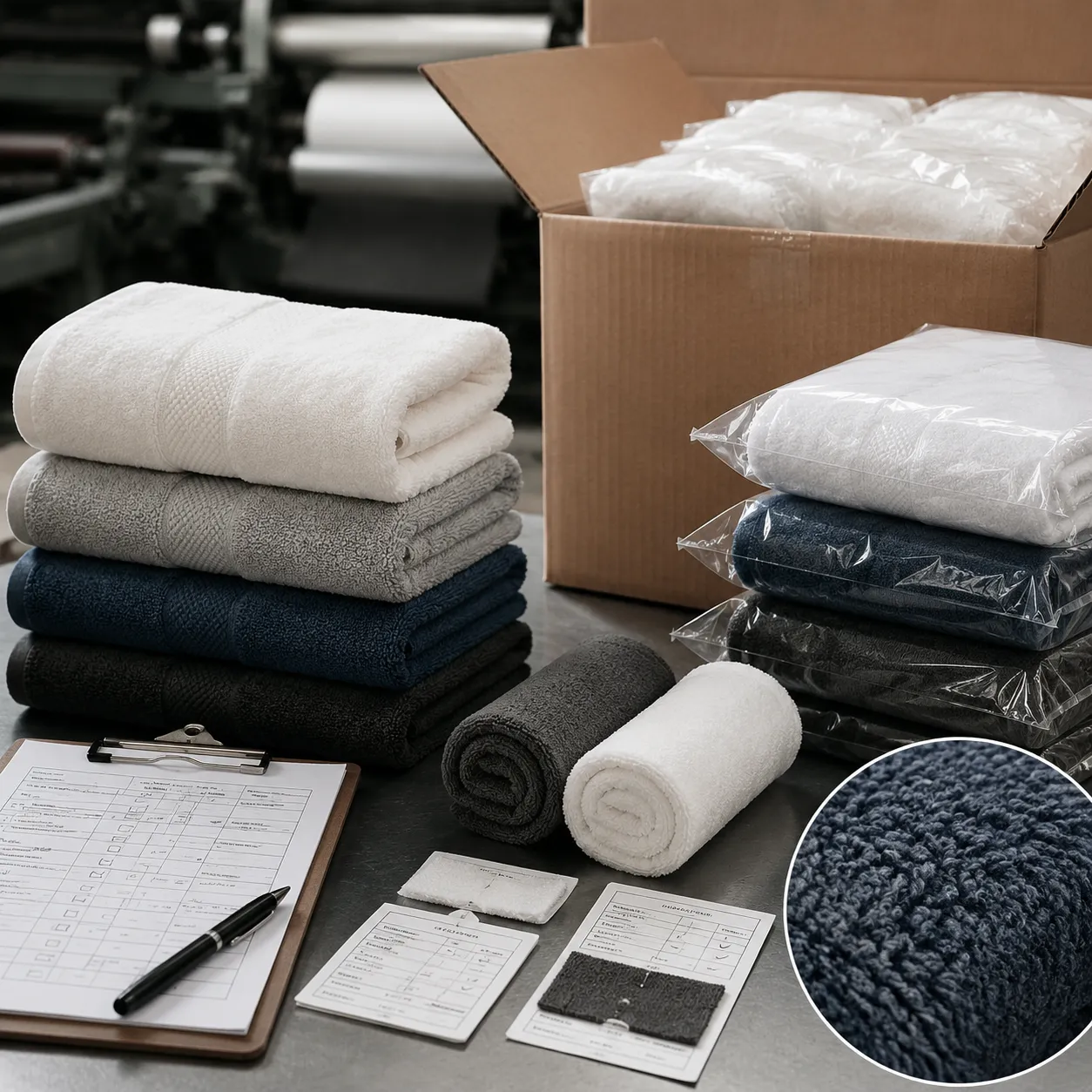
The carton is part of the towel specification
For gym programs, buyers usually focus on GSM, color, logo placement, and unit cost. Those details matter, but the export carton decides whether the order arrives usable. If a carton is too large, towels compress unevenly and corners crush. If it is sealed before residual moisture drops into range, a clean towel can develop a sour carton odor before the first laundry cycle.
We treat carton packout as an operations control point, not a warehouse afterthought. Our ISO 9001 procedure uses a documented packing work instruction for each purchase order: approved folding photo, inner pack method, carton dimensions, carton gross weight limit, label template, inspection sampling level, and release signature. The packing line cannot switch carton size or pieces per carton without a merchandiser and QC sign-off recorded on the order traveler.
For standard cotton gym towels, our normal MOQ is 500 pcs per design and per color. At that volume, carton decisions are still important because mixed-color club orders often travel as LCL cargo, where cartons are handled more than a full-container shipment. For franchise gyms, university recreation centers, and athletic brands, we prefer to lock the export carton standard during sample approval, not after bulk production is finished.
| Gym towel type | Common size | Typical GSM | Usual carton concern |
|---|---|---|---|
| Workout face towel | 30 x 80 cm | 360-450 GSM | Carton count accuracy and barcode sorting |
| Bench or sweat towel | 40 x 90 cm | 400-520 GSM | Compression marks when packed too tightly |
| Locker room bath towel | 70 x 135 cm | 500-650 GSM | Gross weight over 18 kg if carton count is high |
| Microfiber fitness towel | 38 x 80 cm | 220-320 GSM | Polybag slip and carton shifting during transit |
Our gym towel durability export carton checklist
Below is the practical checklist we use before sealing cartons for gym and fitness towel orders. It is not a generic warehouse form. Each item is tied to a defect we have seen in export shipments: dye transfer from damp towels, torn hand holes, incorrect mixed-size cartons, flattened pile on top layers, and cartons rejected by overseas 3PL warehouses because the label data did not match the packing list.
- Confirm approved bulk towel: size tolerance, GSM tolerance, color, logo, edge sewing, and lint level match the signed pre-production sample.
- Check wash-test result before packing: towels must pass the order-specific wash protocol before the packing team receives release approval.
- Measure moisture before polybagging: cotton towels are checked with a calibrated textile moisture meter after final conditioning.
- Verify fold and compression: folded height must fit the carton without forcing the flaps down by body weight.
- Control carton gross weight: standard export cartons are kept below 18 kg for gym towel orders unless the buyer approves otherwise.
- Match label to packing list: SKU, color, size, PO number, carton number, net weight, gross weight, and destination marks must agree.
- Inspect carton sealing: H-tape method is used on top and bottom; straps are added only when the buyer or freight route requires them.
- Photograph sealed master carton: front label, side panel, top seal, and pallet loading are stored in the shipment file.
The photograph step is not for decoration. We photograph every approved carton layout before mass packing starts, then compare random cartons during inline packing. If a line operator changes from 60 pcs per carton to 72 pcs because the towels feel thin after drying, that difference appears immediately in carton height, weight, and count reconciliation.
Wash durability is checked before packing, not after complaints
Durability for a gym towel is not an abstract promise. Sweat, detergent, high drying heat, and disinfecting routines create different stress than a hotel guest bathroom. For cotton workout towels, we normally test 10 wash and tumble cycles for approval, then keep retained samples for comparison when the buyer reorders. For higher-risk colors such as black, navy, red, and bottle green, we add colorfastness checks because gyms often launder mixed loads.
Our common wash procedure for cotton gym towels uses ISO 6330:2021 as the base washing method: machine wash at 40°C, normal mechanical action, ECE reference detergent without optical brightener unless the buyer's laundry requires another detergent, followed by tumble drying at medium heat. For colorfastness to domestic and commercial laundering, we reference ISO 105-C06 with multifiber adjacent fabric, then review staining and shade change under a D65 light booth. For production lots, we do not claim a lifetime wash count from one lab sample; we use wash testing to catch shrinkage, dye migration, seam twisting, and pile loss before packing.
| Checkpoint | Method used | Typical acceptance range | Why it matters for gyms |
|---|---|---|---|
| Dimensional change | ISO 6330:2021 wash and tumble cycle, measured after conditioning | Within -6% length and -5% width for cotton terry gym towels | Keeps towel fit consistent in rental bins and wall dispensers |
| Color staining | ISO 105-C06 with multifiber adjacent fabric | Grade 4 or better for white cotton staining on dark shades | Reduces risk when gyms launder mixed color towels |
| Edge seam integrity | Visual check after 10 cycles plus manual seam tension review | No open seam longer than 5 mm | Prevents towels from being pulled from service early |
| Lint release | Dryer screen review after repeated tumble drying | No heavy loose pile or edge yarn shedding after cycle 3 | Protects laundry filters and member experience |
A realistic example: a 40 x 90 cm cotton gym towel at 460 GSM uses roughly 166 g of fabric before sewing allowance and finishing variation. In bulk, that spec usually lands near 172-184 g finished weight depending on border design and hem. If the buyer asks us to reduce it to 330 GSM to save freight and unit cost, the towel may dry faster, but edge life and absorbency drop. For a facility washing towels five times per week, the cheaper towel can leave service months earlier. We explain that tradeoff with the buyer's laundry temperature, detergent type, and replacement policy, not with a generic wash-count claim.
Moisture control before polybag and carton sealing
Moisture is the quiet problem in export cartons. Cotton towels leave finishing with heat and residual humidity in the pile. If they go into polybags too soon, the carton can feel dry from the outside while the center stack remains warm. That condition is enough to create carton odor or mildew risk during a long ocean route.
Our packing floor target for cotton gym towels is 6.0-8.5% moisture before polybagging, measured on the towel body after the goods have conditioned in the packing area. We stop packing and recondition the lot if random readings exceed 9.5%. The packing area is held around 20-25°C and 55-65% relative humidity when cotton towels are being packed; readings are logged per shift. These numbers are not decorative. They are tied to our BSCI facility management records and our ISO 9001 nonconformance procedure, so a failed moisture check creates a corrective action record, not a verbal reminder.
- Cotton terry towels: condition after drying before final folding, especially for 500 GSM and above.
- Dark dyed towels: check for odor and crocking before polybagging because excess moisture can worsen dye transfer.
- Microfiber towels: control static and slipping inside polybags; moisture is usually lower, but carton shifting is more common.
- Individually bagged retail towels: add vent hole position review if the buyer requires long storage before launch.
For buyers comparing cotton and microfiber fitness lines, the packing risks differ. Cotton needs moisture and pile compression control. Microfiber needs surface protection and carton movement control. We cover the fabric tradeoffs in microfiber vs cotton towel comparison and the cleaning-cloth side in custom microfiber towels wholesale guide.
Carton strength, drop checks, and pallet loading
For export cartons, we specify board grade based on towel weight and route. A small gym face towel order may use a five-layer corrugated carton with 170-170-170 g paper combination. A heavy locker-room bath towel order often needs a stronger five-layer or seven-layer carton, especially when cartons are stacked on pallets for 35-45 days from factory to overseas warehouse.
When the buyer requests a transit test, we define the procedure clearly. For master cartons below 15 kg, our practical drop check uses ten drops from 760 mm: one corner, three edges, and six faces, followed by inspection for burst seams, crushed corners, open tape, and towel contamination. For cartons from 15-20 kg, the drop height is reduced to 610 mm. This mirrors the handling logic used in ISTA 1A-style parcel testing, but the purchase order must state the exact height, sequence, and pass criteria if a formal test report is required.
| Carton item | Our normal control | Buyer decision needed | Common failure if ignored |
|---|---|---|---|
| Gross weight | Usually 12-18 kg per carton | Warehouse maximum handling weight | Cartons split during manual unloading |
| Carton fill | No forced flap closure; top layer sits flat | Pieces per carton and polybag type | Permanent compression marks on pile |
| Tape method | H-seal on top and bottom with 48-60 mm tape | Plain tape or branded tape | Bottom seam opens during LCL handling |
| Pallet pattern | Aligned corners, no overhang, stretch film after corner board if needed | Palletized or floor-loaded shipment | Outer cartons deform at container wall |
Air freight and courier shipments need a tighter carton because cartons are handled individually. Ocean freight can tolerate larger cartons if the load plan is stable, but LCL cargo still gets cross-docked and rehandled. We discuss freight tradeoffs in container vs air freight towel orders, which is useful when a gym brand has a launch date and wants to split the first order between air and sea.
Inspection sampling and export label proof
For finished towel inspection, we use ISO 2859-1 sampling plans as the structure for AQL checks. A typical gym towel order uses General Inspection Level II, with major defects at AQL 2.5 and minor defects at AQL 4.0, unless the buyer's manual requires stricter limits. Critical defects are not accepted. For example, a metal contamination risk, mold odor, wrong fiber content label, or mixed SKU carton is treated differently from a slightly loose thread end.
The export label is checked against the packing list before cartons leave the packing area. We verify PO number, style number, color name, size, pieces per carton, carton sequence, destination mark, country of origin, net weight, gross weight, and carton measurement. If the buyer uses GS1 barcodes or warehouse ASN data, we ask for the label file before bulk packing. Relabeling 300 cartons after sealing is slow, expensive, and avoidable.
- Major defects: wrong size beyond tolerance, open hem, wrong color, logo position outside approved limit, mixed SKU carton.
- Minor defects: loose thread under 20 mm, slight pile variation, small label skew that does not affect scanning.
- Critical defects: mold, strong chemical odor, needle fragment risk, incorrect fiber content, unsafe packaging material.
- Carton defects: burst corner, unreadable label, wrong carton count, wet board, missing destination mark.
For OEKO-TEX Standard 100 Class I orders, trims and packaging that touch the towel are reviewed with the product file. The OEKO-TEX certificate is not a substitute for carton inspection, but it confirms that the certified towel article and listed components meet restricted substance requirements. If your compliance team needs to read certificate scope correctly, start with how to read OEKO-TEX certificate.
Pricing bands with packing choices included
Packing is not free, but it should be visible. A buyer may see two gym towel quotations with the same size and GSM, then miss that one includes individual polybags, barcode labels, stronger export cartons, and pallet loading while the other assumes bulk pack in lower-grade cartons. For gym towel durability export carton checklist work, we quote the packing method line by line so procurement can compare real landed cost.
| Spec example | 500-999 pcs | 1,000-2,999 pcs | 3,000-9,999 pcs | Packing assumption |
|---|---|---|---|---|
| 30 x 80 cm cotton sweat towel, 400 GSM, dyed, no logo | USD 0.92-1.18 | USD 0.78-0.98 | USD 0.66-0.86 | Bulk 50-100 pcs per export carton |
| 40 x 90 cm cotton gym towel, 460 GSM, woven label | USD 1.45-1.82 | USD 1.22-1.55 | USD 1.05-1.36 | Bulk pack or 10 pcs inner polybag |
| 40 x 90 cm cotton towel, 500 GSM, embroidered logo | USD 1.92-2.55 | USD 1.68-2.18 | USD 1.42-1.88 | Individual polybag plus master carton label |
| 38 x 80 cm microfiber fitness towel, printed logo | USD 1.10-1.58 | USD 0.94-1.28 | USD 0.78-1.06 | Individual bag or retail sleeve by artwork |
These bands assume FOB China pricing, normal dyed colors, standard export cartons, and no licensed packaging artwork. Cotton price movement, yarn count, embroidery stitch count, carton board grade, and freight season can move the final number. For a gym with 18 locations ordering 40 x 90 cm towels at 460 GSM, adding individual barcode polybags may add USD 0.07-0.12 per towel, but it can reduce receiving labor if each branch scans inventory by SKU. That is a sourcing-context decision, not a universal recommendation.
If the buyer is still building the product brief, build towel tech pack that mills can quote explains what we need before pricing. For GSM decisions, towel GSM decision framework is more useful than asking for the heaviest towel that fits a budget.
Production timing and documents buyers should request
A clean export packout starts early. If the carton label, barcode format, folding direction, or polybag warning text arrives after towels are finished, the order waits in the packing area while everyone loses time. For gym towel programs, we ask buyers to approve packaging details before yarn dyeing or bulk weaving whenever possible.
- Day 1-3: confirm tech pack, size, GSM, color standard, logo file, packing method, and carton label fields.
- Day 4-9: make lab dip or strike-off; confirm embroidery or woven label if decoration is used.
- Day 10-18: produce pre-production sample and packing mockup for approval.
- Day 19-38: bulk weaving, dyeing, finishing, sewing, decoration, and inline QC for normal cotton orders.
- Day 39-45: final inspection, moisture conditioning, packing, carton release, and shipment booking.
For repeat programs with approved colors and no artwork change, production can be shorter, usually 25-35 days after deposit and material confirmation. New Pantone colors, custom jacquard borders, retail sleeves, or third-party inspection can extend timing by 7-14 days. Our factory has 220 employees and has operated since 2007, but capacity is still scheduled by loom time, dye vat availability, decoration queue, and inspection release. A realistic delivery plan protects the buyer more than a rushed ship date.
- Request before deposit: quotation with size, GSM, towel weight, packing method, carton count, MOQ, and payment terms.
- Request before bulk: approved sample, lab dip record, artwork placement sheet, and carton label proof.
- Request before shipment: final inspection report, packing list, carton photos, moisture record if required, and certificate copies.
- Request for compliance: OEKO-TEX Standard 100 Class I scope, BSCI audit status, and ISO 9001 certificate validity.
What we push back on before the order ships
We push back when a requested packout is likely to fail in transit or laundry. The most common request is to increase pieces per carton to reduce carton count. Sometimes that works. Sometimes it creates cartons over 20 kg, crushed pile, or flaps that need excessive tape tension. Another common request is to skip polybags for dark towels going to humid ports. Bulk pack can be fine, but only if moisture is controlled and cartons are lined or protected according to route conditions.
- Too many pieces per carton: saves carton cost but increases split seams and manual handling complaints.
- Unapproved mixed cartons: may help small branch allocations but creates receiving errors unless labels show exact breakdown.
- Very low GSM for rental use: lowers unit price but can shorten service life under high-temperature laundry.
- Retail labels supplied late: delays packing because sealed cartons may need to be reopened and counted again.
- No retained sample: makes reorder disputes harder because there is no physical reference for pile, shade, and fold.
Related reads: for gym towel construction choices, see sweat towels for gym spec guide and why gym towels fail after 50 washes. If your order includes embroidery, compare decoration risk in embroidery vs sublimation vs jacquard.
LUMA & CO. TEXTILE supplies OEM towel programs for 80+ brand clients across 47 countries, with annual production around 2.4M towels. We hold OEKO-TEX Standard 100 Class I, BSCI, and ISO 9001 certifications, and our standard MOQ is 500 pcs per design and per color. For gym towels, we prefer to approve the towel, the packing, and the carton together because all three affect what the buyer receives at the warehouse door.
Build a safer gym towel carton plan
Send your towel size, GSM target, logo method, destination, and warehouse requirements. We will return a practical quote with carton count, packing method, timing, and inspection points. WhatsApp: +86 13205717266. Email: [email protected].
Request carton-ready quote →