Why MOQ behaves differently on cooling towels
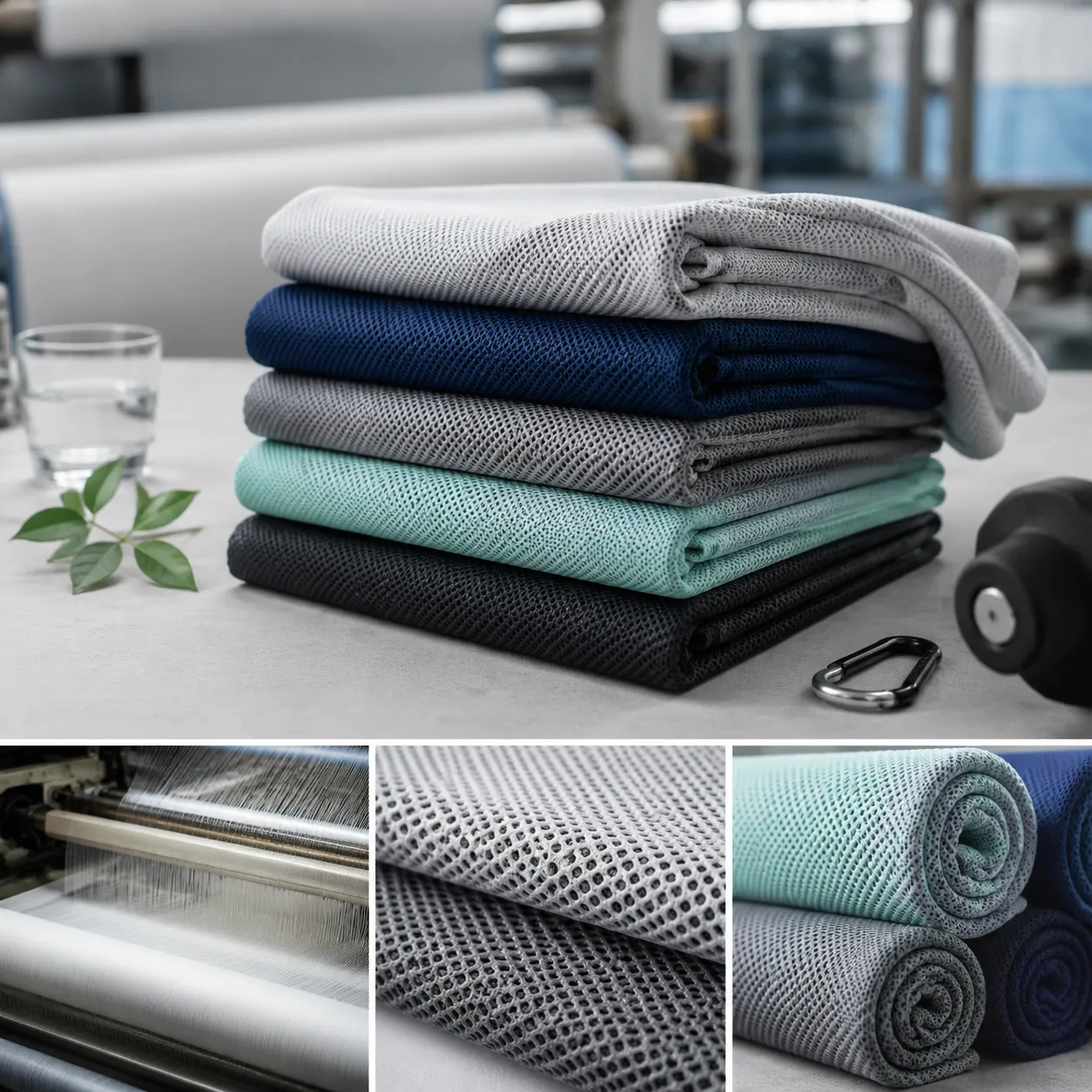
Cooling towels are not quoted like standard cotton gym towels. A cotton sweat towel can often run from greige terry fabric already sitting in the warehouse. A microfiber cooling towel usually depends on a knitted or woven synthetic fabric, most often 80/20 or 85/15 polyester-polyamide, with a mesh or bird-eye structure engineered to hold water and release it through evaporation.
That fabric decision creates the MOQ pressure. If the buyer wants a stock fabric color with a one-color logo, we can build a smaller program. If the buyer wants Pantone-dyed fabric, all-over sublimation, individual zip pouches, and mixed carton ratios, the practical order quantity rises because each step has its own setup loss.
At our mill, the formal MOQ is 500 pcs per design / per color. For cooling towels, we still use that number as the commercial floor, but the negotiation room depends on whether the order can share fabric, share trims, or share logo screens with another SKU. A useful MOQ conversation starts by separating the fixed costs from the variable towel cost.
| MOQ driver | What creates the constraint | Negotiation lever |
|---|---|---|
| Fabric color | Dye vat minimum and shade approval | Use stock color or combine sizes in one dye lot |
| Logo method | Screen, film, embroidery file, or transfer mold setup | Keep the same logo across colors |
| Cutting width | Cooling mesh fabric often has 150-165 cm usable width | Choose dimensions that nest cleanly |
| Packaging | Pouch printing and barcode labeling require separate line setup | Use generic pouch with sticker for trial orders |
| QC testing | Absorbency, evaporation, rubbing, and dimensional checks need retained samples | Limit SKU count in the first PO |
Cooling sport towel moq negotiation guide
The practical way to negotiate MOQ is to decide which parts of the towel are truly brand-critical and which parts can stay standardized. In this cooling sport towel moq negotiation guide, we treat fabric, size, decoration, and packing as separate negotiation blocks instead of one yes-or-no quantity discussion.
For example, a 30 × 100 cm microfiber cooling towel at 180 GSM weighs about 54 g before overlock thread and packing. It does not consume much fabric per piece, but it does consume setup time. If the buyer asks for five towel colors at 500 pcs total, each color may only be 100 pcs. That is usually inefficient because color matching, cutting tickets, and inspection reports multiply while fabric consumption stays small.
A better first-order structure is often 1,000-1,500 pcs total across two colors, with one shared logo. That gives the cutting table enough length to maintain shade continuity, and it gives the sewing line fewer thread changes. For sports clubs, race events, yoga studios, and summer camps, this structure usually protects the landed cost better than forcing too many colorways into a 500 pc trial.
- Protect the fabric first: stock cooling mesh is the easiest way to keep MOQ near 500 pcs per design / per color.
- Limit logo changes: one artwork across two towel colors is easier than two artworks on one color.
- Avoid custom pouch printing on trial orders: printed OPP, EVA, or zip pouches usually add a separate 1,000-3,000 pc packaging MOQ.
- Use carton stickers for small batches: barcode and event-name stickers are cheaper than custom insert cards below 2,000 pcs.
- Approve one standard size: mixed sizes create more cutting loss than mixed logo placements.
Choose the fabric before debating quantity
Most MOQ problems on custom cooling towels bulk orders come from fabric confusion. Buyers may say “cooling towel” while meaning three different products: a thin microfiber gym towel, an evaporative cooling towel with open mesh, or a PVA sponge-style towel packed wet in a tube. These are not interchangeable at the factory.
We make the first two more often for brand and event buyers. PVA has a stronger instant-cooling feel but it dries stiff, needs airtight storage, and is less friendly for embroidered or woven branding. Polyester-polyamide microfiber is more flexible, dries faster, and handles sublimation better. For athletic retail and promotional programs, microfiber cooling towel specifications are easier to control across repeat orders.
| Construction | Typical GSM | Cooling behavior | MOQ impact | Best buyer use |
|---|---|---|---|---|
| Bird-eye microfiber knit | 150-190 GSM | Good evaporation after soaking and wringing | Lowest if stock colors are used | Runs, gyms, camps, retail kits |
| Warp-knit mesh microfiber | 160-220 GSM | Higher airflow, slightly more open handfeel | Medium because fabric width affects cutting yield | Outdoor sport teams and summer events |
| PVA sponge towel | 240-320 GSM equivalent wet-pack style | Strong initial chill, dries rigid | Higher due to wet packing and tube components | Industrial heat relief and outdoor labor kits |
| Brushed microfiber suede | 180-250 GSM | Less cooling, smoother print face | Medium; better for full sublimation art | Retail graphics and souvenir programs |
For most athletic buyers, our starting point is 170-190 GSM bird-eye microfiber, 80/20 polyester-polyamide, overlocked edge, and a size between 30 × 90 cm and 32 × 100 cm. A heavier 220 GSM mesh feels more substantial but absorbs more water, packs heavier, and raises freight cost. A lighter 140 GSM towel packs small but may curl at the edge after 20-30 wash cycles if the overlock tension is not controlled.
Where small orders fail in production
Low MOQ cooling towels can work, but only if the buyer understands the failure modes. The first risk is shade mismatch. Synthetic cooling fabrics take disperse dye differently from cotton terry. If the color standard is a bright lime, cobalt, or safety orange, the lab dip may pass visually under D65 light but shift under TL84 store lighting. We record both light sources on the shade card before bulk dyeing.
The second risk is blocked wicking after decoration. A thick rubber transfer can sit on the fabric surface and reduce evaporative performance in that printed area. On a towel meant to be soaked, snapped, and wrapped around the neck, a large non-breathable logo panel can feel clammy. We prefer small heat transfers below 8 × 12 cm, sublimation on white fabric, or a woven label placed away from the wet contact zone.
The third risk is edge distortion. Cooling mesh stretches more in one direction than the other. If cutting follows the wrong grain direction, the towel twists after laundering. Our cutting team marks the machine direction on incoming fabric rolls and checks skew before spreading. On bulk inspections, we measure diagonal difference after washing; for sport towels we usually keep it within 1.5 cm on a 100 cm length.
- Shade banding: caused by uneven dye migration on synthetic knit fabric; controlled by roll-by-roll shade grouping.
- Logo peeling: caused by low transfer pressure or wrong adhesive film; checked with a 3M 610 tape pull after curing.
- Edge waviness: caused by overlock tension being too tight for stretch mesh; adjusted during the first 50 pcs of line trial.
- Odor after wet packing: caused by towels packed before moisture is fully stabilized; avoided by conditioning fabric before final bagging.
- Size drift: caused by relaxed knit shrinkage; checked after one home-laundry cycle before bulk cutting.
Logo method changes both MOQ and cooling feel
A cooling towel is a functional product, so decoration cannot be selected only by appearance. We run many programs with one-color screen print, sublimation, heat transfer, woven label, or small embroidery. Each has a different MOQ curve.
Sublimation is efficient when the towel base is white or very pale polyester. It allows full-color graphics without heavy ink build-up, but the artwork must allow for 2-3 mm movement during heat pressing and cutting. On dark dyed cooling towels, sublimation is not suitable because disperse ink cannot print opaque white. For a dark navy towel with a white logo, heat transfer or screen print is usually more reliable.
Embroidery is possible on microfiber cooling towels, but we use it carefully. A dense 7,000-stitch logo can pucker a 160 GSM mesh fabric and create a stiff patch against the skin. For athletic orders, we prefer embroidery below 4,500 stitches with soft backing, or we move the logo to a woven side label. Buyers comparing decoration routes can also read our broader method breakdown in embroidery vs sublimation vs jacquard.
| Logo method | Practical MOQ effect | Durability check | Factory note |
|---|---|---|---|
| One-color screen print | Works from 500 pcs if artwork is simple | AATCC 8 crocking and 20 wash review | Best for event logos on stock colors |
| Sublimation | Best from 800-1,000 pcs due to paper setup and calibration | Color migration and wash shade check | Best on white or pale polyester fabric |
| Heat transfer | Works from 500 pcs, but unit cost is higher | Tape pull plus 40°C wash test | Keep logo area small for better cooling feel |
| Woven label | Works from 500 pcs towel MOQ, label MOQ often 1,000 pcs | Label seam pull check | Good for retail-looking low MOQ programs |
| Embroidery | Technically works from 500 pcs but not always functional | Stitch pucker and backing comfort check | Use low stitch count on mesh |
Price bands buyers can use in RFQs
Pricing changes quickly with exchange rate, yarn market, packaging, and print coverage, but buyers need realistic bands before they issue an RFQ. The table below is based on FOB Ningbo / Shanghai style assumptions for a 30 × 100 cm, 170-190 GSM microfiber evaporative cooling towel with overlock edge and one logo. It excludes inland destination duty and final-mile delivery.
| Order quantity | Simple logo, stock fabric | Custom dyed fabric | Full sublimation print | Typical use case |
|---|---|---|---|---|
| 500 pcs | USD 1.05-1.38 / pc | USD 1.42-1.78 / pc | USD 1.55-1.95 / pc | Pilot order, club shop test |
| 1,000 pcs | USD 0.86-1.16 / pc | USD 1.12-1.46 / pc | USD 1.28-1.68 / pc | Race event, gym chain trial |
| 3,000 pcs | USD 0.68-0.94 / pc | USD 0.88-1.18 / pc | USD 1.05-1.38 / pc | Regional promotion |
| 5,000 pcs | USD 0.59-0.82 / pc | USD 0.76-1.02 / pc | USD 0.92-1.22 / pc | Seasonal retail program |
| 10,000 pcs | USD 0.51-0.72 / pc | USD 0.66-0.91 / pc | USD 0.80-1.08 / pc | National campaign or replenishment |
The trap is choosing the lowest unit price while adding many small complications. A buyer may save USD 0.09 per towel by choosing 150 GSM fabric, then lose more through returns because the edge curls and the towel looks narrow after washing. On a 2,400 pc order, upgrading from 150 GSM to 180 GSM may add roughly USD 240-310 total, but if it prevents even 120 customer complaints on a retail program, the cost-per-use is usually better.
Our position is simple: negotiate MOQ by simplifying the order architecture, not by stripping the towel below its function. For summer sport use, a towel that cools poorly after ten uses is more expensive than a slightly higher GSM towel that stays stable through a full season.
A cleaner color-split plan for first orders
Most first-time buyers ask for too many colors because internal sales teams want options. In production, each color creates fabric control, thread matching, shade approval, and carton segregation work. The minimum order may look small on paper, but the handling cost becomes visible in the unit price.
For a 500 pc first order, we normally recommend one towel color and one logo. For 1,000 pcs, two colors can work if the same logo and same packaging are used. At 2,000 pcs, three or four colors become more practical, especially if one color is white for sublimation and the other colors use small heat transfer branding.
- Start with the end user: neck cooling for sport, sweat wiping for gym, or wet-pack heat relief for outdoor staff.
- Select one fabric platform and keep it unchanged across the order.
- Choose no more than two body colors below 1,500 pcs total.
- Use one logo file, one placement, and one packaging format for the first PO.
- Keep a retained sample from each color for reorder shade matching.
This is where a real sports towel manufacturer should push back. If a buyer wants 1,000 pcs split into ten team colors, the quote will either be expensive or production will cut corners. We would rather build two strong colors that pass testing than ten weak SKUs with unstable repeatability.
Testing that should be built into the quote
Cooling towels need more than a visual inspection. We check gram weight, size, edge sewing, logo position, colorfastness, absorbency, and evaporative behavior. For synthetic fabrics, we use AATCC 8 for dry and wet crocking, ISO 105-C06 for domestic washing colorfastness, and internal evaporation timing based on a controlled water pickup and weight-loss method.
Our evaporation check is simple enough for buyers to understand. We condition the towel, soak it in water, wring to a target pickup, weigh it, then hang it under controlled airflow and record weight loss at set intervals. It is not a medical cooling claim; it is a production consistency check. If bulk fabric loses moisture far slower than the approved sample, the knitting density, finishing agent, or print coverage may have changed.
We also run a snap and seam review because users often wet the towel, twist it, and snap it before wearing. Overlock thread must resist seam opening without turning the edge into a hard cord. For a 30 × 100 cm towel, our inline QC checks width tolerance at ±1 cm and length tolerance at ±2 cm unless the buyer specifies a tighter retail standard.
- Material safety: OEKO-TEX Standard 100 Class I available for compliant fabric and dye routes.
- Factory audit: BSCI social compliance records are available for qualified buyers.
- Quality system: ISO 9001 procedures cover incoming fabric inspection, inline QC, final AQL inspection, and complaint traceability.
- Colorfastness: ISO 105-C06 washing and AATCC 8 crocking are recommended for dyed or printed synthetic towels.
- Final inspection: AQL 2.5 for major defects and AQL 4.0 for minor defects is a common export standard.
Timeline from RFQ to shipment
MOQ negotiation also affects lead time. A simple stock-color order can move quickly because fabric is available and decoration is the main step. A custom dyed or sublimated order needs artwork confirmation, lab dip or strike-off, bulk fabric processing, and extra drying or curing time.
For planning, we advise buyers not to count only sewing days. The calendar starts when the tech pack, artwork file, Pantone reference, packaging requirement, and deposit are all confirmed. Missing barcode data or late sponsor artwork can stop a cooling towel order just as easily as missing fabric.
| Stage | Stock-color simple logo | Custom color or full print | What buyer must approve |
|---|---|---|---|
| RFQ and spec check | 1-3 days | 2-4 days | Size, GSM, logo method, packaging |
| Sample or strike-off | 5-8 days | 7-12 days | Handfeel, print color, logo placement |
| Bulk fabric preparation | 3-6 days | 10-16 days | Stock issue or lab dip approval |
| Cut, sew, decorate | 8-13 days | 12-18 days | Inline sample and packing standard |
| QC and packing | 3-5 days | 4-7 days | Inspection report and carton marks |
| Export booking | 5-10 days | 6-12 days | Forwarder details and shipping documents |
In normal season, most cooling sport towel programs ship in 35-50 days after deposit and final approval. Urgent event orders can sometimes be compressed to 22-30 days if the buyer accepts stock fabric, one logo, and simple packing. Air freight is possible, but towels are bulky once individually packed, so it should be reserved for missed event windows or small top-up quantities. For freight planning, see container vs air freight towel orders.
What to include in the PO line item
A cooling sport towel moq negotiation guide is only useful if the final PO locks the decisions clearly. We see problems when buyers write “cooling towel, blue, logo printed” and assume the factory will infer the rest. That leaves too much room for disputes about GSM, fabric handfeel, print method, and packaging.
A good PO line item should include size, GSM, composition, fabric construction, towel color, logo method, logo size, placement, packaging, carton packout, inspection standard, and certification requirement. If the towel is for children, cosmetics, hospitality amenity kits, or skin-contact retail, confirm OEKO-TEX Standard 100 Class I requirements before sampling, not after bulk fabric is dyed.
- Size: 30 × 100 cm, tolerance ±1 cm width and ±2 cm length after one wash.
- Fabric: 180 GSM bird-eye microfiber, 80/20 polyester-polyamide, evaporative cooling towel construction.
- Edge: four-side overlock, matching polyester thread, no loose tails over 5 mm.
- Logo: one-color heat transfer, 70 × 95 mm, bottom right, 10 cm from short edge.
- Packing: one towel per reusable zip pouch, 100 pcs per export carton, carton marks by SKU.
- Inspection: final AQL 2.5 major / 4.0 minor, ISO 105-C06 wash colorfastness, AATCC 8 crocking review.
If your team is still building the document, our build towel tech pack that mills can quote article gives the structure we prefer to receive. For broader MOQ strategy across towel categories, read negotiate towel MOQ without killing margin. Buyers comparing cooling towels with gym sweat towels may also find sweat towels for gym spec guide useful.
The negotiation we usually accept
We are flexible when the order can run cleanly. A 500 pc order in one stock color with one small logo is usually straightforward. A 600 pc order split into three colors, two logos, and custom pouches is not a low-risk trial; it is a miniature multi-SKU program, and the price will show it.
The best negotiation offer from a buyer is not simply “please lower MOQ.” It is more specific: “We can keep one fabric, one logo, one pouch, and accept two stock colors if you can hold the MOQ at 500 pcs per color.” That lets us protect line efficiency while helping the buyer test the market.
Related reads: For fabric and performance comparisons, see microfiber vs cotton towel comparison and why gym towels fail after 50 washes. For color approval, our Pantone color matching custom towels guide explains why lab dips and bulk shade bands must be checked under more than one light source.
LUMA & CO. TEXTILE has operated since 2007 with 220 employees, 80+ brand clients across 47 countries, and annual production around 2.4M towels. Our standard towel MOQ is 500 pcs per design / per color, with OEKO-TEX 100 Class I, BSCI, and ISO 9001 certification routes available. For cooling sport towels, the cleanest orders are the ones where the buyer chooses the few variables that matter and standardizes the rest.
Build a workable cooling towel MOQ
Send us your size, GSM target, fabric color, logo method, packing requirement, and event deadline. We will reply with MOQ options, FOB pricing bands, and a realistic production calendar. WhatsApp: +86 13205717266. Email: [email protected].
Request a quote →