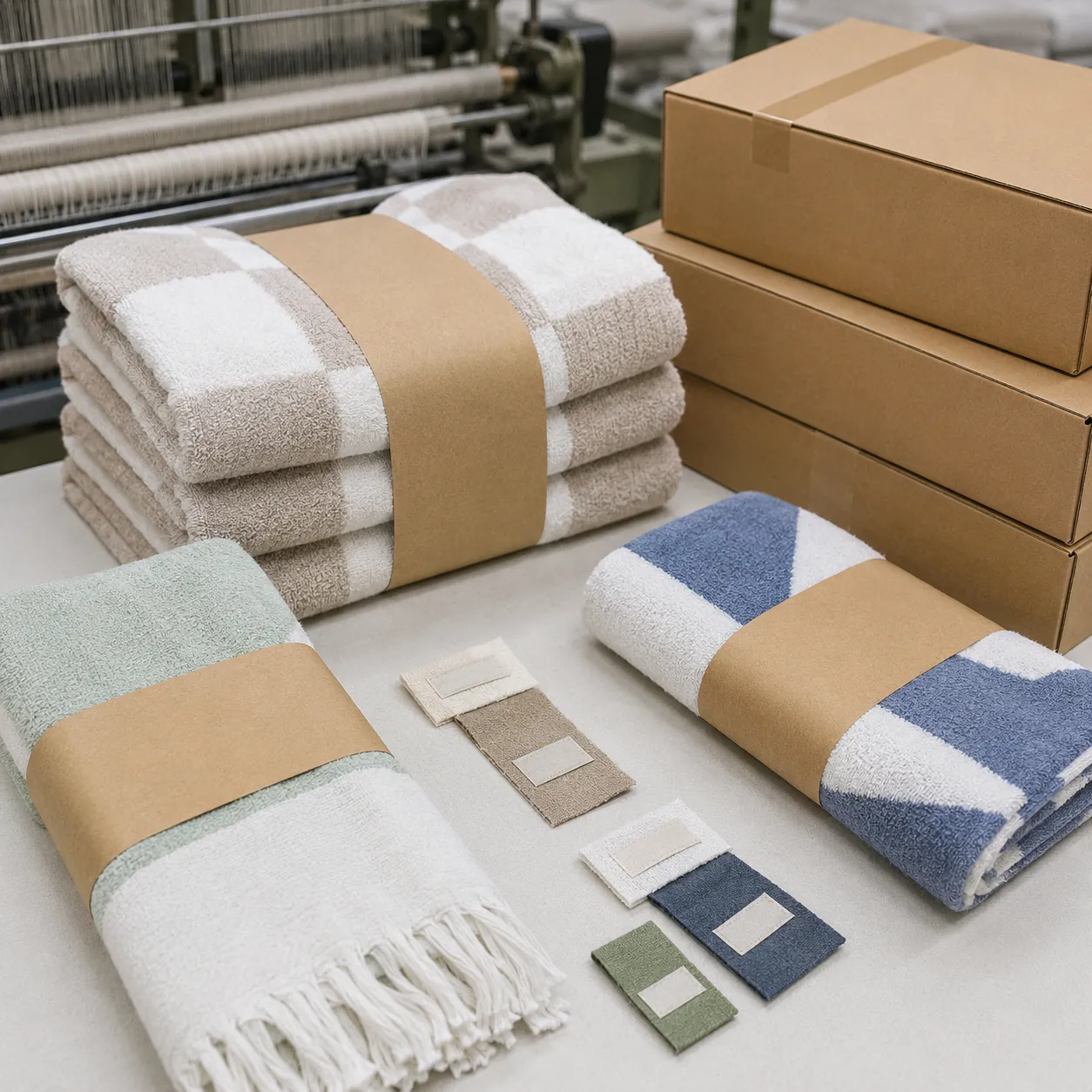
Start with the construction, not the lab form
Most cooling towels are not dyed and finished like bath towels. The common base is 85/15 polyester-polyamide microfiber or 100% polyester mesh, typically 180-260 GSM, with evaporative finishing that changes how water moves through the fabric. Decoration is often full-panel sublimation, but we also see reactive print on knitted polyester blends and pigment print on promotional runs. Each route fails differently, so the test sequence should follow the actual build.
For a buyer, the important distinction is this: a dark navy sublimated towel with white reserve areas is exposed to dye migration risk at the print edge, while a piece-dyed solid towel with a sewn label is more likely to fail on wet crocking or perspiration staining. We map the protocol to the construction listed on the tech pack, then confirm the same build on lab dip, strike-off, pre-production sample, and bulk.
| Construction point | Typical range | Why it changes testing |
|---|---|---|
| Microfiber knit | 180-230 GSM | Lower mass dries quickly but can show rubbing stain faster on dark shades |
| Warp knit cooling fabric | 220-260 GSM | More stable face; useful for edge evaluation after wash |
| Polyester mesh | 140-190 GSM | Open holes can distort grayscale reading if test area is too small |
| Sublimation print coverage | 35-95% | High coverage raises transfer and migration risk near folds |
| Evaporative finish add-on | 0.8-1.7% owf | Can shift wet rubbing result if finish is not fully cured |
The five lab checks that catch most failures
We do not rely on one wash test and call the job approved. For sports cooling products, the useful sequence is washing, rubbing, perspiration, water spotting, and light exposure when the brand sells bright summer colorways. The named method matters because buyers often receive reports with the test name missing and only a grade shown.
- Colorfastness to washing: ISO 105-C06 or AATCC 61, depending on customer market and report format
- Colorfastness to rubbing: ISO 105-X12 for dry and wet crocking on the face print and on the back side
- Colorfastness to perspiration: ISO 105-E04 using both acid and alkaline solutions because sports use exposes both sweat conditions
- Colorfastness to water: ISO 105-E01 to check staining onto adjacent fabric and shade change after soaking
- Colorfastness to light: ISO 105-B02 where summer outdoor use is part of the retail claim
Two details are specific to this category. First, sublimated cooling towels can pass wash grade but still show haloing after wet crocking if the heat transfer dwell was too short and disperse dye sat too close to the surface. Second, towels packed damp after sample review can create fold-line offset, where printed color transfers onto the reverse side under pressure. That is not theoretical; it appears most often on high-coverage black, cobalt, and red layouts.
| Test item | Method | Commercial pass level | Where we read it |
|---|---|---|---|
| Washing shade change | ISO 105-C06 A1S | Grade 4 minimum | Ground color and printed area |
| Washing staining | ISO 105-C06 A1S | Grade 3-4 minimum | Multifiber adjacent strip |
| Dry rubbing | ISO 105-X12 | Grade 4 minimum | Darkest print zone |
| Wet rubbing | ISO 105-X12 | Grade 3 minimum | Darkest print zone after wet pick-up control |
| Perspiration acid/alkali | ISO 105-E04 | Grade 3-4 minimum | Shade change and staining |
| Water spotting | ISO 105-E01 | Grade 3-4 minimum | Face and reverse |
Where cooling towels fail in real production
Failure analysis is more useful than broad statements, so here are the four patterns we actually document on claim reviews. Each one points to a different control step.
- The print edge bleeds after wash because transfer paper release was incomplete or calendar temperature was uneven across width.
- The towel stains onto a white gym bag or a pale collar because wet crocking was not checked on the darkest panel after finishing.
- The shade shifts after sweat exposure because the finishing bath pH drifted and the post-cure was too short.
- The folded towel ghosts onto itself in polybag because the fabric retained residual moisture above the packing control level.
A useful production clue is whether the defect follows the full panel or only the fold. Full-panel weakness usually points back to print fixation. Fold transfer usually points to moisture control or stacking temperature before bagging. On one recent athletic order, navy panels tested grade 4 for washing but only grade 2-3 for wet rubbing at the side seam area because the seam pressing trapped extra heat and finish there; the face center did not show the same weakness.
A passing wash report does not clear a cooling towel for market if the use case includes sweat, neck contact, or storage while still damp.
How we set pass grades by selling channel
The right grade is commercial, not academic. A giveaway item for a 10 km race and a branded retail towel sold with dark apparel are not judged the same way. We set the pass floor before sampling so the lab and merchandising teams are checking against the same target.
| Channel | Typical towel spec | Recommended colorfastness floor | Risk if underspecified |
|---|---|---|---|
| Event giveaway | 160-190 GSM polyester, one-color or simple print | Wash 3-4, dry rub 3-4, wet rub 3 | Low cost but high complaint rate on dark shades |
| Gym chain retail | 180-220 GSM microfiber, full print | Wash 4, dry rub 4, wet rub 3, perspiration 3-4 | Bag staining and neck rub transfer |
| Outdoor sports brand | 200-240 GSM warp knit, high coverage print | Wash 4, dry rub 4, wet rub 3-4, light 4 | Fade under sunlight and fold-line offset |
| Team merch program | 180-230 GSM microfiber with white reserve logo | Wash 4, staining 3-4, perspiration 3-4 | Logo edge bleeding after first wash |
For OEM quotations, these grade targets affect cost because they influence print route, finishing controls, retest frequency, and acceptable rework percentage. On a 30,000-piece order, moving from an event-grade standard to a retail-grade standard usually adds about USD 0.08-0.19 per piece. That comes from tighter shade control, more internal testing, and slower packing release when residual moisture checks are required.
Sample stage controls that prevent bulk claims
The least expensive place to catch a problem is before pre-production sample approval. We ask buyers to avoid approving color from a phone image alone and to request one dark-area crocking check plus one accelerated wash on the exact artwork layout. A small swatch is not enough when the final design has large ink coverage or white reserve text.
- Approve the exact fabric composition and GSM, not only the colorway
- Request a strike-off on final artwork scale if print coverage exceeds 70%
- Check white reserve edges after one wash cycle for feathering or haloing
- Record wet rubbing grade from the darkest zone, not from a mid-tone area
- Confirm packing moisture limit before polybagging for individually packed programs
This category is sensitive to shortcut approvals. If the pre-production sample is made on 200 GSM warp knit and the bulk shifts to 170 GSM mesh to hit cost, test results cannot be treated as equivalent. The fabric openness, print penetration, and abrasion behavior all change. That is why the bulk reservation sample should be cut from the same production lot used for the first colorfastness report.
Related reads: build a mill-ready spec sheet, compare decoration routes, and see why some athletic towels fail early.
Bulk testing plan by order size
The protocol should scale with order volume. A 1,200-piece boutique run does not need the same test frequency as a 65,000-piece chain rollout, but both still need objective gates. We normally tie testing points to dye lot, print batch, and packing release rather than only to calendar dates.
| Order volume | Internal test points | Third-party lab recommendation | Lead-time impact |
|---|---|---|---|
| 500-2,000 pcs | 1 pre-production sample + 1 bulk confirmation | Optional unless retailer requires it | Adds 2-4 days if external report needed |
| 2,001-10,000 pcs | PPS, first bulk lot, final packed lot | Recommended for dark colors | Adds 3-5 days |
| 10,001-30,000 pcs | Each print batch + final packed lot | Recommended | Adds 4-6 days |
| 30,001+ pcs | Each major lot split by color or machine window | Usually mandatory for brand compliance | Adds 5-8 days |
Typical production timing for these towels is 18-28 days after sample approval for straightforward solids or simple prints, and 24-35 days for multi-color sublimation programs with custom packaging. If a third-party report is required before balance payment, build in another 3-6 working days depending on the test menu and courier cut-off.
Cost ranges buyers should budget for
Pricing depends more on construction and decoration than on the test itself, but the quality control standard does change the landed cost slightly. For reference, a plain cooling towel in a pouch at 30×100 cm and 180-190 GSM can sit around USD 0.72-0.98 FOB China at 10,000 pieces. A fuller coverage printed version in 200-220 GSM microfiber typically runs about USD 1.04-1.46 at the same volume. Orders below MOQ are usually not practical because our MOQ is 500 pcs per design per color.
- Internal mill testing and retention sample control usually add USD 0.01-0.03 per piece on retail-grade programs
- Third-party colorfastness reports commonly add USD 180-420 per test set, depending on the method list
- Moisture-controlled individual packing can add USD 0.02-0.05 per piece
- Reprint risk on dark high-coverage artwork is the hidden cost if test criteria are vague
For buyers comparing offers, ask whether the quoted standard includes washing only or also wet crocking and perspiration. Low quotes often assume a simpler check, which makes the factory price look attractive until the first complaint arrives from a customer who used the towel during a run and then dropped it into a white mesh bag.
What to write into the PO and test appendix
The cleanest purchase orders are specific enough that the mill, third-party lab, and buyer all read the same requirement. This is where nonstandard notation causes trouble. Instead of writing repeated shorthand like "min min" or listing a grade with no method, define the method, the condition, and the acceptance level.
- State fabric composition, GSM tolerance, size tolerance, and print method
- Name the test method, for example ISO 105-X12 wet rubbing
- State the required result, such as Grade 3 minimum on darkest printed area
- Specify whether testing is on PPS, bulk, or final packed goods
- Define claim-critical zones like white reserve logo edge, seam area, or fold line
If you need OEKO-TEX 100 Class I alignment for children’s sports programs, say so at the quoting stage because the dyestuff and chemical package may need adjustment. We also work under BSCI and ISO 9001 controls, but those system certifications do not replace product-level colorfastness testing. They only show that the process and documentation framework exists.
Related reads: how to read the paperwork correctly, plan MOQ without forcing a bad spec compromise, and compare shipping choices for urgent launches.
A usable cooling sport towel colorfastness test protocol
If we condense this into a practical rule set, it looks like this. Test the exact construction. Include wet rubbing and perspiration, not only washing. Read the darkest print zone and the white reserve edge. Tie approvals to production lot, not just to the artwork PDF. And hold packed goods until moisture and final shade checks are closed.
For most brand-side buyers, that level of control is enough to prevent the common field complaints: color onto skin-contact areas, transfer to adjacent garments, and print-edge bleeding after the first care cycle. It also keeps the discussion with the factory factual. A report either meets ISO 105 or it does not; a sample either matches the approved construction or it does not.
Need a retail-grade test plan for your next run?
Send the fabric composition, artwork coverage, target GSM, and order quantity. We can map the lab checkpoints, MOQ, price band, and production timing before sampling.
Request a quote →For project details, reach us at [email protected] or WhatsApp +86 13205717266. Our MOQ is 500 pcs per design per color, and typical sampling takes 5-8 days before lab confirmation.