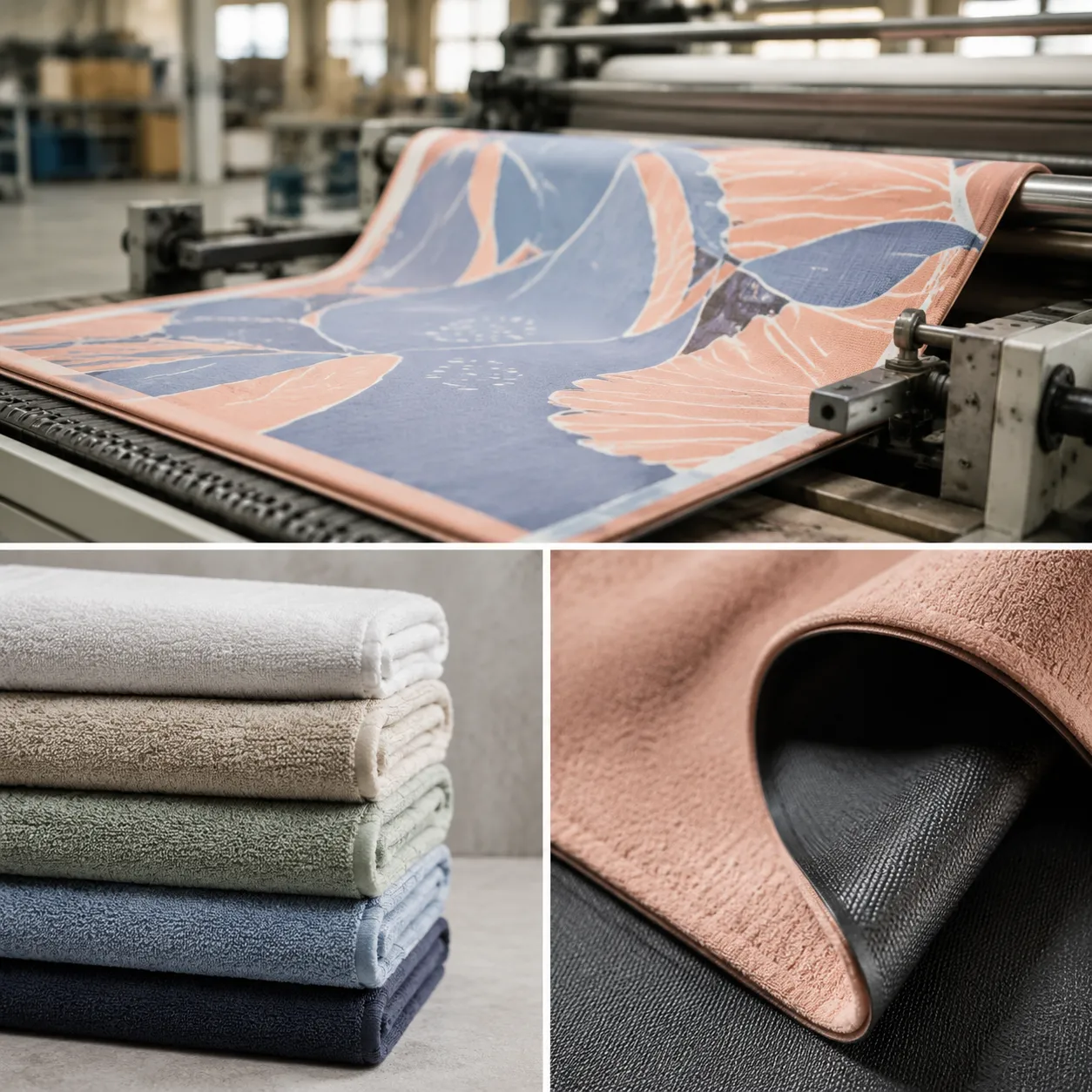
Start with the failure points, not the brochure
Large-format towels expose weaknesses faster than standard bath sizes. Once you move into 90×170 cm, 100×180 cm, or 100×200 cm territory, yarn stress at the selvedge rises, drying time stretches, and carton weight climbs enough to affect freight planning. A vendor that is perfectly acceptable for 30×30 cm washcloths can struggle badly here.
For an oversized beach towels supplier checklist, we look first at four measurable risks: post-wash size loss, skew after laundering, pile pull near the border, and logo clarity on a wide face. Those points can be checked before deposit with a spec sheet, a wash submission, and one carton-loading calculation. They are easier to verify than broad claims about quality.
- Ask for the finished size tolerance after wash, not just loom size. For large beach towels, a realistic buyer spec is often ±3% on length and width after one home-laundry wash.
- Ask whether the face construction is velour sheared or full terry. The answer changes print definition, absorbency feel, and snag behavior.
- Confirm border construction: hemmed 25-35 mm with back-tack reinforcement is safer than a narrow folded edge on heavy towels.
- Request actual carton gross weight at planned packout, not only pieces per carton.
The size line on the quote sheet needs three numbers
Buyers often receive one number for size and one number for GSM. That is not enough for a large towel. The quote sheet should show loom-state size, finished pre-wash size, and guaranteed size after the buyer's agreed wash method. Without those three lines, disputes start after bulk lands.
| Spec item | What to request from supplier | Why it matters |
|---|---|---|
| Nominal selling size | 100×180 cm | What marketing, retail ticketing, and hotel/resort ops will use |
| Finished pre-wash size | 102×184 cm, measured after cutting and sewing | Shows the mill's shrink allowance before laundry |
| Guaranteed post-wash size | Minimum 99×175 cm after agreed wash method | Creates an acceptance threshold you can inspect against |
| Size tolerance method | Measure flat after conditioning, 3 pcs per lot sample | Prevents one-off hand measurements from becoming the standard |
A large towel can miss guest expectations even when the area loss looks small on paper. On a 100×180 cm spec, 4 cm loss in width is noticeable when the towel is used over a lounger. We prefer buyers to lock the acceptance point in writing: for example, width not below 98 cm and length not below 174 cm after one specified wash and tumble sequence.
Related reads: if you are still setting the base construction, compare beach-towels-in-bulk-buyers-guide with towel-gsm-decision-framework. For a cleaner RFQ file, use the fields in build-towel-tech-pack-that-mills-can-quote.
Construction choice changes whether the towel survives pool-deck use
The usual oversized beach formats are not all built the same way. A sheared velour face with terry back is common when the artwork matters. Full terry works better when drying speed and hand feel matter more than logo sharpness. Flatwoven peshtemal styles reduce carton weight, but they are a different product family and should not be compared line-for-line with pile towels.
| Construction | Typical GSM | Best use | Watch-out |
|---|---|---|---|
| Velour face + terry back | 380-450 GSM | Printed resort towels, branded beach clubs | Face can show streaking if shearing is uneven |
| Full terry cotton | 420-520 GSM | High-absorbency pool and beach programs | Large loops can snag on lounger hardware |
| Low-twist terry | 400-480 GSM | Softer hand for premium guest touch | Loop pull risk rises if laundering is aggressive |
| Flatwoven with fringe or hem | 240-320 GSM | Travel, hammam, light-pack resort retail | Not interchangeable with plush oversized pile towels |
Two technical details matter here. First, shearing consistency on velour: if the blade setting is unstable, the print face shows light-dark bands across the width. Second, loop-anchor stability on the back terry: on large towels, weak ground yarn tension can create partial loop extraction near seams after repeated use. Those are factory-floor issues, not showroom issues.
- For printed oversized pool towels, many buyers land in 400-430 GSM velour/terry because it balances image clarity and drying time.
- For non-printed resort issue towels, 430-480 GSM full terry is a common commercial range.
- If the towel will sit on chaise lounges daily, ask for a snag check on metal edge contact during sample review.
- If the towel is for retail resale, confirm whether the hand-feel target justifies combed cotton or whether carded yarn is acceptable.
Print and color approval should be tied to the correct test set
Beach towels fail color review in predictable ways. Dark navy grounds crock onto sunscreened hands. Fluorescent shades drift from lab dip to bulk. Broad solid fields on velour show barre when yarn lots are mixed. A supplier should be able to tell you which print route fits the fabric and which tests they will run against it.
For cotton oversized towels, reactive printing is still the main route when you want a broad face design with decent wash permanence. Pigment print can reduce cost, but hand feel gets stiffer and surface rub can become the complaint. Yarn-dyed jacquard solves some colorfastness concerns but raises design and MOQ constraints. We cover that trade-off separately in embroidery-vs-sublimation-vs-jacquard.
| Check | Named method or criterion | Buyer note |
|---|---|---|
| Colorfastness to washing | ISO 105-C06 | Request grade result against adjacent fabrics, not only pass/fail wording |
| Colorfastness to rubbing | ISO 105-X12 | Especially relevant for dark face colors on velour |
| Absorbency / wet-out | AATCC 79 or internal seconds-to-wet method | Useful when heavy face printing may block absorbency feel |
| Restricted substances documentation | Valid OEKO-TEX certificate review plus article scope check | Certificate number alone is not enough |
On compliance, keep the wording precise. We hold OEKO-TEX Standard 100 Class I, BSCI, and ISO 9001 certifications, but buyers should still verify that the certificate scope and product category match the article being ordered. If you need help checking the paperwork instead of taking a PDF at face value, how-to-read-oeko-tex-certificate is the better reference than squeezing that review into a beach towel meeting.
Carton math is where oversized orders become expensive
A bulk beach towel manufacturer can look competitive on a unit quote and still create avoidable freight cost if carton density is wrong. Oversized pieces compress differently from bath towels because the fold thickness builds at the hems and borders. Over-pressing helps cube on paper but can crush pile, distort hems, and raise recovery complaints on arrival.
We prefer buyers to request three packout lines before approving bulk: pieces per carton, carton dimensions, and gross weight. For manually handled export cartons, many importers try to stay under roughly 18-20 kg gross, but the actual limit should follow your warehouse and destination handling rules.
| Towel spec | Indicative packout | Typical carton concern |
|---|---|---|
| 90×170 cm, 400 GSM, 1 pc polybag optional | 12 pcs/carton | Usually manageable by gross weight |
| 100×180 cm, 420 GSM, no inner bag | 10 pcs/carton | Carton volume starts to rise sharply |
| 100×200 cm, 450 GSM, belly band retail pack | 8 pcs/carton | High cube and risk of top-panel bulge |
| 100×180 cm jacquard, 500 GSM | 6-8 pcs/carton | Weight and compression both need review |
- Ask the supplier whether cartons are packed cross-fold or panel-fold; this changes both presentation and thickness.
- Request drop test readiness if the goods will move through mixed distribution rather than direct resort delivery.
- For retail programs, make barcode placement part of the packout approval, not an afterthought.
- Check whether your chosen belly band or insert card causes the stack to spring open inside the carton.
Price comparison only works when the spec lines are locked
Unit cost on oversized towels moves with more than cotton and size. The biggest quote swings usually come from construction choice, printing route, border width, packaging, and whether the vendor is pricing to finished post-wash size or just loom output. That is why two offers with the same nominal dimensions can be separated by enough to disrupt the sourcing decision.
For a workable comparison, ask all mills to quote the same decision points: exact finished size, GSM tolerance, yarn type, print method, hem width, label count, packaging format, inspection level, and shipment term. Without that, the cheapest line often wins only because something important has been left unstated.
| Program type | Volume band | Indicative USD/pc | What usually sits behind the number |
|---|---|---|---|
| 100×180 cm velour printed beach towel | 1,000-2,999 pcs | USD 5.20-7.10 | Reactive print, cotton pile, export carton, basic sewn label |
| 100×180 cm velour printed beach towel | 5,000-9,999 pcs | USD 4.45-6.15 | Better print efficiency and fabric planning |
| 100×180 cm full terry solid-dyed towel | 1,000-2,999 pcs | USD 4.60-6.40 | No face print, absorbency-led construction |
| 100×200 cm jacquard or high-weight resort towel | 2,000-5,000 pcs | USD 7.30-10.80 | Higher yarn consumption, lower pack density, longer loom commitment |
Those bands are sourcing references, not promises, because cotton, dyestuff, packaging, and booking costs move over time. We quote by confirmed specification and quantity. Our factory MOQ is 500 pcs per design per color, but oversized printed towels generally price more rationally from 1,000 pcs upward because cylinder setup, strike-off approval, and carton inefficiency weigh less heavily per piece.
Lead time should be broken into approvals, not one total number
A vendor saying 35 days or 45 days is less useful than a stage-by-stage schedule. Large-format towels often lose time in artwork scaling, strike-off correction, or packaging confirmation rather than weaving itself. Once buyers see the calendar in stages, the risky points become obvious.
- Tech pack and quote alignment: 2-4 days
- Lab dip or print strike-off approval: 4-8 days depending on revisions
- Sample towel or pre-production panel: 7-12 days
- Bulk fabric and sewing production: 18-30 days based on quantity and construction
- Final inspection, packing, booking: 3-7 days
For seasonal launches, the approval stage matters more than the sewing stage. A beach club trying to open before peak summer can lose a week simply because logo scale on a 100×180 cm face was approved from a digital mockup instead of a physical strike-off. That is one reason we ask buyers to sign off print size from an actual towel panel whenever possible.
Related reads: for shipment planning after production, see container-vs-air-freight-towel-orders. If the order is part of a broader resort setup, beach-club-resort-towel-program and chair-towels-lounger-pool-deck-guide fit more naturally than forcing every issue into one article.
A supplier audit for this product is narrower than a full factory audit
Not every buyer needs a full social and systems audit before a trial order. For oversized pool towels wholesale, the quicker qualification route is a product-specific audit. We would focus on the equipment and controls that directly affect this article: width handling, shearing quality, print registration, inspection tables wide enough for the size, and packout discipline.
- Can the mill show recent production of 90×170 cm or larger towels, not just standard bath items?
- Is there a shearing line if the article is velour, and can they show face-uniformity control?
- How is bow and skew checked on printed panels before cutting and sewing?
- Do final inspectors measure from a written post-wash standard or from nominal size only?
- Can the supplier separate bulk shade lots if the order ships in partial batches?
If a factory cannot answer those product-level questions clearly, a low quote does not help much. Large beach towels hide defects when folded, and by the time the cartons reach destination, correction is not practical.
The short checklist buyers should actually use
A practical oversized beach towels supplier checklist fits on one page. It should be specific enough for quotation and strict enough for approval, but not padded with generic wording that no one will inspect against.
- Lock nominal size, pre-wash size, and minimum post-wash size.
- State construction: velour/terry, full terry, or flatwoven.
- State GSM with tolerance and yarn type if relevant.
- Name the decoration route and approve a physical strike-off for large face artwork.
- Set test references such as ISO 105-C06 and ISO 105-X12 where color performance matters.
- Confirm hem width, label placement, and packaging format.
- Review carton dimensions, gross weight, and pieces per carton before PO issue.
- Ask for production timeline by stage, not one blanket lead-time figure.
- Verify certification copies and scope for OEKO-TEX Standard 100, plus factory BSCI and ISO 9001 status.
- Approve a wash-tested sample against the same acceptance points that will be used in bulk inspection.
That checklist works for resort procurement, private-label retail, and club programs because it deals with the real sources of disagreement. The biggest purchasing mistake in this category is treating an oversized towel as a standard towel with more fabric. It is a different risk profile.
What we need to quote accurately
LUMA & CO. TEXTILE runs with 220 employees, has operated since 2007, and produces roughly 2.4 million towels per year for more than 80 brand clients across 47 countries. For this category, we can quote from a clear tech pack or from a benchmark sample. Our MOQ is 500 pcs per design per color, though larger oversized formats usually benefit from higher volumes on price efficiency.
The most useful RFQ includes the target size, intended use case, construction preference, artwork file, packaging requirement, destination market, and whether the approval standard is pre-wash or post-wash. If the project is still open at the material stage, microfiber-vs-cotton-towel-comparison is worth reading for teams that are debating quick-dry versus classic cotton hand feel.
Need a quote against your oversized beach towel spec?
Send the size, construction, artwork, quantity, and destination. We will reply with a spec-based quotation, MOQ, production timing, and packaging notes. WhatsApp: +86 13205717266 | Email: [email protected]
Request a quote →