What the Alo Yoga Mat Benchmark Actually Changes
The alo yoga mat search intent is useful for a towel buyer because it tells us what users expect from the surface below them: a clean studio look, stable grip, muted colors, and no bulky edge that catches under the heel. A towel made for that environment cannot be specified like a hotel bath towel or a beach towel. It has to behave like training equipment.
In our sampling room, the first decision is not the logo method. We start with contact behavior: how the towel sits on a 180-183 cm mat, how fast the face wets out, whether corners curl after drying, and whether the backing creates drag when the user moves from plank to lunge. A towel that photographs well but slides 12 cm during class will come back as a return, not a reorder.
For most studio and retail programs, we quote yoga towels from 220 to 310 GSM. Below 220 GSM, the hand feel is light but the towel can bunch under knees. Above 310 GSM, absorption improves, yet drying time and freight cost rise quickly. A 183 x 68 cm towel at 270 GSM is about 336 g before label, packaging, and grip coating, which is a realistic middle point for hot yoga and Pilates retail kits.
| Use case | Recommended size | GSM range | Construction note |
|---|---|---|---|
| Mat cover towel | 183 x 68 cm | 240-290 GSM | Full-length cut to cover wider studio mats without overhang |
| Hot yoga towel | 183 x 63 cm or 183 x 68 cm | 260-310 GSM | Higher pile density improves sweat pickup after the first 8-10 minutes |
| Pilates reformer towel | 100 x 45 cm or 120 x 50 cm | 230-270 GSM | Shorter format with elastic corner loops if required |
| Travel yoga towel | 175 x 61 cm | 200-240 GSM | Lower bulk for folding into a retail pouch |
| Face and hand towel set | 40 x 70 cm | 300-380 GSM | Cotton or microfiber, depending on brand position |
Size Fit: Do Not Copy a Mat Dimension Blindly
Most mat-led briefs ask for the towel to match the mat exactly. That sounds tidy on a spec sheet, but it can create edge roll in production. Fabric relaxes after dyeing, drying, cutting, stitching, and the first wash. A nominal 183 x 68 cm finished towel needs a cutting allowance and a shrinkage target, usually 2.5% to 4.0% for microfiber and 4.0% to 6.5% for cotton-rich terry.
We confirm finished size after one wash using ISO 6330 domestic washing procedures, then measure dimensional change under ISO 5077. For yoga towels, our usual finished tolerance is +/-2 cm on length and +/-1 cm on width after wash. Tighter tolerance is possible, but it means slower cutting inspection and higher rejection in bulk.
- For a retail towel matched to a 183 cm mat, approve the washed finished size, not only the pre-wash size.
- If the towel is wider than the mat by more than 2 cm per side, users feel the edge under their hands during side plank.
- If the towel is shorter by more than 4 cm, it looks like a gym towel laid on top of a mat instead of a designed accessory.
- Corner pockets help stability, but they require a consistent mat thickness. For mixed studio mats, silicone dots are usually safer.
- Elastic loops are useful for reformer towels, but they look less retail-ready on a full mat towel.
Fabric Choices for Grip, Sweat, and Hand Feel
A microfiber yoga towel is usually the strongest choice when a buyer wants compact packing, saturated color, and fast drying. Our standard yarn is 80/20 polyester-polyamide, with split microfiber after finishing. The polyamide portion improves moisture pickup and a softer touch; the polyester portion controls shape and print clarity. For economy programs we can quote 85/15, but the first-touch absorption is noticeably weaker.
Cotton terry can work for restorative yoga or spa-led wellness kits, especially at 360-450 GSM. It feels familiar, but it is bulkier and dries slower. If the buyer wants the visual language of an alo yoga mat set, cotton also becomes harder to keep sleek because the pile catches lint and the stitched border looks heavier.
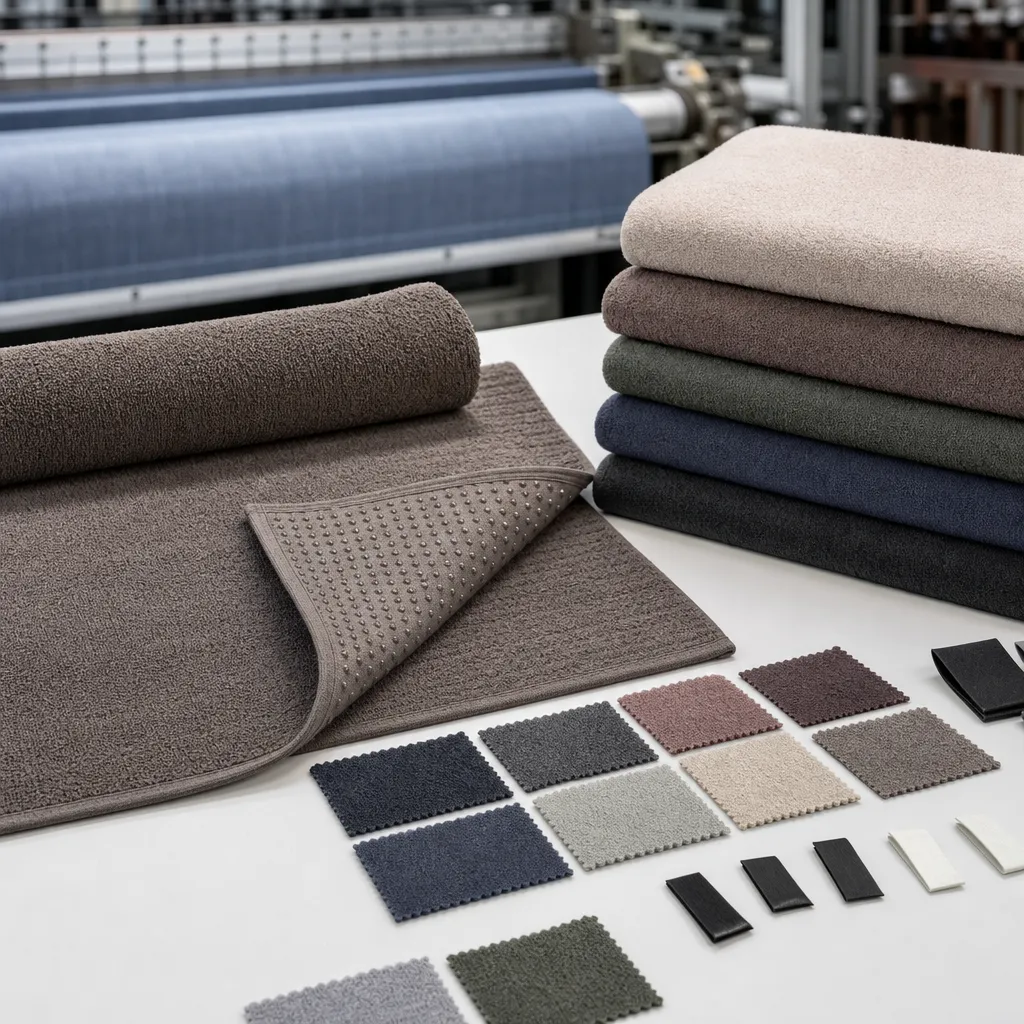
For hot yoga towel orders, we often use suede microfiber on the top face with a fine grid or silicone dot backing. The top face should not be too slick when dry, because many users begin class before sweating. We run a simple incline board check during development: dry towel on PU mat surface, damp towel after a 30 ml water spray, and towel after three wash cycles. It is not a public ISO standard, but it catches sliding behavior before the buyer spends money on photography samples.
| Material option | Best for | GSM range | Trade-off |
|---|---|---|---|
| Suede microfiber 80/20 | Retail yoga mat towel, hot yoga, travel towel | 220-300 GSM | Smooth hand; needs grip treatment for dry stability |
| Waffle microfiber | Pilates, spa-yoga crossover, compact kits | 240-320 GSM | Textured look; print detail is softer than suede |
| Cotton terry | Wellness sets, studio rental towels | 360-500 GSM | Absorbent and familiar; slower drying and heavier cartons |
| Cotton-poly blended terry | Mid-price studio programs | 320-430 GSM | Lower lint than cotton; less natural hand feel |
| Recycled polyester microfiber | Sustainability-led retail programs | 230-290 GSM | Requires careful color approval due to yarn shade variation |
Grip Systems: Silicone Dots, Pockets, or Plain Back
The biggest defect mode on a non slip yoga towel is not dramatic. It is small movement that repeats. A towel shifts 3 cm in downward dog, the user straightens it, then it shifts again. By the end of class, the brand feels poorly engineered even if the fabric is technically within spec.
For full-length towels, silicone dot backing is the most common solution. Dot diameter is usually 2.0-3.5 mm, with spacing from 8 to 14 mm depending on fabric weight. Too much silicone makes the towel stiff and harder to fold into retail packaging. Too little silicone saves about USD 0.10-0.18 per piece but can increase complaints in hot classes.
We cure silicone at controlled temperature and dwell time according to the paste supplier's sheet, then check adhesion after wash. Poor curing creates two problems: dots peel during laundering, or the backing leaves a faint tacky feel on the mat surface. Both are avoidable if bulk production is tested before packing.
- Silicone dot backing: best all-purpose grip system for studio and retail mat towels.
- Corner pockets: useful when all users have the same mat size, but risky for mixed retail customers.
- Elastic corner straps: practical for Pilates reformer towels, less clean for a fashion-led yoga accessory.
- Plain microfiber back: acceptable only for low-intensity use or when the towel is meant to be dampened before class.
Decoration That Survives Studio Use
Decoration needs to match how the towel is handled. A buyer may want a large tone-on-tone logo because it looks strong beside an alo yoga mat in e-commerce images. We can do that, but the method matters. Oversized embroidery on a mat towel creates hard areas under the palm and can curl after washing. A small woven label, sublimation print, jacquard texture, or low-profile heat transfer is usually better.
Sublimation gives the cleanest all-over artwork on polyester microfiber. It is strong for marble effects, tonal gradients, and studio collection colors. The limitation is fiber content: sublimation needs polyester on the printable face. If the towel has high cotton content, we move to reactive dyeing, yarn-dyed jacquard, embroidery, or label trim.
For a yoga towel that needs the same quiet retail feeling as premium custom yoga accessories, we prefer one of three decoration routes: tonal sublimation, small woven hem label, or jacquard logo panel at one short end. For a deeper comparison, our article on embroidery vs sublimation vs jacquard explains why the same artwork can behave very differently across towel constructions.
| Decoration method | Minimum practical order | Good fit | Risk to check |
|---|---|---|---|
| Sublimation print | 500 pcs per design/color | Full-face microfiber yoga towel artwork | Color shift under warm studio lighting |
| Woven hem label | 500 pcs | Quiet retail branding and capsule sets | Label edge must not scratch skin |
| Jacquard end panel | 800-1000 pcs | Tone-on-tone logo or repeat mark | Longer loom setup and less sharp small text |
| Embroidery | 500 pcs | Small monogram or club mark | Hard hand feel if logo exceeds 6 x 6 cm |
| Heat transfer | 500 pcs | Sharp small logo on microfiber | Cracking risk if film is too thick |
Color Approval Around the Alo Yoga Mat Look
The alo yoga mat palette buyers reference is usually restrained: black, chalk, espresso, mineral green, dusty pink, fog blue. These colors look simple, but they are easy to miss in dyeing because microfiber reflects light differently from PU mat surfaces. A color that matches under office LED can look flat in a yoga studio with warm ceiling light.
We ask buyers to approve lab dips or strike-offs under D65 daylight and TL84 store light. For Pantone-led programs, we keep a realistic tolerance of Delta E 1.0-1.5 for solid dyed microfiber and Delta E 1.5-2.5 for sublimation print, depending on shade. Deep black and muted clay colors need extra care because silicone backing can slightly change perceived color once the towel is folded.
- Send physical mat, Pantone TCX reference, or approved fabric swatch before lab dip.
- Confirm whether the towel should match the mat, contrast with it, or sit inside a seasonal collection.
- Approve color on the final fabric construction, not a loose polyester swatch.
- Check the sample after one wash, because pile direction and surface brushing change reflection.
- Lock packaging artwork only after towel shade is approved under the buyer's lighting condition.
If your team is building a color-controlled retail range, Pantone color matching custom towels is the better planning guide. It covers lab dip rounds, dye lot control, and why screenshots are not enough for factory approval.
Testing Plan Before Bulk Production
A yoga towel sits close to the face, gets soaked with sweat, touches skin, and is washed often. We treat that risk differently from a one-day promotional towel. For export programs, our factory can support OEKO-TEX Standard 100 Class I materials, BSCI social compliance, and ISO 9001 quality management. If the buyer is selling into children's wellness or family hotel programs, Class I gives the strongest material safety position.
Wash testing is where many low-cost towels fail. We use ISO 105-C06 for color fastness to domestic laundering where required, ISO 105-E04 for perspiration color fastness, and AATCC TM61 when the buyer's market asks for accelerated laundering. For silicone-backed towels, we also check dot adhesion after 10 wash cycles at 40 degrees C. Bulk cartons are inspected for size, shade, odor, stitching, label placement, and visible contamination before shipment.
- Target shrinkage after first wash: microfiber 2.5%-4.0%, cotton terry 4.0%-6.5%.
- Color fastness to washing: usually grade 4 or above for solid shades, depending on color depth.
- Perspiration fastness: grade 4 or above for yoga and gym use.
- Silicone adhesion: no obvious peeling after 10 wash cycles for approved grip designs.
- Needle inspection: required for many retail and hospitality customers before carton sealing.
The cheap version of this product often skips wash testing and uses a lower polyamide ratio. That may save USD 0.22-0.35 per piece at 2,000 pcs. If 9% of customers return a USD 24 retail towel because it slides or smells after washing, the savings disappear quickly. For studio rental, the math is even clearer: a USD 4.10 towel lasting 85 washes costs about USD 0.048 per use, while a USD 3.45 towel that loses grip after 38 washes costs about USD 0.091 per use before labor and replacement freight.
MOQ, Pricing, and Lead Time from Our Mill
Our MOQ is 500 pcs per design per color for custom towel production. That applies to most microfiber yoga towel programs with standard dyeing, sublimation, woven labels, and silicone backing. Jacquard or fully custom yarn-dyed constructions may need 800-1000 pcs because loom setup and yarn preparation are less flexible.
Sampling usually takes 7-12 days for solid dyed microfiber with label, 10-15 days for sublimation print, and 14-18 days if silicone backing and packaging both need approval. Bulk production is normally 25-35 days after deposit and approved pre-production sample. Add 4-7 days for third-party testing if your internal compliance team requires lab reports before shipment.
| Order volume | Typical FOB China price | Spec assumption | Production timing |
|---|---|---|---|
| 500-999 pcs | USD 4.35-6.20/pc | 183 x 68 cm, 250-290 GSM microfiber, label, simple packing | 30-38 days after approval |
| 1,000-2,999 pcs | USD 3.75-5.40/pc | Same size with silicone dot backing or sublimation artwork | 28-35 days after approval |
| 3,000-7,999 pcs | USD 3.25-4.85/pc | Retail-ready towel with belly band or pouch | 25-33 days after approval |
| 8,000+ pcs | USD 2.95-4.30/pc | Program pricing with reserved fabric and repeat artwork | 25-32 days after approval |
These bands move with yarn price, exchange rate, packaging, and test requirements. A drawstring pouch, FSC paper belly band, barcode sticker, and individual polybag can add USD 0.16-0.42 per piece. Air freight for a launch deadline can cost more than the towel margin, so we prefer to lock samples early and ship bulk by sea when the retail calendar allows it. For planning the freight side, see container vs air freight towel orders.
How to Brief the Factory Without Over-Specifying
A strong brief does not need 40 pages. It needs the right decisions in the right order: finished size, target user, fabric face, grip system, decoration method, color standard, packaging, compliance, and expected landed cost. If the buyer already sells mats, we also need the mat thickness and surface type because PU, TPE, rubber, and cork surfaces interact differently with silicone and microfiber.
- Send one physical benchmark mat or towel when possible, especially if your team is referencing an alo yoga mat finish.
- State whether the product is for retail resale, studio rental, event gifting, or hotel wellness kits.
- Give a target FOB range early. A USD 3.20 towel and a USD 5.20 towel are built differently.
- Confirm carton limits if your warehouse has weight restrictions. Full-length towels can make cartons heavy fast.
- Tell us whether OEKO-TEX 100 Class I, BSCI, ISO 9001 documents, or buyer-specific testing must be included in the first quote.
Related reads: For fabric trade-offs, start with microfiber vs cotton towel comparison and towel GSM decision framework. If your team is still building the buying file, build a towel tech pack that mills can quote will prevent most sampling delays.
Related reads: For adjacent wellness programs, see our guide to private label yoga towel OEM specs and the yoga and Pilates towel industry page. Buyers sourcing hand towels for studios can also review sweat towels for gym spec guide.
Build a Yoga Towel Spec That Holds Up
Send us your mat size, target GSM, artwork, color references, and order quantity. Our team will quote MOQ 500 pcs per design/color with realistic sampling, testing, and bulk timing. WhatsApp: +86 13205717266. Email: [email protected].
Request a Quote →