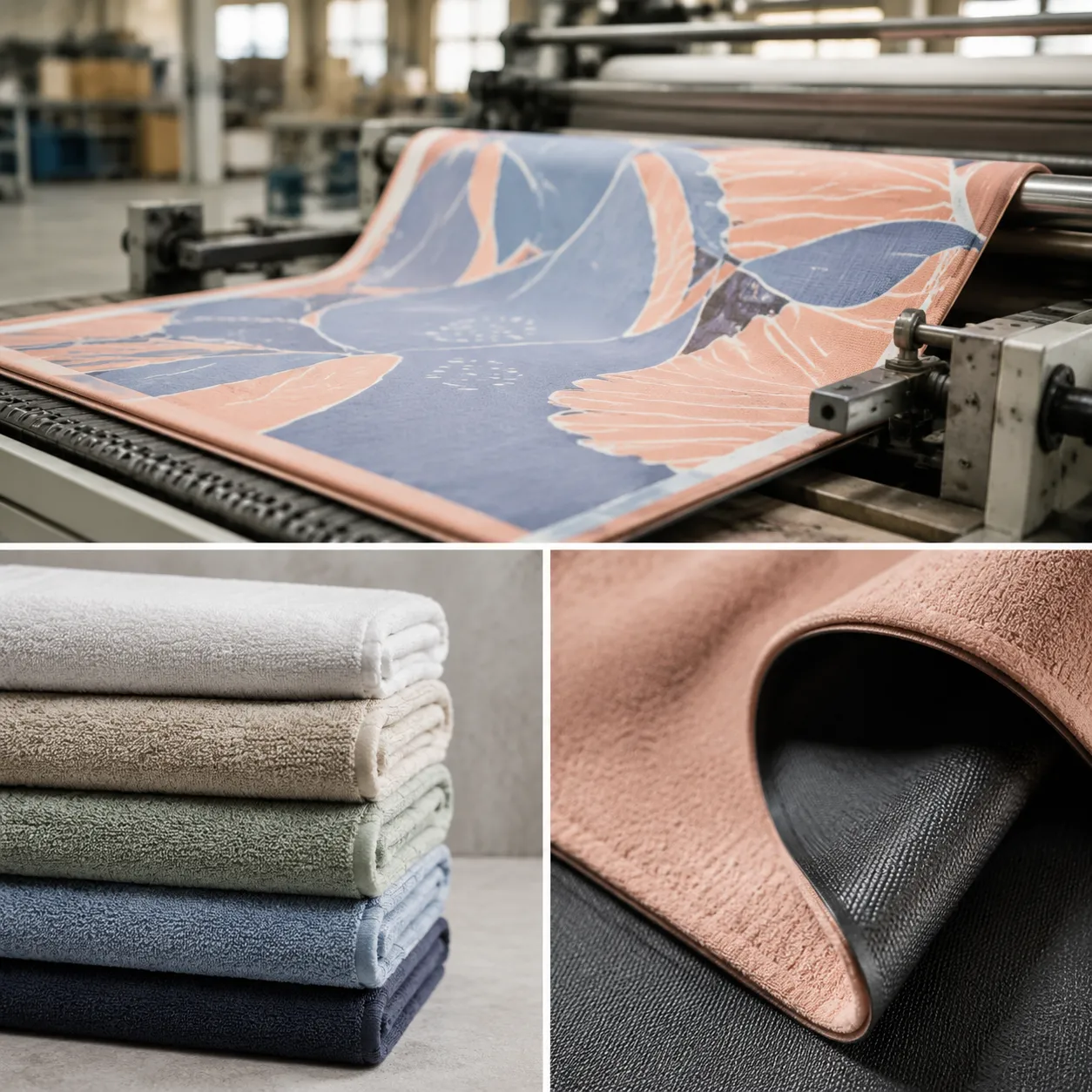
Start With The Failure Points, Not The Catalog Photo
For hair towels, buyers often compare color cards and pouch style first. In our mill meetings, we start with the parts that fail: the elastic loop, the button attachment, the narrow tail seam, edge binding around the forehead, and whether the microfiber keeps enough grip after repeated laundry. A towel that photographs well but slips off wet hair will create refund tickets faster than a bath towel with a slightly imperfect border.
Most OEM hair wraps are made from 180-320 GSM microfiber, usually 80/20 or 85/15 polyester-polyamide. The lower end works for travel kits and airline-style amenities. The middle range, around 220-260 GSM, is common for DTC haircare and salon retail. Above 280 GSM, the wrap feels more substantial but drying time increases, and carton weight rises quickly. We do not recommend chasing heavy GSM unless the brand position and retail price can carry it.
| Use case | Common GSM | Construction note | Factory concern |
|---|---|---|---|
| Travel or gift set | 180-210 GSM | Single-sided coral fleece or smooth microfiber | Can feel thin if the edge binding is too light |
| Salon retail wrap | 220-260 GSM | Coral fleece or fine plush, 80/20 blend | Needs stable loop recovery after steam pressing |
| Curly hair towel OEM program | 240-300 GSM | Low-friction plush or waffle microfiber | Avoid aggressive brushing that raises lint |
| Spa or hotel amenity | 200-240 GSM | Fast-dry microfiber with compact button | Packout must prevent button dents in fabric |
A practical supplier review should ask for the material data sheet, lab dip history, wash test record, and a stitched pre-production sample before any bulk cutting. The sample must be made on the same sewing line planned for production. A hand-made showroom sample does not tell us how the loop will behave at 3,000 pieces per shift.
Microfiber Hair Towels Supplier Checklist
This microfiber hair towels supplier checklist is the version we use when a buyer wants to compare factories without relying only on FOB price. It covers fabric, decoration, testing, order control, and the boring but important packout details that affect claims after delivery.
- Mill profile: confirm the supplier is cutting, sewing, inspecting, and packing in-house, or clearly identify which steps are subcontracted.
- Compliance: request OEKO-TEX Standard 100 Class I or Class II scope, BSCI audit status, and ISO 9001 quality management certificate.
- Fabric proof: ask for GSM tolerance, fiber ratio, yarn split description, shrinkage result, and colorfastness report before approving bulk.
- Button-loop proof: require pull strength records for button stitching and elastic loop recovery after wash.
- Shape control: approve a paper pattern with length, crown width, tail width, and loop position, not just a photo sample.
- Bulk inspection: use AQL 2.5 for major defects and AQL 4.0 for minor defects unless the brand has a stricter standard.
At LUMA & CO. TEXTILE, our normal MOQ is 500 pcs per design per color. That MOQ is realistic for custom colors, private label labels, and simple logo methods. Below 500 pcs, the dyeing minimum, label setup, and line change cost push the unit price up in a way that usually does not make sense for brand-side replenishment.
Fabric And GSM Lines That Need Written Limits
Microfiber hair wraps are sensitive to small fabric changes. A bath towel can hide some variation in pile height; a hair wrap cannot. If one side stretches more than the other, the tail twists. If the brushed face is too open, lint appears on dark hair. If the fabric is too slick, the wrap slides backward when the user moves around.
For private label hair towels, we normally quote GSM with a tolerance of plus or minus 5 percent after conditioning. Size tolerance is usually plus or minus 1.5 cm on length and plus or minus 1.0 cm on width after sewing. Shrinkage should be tested after three home-laundry cycles at 40 degrees C; for better programs, we also run five cycles before locking the pattern.
| Spec line | Recommended range | What to ask the supplier to show |
|---|---|---|
| Fiber composition | 80/20 or 85/15 polyester-polyamide | Blend declaration and fabric invoice consistency |
| GSM | 220-260 GSM for most retail wraps | GSM test from bulk fabric roll, not only sample yardage |
| Size before wash | Approx. 25-27 cm crown width, 62-68 cm length | Flat pattern drawing with seam allowance |
| Shrinkage | Within 3 percent lengthwise and widthwise | Wash record after 3 cycles at 40 degrees C |
| Colorfastness to washing | Grade 4 or better under ISO 105-C06 | Lab report by color family, especially black, burgundy, navy |
| Dimensional twist | Tail twist under 2 cm after wash | Washed sample laid flat against pattern board |
One construction quirk we watch closely is nap direction. If the cutter flips panels to save fabric, the crown and tail can reflect light differently, especially on blush, sage, or charcoal. We mark cutting direction on the marker plan for solid-color retail orders so the finished towel does not look like it was made from two dye lots.
Button, Loop, And Seam Tests Buyers Should Require
The button-loop system is where many low-cost wraps fail. A light plastic button saves only a few cents, but if the shank hole cuts the thread after repeated tension, the towel becomes unusable. For salon or curly hair programs, we prefer a low-profile resin button with cross-stitch attachment and a reinforced backing patch when the fabric is below 220 GSM.
Our internal button pull check uses a spring gauge. For most hair wraps, the button should hold at 70-90 N for 10 seconds without thread rupture or fabric tearing. Elastic loops should recover to at least 90 percent of original length after 20 stretch cycles. These are not expensive tests, but they reveal whether the sewing line is treating the wrap as a garment-like item instead of a simple towel.
- Check the button position against the approved pattern before bulk sewing starts.
- Pull-test button attachment from the first 50 finished pieces and record the result.
- Stretch the loop 20 times, then measure recovery after 60 seconds at rest.
- Wash three finished wraps and inspect button imprint marks, loose thread, and seam puckering.
- Open one failed sample, if any, to see whether the thread broke, the fabric tore, or the button cracked.
Edge binding also needs attention. A narrow overlock is cheaper, but it can curl against the forehead. Bound edges cost more because the sewing speed is slower and the operator must manage curves carefully. For retail programs, the extra USD 0.05-0.11 per piece is usually cheaper than handling returns about scratchy edges or distorted shape.
Absorbency, Friction, And Haircare Claims
Haircare brands sometimes ask for claims like anti-frizz, ultra-absorbent, or curly-hair safe. We are careful with those words because they need test support and user context. Microfiber can reduce surface water quickly, but the exact hand feel depends on pile height, filament split, and finishing. A towel that absorbs aggressively may also feel grippy on delicate curls if the face is brushed too hard.
For absorbency, we use a drop test as a quick production check and a sink time test for comparison between fabrics. In the drop test, 0.2 ml of water should disappear into the surface within 2-4 seconds on a 240 GSM coral fleece wrap. For a denser 300 GSM fabric, the first drop can sit longer if softener residue is present, so we also wash the sample once and retest.
| Quality point | Basic check | Stronger buyer requirement |
|---|---|---|
| Absorbency | Water drop disappears within 5 seconds | Sink time comparison after 1 wash and 5 washes |
| Surface friction | Hand check on wet hair swatch | Internal panel test against cotton terry control |
| Linting | Visual rub on black cloth | 10-cycle tumble check with lint weight record |
| Color transfer | Wet crocking check | ISO 105-X12 grade 4 or better for dark colors |
| Laundry durability | 3 wash cycles | 10 wash cycles with seam and loop review |
If the buyer plans to position the item for curly hair, we suggest sampling two constructions before bulk: a smooth low-pile microfiber and a fine plush microfiber. The smooth option packs smaller and glides better. The plush option absorbs faster and feels more familiar to consumers used to spa towels. The right choice depends on the brand promise, not only the material cost.
Logo, Label, And Private Label Decisions
Decoration on hair wraps is small, so placement matters more than size. A logo that looks balanced on a flat pattern may disappear when the towel is twisted. We normally place woven labels near the lower side seam, embroidery near the crown edge only when stitch count is low, and heat-transfer care labels inside the seam when the buyer wants a cleaner retail look.
- Woven label: reliable for brand identity, low risk in washing, usually USD 0.03-0.08 per piece depending on size and fold.
- Embroidery: suitable for initials or small marks, but dense logos can stiffen the crown area and pull the fabric.
- Heat-transfer label: clean appearance, but must pass wash adhesion checks before bulk.
- Hangtag and pouch: useful for retail, but pouch size must match the compressed towel instead of the showroom fold.
- Barcode sticker: should be tested on the outer pouch after carton compression so it does not curl during sea freight.
For decoration comparisons, buyers can also read our embroidery vs sublimation vs jacquard guide. For color approvals, Pantone color matching custom towels explains why lab dips on microfiber can shift under warm bathroom light.
FOB China Pricing And MOQ Reality
A supplier checklist should include price logic, not just a final number. For microfiber hair wraps, cost is driven by GSM, fabric width utilization, button and loop quality, label count, pouch style, inspection level, and carton packout. A very low quote often removes one of those controls without saying so.
| Order volume | Typical FOB China range | What is usually included |
|---|---|---|
| 500-999 pcs per color | USD 1.42-2.15 | Custom color surcharge may apply, simple label, bulk polybag |
| 1,000-2,999 pcs per color | USD 1.18-1.78 | Better fabric yield, woven label, standard button-loop QC |
| 3,000-7,999 pcs per color | USD 0.96-1.46 | Custom pouch or hangtag possible, more stable dye lot planning |
| 8,000+ pcs per color | USD 0.82-1.28 | Dedicated fabric batch, negotiated packout, stronger inline inspection coverage |
Here is a real cost-per-use way to think about it. A 230 GSM wrap at USD 1.05 FOB may pass three washes but lose loop recovery by wash 18. A 255 GSM wrap with a better elastic loop and resin button may cost USD 1.34 FOB and hold through 45 washes. If landed cost adds USD 0.29 per piece, the cheaper towel costs about USD 0.074 per use over 18 uses, while the stronger one costs about USD 0.036 per use over 45 uses. The higher FOB is not always the more expensive towel.
Our standard MOQ remains 500 pcs per design per color. For buyers trying to launch many shades, we usually recommend two core colors first, then reorder based on sell-through. The MOQ discussion is similar to the logic in negotiate towel MOQ without killing margin, but hair wraps are less forgiving because button and loop setup cannot be spread cleanly across too many small colors.
Timeline From RFQ To Shipment
A normal OEM hair towel order takes 36-55 days before vessel departure after artwork and deposit are complete. Fast projects can move quicker if the buyer accepts stock fabric colors and standard packaging. Custom dyed microfiber, custom woven labels, and retail pouches add time because each approval step has to be locked before bulk sewing.
- RFQ review and quote: 1-3 working days if size, GSM, color, label, and packout are clear.
- Lab dip or stock color confirmation: 4-8 days for dyed fabric, 1-2 days for available colors.
- Proto sample: 5-9 days after fabric and trim confirmation.
- Pre-production sample with final label and packaging: 6-10 days after comments are received.
- Bulk fabric dyeing and finishing: 9-16 days depending on color depth and order volume.
- Cutting, sewing, inline QC, and packing: 8-14 days for 1,000-8,000 pcs.
- Final inspection and export booking: 3-6 days before handover to forwarder.
For air shipment, hair wraps are compact enough that freight can be reasonable for urgent launches. For sea shipment, carton compression and moisture control matter more. We use export cartons with 5-ply board for heavier retail packouts and keep gross weight commonly under 16 kg per carton so the carton does not deform in handling. Buyers comparing air and ocean planning can use container vs air freight towel orders for a broader freight framework.
Factory Audit Questions That Expose Real Capability
A microfiber hair wrap is not technically difficult, but consistency is difficult when the supplier treats it like a low-value accessory. During a supplier audit, buyers should look at the fabric warehouse, cutting table, sewing attachments, needle control, metal detection if required, inline inspection records, and how rejected pieces are separated. We also recommend asking who owns the pattern file and whether revisions are logged after sample approval.
- Ask to see the cutting marker for your shape and confirm nap direction is marked.
- Check whether operators use a seam guide for the curved crown section.
- Review broken-needle policy and finished-goods needle detection if the product is for hotel or children-adjacent retail.
- Ask for the last three inline QC reports on similar microfiber wraps, not bath towels.
- Confirm the supplier can keep shade lots separated from sewing through final carton labeling.
- Request a retained sample system so future reorders are compared against the same approved standard.
Certification scope also matters. OEKO-TEX Standard 100 should match the fabric or finished article category being supplied. BSCI tells us something about social compliance. ISO 9001 tells us the factory has a documented quality system, but it does not prove the towel is good by itself. Buyers should read certificates carefully; our article on how to read an OEKO-TEX certificate covers the common traps.
Final Inspection Before You Release Balance
For finished microfiber hair towels, final inspection should not be limited to carton count. Pull out samples across cartons and colors, then check shape, loop position, button strength, odor, shade consistency, label placement, loose threads, stain, lint, and packout. We use AQL sampling, but we add functional checks because one failed loop can matter more than several small thread ends.
- Measure at least 13 pieces across the lot for size and compare with the approved tolerance.
- Run button pull checks on random units from different sewing bundles.
- Wash a retained sample from each color if the bulk schedule allows pre-shipment laundry verification.
- Check pouch barcode scan rate after cartons have been closed for at least 12 hours.
- Open bottom cartons as well as top cartons to check compression marks and moisture exposure.
Related reads: buyers building a wider microfiber program can compare specifications in custom microfiber towels wholesale guide and microfiber vs cotton towel comparison. For RFQ preparation, build towel tech pack that mills can quote is the fastest way to reduce back-and-forth before sampling.
LUMA & CO. TEXTILE is a 220-employee towel mill operating since 2007, with about 2.4 million towels produced annually for 80+ brand clients across 47 countries. For microfiber hair towels, we can quote OEM programs from 500 pcs per design per color, with OEKO-TEX 100, BSCI, and ISO 9001 documentation available for qualified orders. Send the spec sheet, target retail channel, quantity by color, packaging requirement, and delivery window to [email protected] or WhatsApp +86 13205717266.
Build A Hair Towel Supplier Checklist
Send us your GSM, size, loop style, packaging, and target order quantity. We will return a practical OEM quote with sample timing, FOB range, and QC points to approve before bulk.
Request a Quote →