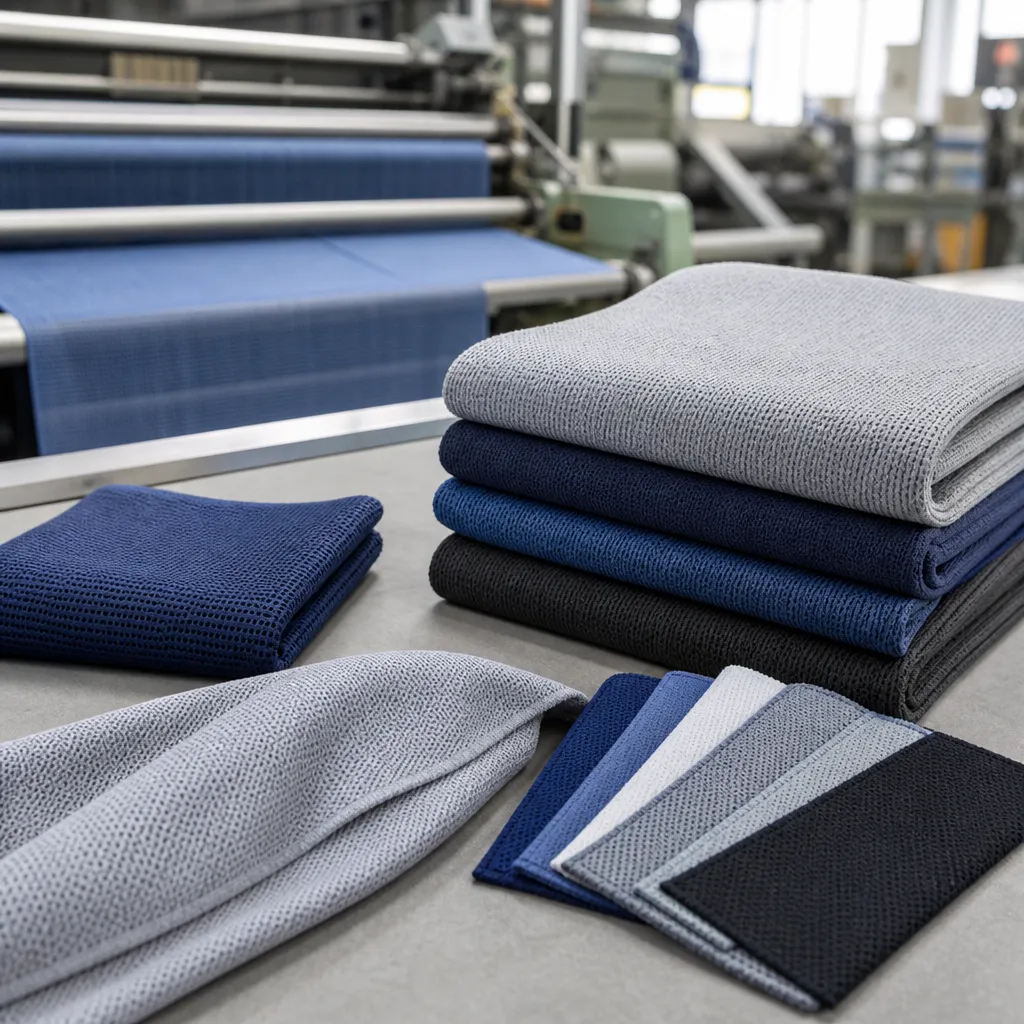
Start with the use case, not the color card
The fastest way to buy the wrong cloth is to ask for "a microfiber cloth" without naming the surface, soil load, and wash cycle. A cloth for optical lenses, a cloth for auto interiors, and a cloth for household retail multipacks may all use polyester/polyamide microfiber, but they do not behave the same in absorbency, drag, pile recovery, or edge wear. We usually begin with five questions: what surface it touches, whether it must absorb or only wipe, whether printing is required, how many industrial or domestic wash cycles it must survive, and what pack format the buyer needs.
- For glass and screens, buyers usually need low-drag suede or tight short-pile knit at about 180-230 GSM with low lint release.
- For auto detailing interiors, short terry or pearl weave at roughly 250-320 GSM is more forgiving on dust pickup and hand feel.
- For kitchen and household multipurpose, 260-340 GSM warp knit cloths give better bulk and perceived value at retail.
- For promotional giveaway cloths, printability and low unit cost matter more than deep pile, so 170-220 GSM suede is common.
- For electronics or eyewear, edge bulk is often the failure point, so ultrasonic cut or very fine overlock matters more than GSM alone.
| End use | Typical construction | Working GSM | Most common risk |
|---|---|---|---|
| Eyewear / screens | Suede knit | 180-210 | Edge abrasion or logo cracking |
| Glass cleaning | Short-pile warp knit | 190-230 | Drag after washing |
| Auto interior | Short terry | 260-300 | Linting on piano-black trim |
| Household multipurpose | Warp knit terry | 280-340 | Shrinkage and skew |
| Retail gift / promo | Printed suede | 170-220 | Color transfer and weak hand feel |
The fabric decision in any microfiber cloth 2026 buyer guide
The core spec is not just GSM. It is knit type plus fiber split quality plus blend ratio. Buyers often compare a 230 GSM suede cloth and a 230 GSM terry cloth as if they are equivalent. They are not. The suede version gives cleaner logo printing and lower surface drag on glass. The terry version gives more bulk and better particle pickup. We sample both when the buyer is undecided because hand feel in a PDF is meaningless.
For blend, the most common starting points are 80/20 and 85/15 polyester/polyamide. More polyamide usually improves softness and water uptake, but it also raises cost. In our production, buyers who chase the lowest piece price often approve a high-polyester cloth that looks acceptable at first touch but becomes harsh after repeated laundering. For high-contact surfaces such as car interiors or camera screens, that saving is usually false economy.
| Construction | What it does well | What to watch | Typical FOB China price |
|---|---|---|---|
| 170-190 GSM suede | Sharp print definition, low bulk, low freight weight | Feels thin if sold as retail premium | USD 0.16-0.24 per pc at 20,000 pcs |
| 200-230 GSM short warp knit | Good glass wipe, stable shape, low lint | Less plush than terry | USD 0.21-0.31 per pc at 15,000 pcs |
| 260-300 GSM short terry | Better pickup, fuller hand, versatile | Can snag if loop definition is loose | USD 0.28-0.41 per pc at 12,000 pcs |
| 300-340 GSM pearl / dense terry | Retail weight perception, stronger absorbency | Higher drying time and carton weight | USD 0.35-0.52 per pc at 10,000 pcs |
Edge finish is where many claims fall apart
Two cloths with the same body fabric can perform very differently because of the edge. On delicate surfaces, the edge touches first. On low-cost bulk orders, we see buyers approve body fabric and ignore edge method, then complain about micro-scratching or curling. The three common routes are overlock, turned hem, and ultrasonic cut. Each has a place.
- Overlock edge is the most economical and durable for household cloths, but the seam ridge is not ideal for optics or glossy trim.
- Turned hem improves appearance for retail packs, yet adds corner bulk and can distort if stitch tension is not balanced.
- Ultrasonic cut gives a flat edgeless profile for sensitive surfaces, but only works well when the fabric structure and split microfiber are compatible with heat sealing.
A topic-specific issue here is edge beading after laundering. On some low-denier suede programs, an aggressive ultrasonic setting hardens the edge line. After 15-20 washes, that line can feel wiry even if the center panel stays soft. Another issue is seam grin on overlocked corners: when stitch density is too open, the corner pulls apart visually and buyers read it as poor quality, even if tensile strength is still acceptable.
| Edge option | Best for | Added cost impact | QC checkpoint |
|---|---|---|---|
| Overlock | Multipurpose and auto interior cloths | Lowest | SPI consistency and corner closure |
| Turned hem | Retail gift sets and branded packs | Medium | Flatness after wash and corner squareness |
| Ultrasonic cut | Lens, screen, glass, gloss-sensitive use | Medium to high | Seal hardness and edge lint under rub test |
Size tolerance matters more than buyers expect
A microfiber cloth listed as 30 x 30 cm can legally exist in a range unless the purchase order fixes tolerance. We normally quote with a cut-size tolerance and a post-wash tolerance separately. For suede cleaning cloths, buyers often want neat folded presentation, so even a 1.2 cm diagonal skew becomes visible in the pack. For terry cloths, size consistency affects stack height and carton fill more than shelf appearance.
- State cut size and whether measurement is before or after washing.
- Set a tolerance such as ±2% for bulk and tighter only if truly needed.
- Define whether the cloth is measured relaxed, folded, or tensioned flat.
- If the cloth is printed, confirm whether artwork registration must align with final folded pack position.
One process detail buyers rarely ask about is heat-set behavior. Polyester-rich microfiber can look dimensionally stable on day one, then relax after the first wash if heat setting was rushed. That is why we compare loom-state size, finishing-state size, and post-laundry size during sampling instead of relying on finished-goods measurement alone.
How we test before bulk approval
If we were buying for a brand in 2026, we would not approve on hand feel alone. We would require a short lab and wash sequence tied to the intended use. For colorfastness, common references include ISO 105-C06 for domestic laundering and ISO 105-X12 for rubbing. For dimensional change after washing, ISO 5077 is widely understood. For pH on finished textiles, ISO 3071 is standard and useful when cloths contact skin or screens handled constantly.
- Run lint check on dark gloss surface under angled light, not only on white table background.
- Do a drag test on glass after 5 and 15 wash cycles, because many cloths pass new but fail after detergent buildup and pile collapse.
- Check color transfer wet and dry if the cloth is navy, red, black, or heavily printed.
- Measure dimensional change after wash and tumble or line dry, matching the real care route.
- Confirm absorbency pickup time if the cloth is positioned as drying or spill-cleaning rather than dusting.
A soft cloth is not automatically a safe cloth. On sensitive surfaces, edge hardness, lint release, and wash drift matter more than first-touch softness.
Pricing bands: what changes the unit cost
Buyers usually focus on GSM and miss the cost drivers that move a quote by 15-30%. In microfiber, the biggest shifts come from blend ratio, knit density, edge finish, print route, and packing. A plain 30 x 30 cm cloth in 200 GSM suede packed in bulk PE bags prices very differently from a 40 x 40 cm edgeless terry cloth with barcode sticker, belly band, and insert card.
| Spec scenario | MOQ | FOB China price | Notes |
|---|---|---|---|
| 30 x 30 cm, 180 GSM suede, overlock, 1-color print | 20,000 pcs | USD 0.18-0.27 | Promo or optical cleaning use |
| 30 x 30 cm, 210 GSM suede, ultrasonic cut, full print | 15,000 pcs | USD 0.24-0.36 | Better for screen and lens retail |
| 40 x 40 cm, 280 GSM terry, overlock, solid dyed | 12,000 pcs | USD 0.31-0.46 | Multipurpose or auto interior |
| 40 x 60 cm, 320 GSM dense terry, turned hem, hangtag | 8,000 pcs | USD 0.52-0.78 | Retail shelf program |
MOQ at our mill is usually 500 pcs per design per color for towel programs, but microfiber cloth economics become more efficient above that level only when packing is simple and greige availability matches the spec. For printed or retail-packed programs, practical MOQs are often higher because setup cost spreads poorly over very short runs. If a buyer wants six colorways at 700 pcs each with custom belly bands, the packaging line will drive cost faster than the fabric does.
Related reads: if you are still deciding between wiping performance and absorbency, compare microfiber-vs-cotton-towel-comparison and custom-microfiber-towels-wholesale-guide. For RFQ structure that mills can actually quote, use build-towel-tech-pack-that-mills-can-quote.
Lead times buyers should plan around
Lead time depends less on sewing than on material readiness, printing queue, and packaging complexity. For stock-color plain cloths with simple overlock and bulk packing, production can move quickly. For Pantone-matched dyed cloths with printed artwork and retail insertion, the calendar stretches.
- RFQ and spec confirmation: 2-4 days
- Proto or material swatch: 5-8 days
- Printed sample or pre-production sample: 7-12 days
- Bulk fabric and finishing: 18-28 days
- Sewing, packing, final inspection: 6-10 days
- Booking and export handoff: 3-7 days
A realistic total is around 28-40 days for straightforward programs and 40-55 days for complex retail-packed orders. If shipment is urgent, read container-vs-air-freight-towel-orders. We also tell buyers to freeze carton count assumptions early, because last-minute retail pack changes can add several days even when the cloth itself is finished.
Common failure modes in 2026 sourcing
The same defects keep appearing across microfiber programs, and most are preventable at spec stage. In this microfiber cloth 2026 buyer guide, these are the issues we would flag first during sample review.
- False GSM confidence: fabric meets GSM but uses looser structure, so pickup is weak and hand feel collapses after wash.
- Pile direction mismatch: printed lots show shade variation because nap orientation differs panel to panel.
- Crooked cutting on suede: cloth looks acceptable unfolded, then misaligns badly in retail stack.
- Edge dusting: cut edge sheds fine filaments during first use because sealing or overlock tension is unstable.
- Over-softener finish: sample feels great initially but leaves streaking on glass after laundering.
Two technical checks help here. First, compare fabric weight and area together, not separately; a heavy cloth with unstable width can still deliver inconsistent pieces. Second, ask for a wash-retained hand-feel sample, not only a fresh production swatch. We often wash trial cloths in-house because some finishing lubricants hide real performance in the approval stage.
What a usable RFQ should include
A mill can quote quickly when the RFQ is written like a specification sheet rather than a mood board. Buyers who send only a photo usually get broad price ranges and more revision rounds. Buyers who send the fields below usually get a stable quote in one pass.
- End use and target surface: glass, lens, auto interior, household, electronics
- Fabric construction: suede, short terry, pearl weave, warp knit
- Blend ratio target: for example 80/20 or 85/15 polyester/polyamide
- Finished size with tolerance and pre- or post-wash basis
- Target GSM with acceptable variance
- Edge finish: overlock, hemmed, ultrasonic cut
- Color route: stock color, Pantone match, or full print
- Branding: woven label, print, emboss, insert card, barcode
- Packing format and master carton target
- Required test standards and inspection level
Related reads: for color approval, see pantone-color-matching-custom-towels. For MOQ trade-offs, read negotiate-towel-moq-without-killing-margin. If you need a broader sourcing framework, microfiber-cleaning-towels-oem-guide is also useful.
Our practical recommendation for most buyers
If the program is still open and the buyer wants the safest middle path, we usually recommend starting with a 40 x 40 cm cloth in 80/20 blend, 260-290 GSM short terry or tight warp knit, with a clean overlock for general-purpose use. That profile balances cost, wash life, pickup, and freight efficiency. For glass- or screen-specific use, move down in GSM and switch to suede or a tighter low-drag knit with ultrasonic cut if the surface is sensitive.
The point is not to buy the cheapest square of microfiber. It is to buy a cloth that survives the buyer's real use cycle. A cloth that costs USD 0.07 less but leaves lint on black trim, loses shape after six washes, or triggers repacking due to crooked cuts becomes the expensive option very quickly.
Need a microfiber cloth quote that is spec-accurate?
Send your target use, size, GSM, edge finish, and packing format. We will quote with realistic MOQ, testing checkpoints, and production timing. WhatsApp: +86 13205717266 | Email: [email protected]
Request a quote →