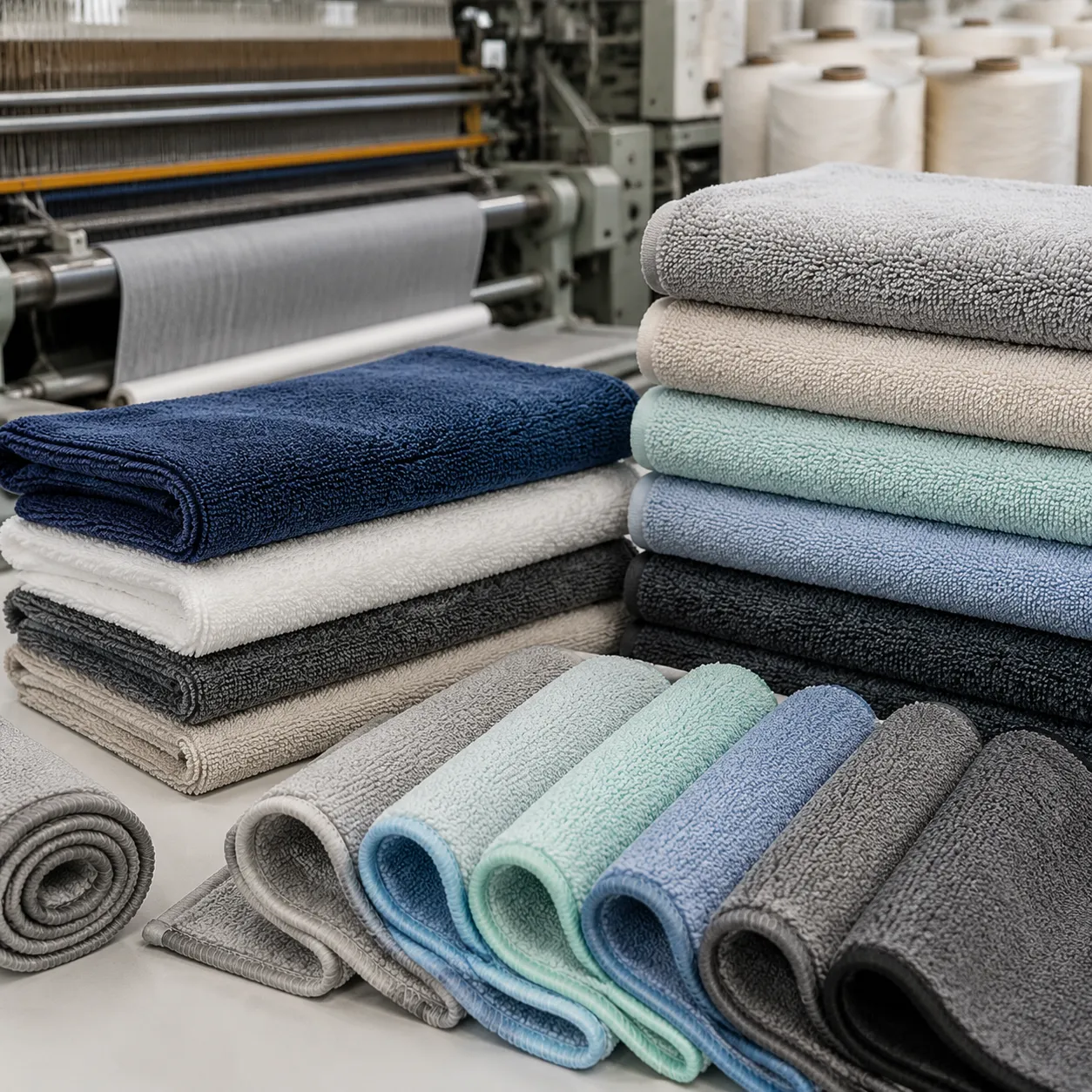
What Actually Moves the Microfiber Cleaning Towel Bulk Pricing Model
For cotton towels, buyers usually start with size and GSM. For microfiber cleaning towels, those two lines are still important, but they do not explain enough. The price changes sharply when the yarn is 80/20 versus 70/30 polyester-polyamide, when the edge is overlocked versus ultrasonic cut, and when the towel must pass lint testing for glass or paintwork rather than general janitorial wiping.
We manufacture microfiber towels for auto-detailing kits, janitorial distributors, retail cleaning bundles, hotel housekeeping carts, and private label e-commerce programs. The same 40×40 cm size can land in very different price bands because its job is different. A glass cloth needs low-lint performance and a flatter face. A drying towel needs a higher pile and more absorbency. A general cleaning cloth can use a simpler warp-knit construction if the buyer accepts shorter service life.
| Cost driver | Low-cost choice | Higher-cost choice | Why it changes price |
|---|---|---|---|
| Fiber split | 80/20 polyester-polyamide | 70/30 polyester-polyamide | More polyamide improves absorbency and softness but raises yarn cost |
| GSM | 180-220 GSM | 300-420 GSM | Higher pile weight increases yarn consumption and slower drying in finishing |
| Edge | Standard overlock | Edgeless ultrasonic cut | Ultrasonic cutting reduces scratch risk but adds process control and trimming loss |
| Dyeing | Stock color batch | Custom Pantone match | Lab dip, shade approval, and smaller dye lots add time and cost |
| Inspection | AQL 2.5 visual | AQL 1.5 plus lint check | More rejection and rework must be priced into bulk production |
| Packout | Bulk 50 pcs/polybag | Retail belly band or insert card | Labor, paper printing, barcode control, and carton sorting add unit cost |
Our MOQ remains 500 pcs per design / per color, but that does not mean 500 pcs will carry the same price as 20,000 pcs. At small volume, dyeing, cutting setup, packaging setup, and inspection time are spread over fewer pieces. For realistic costing, we quote by construction and by packout, not only by towel size.
Start With the Use Case, Not the Lowest Unit Price
A cheap cloth can be correct if it is going into a one-time promotional cleaning kit. It is usually wrong for detailing, housekeeping, or industrial accounts where the towel is washed weekly. In our RFQ review, we first ask where the towel will be used, how it will be laundered, and whether it will touch glass, paint, stainless steel, screens, or only hard surfaces.
- Retail cleaning bundle: 230-280 GSM, 80/20 split, bright colors, folded with belly band or printed insert card.
- Janitorial route supply: 250-320 GSM, color-coded by task, overlocked edge, bulk carton packout, barcode optional.
- Auto detailing cloth: 300-420 GSM, 70/30 or high-grade 80/20 split, edgeless or silk edge, lint and scratch checks required.
- Glass and screen cloth: 200-260 GSM, tighter knit or suede-style surface, low lint, packed cleanly to avoid loose fiber contamination.
- Hotel housekeeping cloth: 260-300 GSM, color-coded system, wash durability more important than retail packaging.
This is where a practical microfiber cleaning towel bulk pricing model protects the buyer. A 220 GSM cloth at USD 0.39 might survive 25 commercial washes before the edge curls or the pile compacts. A 300 GSM towel at USD 0.66 might reach 70 washes in the same laundry program. If a janitorial account uses 6,000 pieces and each cloth is used once per day before laundering, the cheaper towel can cost about USD 0.0156 per use while the stronger cloth sits near USD 0.0094 per use. That difference is not visible on the PO line, but it is visible in reorders and complaints.
Price Bands We See by Size, GSM, and Volume
The following bands are factory-side estimates for OEM microfiber cleaning towels shipped from China, excluding international freight, duty, and importer margin. They assume OEKO-TEX Standard 100 Class I compliant inputs where requested, BSCI-audited production environment, and ISO 9001 quality procedures. Actual pricing moves with exchange rate, yarn market, packaging artwork, color count, and inspection standard.
| Spec example | 500-999 pcs | 1,000-4,999 pcs | 5,000-19,999 pcs | 20,000+ pcs |
|---|---|---|---|---|
| 30×30 cm, 220 GSM, 80/20, overlock | USD 0.28-0.40 | USD 0.22-0.34 | USD 0.18-0.28 | USD 0.16-0.24 |
| 40×40 cm, 250 GSM, 80/20, overlock | USD 0.48-0.68 | USD 0.40-0.58 | USD 0.34-0.49 | USD 0.30-0.43 |
| 40×40 cm, 320 GSM, 80/20, overlock | USD 0.62-0.88 | USD 0.54-0.76 | USD 0.46-0.65 | USD 0.41-0.58 |
| 40×40 cm, 360 GSM, 70/30, edgeless | USD 0.84-1.18 | USD 0.74-1.02 | USD 0.63-0.88 | USD 0.56-0.78 |
| 50×80 cm, 420 GSM, 70/30 drying towel | USD 2.15-2.95 | USD 1.86-2.52 | USD 1.58-2.18 | USD 1.42-1.95 |
For wholesale microfiber cleaning cloths, we normally recommend separating the RFQ into base towel cost, decoration cost, and packaging cost. Otherwise the buyer cannot see whether a high quote is caused by the textile or by a retail-ready packout. This matters for retailers that need UPC labels and carton assortments, but it also matters for janitorial buyers who only need bulk bags.
For comparison with cotton and microfiber applications outside cleaning, buyers often read microfiber vs cotton towel comparison, custom microfiber towels wholesale guide, and auto-detailing microfiber towel program before finalizing the first RFQ.
Yarn Split and Knitting Choices Buyers Often Miss
Most buyers know the words 80/20 and 70/30, but fewer buyers connect them to performance and pricing. The first number is polyester, which gives structure and cleaning bite. The second is polyamide, which helps absorbency and softness. A 70/30 towel is not automatically better for every program. It is better when the cloth needs a softer hand, higher liquid uptake, or safer contact with delicate surfaces.
The splitting process is also important. Microfiber is not only thin yarn; it is split during finishing so the fiber creates wedge-shaped channels that pick up dust and liquid. A poorly split microfiber towel feels smooth in the hand but pushes moisture around. We check absorbency with a drop test and capillary uptake observation after finishing, then confirm wash behavior from bulk-lot samples. For glass cloths, we also check lint transfer against a dark panel and under angled light.
| Construction decision | Best fit | Factory note |
|---|---|---|
| 80/20 warp-knit terry, 220-280 GSM | General cleaning, promo kits, housekeeping color coding | Good balance of cost and performance; avoid very loose pile if laundering is aggressive |
| 70/30 terry, 300-380 GSM | Auto-detailing, polished metal, higher-end retail packs | Higher yarn cost but better absorbency and softer surface |
| Suede microfiber, 200-250 GSM | Screens, lenses, glass, appliance panels | Needs tighter lint control; decoration should be minimal or on packaging |
| Waffle microfiber, 300-400 GSM | Drying, kitchen, car wash, spill pickup | Texture improves pickup but can snag if loops are not stable |
| Twisted-loop microfiber, 500-900 GSM | Car drying towels and high-absorbency kits | Too heavy for most janitorial budgets; carton cube and drying time increase |
One construction quirk: edgeless towels require more stable fabric because the cut edge cannot hide yarn instability. If the knit tension is uneven, the ultrasonic knife may seal one side cleanly and leave feathering on another. That feathering becomes lint after washing. We normally run edge inspection after cutting and again after tumble finishing, not only after sewing.
Edges, Labels, and Decoration Add More Than Buyers Expect
On microfiber cleaning towels, decoration is usually more sensitive than on cotton. Embroidery can make sense for a retail logo towel, but it adds a thread path that can scratch delicate surfaces and stiffen the corner. Heat transfer labels look clean, but poor adhesive can crack after 20-30 hot washes. Woven labels are durable, but the edge and label placement must avoid the working face if the towel will be used on paint or glass.
- Standard overlock: lowest-cost edge, strong enough for janitorial and hotel housekeeping use, but the thread may pick up debris.
- Silk or satin border: smoother contact edge for detailing towels, adds sewing cost and raises QC requirements for puckering.
- Edgeless ultrasonic cut: common for scratch-sensitive detailing cloths; cutting speed and sealing temperature must be controlled.
- Corner label: acceptable for retail branding, but specify size under 25×35 mm when towels are used on cars or glass.
- Printed polybag or insert card: often cheaper than decorating every towel when brand visibility is needed at retail shelf level.
If the brand wants a visible logo, we often push the logo to the package for cleaning cloth programs. A four-pack belly band, kraft sleeve, or printed insert can carry the brand story without changing towel performance. For more detailed decoration trade-offs, embroidery vs sublimation vs jacquard is useful, although microfiber cleaning cloths have stricter scratch and lint considerations than bath or beach towels.
Packout Can Change the Landed Cost by 8-22%
Retail and distributor buyers sometimes compare base towel quotes without matching packout. A towel packed 100 pcs per master carton in two inner polybags is not the same job as a 3-piece color set with printed belly band, suffocation-warning polybag, UPC sticker, carton side mark, and mixed-SKU pallet plan. The towel may be identical, but the factory labor and paper cost are not.
| Packout type | Typical add-on cost | Best for | Operational risk |
|---|---|---|---|
| Bulk pack, 50-100 pcs/polybag | USD 0.01-0.035 per towel | Janitorial distributors, hotel housekeeping | Low risk; carton weight must stay manageable |
| Individual clear polybag | USD 0.025-0.06 per towel | E-commerce replacement packs | Static and trapped lint must be controlled before sealing |
| 3-pack or 5-pack belly band | USD 0.055-0.14 per towel equivalent | Retail cleaning sets | Manual folding consistency affects shelf appearance |
| Printed insert card plus barcode sticker | USD 0.04-0.10 per towel | Private label microfiber towels | Artwork approval and barcode position must be locked before bulk |
| Assorted color carton sorting | USD 0.015-0.05 per towel | Color-coded cleaning systems | Picking errors occur if carton marks are not simple |
Carton design also affects freight. Microfiber is lighter than cotton, but high-pile towels trap air. A 40×40 cm 320 GSM cloth can cube out before it weighs out when packed loosely. For export cartons, we usually keep gross weight around 12-18 kg for handling and adjust pieces per carton after a compression and recovery check. Over-compressed towels look smaller when the customer opens the carton and can hold creases that take one wash to relax.
For logistics planning, container vs air freight towel orders explains why air shipment can erase the savings of a low factory price, especially when the towel is bulky but not high-value per carton.
MOQ, Color Count, and Sample Timing
Our standard MOQ is 500 pcs per design / per color. For microfiber programs, color count is often the hidden MOQ problem. A buyer may ask for 2,000 pieces total, but if the order is split into eight colors, that becomes 250 pieces per color and does not cover dyeing and cutting setup efficiently. For color-coded cleaning systems, we recommend building around four colors first: blue, green, red, and yellow. Extra shades can be added once the reorder pattern is visible.
- Send a tech pack with size, GSM, fiber split, edge, color, packout, and wash target. A photo alone is not enough for accurate costing.
- Approve lab dips or stock color cards. Custom Pantone shades usually add 3-6 days before sample sewing.
- Review pre-production samples for hand feel, edge stability, lint, absorbency, and folded pack appearance.
- Confirm carton marks, barcode files, and polybag warnings before bulk material is cut.
- Run bulk inspection under ISO 9001 procedures with AQL level agreed in the PO, usually AQL 2.5 for major defects and AQL 4.0 for minor defects unless the buyer requires stricter control.
A realistic timeline is 5-9 days for quotation and material confirmation when the spec is clear, 7-14 days for samples depending on color and packout, 18-30 days for bulk production after sample approval and deposit, and 5-8 days for final inspection, carton correction if needed, and export document preparation. During peak months, dyeing capacity and packaging print lead time matter more than sewing capacity.
QC Standards That Belong in the PO
Microfiber cleaning towels fail in different ways than bath towels. A bath towel complaint is often about softness, shrinkage, or shade. A cleaning cloth complaint is often about lint, edge unraveling, bleeding color, odor after washing, or scratching a surface. The PO should define the test method or at least the acceptance condition, not only say 'good quality'.
- GSM tolerance: specify target GSM with acceptable range, usually ±5% for repeatable bulk orders.
- Size tolerance: use ±2 cm for general cleaning cloths and tighter ±1 cm when retail pack folding must align.
- Colorfastness: request ISO 105-C06 washing and ISO 105-X12 rubbing where color transfer risk matters.
- Absorbency check: define a simple drop test time or buyer-approved reference sample for side-by-side comparison.
- Lint control: inspect against black glass or a dark acrylic panel after shaking and wiping; this is especially important for glass and auto-detailing towels.
- Restricted substances: request OEKO-TEX Standard 100 Class I or equivalent input control if the towel may contact skin, children, or household surfaces.
We operate under ISO 9001 quality management and BSCI social compliance, and we can produce with OEKO-TEX 100 Class I certified materials when requested. Buyers should still ask to see the certificate scope, product category, and expiry date. The article how to read OEKO-TEX certificate helps procurement teams avoid accepting a certificate that covers a different material or supplier.
For microfiber, a clean edge and a low-lint finish are not cosmetic details. They decide whether the towel becomes a repeat program or a one-season complaint file.
How We Build a Quote That Finance Can Compare
A useful quote should let your finance team compare apples to apples. We normally separate textile cost, decoration, packaging, inspection requirement, and estimated carton data. If a supplier refuses to separate those lines, the buyer cannot see whether the savings came from lighter GSM, cheaper edge sewing, looser inspection, or fewer packaging steps.
- Ask for net towel weight and GSM, not only size. This catches underweight substitutions before production.
- List the fiber split as 80/20 or 70/30 and confirm whether the yarn is properly split microfiber after finishing.
- Define edge type and thread color. Overlock thread can bleed or contrast badly if it is not matched.
- Confirm packout math: pieces per inner bag, inner bags per carton, carton dimensions, gross weight, and barcode placement.
- Lock the wash target. A promo cloth may need 10-15 washes; a commercial cleaning cloth should be spec'd for 50-80 washes depending on laundry chemistry.
- Set the reorder plan. If you need the same shade again, reserve the color standard and keep a sealed approval sample.
For buyers building their first RFQ, build towel tech pack that mills can quote and negotiate towel MOQ without killing margin are practical references. They help avoid the common problem where three suppliers quote three different towels under the same product name.
A Practical Target Spec for First Orders
If a buyer is unsure where to start, we usually recommend a mid-range spec instead of chasing the cheapest cloth. For a general cleaning or janitorial program, a 40×40 cm towel at 280-300 GSM, 80/20 split, overlocked edge, four-color system, and bulk carton pack is a stable first order. It is strong enough for repeat laundering but not so expensive that the distributor struggles to sell it.
For auto-detailing or scratch-sensitive retail, move to 320-380 GSM, consider 70/30 split, and choose edgeless ultrasonic cutting or a soft border. For glass and screen cloths, reduce pile height and focus on lint control. For e-commerce kits, decide packaging early because packout can take longer than the towel itself once printed cards and barcode approvals are involved.
For current production, realistic bulk pricing for a balanced 40×40 cm, 300 GSM, 80/20 overlock towel is usually USD 0.43-0.72 depending on volume and packaging. A 40×40 cm, 360 GSM, 70/30 edgeless detailing towel is more commonly USD 0.60-1.05. Those ranges can move, but they are more useful than a single low quote with no GSM tolerance, no lint standard, and no carton data.
To build a microfiber cleaning towel bulk pricing model for your own program, send us the use case, size, GSM target, fiber split, edge finish, color count, packaging plan, annual forecast, and required certification. We can quote from 500 pcs per design / per color, with sampling and bulk lead times matched to your launch calendar. Contact us by WhatsApp at +86 13205717266 or email [email protected].
Build a Comparable Microfiber Quote
Send your target size, GSM, edge finish, color count, packaging plan, and annual forecast. We will separate towel cost, decoration, packout, and lead time so your team can compare the real numbers.
Request a Quote →