Start With the Use Point, Not the Catalog Photo
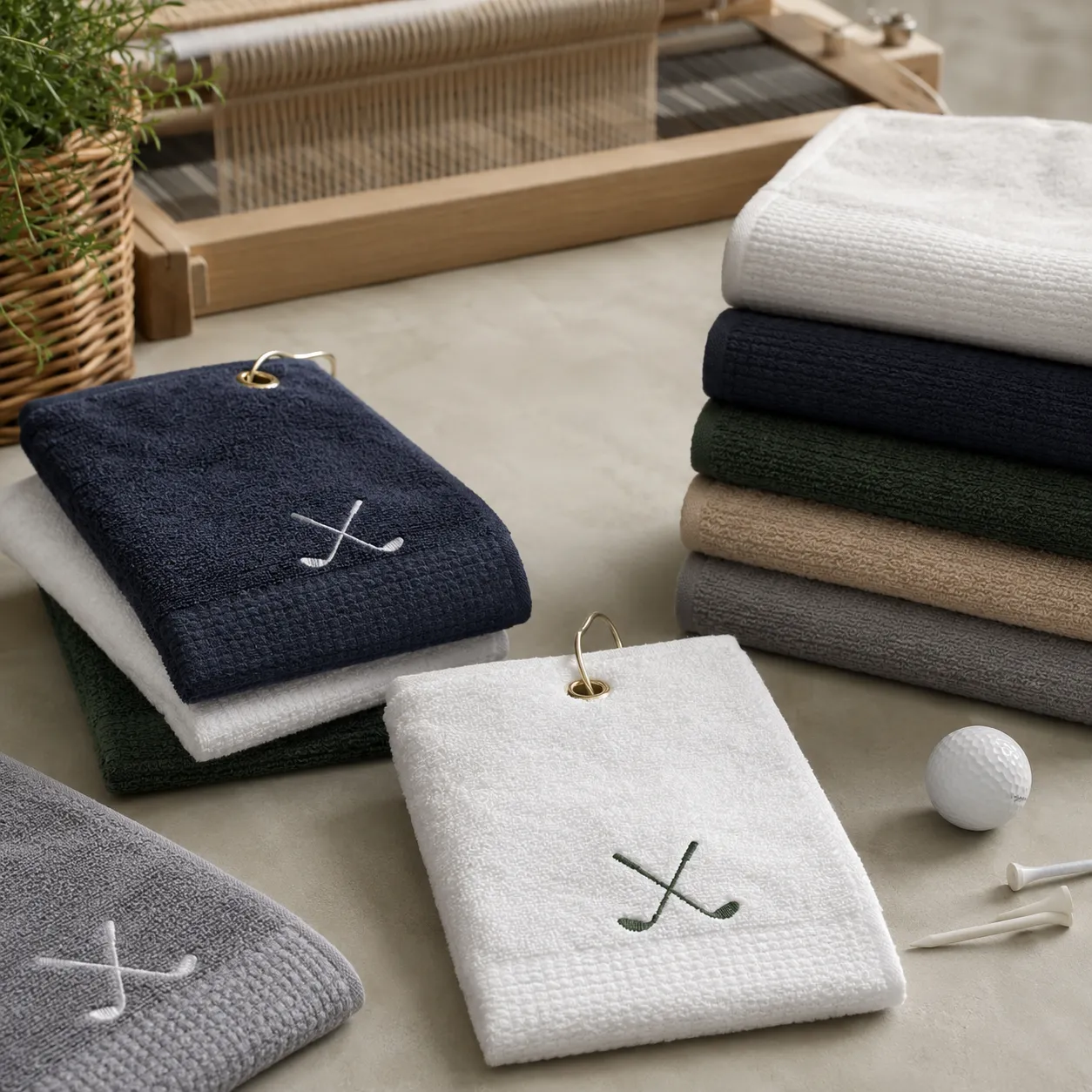
Golf towels fail in different ways depending on where they are used. A towel clipped to a guest golf bag needs a secure grommet and hook. A towel folded on a cart seat needs a clean presentation and less hardware. A towel issued at the pro shop for retail needs hangtag space, barcode planning, and a retail face that does not collapse after steaming.
For hotel procurement teams, the first mistake is treating all golf towels as one item. In our mill, we quote them differently because the weaving, dyeing, decoration, inspection, and packing steps change. A 40 × 60 cm tri-fold towel with corner grommet is not the same production item as a 30 × 50 cm caddie towel with center embroidery and no hardware.
| Hotel use point | Recommended towel type | Practical spec range | Main risk to control |
|---|---|---|---|
| Guest golf bag amenity | Tri-fold golf towel with hook | 40 × 60 cm, 420-520 GSM cotton terry | Grommet tear-out after repeated pulling |
| Cart staging area | Flat cotton towel, no hook | 35 × 70 cm, 450-550 GSM | Slow drying between morning and afternoon tee times |
| Pro shop retail | Logo towel with hangtag | 40 × 60 cm, 500-600 GSM or waffle face | Logo distortion after folding and packaging |
| Tournament giveaway | Lighter promo golf towel | 30 × 50 cm, 330-420 GSM | Cheap handfeel and weak colorfastness |
If the towel is clipped to a bag, we also ask which side should face outward after tri-folding. This matters because the embroidery, woven label, care label, and grommet position need to work together. We have seen otherwise good hotel golf towels bulk orders arrive with the logo hidden on the inside fold because the tech pack did not show the folded view.
Custom Golf Towel Hotel Procurement Checklist
Use this custom golf towel hotel procurement checklist before asking suppliers for price. If these points are missing, factories will either quote with assumptions or quote high to protect against rework.
- Confirm the use point: bag clip, cart towel, guest room amenity, retail shop, tournament gift, or spa-golf package.
- Specify size after washing, not only cutting size. Cotton towels can shrink 4-8% depending on yarn and finishing.
- Choose construction: terry, sheared velour front with terry back, waffle, or microfiber.
- State GSM range and target finished weight per piece for freight planning.
- Define logo method: embroidery, jacquard, woven label, sublimation on microfiber, or screen print for event use.
- Confirm hardware: no hook, plastic hook, zinc alloy hook, brass-tone hook, or carabiner with reinforced grommet.
- Set color standard by Pantone TCX/TPG or physical swatch, then approve lab dip under D65 and TL84 light.
- Require wash test, colorfastness test, and grommet pull check before bulk release.
For a hotel group buying across several properties, we recommend locking the towel body first and varying only logo or accent color. That keeps the yarn, dyeing, and cutting process stable while still letting each course carry its own branding.
Construction Choices That Affect Laundry Life
Golf towels have more mechanical stress than most hotel hand towels. They are dragged across club heads, clipped and unclipped, washed with soil from grass and sand, and sometimes treated with strong alkaline detergent. We normally avoid very loose low-twist constructions for club use because the pile can snag on wedge grooves.
| Construction | Best use | Typical GSM | Factory note |
|---|---|---|---|
| Cotton terry, dobby border | Bag towel and cart towel | 420-560 GSM | Good absorbency; control lint by pre-wash and pile height |
| Sheared velour face, terry back | Retail or guest amenity towel | 480-620 GSM | Clean logo surface; slightly lower absorbency on sheared side |
| Cotton waffle golf towel | Quick-dry cart service | 300-420 GSM | Lower bulk for laundry; can distort if border tension is poor |
| Microfiber waffle | Tournament gift or wet cleaning use | 240-320 GSM | Fast drying; must test edge binding and sublimation color |
A resort golf towel supplier should be able to explain the border tension. On waffle golf towel styles, the body and border shrink at different rates. If the border is too tight, the towel cups after washing. If the border is too loose, the towel waves and looks cheap when folded on a cart.
For terry golf towels, our common hotel range is 450-520 GSM. Below 380 GSM, the towel feels more like a giveaway and loses absorbency quickly. Above 600 GSM, it looks heavier but dries slowly and increases freight cost. For humid coastal courses, a 470 GSM terry towel often performs better than a dense 620 GSM towel because it turns over faster in laundry.
Hardware Is a Procurement Item, Not an Accessory
The grommet and hook are small cost lines, but they create many complaints if underspecified. A grommet and hook golf towel needs reinforcement around the hole, correct metal thickness, and a pull test. We use a simple in-line check: clamp the towel body, pull the hook area to 8-10 kg for 10 seconds, and reject pieces where the eyelet cuts into the terry base.
- Grommet location: 20-25 mm from the finished corner edge is common; too close causes tear-out, too far makes the towel hang awkwardly.
- Reinforcement patch: Needed for lighter waffle or microfiber styles; cotton terry above 480 GSM can often use a folded corner reinforcement instead.
- Hook material: Plastic is light and quiet; zinc alloy feels stronger but can scratch packaging if packed loose.
- Metal finish: Nickel, black nickel, antique brass, and matte black should be tested for corrosion after wet storage.
- Cart compatibility: Some hotel carts use thicker bag loops, so the hook opening should be checked against the actual course equipment.
For coastal hotels, we suggest a 24-hour damp storage test on hardware. We wet three towels, clip the hooks together, seal them in a polyethylene bag, and check for black transfer, rust marks, or plating smell the next day. This is not a formal ISO method, but it catches a real field problem before shipment.
Logo Method: Embroidery, Jacquard, or Label
A golf towel embroidery logo is the safest choice for many hotels, especially on terry or velour. The logo needs a stable stitch count and backing that survives commercial washing. Dense embroidery on a small towel corner can curl after drying, so we usually keep solid-fill logo areas below 45 × 45 mm unless the towel is heavier than 500 GSM.
Jacquard works when the logo is large, simple, and part of the towel design. It is not ideal for tiny crests or fine serif lettering. For art with gradients or tournament sponsor panels, microfiber sublimation gives the best print accuracy, but it changes the handfeel and does not match the cotton towel experience many hotels want.
| Logo method | MOQ impact | Best artwork type | Common defect |
|---|---|---|---|
| Embroidery | 500 pcs per design/color | Club crest, hotel initials, single-color logo | Puckering around dense stitches |
| Jacquard weave | 800-1200 pcs per design | Large repeat pattern or oversized wordmark | Jagged curves if artwork is too detailed |
| Woven label | 500 pcs towel MOQ plus label setup | Small brand tab or property marker | Label edge irritation or crooked sewing |
| Sublimation microfiber | 500 pcs per print design | Full-color event graphics | Color shift if ICC profile is not matched |
Related reads: For decoration trade-offs, see embroidery vs sublimation vs jacquard. For logo color approval, our Pantone color matching guide explains why lab dips and thread cards should not be approved under warm office lighting.
QC Tests We Put on the Approval Sheet
Hotel procurement teams usually ask for OEKO-TEX, but performance testing still has to be written into the PO. LUMA & CO. TEXTILE holds OEKO-TEX Standard 100 Class I, BSCI, and ISO 9001 certification, but those standards do not replace product-level checks for lint, shrinkage, logo durability, and hardware strength.
- Dimensional change: ISO 6330 domestic washing procedure adapted with buyer-approved wash temperature; target shrinkage for cotton golf towels is usually within 6%.
- Colorfastness to washing: ISO 105-C06, with special attention to dark green, navy, black, and burgundy towels.
- Colorfastness to rubbing: ISO 105-X12, dry and wet crocking, important for dark towels placed on light golf bags.
- Absorbency check: AATCC 79 drop test target under 5 seconds for terry towels after first wash.
- Embroidery wash review: 5-cycle laundry test to inspect thread fuzzing, backing exposure, and logo distortion.
One golf-specific defect is sand retention at the border seam. If the dobby border is too dense and the finishing is not clean, sand and grass dust lodge in the transition between border and pile. It does not show in a showroom sample, but it appears after course use and laundry. We check this by brushing damp sand across the towel, rinsing, and inspecting the border under bright light.
Another defect is hook shadow marking. If metal hooks are packed directly against light-colored towels, pressure plus humidity can leave grey marks during ocean freight. For white or cream resort towels, we pack hooks in a small sleeve or fold the towel so the hook sits away from the display face.
Pricing Bands and What Changes Them
Our MOQ is 500 pcs per design per color. Prices below are realistic FOB China bands for 2026, assuming approved artwork, standard cotton yarn, normal dyeing, and export carton packing. Final pricing changes with yarn market, embroidery stitch count, hardware, packaging, and inspection requirements.
| Order volume | Basic terry towel no hook | Tri-fold towel with hook | Embroidered velour towel |
|---|---|---|---|
| 500-799 pcs | USD 2.05-2.70 | USD 2.55-3.45 | USD 3.10-4.35 |
| 800-1499 pcs | USD 1.82-2.42 | USD 2.32-3.08 | USD 2.78-3.85 |
| 1500-2999 pcs | USD 1.58-2.15 | USD 2.08-2.72 | USD 2.45-3.38 |
| 3000+ pcs | USD 1.43-1.96 | USD 1.88-2.48 | USD 2.22-3.05 |
Cheap quotes usually remove something: lower pile density, weaker hook, thinner embroidery thread, no pre-shrink control, or looser inspection. For example, a 34 × 55 cm towel at 360 GSM with a light plastic hook may quote around USD 1.36 at 2000 pcs. A 40 × 60 cm towel at 500 GSM with reinforced eyelet and 6000-stitch embroidery may quote around USD 2.74. If the stronger towel lasts 55 service cycles and the cheaper one is retired after 22 cycles, the cost per use is about USD 0.050 versus USD 0.062 before laundry labor is counted.
The custom golf towel hotel procurement checklist should therefore include expected service life, not only unit cost. Hotels with high guest visibility are usually better served by a mid-weight stable towel than by the lowest bid.
Sampling and Bulk Timing
A clean timeline prevents the towel order from missing tournament openings or high-season replenishment. For new golf towel programs, we usually need 5-7 days for artwork review and material planning, 7-10 days for lab dip or yarn color confirmation, and 10-14 days for physical samples depending on embroidery and hardware.
- Day 1-3: Buyer sends tech pack, logo file, Pantone reference, intended use point, and target delivery window.
- Day 4-10: Mill confirms yarn, GSM, size, hardware, decoration route, carton plan, and FOB price.
- Day 11-24: Sample weaving, dyeing or lab dip approval, embroidery strike-off, and hook attachment trial.
- Day 25-28: Buyer reviews sample, folded presentation, logo placement, and wash result.
- Day 29-58: Bulk production for standard 500-3000 pcs orders after deposit and signed sample.
- Day 59-65: Final inspection, carton marking, export documents, and vessel or air booking.
For reorder programs, timing can be shorter. If the towel body, thread, hardware, and carton packout are already approved, production can often run in 25-35 days after deposit. New jacquard designs need more time because loom programming and strike-off approval cannot be skipped.
Related reads: If your hotel is building a broader towel program, start with hotel towel sourcing guide 2026 and setting up a hotel linen program. For freight planning, see container vs air freight towel orders.
PO Lines That Prevent Rework
The final purchase order should be specific enough that the factory, merchandiser, QC inspector, and packing team all read the same instruction. We recommend attaching the approved sample photo and folded-view diagram to the PO, especially for tri-fold golf towels where the logo face matters.
- Finished size tolerance, such as 40 × 60 cm after wash with ±2 cm tolerance.
- GSM tolerance, usually ±5% for cotton terry golf towels.
- Color standard with Pantone code and approved lab dip number.
- Embroidery file name, thread code, stitch count, backing type, and placement from finished edges.
- Hook and grommet material, finish, pull-test requirement, and packing protection.
- Carton quantity, inner polybag rule, barcode or property code, and carton mark format.
- Inspection level, acceptable quality limit, and required test reports before shipment.
For inspection, many hotel buyers use ANSI/ASQ Z1.4 sampling with General Inspection Level II. A common AQL setting is 2.5 for major defects and 4.0 for minor defects, but golf towels with metal hardware may need stricter review on eyelet damage, rust marks, and sharp hook edges.
Our team can quote from a short brief, but a complete custom golf towel hotel procurement checklist gives better pricing and fewer sample rounds. Send the intended use, size, GSM, logo, color, hook requirement, packing method, and target delivery date. We can then respond with a realistic FOB range, sample plan, and production calendar.
Build a Golf Towel RFQ We Can Quote
For hotel and resort golf towel programs, send your brief to [email protected] or WhatsApp +86 13205717266. MOQ is 500 pcs per design/color, with sampling and bulk timing confirmed after artwork review.
Request Golf Towel Quote →