Towel Sourcing Product Development Capability for European Procurement
Vincent Xi, Editorial Author, author profile
Decision for procurement teams in Europe: score towel sourcing product development capability as a gated manufacturing system, then issue the RFQ only against a frozen construction. Approve a mill when it can lock fibre, yarn, GSM, terry structure, finished size, colour, finishing, and branding in a written tech pack and repeat that construction through tested samples and bulk lots. Do not buy from a catalogue photo. Do not pay a production deposit before a contractual pre-production sample (PPS) is signed. Split chemical, labelling, and product-safety duties for the EU, the EEA, and the UK; Europe is not one compliance jurisdiction.
Approve if the mill returns a construction sheet, named lab methods with numeric limits, mill-named social-audit and harmful-substance files with expiry dates, a documented QC process, a dated PPS lead time, and a comparable FOB or named-place DDP quote on the same specification. Hold if files exist but mill legal names, after-wash sizes, or destination (EU member state versus EEA state versus Great Britain versus Northern Ireland) are missing. Reject photo-only offers and any bid that will not lock construction before bulk.
Process claims below are limited to the cited publications plus named public-law instruments. They are not measurements, certificates, prices, or factory claims from LUMA & CO. TEXTILE.
A 2025-edition custom-towel sourcing guide written for professional buyers frames the lifecycle as RFQ, sample tests, negotiation, and 3-stage QC, and it uses a 1,000-unit, 600 GSM cotton bath towel FOB request as a comparison benchmark (The Ultimate Guide to Sourcing Custom Towels from China (2025 Edition)). That benchmark is a specification equaliser, not a LUMA & CO. TEXTILE quote and not an instruction to buy from any named origin. Private-label program descriptions list product development support as alignment of quality standards, production, and delivery timelines (Premium Products International announcement). Manufacturer-service briefings describe fabric selection, GSM optimisation, and sample iterations for absorbency, wash resistance, and branding (7 Towel Manufacturer Secrets Every B2B Buyer Must Know).
Towel sourcing product development capability for European RFQs
In a towel program, product development capability is the mill’s ability to convert a buyer file into a bulk article with locked construction. It is not logo embroidery on unspecified greige. Score the partner on five gates that must exist as documents:
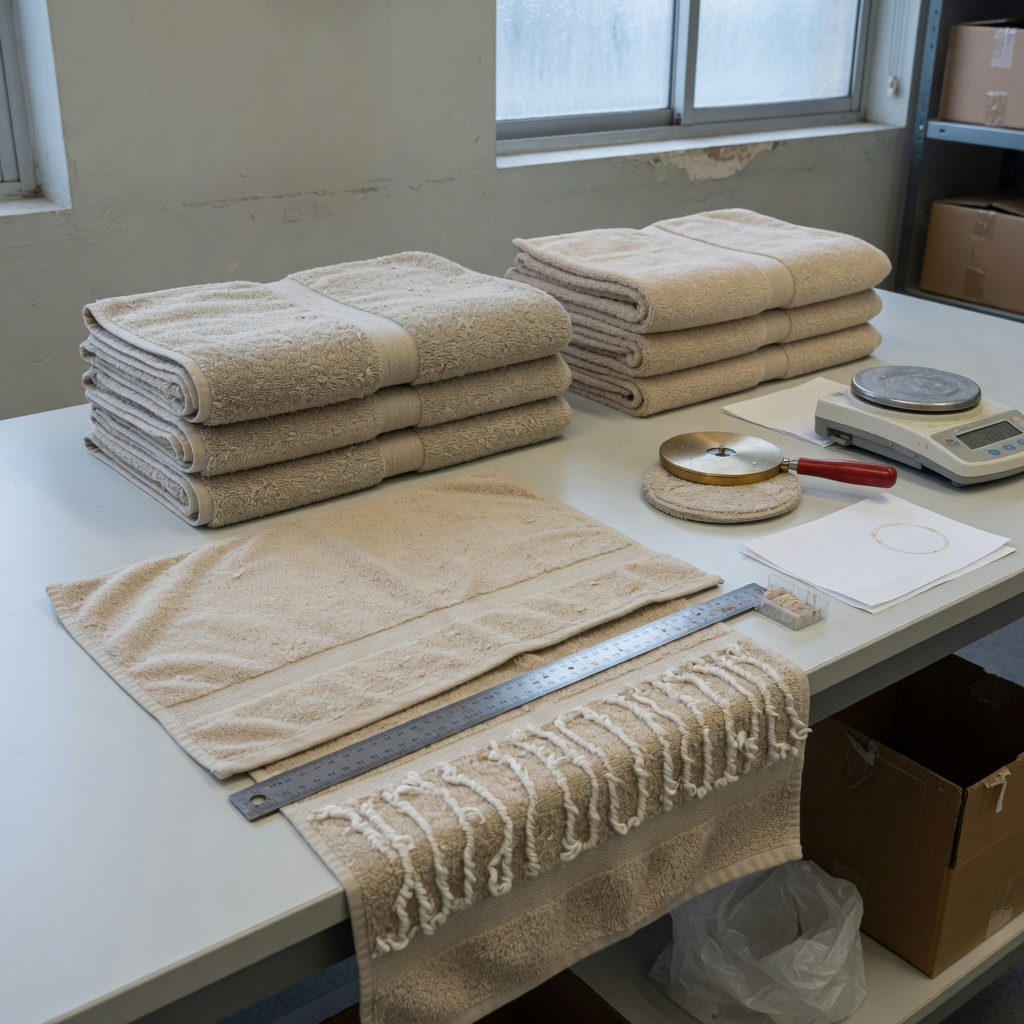
- Tech pack ownership. Professional buyers use the tech pack as the manufacturing blueprint: specs, colours, size, weight, and artwork (2025 custom-towel sourcing guide). If the mill will only work from a photo, development control is missing.
- Construction control. Yarn type (carded, combed, compact, or OE), yarn count, pile/ground ratio, loop height, stitch density, hem construction, and finishing (singeing, enzyme, softening, hydrophilicity) must sit on the mill construction sheet. These are RFQ fields to freeze, not attributes claimed for LUMA & CO. TEXTILE.
- Sample path. Prototyping should iterate absorbency, wash resistance, and branding before bulk (manufacturer-services briefing). Count the paid sample rounds, who pays freight, and which round is the contractual PPS.
- Test methods. Weight (GSM), absorbency, colourfastness, and shrinkage need method names and numeric limits, not adjectives (2025 custom-towel sourcing guide).
- Lot repeatability. Product development support, as described in private-label sourcing programs, is consistency across development, quality standards, production, and delivery timelines (PPI program description). Demand that consistency in writing. Do not import the cited program’s sales-market terms.
Ask who writes the construction sheet, who signs the PPS, and which mill (legal name, address, process list) will weave, dye, sew, and pack. If dyeing or finishing is subcontracted, that legal entity must be the name on the chemical file.
Construction, GSM, and finishing trade-offs to lock in the tech pack
GSM is mass per area, not a quality grade. A heavier towel can feel denser and can also raise carton weight, ocean freight, and drying time in a hotel laundry in Europe; quantify those effects on the supplier quote rather than treating them as a lab result in this article. A lighter towel can reduce freight and tumble-dryer energy and can also feel thin if loop height and ground fabric are weak. GSM optimisation is a development task, not a last-minute cost cut (manufacturer-services briefing).
Example calculation to verify in the supplier quote (not a price, not a mill result, not a figure from the cited guide, not a LUMA & CO. TEXTILE measurement): a bath towel with a buyer-assumed finished face of 70 cm × 140 cm and 600 g/m² has a theoretical face mass of 0.70 m × 1.40 m × 600 g/m² = 588 g per piece before sewing loss, hem add-on, moisture regain, and packaging. On a 1,000-piece lot that is 588 kg of textile mass before cartons. Packed piece weight will not equal 588 g if hems, labels, or moisture differ. Confirm finished size after wash, not only cut size. The 2025-edition guide’s 1,000-unit / 600 GSM cotton bath towel FOB request is the comparison shape only (2025 custom-towel sourcing guide).
Lock these construction fields before colour work:
- Fibre. Cotton species and grade, or blend percentages by mass. If viscose, lyocell, or polyester is present, labelling and chemical files change.
- Yarn and terry. Ring-spun versus open-end; two-ply versus single; loop height; whether dobby borders are woven or sewn on.
- Dye and finish. Yarn-dye versus piece-dye; reactive versus other dye classes; optical brightener yes/no; softener type; residual hydrophilicity after N wash cycles (define N in the tech pack).
- Brand execution. Woven label, printed label, embroidery, jacquard, or hem tag, with placement in millimetres from edges.
- After-wash dimensions. Hospitality programs in Europe are exposed when a 70 × 140 cm towel is that size only at packing; set numeric after-wash limits in centimetres.
Raising GSM without raising stitch density or yarn quality often adds weight without adding pile integrity. Lowering GSM without shortening loop height can produce lean, snaggy terry. Neither outcome is visible in a first lab-dip photo, so both belong in the signed construction sheet.
EU, EEA, and UK chemical and labelling files for towel programs in Europe
Do not copy one Europe-wide compliance clause into every contract. The EU, the EEA, and the UK are not a single chemical or labelling jurisdiction. The instruments in this section are public-law references for RFQ file-building. They are not excerpts from the three commercial sources and are not LUMA & CO. TEXTILE certifications.
- EU chemical restrictions. REACH (Regulation (EC) No 1907/2006), including Annex XVII restrictions and SVHC communication duties, applies to articles placed on the EU market. A towel is an article. Restricted substances in dyes, pigments, formaldehyde in finishes, and certain azo colorants are development inputs, not packing-list afterthoughts. OEKO-TEX STANDARD 100, where used, is a voluntary harmful-substance test protocol against that scheme’s limit values. It is not a legal substitute for REACH duties and is not proof that a mill is certified by the EU.
- EEA. Iceland, Liechtenstein, and Norway apply a large body of EU product and chemicals law through the EEA Agreement. Confirm the destination country’s applicable REACH-aligned duties and national market-surveillance practice. Do not assume an EU-27 technical file is automatically complete for every EEA destination without checking the importer of record.
- UK. Great Britain operates UK REACH, which is not the same dossier and registration system as EU REACH. Northern Ireland arrangements can differ from Great Britain. Fibre-name and product-safety files written for the EU must be re-checked for UK placement. Do not state that an EU test report covers the UK.
- Fibre labelling. EU fibre-composition rules sit in Regulation (EU) No 1007/2011 (textile fibre names and labelling). The UK retains a corresponding framework; the label copy still has to match the actual fibre percentages on the development sheet.
- Product safety. For the EU, the General Product Safety Regulation (EU) 2023/988 applies to consumer products placed on the market, with application from 13 December 2024. A hotel-issue towel can still be a consumer product depending on the sales channel. The UK continues to apply its own general product-safety framework; do not paste GPSR economic-operator language onto a GB-only contract without UK legal review.
- Social audits. BSCI (amfori) is a social-compliance audit methodology. It does not test GSM, absorbency, or restricted substances. Request the current audit report, the mill legal name, the rating or findings summary, and the expiry or next-audit window. The 2025-edition sourcing guide tells professional buyers to ask for BSCI and OEKO-TEX certificates together with QC process and PPS lead time (2025 custom-towel sourcing guide).
Colour recipes, optical brighteners, antimigrants, and softener systems belong in the tech pack because they drive both hand-feel and restricted-substance risk. A late colour change is a chemical-file change, not only an aesthetic change. This article does not claim that LUMA & CO. TEXTILE holds REACH, UK REACH, OEKO-TEX STANDARD 100, BSCI, ISO, or any other named certificate, mill audit, or test report. Buyers must verify current documents against the producing mill, not against a trading-company brochure.
Sampling, lab tests, and QC stages before bulk approval
The 2025-edition sourcing guide lists sample tests for weight, absorbency, colourfastness, and shrinkage, then negotiation, then 3-stage QC (2025 custom-towel sourcing guide). Manufacturer briefings add wash-resistance and branding iterations (manufacturer-services briefing). Use that as a minimum map. The cited guide does not, in the claims used here, define the three stage names; make the mill name each stage in its SOP.
A practical sampling sequence for a program destined for Europe:
- Construction proto. Greige or finished terry in the target GSM and loop, unbranded, for hand, mass, and stitch review.
- Lab dips / strike-offs. Colour on the actual fibre and finish, not on paper. Agree a light source (for example D65) and a numeric colour-difference limit in the RFQ; do not treat an unstated Delta E as a default.
- Washed proto. Same construction after a stated wash method. Absorbency and dimensional change are meaningless on an unwashed first fold if the hotel will wash daily.
- Branded PPS. Size, hem, label, embroidery, folding, and polybag that will be used in bulk. This is the contractual sample.
- Bulk gold seal. Keep a retained PPS in Europe (buyer office or 3PL) for lot comparison.
Do not invent a default PPS lead time. The mill’s dated RFQ commitment is the figure that matters, including whether yarn is in stock. A development-capable mill can state yarn-dye lead time, piece-dye lead time, embroidery versus jacquard extra days, and whether the PPS is cut from bulk greige or from a sample loom.
Name methods in the RFQ. Method numbers are not mill certifications and are not LUMA & CO. TEXTILE test results:
- GSM. Cut area and conditioned mass. Agree tolerance in g/m², not an approximate 600.
- Absorbency. Method and seconds-to-sink or mass-of-water absorbed; agree the preconditioning (washes).
- Colourfastness. To washing, rubbing (wet/dry), and water. ISO 105 parts are often written into textile contracts; agree the exact part and minimum grey-scale grades in the quote.
- Shrinkage / growth. Length and width after N cycles of a named method. ISO 6330 is commonly specified in textile contracts; confirm the exact procedure number, wash temperature, and drying method. Set numeric percent limits.
- Appearance after wash. Pilling, loop pull, hem twist, shade change.
A 3-stage QC plan is useful only if the stages are named in the mill SOP. A common buyer split to ask for is incoming yarn/greige, in-process dyeing/sewing, and final inspection against an AQL; only the written SOP counts. Agree the inspection standard (ISO 2859-1 / ANSI/ASQ Z1.4 is often used in apparel-adjacent contracts), the numeric AQL for critical/major/minor, and whether inspection is at mill, at consolidator, or on arrival. Example arrival ports in Europe, not a routing offer: Rotterdam or Antwerp (EU) or Felixstowe (UK). Incoming inspection at those ports does not replace mill-gate inspection if defects are construction defects.
Decision table: comparing towel sources on development control
Use this table to specify, compare, and approve, not to rank marketing claims. Every row is a file the buyer should receive or a measurement the buyer should run.
| Decision field | What the buyer specifies | How to compare two sources | How to verify before PO | Trade-off if you skip it |
|---|---|---|---|---|
| Tech pack | Fibre, yarn, GSM, size after wash, terry construction, colour refs, artwork, packing | Completeness of construction fields vs photo-only offer | Signed PDF + mill stamp on PPS | Bulk will drift to whatever greige is in stock |
| GSM and piece mass | g/m² plus finished L × W in cm; carton GW | Mass per dozen and kg per 20-ft/40-ft load | Cut-and-weigh on PPS and first bulk lot | Freight and laundry energy blow the landed cost |
| Sample path | Number of protos, PPS definition, who pays | Days committed and whether PPS is from bulk yarn | Dated PPS with retained duplicate in Europe | Branding approved on a hand sample that sewing cannot repeat |
| Lab tests | Weight, absorbency, colourfastness, shrinkage methods and limits | Numeric limits vs vague hotel-quality adjectives | Third-party or mill lab report tied to the PPS lot and producing mill | Shade and size fail after first industrial wash |
| Chemical file | EU REACH vs UK REACH vs EEA destination; dye/finish recipe family | Separate declarations per destination, not one Europe PDF | Current test reports + SDS/finish list matching the dyehouse legal name | Goods detained or unsaleable in one jurisdiction only |
| Harmful-substance scheme (if required by brand) | OEKO-TEX STANDARD 100 class, mill, article group, expiry | Scope match to terry, sewing thread, labels | Certificate copy, not a logo on a website | Certificate covers yarn but not embroidery thread |
| Social audit | BSCI or equivalent; mill legal name | Audit date, site, findings | Full report or summary with site address | Brand onboarding blocked after sampling spend |
| QC plan | Named stages, AQL, inspector identity | In-line photos vs final carton inspection only | SOP + right to appoint third-party inspector | A passing AQL with construction defects missed in-line |
| Incoterms and lead time | FOB port or DDP named EU/EEA/UK place; yarn-in vs yarn-out | Calendar days from PPS approval to onboard | Production calendar with greige, dye, sew gates | Cheap FOB with unusable transit time into peak season |
| Repeatability | Shade continuity, GSM continuity across lots | Delta E and GSM range on last 3 lots (ask for data) | Keep gold-seal PPS; measure lot 2 against it | Lot 2 is a different towel wearing the same SKU |
The 1,000-piece, 600 GSM cotton bath towel FOB shape remains a useful equaliser when two mills quote different constructions (2025 custom-towel sourcing guide). Hypothetical equaliser, not a measured result: if mill A quotes 520 g/m² at a lower unit price, it is not cheaper until piece mass, carton weight, and after-wash size are equalised on the buyer’s actual size.
RFQ checklist for European towel procurement programs
After two sources are scored on the table, send this list as a single RFQ package. Each item is something the buyer must specify, compare, verify, approve, or order. A complete RFQ return is the evidence of product development capability.
- Legal entities and destination. Buyer entity, importer of record, and destination listed separately: EU member state, EEA state, Great Britain, and/or Northern Ireland.
- Producing sites. Legal name and address for weaving, dyeing/finishing, sewing, and packing; state if any step is subcontracted; require the dyehouse name on the chemical report to match.
- Article list. Bath, hand, face, bath mat, pool, or kitchen towel; quantity per SKU; first order vs annual forecast (forecast labelled as non-binding unless contracted).
- Construction sheet. Fibre % by mass, yarn type and count, GSM (g/m²), loop height, ground fabric, hem type, size before and after wash (cm).
- Equaliser quote. FOB price and lead time on a 1,000-unit, 600 GSM cotton bath towel in the buyer’s actual size, matching the 2025-edition professional-buyer benchmark shape (2025 custom-towel sourcing guide), plus the buyer’s true quantity break. Label the 1,000-unit line as a comparison tool, not as the order quantity unless it is.
- Colour. Pantone or spectral data, fabric side, finish state, light source, pass/fail Delta E.
- Branding. Artwork in vector form, stitch count, placement millimetres, thread colour, label fibre content and care copy in the languages required by the destination law.
- Tech pack sign-off. Who at the mill is authorised to freeze the file; revision control.
- Sample fees and PPS lead time. Calendar days from tech-pack freeze and from yarn availability; air-freight terms for samples into the EU, the EEA, or the UK; which sample is contractual PPS.
- Test plan. Weight, absorbency, colourfastness, shrinkage, and wash appearance; method numbers; who pays the lab.
- Chemical declarations. EU REACH (restrictions + SVHC as applicable) for EU placement; UK REACH for GB placement; EEA destination checked separately; any extra retailer Restricted Substances List. Finish and dye class listed.
- Voluntary schemes. Current OEKO-TEX STANDARD 100 (or equivalent) certificate: mill name, product class, expiry. State that it is additional evidence, not a legal substitute.
- Social compliance. Current BSCI (or equivalent) report for the sewing and dyeing sites, not only the trading office (2025 custom-towel sourcing guide).
- QC process. Named stages (3-stage or more), AQL, inspection location, photo protocol, and right of refusal.
- Packing. Pieces per polybag, bags per carton, carton dimensions (cm), gross weight (kg), palletisation for the arrival warehouse.
- Incoterms 2020. Named port or named place in the EU, EEA, or UK. Insurance and duty as a separate line if DDP is requested.
- Payment. Deposit tied to PPS approval, not to first proto; balance against on-board or against arrival inspection as negotiated.
- Gold-seal retainers. One PPS stays at mill, one in the buyer’s office in Europe.
- Change control. How a GSM, shade, or label change re-opens chemical and labelling files for the named destination.
- Capacity calendar. Weekly sewing output for this construction; peak-season cut-off for arrival in Europe.
- Non-conformance. Repair, recut, or debit-note rules when after-wash size or GSM is outside the agreed tolerance.
If a supplier cannot complete items 4, 9, 10, 13, and 14, it does not have product development capability for a program in Europe, regardless of mill photos.
How this briefing was prepared and what to verify
Author basis. This page is editorial work by Vincent Xi, Editorial Author (author profile). It does not claim mill visits, laboratory tests, personal handling of lots, client engagements, or years of factory experience.
Source context 1. A 2025-edition custom-towel sourcing guide describing professional-buyer practice: tech packs; RFQ; tests for weight, absorbency, colourfastness, and shrinkage; 3-stage QC; and requests for BSCI/OEKO-TEX documents, QC process, PPS lead time, and a 1,000-unit 600 GSM cotton bath towel FOB comparison (source).
Source context 2. A company announcement describing product development support as manufacturing alignment of quality standards, production, and delivery for private-label towel programs (source). Extract the control points; do not import another market’s commercial terms.
Source context 3. A manufacturer-services briefing on fabric selection, GSM optimisation, prototyping iterations, absorbency, wash resistance, branding, and direct specification control (source).
Methodology. Claims about buyer process (tech pack, listed tests, 3-stage QC, certificate requests, GSM optimisation, sample iteration) are attributed to those publications. Legal instruments (REACH, UK REACH, Regulation (EU) No 1007/2011, GPSR (EU) 2023/988) are named as public rules, not as this company’s certifications. The 588 g/piece and 588 kg/1,000 pieces figures are arithmetic from an assumed 70 cm × 140 cm face at 600 g/m² and must be recalculated on the actual finished size, hem mass, and moisture condition in the quote. The 1,000-unit count and 600 GSM cotton bath-towel FOB shape are taken from the 2025-edition guide cited above. The GPSR application date 13 December 2024 is the regulation’s stated application date for (EU) 2023/988, scoped to consumer products placed on the EU market.
Limitations / what to verify. None of the cited pages is a current mill certificate, a LUMA & CO. TEXTILE test report, or a landed-cost model for a named EU, EEA, or UK port. Audit ratings expire. OEKO-TEX scope may exclude sewing thread, labels, or embroidery. BSCI does not prove product chemistry. GPSR economic-operator duties depend on the sales channel and the importer. UK and EU chemical files can diverge after the same mill run. Prices, GSM, and lead times in any example are not offers; they must be confirmed on a dated supplier quote. Destination-specific labelling languages, EPR textile rules where adopted by a member state, and retailer RSLs are outside the three source excerpts and must be added by the buyer’s compliance team before order.
Discuss Your Requirements
Review our manufacturing capabilities, then share your specifications for a supplier-fit review.