Spa Towel Wholesale Supplier Sustainability Sourcing Criteria for Canada
By Vincent Xi, Editorial Author
First-hand experience note: The author profile confirms Vincent Xi’s name and role as Editorial Author. It does not document hands-on factory, laboratory, sourcing-engagement, product-testing, or customer-outcome experience; no such experience is claimed here.
For Canadian B2B buyers, the core screening question is whether the exact quoted spa towel—not a supplier’s general marketing—can be tied to current evidence, a representative sample, the stated manufacturing site, packaging data, QC controls, and a complete commercial offer. Advance a supplier only when all mandatory gates pass. Use Hold for missing scope, unmatched documents, incomplete test conditions, or an unclear quote basis. Use Reject when the quoted product differs from the RFQ or the supplier will not accept no-substitution and prior change-notification controls.
The supplied sources are secondary procurement references. They do not approve any supplier, establish a Canadian legal threshold, prove a current certification, or validate the performance of a quoted SKU.
Canada RFQ sustainability sourcing criteria for spa towel wholesale supply
Use mandatory gates rather than averaging strong and weak responses into a single score. A favourable price should not offset an unsupported sustainability claim, an untraceable sample, or missing change controls.
| Approval gate | Put in the RFQ | Required evidence and decision |
|---|---|---|
| Product identity and equivalence | Intended spa use; nominal dimensions and tolerance; GSM target and tolerance; conditioning and measurement method; fibre percentages; yarn and terry construction; colour; finish; and pack configuration. | Require the exact SKU, stated manufacturing site and country, complete specification, quote-linked sample, and every disclosed sample-to-production difference. Pass only after deviations are accepted in writing. |
| Sustainability claim traceability | A register of every material-origin, named-standard, energy, water, packaging, durability, or environmental claim affecting approval. | Require the exact claim wording, evidence reference, covered SKU or material, covered site, issue or reporting period, scope, method, and verification status. Hold general, expired, unmatched, or unverifiable evidence. |
| Manufacturing-site energy and water | Energy and water reported separately, each with a value, unit, output denominator, site boundary, operating scope, reporting period, method, exclusions, and verification status. | Compare suppliers only when the units, denominators, boundaries, and reporting periods are equivalent. Otherwise, Hold the comparison. |
| Packaging | Component materials, packaging mass per saleable towel, evidence for claimed recycled content, disposal assumptions, and protective purpose. | Review records for the actual quoted pack and inspect the packed sample. Do not credit a packaging claim when production packaging differs. |
| Quote-linked sample performance | Sample identity, baseline measurements, laundry process, acceptance limits, failure definition, and required post-laundry records. | Pass only when the identified sample meets criteria set before results are reviewed. Treat unmatched or incompletely documented results as Hold. |
| QC and change control | Product tolerances, defect definitions, retained approved-sample control, lot traceability, inspection records, remedies, no-substitution terms, and prior notification of changes. | Reject a supplier that will not control changes to material, construction, finish, manufacturing site, or packaging. |
| Commercial comparability | Minimum order quantity, quote unit, unit and lot price, currency, validity, lead time, payment terms, delivery basis, named Canadian receiving point, inclusions, and exclusions. | Compare price only after the product, evidence, sample, and QC gates pass for the same SKU and pack configuration. |
An approved change to fibre composition, dimensions, GSM, construction, finish, manufacturing site, or packaging should reopen every affected gate.
Source-backed technical baselines for the quoted spa towel
These values are screening references rather than automatic specifications or sustainability scores. Any value adopted in an RFQ still needs a tolerance, measurement basis, and quote-linked verification requirement.
| Data point | Source, date status, and scope | Permitted RFQ use | Limitation |
|---|---|---|---|
| 500–700 grams per square metre (GSM) | The Smart Linen hospitality procurement guide, published in 2025, gives this range for cotton towels in a hotel, resort, and spa procurement context. | Use as a starting range when defining the quoted towel’s target GSM. Require the supplier’s tolerance, conditioning procedure, and measurement method. | It is not a Canadian requirement, a sustainability indicator, or proof of an individual SKU’s mass or performance. |
| 27 × 54 inches, nominal dimensions | The Towel Depot spa towel reference lists this nominal spa towel size; no publication date is stated in the supplied excerpt. | Use as a comparison point if the dimensions fit the intended spa use. Require dimensional tolerances and the measurement condition in the quote. | It is not established as a mandatory Canadian size. |
| 150–200 commercial wash cycles or 12–18 months in commercial use | The same Towel Depot reference, whose publication date is not stated in the supplied excerpt, reports these replacement benchmarks in its commercial spa towel discussion. | Use the benchmarks to request a supplier’s claimed usable life, complete laundry conditions, and failure definition for the quoted SKU. | The supplied excerpt does not state the test protocol, sample size, usage frequency, or statistical method. The figures are not guaranteed service life. |
Example calculation—assumption to verify in the supplier quote: Using the 27 × 54 inch nominal size from the undated supplied excerpt of the Towel Depot reference and the 500–700 grams per square metre range from the Smart Linen hospitality guide published in 2025, nominal planar area is approximately 0.941 square metres per towel and theoretical mass is approximately 470–658 grams per towel. This arithmetic does not set a purchase specification. Hems, terry construction, finishing, conditioning, dimensional tolerance, and the supplier’s GSM method can change the measured mass of the quote-linked sample.
Apply these baselines with clear boundaries:
- Treat GSM as a measurable product specification, not sustainability evidence by itself.
- Treat the source-reported replacement benchmark as an RFQ question until a controlled laundry trial supports a usable-life result.
- Keep fibre-origin evidence separate from absorbency, drying, lint, shrinkage, colour, seam, and appearance approval.
- Normalize dimensions, GSM basis, fibre percentages, construction, finish, packaging, and test methods before comparing suppliers.
Sustainability sourcing criteria for claim evidence
The Smart Linen guide published in 2025 and the Towel Supercenter guide, whose publication date is not stated in the supplied evidence, identify organic cotton, bamboo, recycled fibres, OEKO-TEX evidence, energy, water, and longevity as procurement categories. These category references are not SKU-matched proof for a candidate supplier.
If a supplier names OEKO-TEX, request the exact scheme and current document. The cited sources do not establish an OEKO-TEX scheme as a Canadian legal requirement, prove that a candidate supplier holds a current certificate, or establish certification as a documented LUMA & CO. TEXTILE operating practice.
The following are buyer-defined RFQ controls. They are not presented as requirements of OEKO-TEX, Canadian law, or a stated company practice.
| Claim category | Minimum evidence fields | Approval control |
|---|---|---|
| Named standard or certification | Exact scheme and document title; holder; issuer; covered material, product, and site; issue and expiry status where applicable; verification route; and mapping to the quoted SKU. | Hold a logo, expired record, unrelated site, unmatched material scope, or unverifiable document. Accept only the claim covered by the current scope. |
| Fibre content or origin | Claimed fibre percentage, exact material identity, applicable scope evidence, and available lot, batch, transaction, or chain-of-custody records linking the material to the quoted product. | Keep material-origin approval separate from durability and laundry-performance approval. Hold a claim supported only by a general supplier policy. |
| Manufacturing-site energy | Reported value, unit, output denominator, site boundary, operational scope, reporting period, method, exclusions, and verification status. | Compare only equivalent boundaries and denominators. Do not score unmeasured terms such as efficient or low impact. |
| Manufacturing-site water | Reported value, unit, output denominator, site boundary, process coverage, reporting period, method, exclusions, and verification status. | Keep water separate from energy. Hold comparisons that mix site totals, product estimates, or different output denominators. |
| Packaging | Component-level materials, packaging mass per saleable towel, evidence for claimed recycled content, disposal assumptions, and protective purpose. | Approve a reduction claim only when it covers the actual quoted pack and the packaging still protects the approved towel. |
| Durability or environmental performance | Exact SKU or sample identity, report issuer, method, complete test conditions, result, and failure definition. | Exclude marketing language that cannot be mapped to the quoted product and documented conditions. |
Quote-linked sample and QC method
The Smart Linen hospitality procurement guide published in 2025 supports consideration of industrial-laundry durability testing. The method below converts that consideration into a buyer-defined control; it is not presented as a universal protocol from the source.
| Stage | Required record | Control objective |
|---|---|---|
| Document and identity lock | Quote reference, exact SKU, fibre percentages, dimensions, GSM basis, construction, colour, finish, manufacturing site, packaging, and every pilot-sample or production difference. | Prevent approval of a sample that is not representative of planned bulk production. |
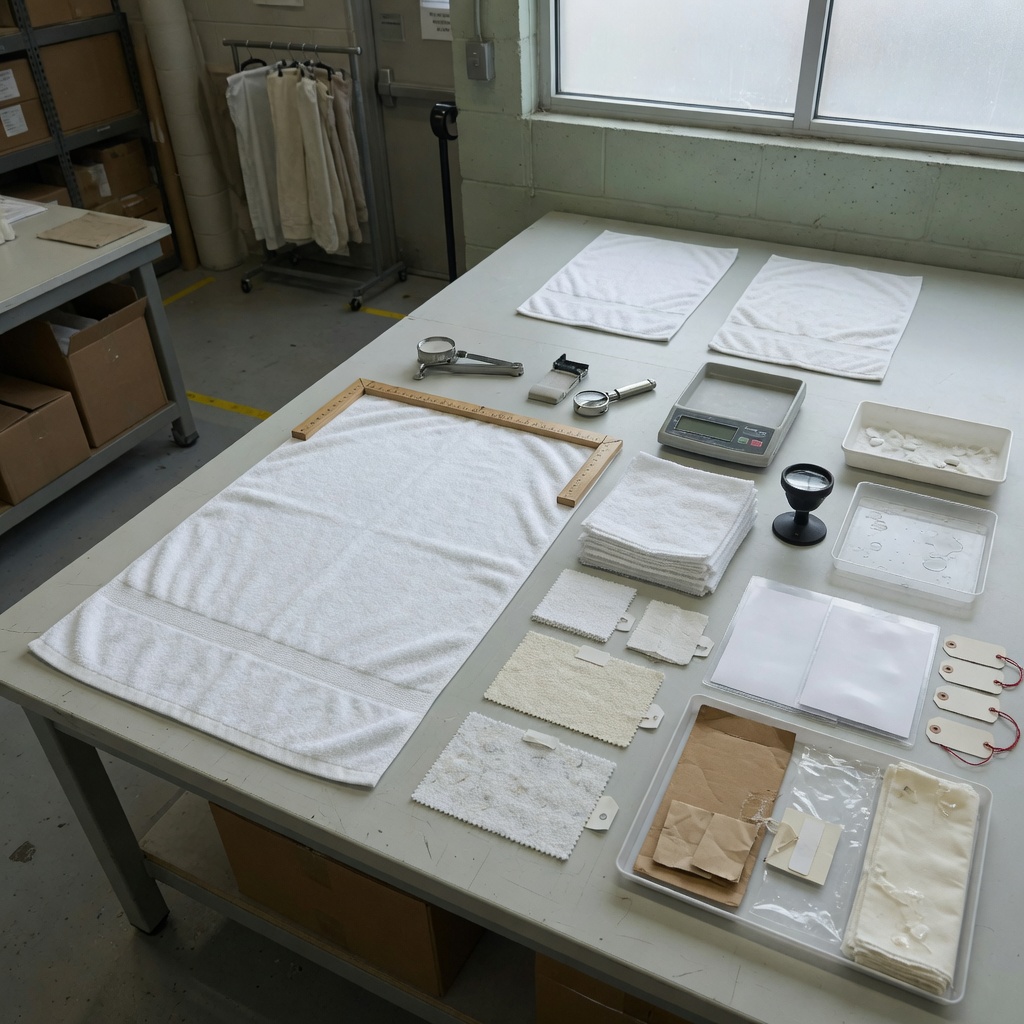
| Baseline measurement | Conditioning method; length and width; conditioned mass; GSM method; hems; terry loops; edges; visible defects; lint condition; absorbency method; drying method; shade; and appearance. | Create a repeatable pre-laundry record before deterioration is assessed. |
| Laundry exposure | Machine type, chemistry, wash temperature, cycle description, load composition, drying process, handling, wash count, and pre-agreed failure criteria. | Expose candidate samples to the same documented process. |
| Post-laundry assessment | Dimensional change, edge distortion, seam or hem failure, pulled loops, lint, staining, colour change, absorbency, drying, hand feel, and appearance using the baseline methods. | Compare results with limits established before testing rather than selecting thresholds afterward. |
| Bulk release | Retained approved sample, final purchase specification, tolerances, defect definitions, lot traceability, inspection records, remedies, and change-notification procedure. | Control sample-to-bulk consistency and prevent unapproved substitutions. |
Use consistent buyer calculations where the input data is comparable:
Calculated GSM = conditioned towel mass in grams ÷ verified planar area in square metresPackaging intensity = total packaging mass in grams ÷ accepted saleable towelsAccepted unit cost = comparable quoted lot amount ÷ accepted saleable towelsCost per buyer-verified usable wash = accepted unit cost ÷ buyer-verified usable washesSite energy intensity = reported site energy in the stated unit ÷ declared output denominatorSite water intensity = reported site water in the stated unit ÷ declared output denominator
Do not compare calculated results unless measurement methods, units, reporting periods, site boundaries, and output denominators are equivalent.
Compare spa towel wholesale supply quotes for Canada
Open the commercial comparison only after the quoted product, sustainability evidence, sample, and QC controls are normalized. Require each offer to identify:
- The exact approved SKU and pack configuration.
- The minimum order quantity and quote unit.
- Unit and lot pricing, currency, and quote validity.
- Production lead time and any stated capacity constraint affecting the offer.
- Payment terms and sample-related charges.
- Delivery basis and named Canadian receiving point.
- Included and excluded packaging, services, and charges.
- Inspection arrangements, nonconformance remedies, and responsibility for goods that differ from the approved specification.
- Written confirmation that material, construction, manufacturing-site, finish, and packaging changes require prior buyer approval.
For sustainability-related comparison, use the buyer’s controlled laundry result for the usable-wash denominator, compare packaging intensity only for the actual pack configurations, and keep energy and water as separate measures. Do not rank a lower-priced quote ahead of a candidate with complete evidence while product identity, sample status, or change controls remain unresolved.
The supplied sources do not establish Canada-specific labelling, compliance, import, tax, freight, or landed-cost rules, so none are asserted here. Applicable obligations should be checked independently before purchase-order release.
Copy-ready RFQ response structure
Require a separate response row for each requirement, using these columns:
Buyer requirement | Supplier response | Evidence reference | Covered SKU or material | Covered manufacturing site | Issue or reporting period | Declared deviation | Buyer status
Minimum response lines should cover:
- Supplier legal name, manufacturing site, manufacturing country, quote reference, and exact spa towel SKU.
- Intended spa use, nominal dimensions, tolerance, GSM target, GSM method, fibre percentages, construction, colour, finish, and pack configuration.
- A claim register linking every approval-relevant sustainability statement to its document, material, SKU, and site scope.
- Named-standard documents, material-origin records, site energy data, site water data, and packaging evidence.
- Quote-linked sample identity, baseline measurements, laundry conditions, post-laundry results, and failure criteria.
- Product tolerances, defect definitions, retained-sample control, lot traceability, inspection records, remedies, and change notification.
- Minimum order quantity, quote unit, price, currency, validity, lead time, payment terms, delivery basis, named Canadian receiving point, inclusions, and exclusions.
Unavailable evidence should be marked unavailable rather than left blank. The buyer should assign Pass, Hold, or Reject only after checking both the response and the cited evidence.
Methodology, source context, and limitations
Methodology: Claims were retained only where the supplied article package attributed them to a cited source. Numerical values were recorded with their units, date status, source, and stated procurement or product scope. Source statements were then converted into buyer-defined RFQ fields, evidence gates, sample controls, and approval decisions. The area and mass result is explicitly labelled as an example calculation to verify against the supplier’s quote, sample, tolerances, and measurement method. No independent product test, laboratory review, supplier audit, certificate validation, or legal assessment was performed for this article.
Source contexts:
- The Vincent Xi author profile supports the visible byline, author name, editorial role, and profile URL only.
- The Smart Linen hospitality procurement guide, published in 2025, is used for its cotton-towel GSM screening range, industrial-laundry testing consideration, and broad sustainability evidence categories within hotel, resort, and spa procurement.
- The Towel Depot spa towel reference, whose publication date is not stated in the supplied excerpt, is used for its source-reported nominal size and replacement benchmarks. Its test methodology is not available in the supplied evidence.
- The Towel Supercenter wholesale towel guide, whose publication date is not stated in the supplied evidence, is used for category-level consideration of fibre choices, OEKO-TEX evidence, energy, water, and longevity. It does not provide matched SKU tests, site records, or supplier credentials in the supplied material.
Limitations and what to verify: These secondary sources do not replace complete standards, current certificate records, material transaction documents, manufacturing-site energy or water records, packaging measurements, commercial-laundry reports, quote-linked samples, legal advice, or binding supplier specifications. Before approval, verify the exact SKU, fibre percentages, construction, dimensions, GSM basis, manufacturing site, evidence scope, certificate status, reporting boundaries, sample-to-production consistency, packaging configuration, laundry performance, quote basis, QC remedies, and change-control commitments. Release an order only when the same quoted product passes every mandatory product, evidence, sample, QC, and commercial gate.
Discuss Your Requirements
Review our manufacturing capabilities, then share your specifications for a supplier-fit review.