Promotional Towel Sourcing Packing Requirements for United Arab Emirates RFQs
By Vincent Xi, Editorial Author
Direct answer: For United Arab Emirates B2B buyers, promotional towel sourcing packing requirements should specify, for every SKU, the approved fold; unit-pack format, construction, dimensions, closure, artwork revision, and application method; pieces per carton; measured closed-carton external dimensions; stated net-weight basis; gross weight; carton volume; carton marks; packing-list fields; itemized packing charges; and the approved packing revision. A promotional towel request for quotation (RFQ) should require the supplier to return those fields in a SKU-level packing schedule and should hold mass packing until procurement approves an applied production-equivalent unit-pack sample and measurements from a closed carton in the proposed shipment configuration. This replaces vague wording such as standard export packing with measurable evidence for comparing product, packaging, and UAE delivery quotations.
CJPro recommends confirming the packing method and carton volume before mass production and reviewing labels, carton marks, and packing details before shipment (CJPro Sourcing). That citation supports category-level control points only; it does not establish LUMA & CO. TEXTILE practices, a proposed supplier's included service, or a United Arab Emirates legal requirement.
The cited sources do not establish current UAE customs, tax, mandatory labeling, origin-wording, or shipment-document rules. Before approving artwork or shipping documents, obtain order-specific instructions from the buyer-designated UAE importer, forwarder, or customs broker.
United Arab Emirates promotional towel packing requirements for the RFQ
Require an actual value, quote reference, approval status, or reasoned not-applicable response for every packing field.
| RFQ control | Buyer-controlled entry | Supplier return | Hold approval when |
|---|---|---|---|
| Product link and fold | Towel SKU, color, finished dimensions, material specification, fabric-mass specification, order quantity, fold direction, orientation, folded dimensions, and buyer-set tolerances | Completed packing schedule and applied sample showing the proposed fold | Product specification, sample, packing schedule, and quotation do not describe the same SKU or fold |
| Unit pack | Format, component construction, finished dimensions, closure, artwork revision, variable data, placement, and application method | Component details, applied production-equivalent sample, packed dimensions, approval revision, and separate quote line | A component, dimension, closure, artwork revision, or price differs across the evidence |
| Carton packout | Carton construction and closure, pieces per carton by SKU, mixed-SKU policy, and balance-carton treatment | Closed-carton external dimensions, stated net-weight basis, gross weight, volume, carton count, and measurement record | Values are nominal, taken from a different packout, or based only on a presentation sample |
| Marks and records | Required carton fields, label placement, buyer-controlled data files, barcode instruction, and packing-list template | Artwork proof, scan result where applicable, carton sequence, and completed packing-list example | Physical count, label data, purchase order, and packing-list structure cannot be reconciled |
| Commercial basis | Separate component, application, carton, setup, inspection, rework, and delivery lines; quote currency, date, validity, trade term, named UAE delivery point, readiness date, and exclusions | Itemized quotation using the proposed packout | Competing quotations use different packouts, charge scopes, or delivery bases |
| Approval and changes | Approval evidence, responsible party, timing, acceptance criteria, remedy, and written deviation process | Signed packing revision, findings, corrective records, and disclosed deviations | Packing changes without written buyer authorization or accepted revised shipment data |
Descriptions such as retail-ready packing are not complete RFQ responses. Replace them with component, construction, count, dimension, weight, data, price, approval, and deviation fields.
Select and price the unit pack
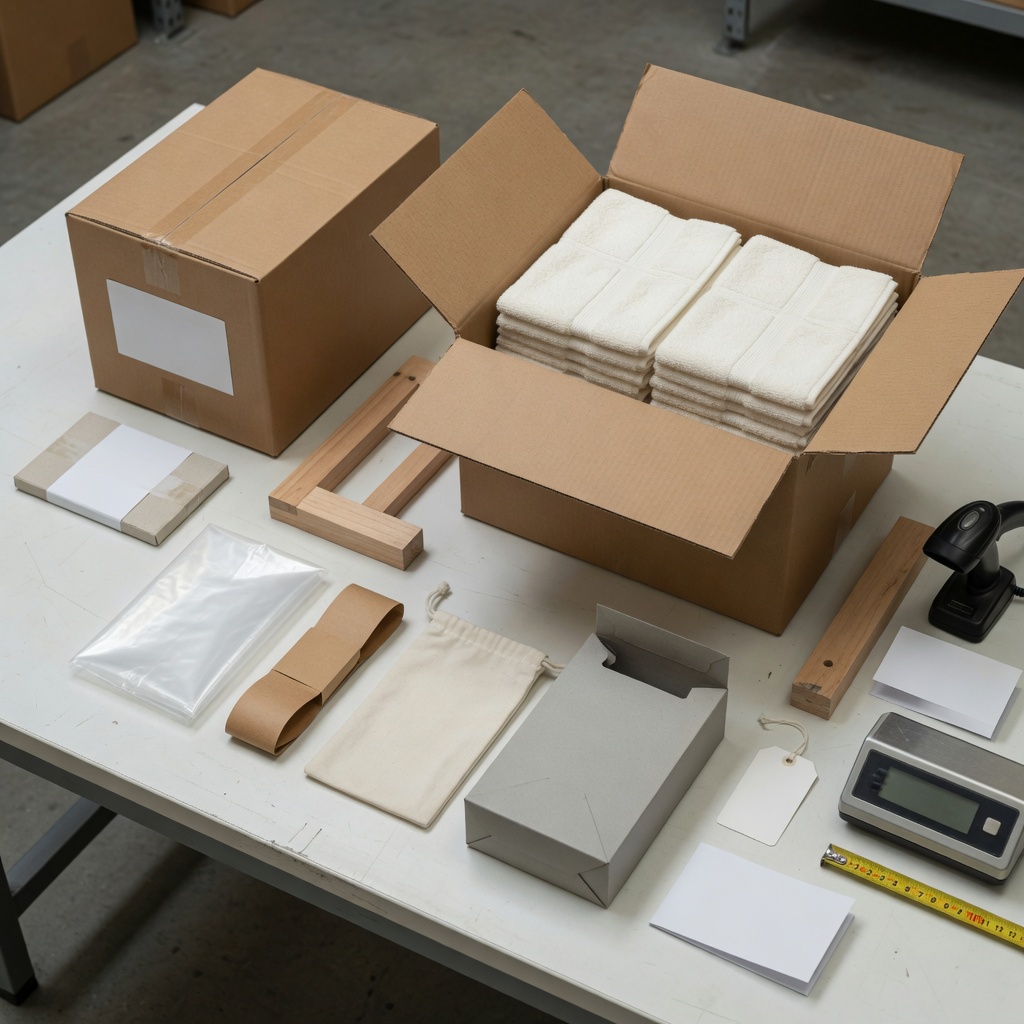
The CJPro source lists polybags, belly bands, pouches, gift boxes, and hangtags as towel-packing options (CJPro Sourcing). The Peshtemal City manufacturer blog separately lists OPP bags, belly bands, insert cards, and gift boxes (Peshtemal City). These are candidate RFQ formats, not evidence that every supplier offers each option.
| Candidate format | Packing requirements to specify | Quote and approval evidence |
|---|---|---|
| Bulk or bundled packout | Fold, towels per bundle, liner or wrap, closure, SKU separation, identification method, and carton orientation | Component and application price, production-equivalent bundle, open-carton evidence, and resulting carton data |
| Individual polybag or OPP bag | Material or construction, thickness where applicable, finished dimensions, seal, transparency, approved variable data, and application method | Incremental price per piece, sealed sample containing the approved towel, packed dimensions, and revised carton packout |
| Belly band | Stock construction, finished width, overlap, closure, artwork revision, variable data, and movement tolerance | Component and application price, dieline, applied sample, packed dimensions, and scan evidence where a barcode is used |
| Pouch | Material, dimensions, closure, towel orientation, insert requirements, and artwork revision | Finished pouch containing the approved towel, application price, added packed weight, and production-equivalent carton data |
| Gift box | Board construction, finish, internal fit, closure, insert, artwork revision, and buyer-defined handling condition | Assembled box with fitted towel, assembly price, closed-carton packout, gross weight, and agreed damage remedy |
| Hangtag or insert card | Material, dimensions, attachment or placement, artwork revision, SKU data, and buyer-supplied barcode data | Applied sample, artwork proof, component and application price, placement confirmation, and scan evidence where applicable |
Request separate commercial lines for every option under review. The supplier should also return each option's effect on folded pack dimensions, pieces per carton, carton count, external dimensions, volume, and gross weight. Do not compare unit-pack prices while leaving those shipment variables unconfirmed.
Verify carton data before comparing UAE delivery quotations
The Peshtemal City source says bulk buyers should confirm units per carton, carton dimensions and weight, SKU labels, and barcodes (Peshtemal City). Use those points as buyer-controlled RFQ fields, not as a UAE regulation or independent packaging standard.
Apply a consistent measurement protocol:
- Measure a carton that is closed and packed in the same configuration proposed for shipment.
- Distinguish nominal component dimensions from measured packed dimensions.
- State whether dimensions are internal or external; use measured external shipping dimensions for delivery comparison.
- Record the dimension order and unit of measure.
- Define what the stated net weight includes and report gross packed-carton weight separately.
- Calculate carton volume as external length × external width × external height using one unit convention.
- Measure full, mixed, and balance cartons separately when their configurations differ.
- Record the measurement date, packing revision, SKU content, carton quantity, and evidence owner.
Calculate each accepted carton type separately:
- Carton volume = measured external length × measured external width × measured external height.
- Shipment volume = the sum of accepted carton volume × carton count for each carton type.
- Carton count = SKU quantity allocated to the packout ÷ accepted pieces per carton, with balance cartons identified separately.
- Shipment gross weight = the sum of measured packed gross weight × carton count for each carton type.
A quotation that provides pieces per carton but omits measured external dimensions and gross weight remains incomplete for delivery-cost comparison.
Source figures: context, not quote inputs
| Source-reported value | Unit and scope | Date or as-of context and source | Procurement treatment |
|---|---|---|---|
| $0.05–$0.15 per piece | Individual-polybag packaging-cost indication in the guide's sourcing context; the currency code, geography, tax treatment, application-labor scope, and quote validity are not established in the available context | The citation context identifies the guide as a 2025 edition; verify the live page date and status (Custom Towel Manufacturer) | Dated editorial context only; not a current supplier quotation |
| 20 pieces per carton | Bulk towel packing example; not a recommended packout for a UAE promotional towel order | The citation context identifies the guide as a 2025 edition; verify the live page date and status (Custom Towel Manufacturer) | Example input only after production-equivalent packout verification |
| $0.15–$0.35 per piece | Ocean-freight impact indication for promotional orders in the guide's context; route, transport scope, currency code, trade term, shipment date, and exclusions are not established | The citation context identifies the guide as a 2025 edition; verify the live page date and status (Custom Towel Manufacturer) | Not a UAE freight or landed-cost estimate |
The dollar sign is retained as reported because the available source context does not identify a currency code. These values are not LUMA prices, current supplier offers, UAE freight quotations, or landed-cost allowances.
Assumption-to-verify calculation
Every input and output below is an example assumption to verify in the supplier's current quotation and production-equivalent packout:
- Assumed product and order scope: off-white cotton terry promotional towels with a finished size of 50 cm × 100 cm, a fabric-mass specification of 400 g/m², and an order quantity of 10,000 pieces.
- Assumed packout: 20 pieces per carton.
- Assumed closed-carton external dimensions: 0.50 m × 0.40 m × 0.30 m.
- Derived example carton count: 10,000 pieces ÷ 20 pieces per carton = 500 cartons, before SKU splits, approved overage, or balance-carton adjustments.
- Derived example carton volume: 0.50 m × 0.40 m × 0.30 m = 0.060 m³ per carton.
- Derived example shipment volume: 0.060 m³ per carton × 500 cartons = 30 m³, before adjustments for differing carton types.
This arithmetic example is not a product specification, supplier commitment, packing recommendation, freight forecast, or UAE shipment estimate. Gross weight is not estimated because the actual towel, unit-pack, and carton weights remain unverified. The assumed packout echoes the dated source example but still requires a physical check.
Normalize supplier responses into the same commercial lines:
- Promotional towel price before optional unit packaging.
- Component and application price for each proposed pack.
- Export-carton price and whether it is included elsewhere.
- Pieces per carton, carton count, measured external dimensions, volume, stated net-weight basis, and gross weight.
- Artwork, setup, label, barcode, insert, inspection, rework, and replacement charges where applicable.
- Freight based on accepted carton data, transport mode, trade term, quote date, validity, readiness date, and named UAE delivery point.
- Destination charges, customs charges, taxes, and local delivery only when supported by current buyer-approved, forwarder, broker, or commercial documentation.
Calculate packaging totals only from current supplier unit prices and the accepted order quantity. Do not convert the dated editorial ranges into automatic budget allowances.
Control carton marks and shipment records
Treat carton-mark artwork and variable data as controlled buyer inputs. The RFQ should provide the applicable fields and identify who approves them:
- Purchase-order reference and promotional towel SKU.
- Product description, color, finished size, and quantity in the specific carton.
- Packing configuration and carton sequence.
- Mixed- or balance-carton identification when permitted.
- Stated net-weight basis, gross weight, external dimensions, and carton volume.
- Consignee, destination, handling, origin, and barcode data exactly as approved for the shipment.
The Peshtemal City source says cartons need SKU, color, quantity, and size labels and that packing-list counts should match the cartons (Peshtemal City). CJPro describes reviewing labels and carton marks and includes packing and carton marks within its pre-shipment inspection context (CJPro Sourcing). These statements support the control fields; they do not prove a proposed supplier's inspection scope or establish UAE labeling requirements.
Build the final packing list from the accepted physical packout rather than a preliminary estimate. Reconcile the purchase-order quantity, physical carton count, carton labels, packing-list quantity, mixed cartons, balance cartons, replacements, and approved deviations. The custom-towel sourcing guide describes a packing list as accompanying the commercial invoice in its own export context (Custom Towel Manufacturer). The buyer's UAE importer, forwarder, or customs broker should confirm the current document set and required fields for the actual shipment.
Where barcodes are used, the instruction should identify the buyer-controlled data source, symbology, encoded value, dimensions, placement, artwork revision, and required scan evidence. Verify scans against approved data rather than relying only on a visual artwork proof.
Approve packing and control changes
The approval record should show the configuration that production is expected to reproduce: the approved towel folded to the signed dimensions, fitted into the selected unit pack, placed in a production-equivalent carton, and linked to the proposed marks and packing-list structure.
Set buyer-defined pass and fail criteria for:
- Correct towel SKU, color, fold, unit pack, and carton quantity.
- Correct packaging component, construction, dimensions, closure, artwork revision, and placement.
- Clean, dry, and intact packaging under the buyer's stated acceptance conditions.
- Closed-carton external dimensions, condition, stated net-weight basis, and gross weight within signed tolerances.
- Correct and readable carton marks.
- Barcode scanning against approved buyer data where barcodes are used.
- Agreement among physical counts, carton labels, packing list, and purchase order.
- Documented treatment of mixed, balance, replacement, and reworked cartons.
CJPro describes a pre-shipment inspection that covers packing and carton marks (CJPro Sourcing). Treat that as an example from the cited source, not evidence that LUMA or a proposed supplier performs the same process. The RFQ and purchase order should identify the inspection party, timing, buyer-defined sampling instruction, tolerances, evidence format, corrective action, and reinspection responsibility. The cited evidence establishes no universal sampling threshold.
Require written buyer approval before changing the fold, component material or construction, dimensions, closure, artwork, variable data, pieces per carton, carton construction, or carton marks. A change affecting packed dimensions, gross weight, carton count, or price should trigger a revised packing schedule, updated production-equivalent evidence, new closed-carton measurements, an itemized quote revision, and updated delivery data where the shipment basis changes.
RFQ checklist: promotional towel sourcing packing requirements
Attach the completed packing schedule to the RFQ and require a line-by-line supplier response.
- [ ] Identify every towel SKU, color, pack-relevant product specification, and order quantity.
- [ ] Define the fold direction, orientation, folded dimensions, and buyer-set tolerances by SKU.
- [ ] Select the unit pack or request separately priced alternatives.
- [ ] Specify each bag, band, pouch, box, tag, insert, liner, wrap, and closure component.
- [ ] Supply controlled artwork and barcode data with revision and approval ownership.
- [ ] State pieces per bundle, inner pack, and export carton by SKU.
- [ ] Define mixed-SKU and balance-carton rules.
- [ ] Require measured external carton dimensions, stated net-weight basis, gross weight, and volume.
- [ ] Provide carton-mark fields, placement, artwork, and importer-approved destination wording.
- [ ] Require scan evidence against buyer-supplied data where barcodes are used.
- [ ] Provide the packing-list template and physical-count reconciliation fields.
- [ ] Request itemized packing prices, trade term, named UAE delivery point, readiness date, and current delivery data using the same packout.
- [ ] Require production-equivalent unit-pack and carton approval before mass packing.
- [ ] Define inspection responsibility, timing, sampling instruction, tolerances, evidence, and remedy.
- [ ] Require written disclosure and approval of every deviation from the signed packing schedule.
- [ ] Obtain current UAE labeling and shipment-document instructions from the buyer's importer, forwarder, or customs broker.
Evidence method, source boundaries, and limitations
| Cited source | Packing context used | Boundary applied |
|---|---|---|
| CJPro Sourcing | Packing-method and carton-volume confirmation; candidate unit-pack formats; label, carton-mark, and pre-shipment packing checks | Category guidance only; not evidence of UAE law, LUMA practices, supplier capability, or an included inspection service |
| Custom Towel Manufacturer | Dated packaging-cost and freight indications, bulk-carton example, and packing-list context | Editorial source context only; not a current quote, verified currency basis, UAE landed-cost estimate, or packing recommendation |
| Peshtemal City | Candidate pack formats, units per carton, carton dimensions and weight, SKU labels, barcodes, and count reconciliation | Manufacturer-blog guidance; not a universal supplier offer, technical standard, UAE rule, or independent test result |
| Vincent Xi author profile | Author identity and role | Supports the byline and Editorial Author title only |
Methodology: Packing-specific statements from the cited sources were translated into fields that a buyer can specify, a supplier can answer, and procurement can verify. Source-reported numbers are isolated with their scope and date-context limitations. The formulas are arithmetic methods, while every worked-example value is expressly labeled as an assumption to verify. No source was used to infer LUMA capabilities, supplier performance, certification, or UAE law.
Limitations and points to verify: The cited commercial sourcing and manufacturer pages are not government notices, independent packaging tests, current supplier quotations, or current freight quotations. Verify the towel specification, fold, packaging material and construction, dimensions, weights, packout, carton construction, prices, currency, trade term, marks, barcode data, inspection service, freight basis, and shipment-document fields through current commercial documents and production-equivalent evidence. If a buyer mandates a technical standard, identify its exact current edition in the RFQ, distinguish that standard's requirements from a supplier's internal practice, and do not infer certification without a current document covering the relevant product, facility, scope, and validity period.
Author basis: The Vincent Xi author profile identifies Vincent Xi as Editorial Author. It supports identity and role only; it does not document factory visits, inspections, laboratory testing, client work, or customer outcomes, and no first-person experience claim is made here.
Release decision: Authorize mass packing only after the supplier has returned a signed packing schedule, an itemized commercial response, production-equivalent approval evidence, accepted closed-carton data, and a defined process for reconciling the physical shipment with the final packing list.
Discuss Your Requirements
Review our manufacturing capabilities, then share your specifications for a supplier-fit review.