Promotional Towel OEM Production Scalability Planning for United States RFQs
By Vincent Xi, Editorial Author · Author profile
For a United States B2B buyer, promotional towel OEM production scalability planning is a release-control exercise. The relevant question is not the largest order a supplier advertises. It is whether the exact approved SKU can move through material allocation, the limiting production step, inspection, rework, folding, packing, and carrier handoff at the quantities and dates stated in the RFQ.
Compare every bid against the same specification revision, release quantity, production location, quote date, commercial basis, and named United States destination. A generic MOQ, factory area, annual portfolio output, or undefined lead time cannot establish release fit on its own.
Scale-approval rule: approve the release only when the sample, material allocation, bottleneck schedule, net accepted output, QC plan, label revision, packed-cargo data, landed-cost basis, and delivery milestones all refer to that release. Treat any material, construction, decoration, tolerance, label, or packout change as a controlled alternate quote.
United States promotional towel production scalability planning: fix the release basis
The following controls are buyer-side RFQ recommendations, not claims about a supplier's current practices.
| Control | Evidence required in the RFQ response | Scale decision |
|---|---|---|
| Unit equivalence | SKU, specification revision, issue date, approved sample, artwork revision, and document-precedence rule | Compare capacity only if all quantity tiers represent the same unit. |
| Release pattern | Committed quantity, forecast quantity, MOQ, setup charges, unit-price tiers, cargo-ready window, and required receipt date | Assess the requested releases rather than an unsupported maximum-order statement. |
| Material allocation | Stock, on-order, or reserved status; lot plan; reservation expiry; and substitution restrictions | Require a dated statement tied to the quoted release. |
| Bottleneck allocation | Limiting operation, production site, applicable line or equipment group, allocated window, and output time basis | Use SKU-level allocation instead of factory-wide area or portfolio output. |
| Accepted-output basis | Gross planned output, expected rejects, rework allowance, downtime, inspection time, and net accepted output | Compare bids only when the time units and output definitions match. |
| Label readiness | Controlled artwork, proposed origin and fiber fields, placement, attachment, packaging presentation, and review status | Place unresolved label decisions on the release schedule. |
| Packed-cargo readiness | Units per carton, carton count, dimensions, net and gross weight, pallet plan, and data-release date | Do not finalize freight or landed cost from theoretical product weight alone. |
| Delivery and change control | Defined schedule events, carrier handoff, named destination, subcontractor disclosure, and written approval path for changes | Require each milestone and proposed change to reference the same release. |
Freeze the promotional towel SKU before comparing capacity
Capacity responses are not comparable if bidders are scheduling different products. The controlled specification should contain only measurable or reviewable requirements relevant to the intended promotional towel.
| Specification block | RFQ control |
|---|---|
| Document identity | SKU, revision, issue date, approval authority, and the controlling record if the written specification conflicts with the approved sample |
| Material and construction | Fiber percentages, terry or microfiber structure, pile or face construction, border design, hem construction, thread, and prohibited substitutions |
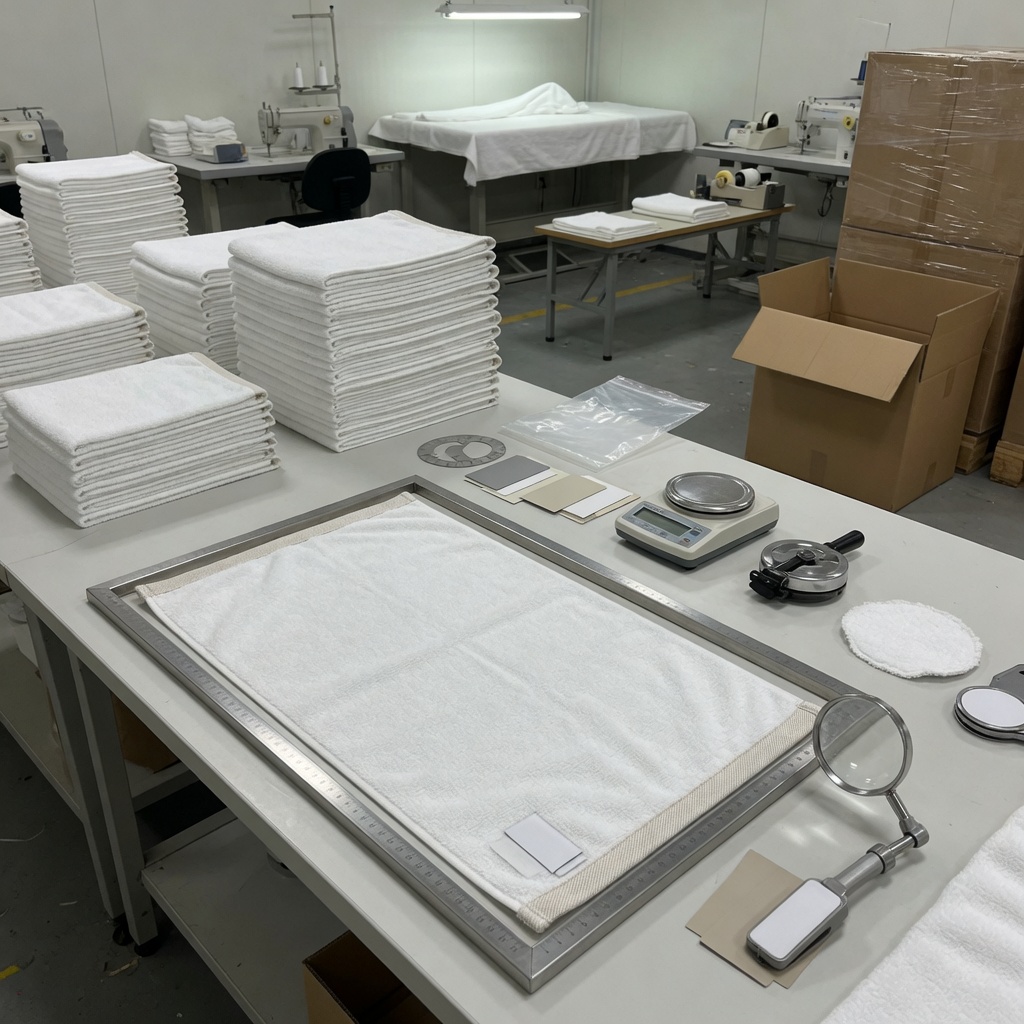
| Dimensions and mass | Finished length, finished width, areal mass, finished unit mass, tolerances, conditioning method, controlling unit system, and rounding rule |
| Color and decoration | Approved color reference, lot-to-lot rule, decoration process, artwork revision, dimensions, placement tolerance, coverage, and durability acceptance |
| Label and assembly | Proposed label content, location, attachment method, loop requirements if applicable, and the reviewer responsible for approval |
| Packout | Fold, individual packaging, units per carton, carton limits, barcode fields, pallet plan, and mixed-carton restrictions |
| Quality acceptance | Applicable methods and pass/fail limits for dimensions, mass, shade, shrinkage, colorfastness, absorbency, lint, seams, odor, decoration, and packing accuracy |
The cited Custom Towel Manufacturer production-design page discusses fiber selection as a production-design input. It is used here only to support freezing the selected fiber in the RFQ. It does not establish publication timing, product performance, test results, lead time, or any supplier's available capacity.
Illustrative release-mass check to replace with quote data
Every value in this table is an example assumption or a calculation derived from those assumptions. It is not a supplier offer, historical result, or industry benchmark. Date context: this is a non-historical scenario prepared for the article and must be replaced or confirmed in the supplier's dated quote for the planned release.
| Input or result | Illustrative scope |
|---|---|
| Finished dimensions | 30 cm × 60 cm for one assumed cotton-terry promotional towel |
| Areal mass | 400 g/m² for the assumed towel specification |
| Flat area | 0.18 m² per towel, calculated from the assumed finished dimensions |
| Theoretical flat-fabric mass | 72 g per towel, calculated from flat area multiplied by assumed areal mass |
| Finished unit mass | 78 g per unit, an assumption allowing for construction details outside the flat-area calculation |
| Release quantity | 20,000 units in the illustrative release |
| Product mass | 1,560 kg before individual packaging, cartons, and pallets, calculated from assumed finished mass multiplied by release quantity |
Freight approval should use a dated packing record showing final carton count, carton dimensions, net weight, gross weight, and pallet configuration. The illustrative product mass is not a substitute for packed-cargo data.
Translate published scale claims into RFQ evidence
Published figures can identify questions for the RFQ, but they are not comparable capacity until each figure is tied to the controlled SKU, production route, loading window, QC plan, and packout.
| Supplied source and date context | Source-reported figure | Permitted scalability use | Evidence required in the quote |
|---|---|---|---|
| Rally Towels rush-order page. Its title presents the page as a 2026 guide; that year is page-title context rather than an independently established audit date. | Seller-reported output of 50,000 promotional-towel units in a 24-hour cycle. | Use as a seller-specific rush claim and a prompt for exact-SKU verification. It does not establish output for the selected material, decoration, inspection, packout, or release window. | Material status, route, shift definition, gross output, net accepted output, QC time, packing throughput, cargo cutoff, and dated commitment |
| Towelscc manufacturer page. No publication or update date was established from the supplied page, so the figures require confirmation as of the quote issue date. | Seller-reported MOQ from 100 pieces and bulk orders of 100,000+ pieces across its stated towel offer. | Ask which exact material, construction, decoration, label, tolerance, and packout apply at each endpoint. | SKU-specific MOQ and quantity tiers tied to the controlled specification and release schedule |
| Towelscc manufacturer page, under the same undated source context requiring quote-date confirmation. | Seller-reported site area of 5,000 m² and portfolio output of 7.2 million towels per year. | Use only to request process-level evidence. Site area and portfolio output do not establish free capacity at the selected SKU's bottleneck. | Current loading, relevant equipment, planned downtime, net-output assumptions, QC throughput, and purchase-order-linked allocation |
| Towelscc manufacturer page, under the same undated source context requiring quote-date confirmation. | Seller-reported 15-day production period for its customization offer. | Use as a verification prompt until day type, prerequisites, start event, finish event, and included operations are defined. | Written schedule covering approvals, material readiness, production, inspection, rework allowance, packing, and cargo-ready status |
A compliant capacity statement should identify the quote date, validity period, SKU revision, production location, release quantity, output unit, time basis, source record, assumptions, and responsible supplier contact.
Build a quote-linked capacity worksheet
The worksheet should convert a broad capability statement into a release commitment that can be tested against the United States receipt requirement.
| Worksheet field | Mandatory supplier evidence | Buyer approval test |
|---|---|---|
| Quote identity | Quote date, validity, SKU revision, production location, committed quantity, forecast quantity, and cargo-ready window | All commercial and technical records identify the same release. |
| Material readiness | Stock, on-order, or reserved status; lot plan; reservation expiry; and substitution restrictions | The material statement is dated and protected for the quoted window. |
| Process route | Operations from material preparation through decoration, sewing, inspection, folding, and packing, including each location and owner | All handoffs and external processes are disclosed. |
| Bottleneck and loading | Limiting operation, allocated line or equipment group, queued work, maintenance, shutdowns, and schedule owner | The allocation covers the release rather than general factory availability. |
| Output basis | Defined production day or shift, gross output, startup loss, reject allowance, rework, planned downtime, inspection time, and net accepted output | The output basis uses the same unit and time period as the buyer's requirement. |
| QC throughput | In-line checks, final inspection, test timing, reinspection, release time, and rework capacity | Quality-control activity is included in the critical path. |
| Packout throughput | Packing output, units per carton, carton dimensions, weights, pallet plan, and final data-release date | Packing and freight data can be completed within the release window. |
| Subcontracting and recovery | External sites, approval requirements, delay triggers, alternate capacity, split-release options, incremental cost, and transport responsibility | Changes cannot be implemented without the agreed written approval route. |
Use calculations tied to the current quote:
- Required accepted output = committed release units ÷ supplier-confirmed production time available after required approvals.
- Capacity coverage = supplier-committed net accepted output ÷ required accepted output, using the same time unit.
- Estimated product mass = approved finished mass per unit × release units.
- Landed cost per accepted unit = total buyer-approved landed cost ÷ accepted units delivered to the named destination.
Each supplier input should carry its unit, exact SKU scope, as-of date, source document, assumptions, and owner. A per-day figure is not comparable until the bidder defines the day, shift pattern, planned stops, inspection time, and whether the result is gross production or net accepted output.
United States RFQ controls that constrain production scalability planning
Put labeling review on the release schedule
The linked FTC textile labeling rules and United States country-of-origin marking rules are official, dynamic references. The importer or qualified compliance adviser should confirm their current applicability to the exact fiber composition, construction, manufacturing origin, packaging, and transaction before artwork approval.
The following workflow is a buyer-side control and should not be read as a quotation of the regulations:
- Require proposed fiber, origin, responsible-party identity where applicable, label placement, attachment, and packaging presentation for review.
- Tie the approved artwork to the SKU revision, production location, label source, and packaging revision.
- Record which fields are compliance-driven and which are optional customer-program content.
- Reopen review after a change to fiber, manufacturing origin, site, label construction, attachment, or packaging.
- Do not release affected bulk work until the designated reviewer closes unresolved fields in writing.
Keep certificate claims separate from capacity evidence
The undated Towelscc page presents an ISO 9001 claim. Treat it as a seller statement until a current, scope-matching certificate is supplied. The linked ISO overview, to be rechecked at the document-review date, identifies ISO 9001 as a quality-management-systems standard. ISO 9001 is a standard designation rather than a production-capacity measurement, and the overview does not establish that a particular supplier, site, or product is certified.
If the claim is relevant to the RFQ, request the current certificate, holder name, covered site, issuer, validity status, scope, and applicable annex. Certificate review does not replace SKU-level testing, inspection, or capacity evidence.
Compare landed cost on the same accepted-unit basis
Require a common currency, delivery basis, named place, importer-of-record assumption, quote validity, payment milestones, and exclusions. Use the same release quantity and final United States destination for every bid.
| Cost block | Evidence required |
|---|---|
| Product and manufacturing | Unit price, sampling, setup, decoration, labels, packaging, permitted quantity variance, and change charges |
| Origin and export movement | Inland transport, export handling, documentation scope, and exclusions |
| International transport | Freight basis, insurance scope, booked or estimated status, cargo cutoff, and packed-volume inputs |
| United States entry | Classification assumption, origin assumption, duties or tariffs, government charges, broker charges, and examination exposure |
| Final delivery | Terminal handling, drayage, storage exposure, appointment requirements, and delivery to the named destination |
| Quality and recovery | Inspection, reinspection, rework, shortage remedy, replacement, split release, and approved expedited transport |
Have the importer or customs broker verify classification, origin treatment, and current entry assumptions for the actual towel through the United States Harmonized Tariff Schedule and other applicable official sources. This article states no classification conclusion, duty rate, tariff rate, or freight rate.
Define delivery milestones, not a single duration
Work backward from the required United States receipt date. Require dated milestones for artwork approval, material reservation, production start, production completion, inspection release, packing completion, cargo-ready status, carrier handoff, departure, arrival, customs release, and final delivery.
For a deadline-driven promotion, include a priced recovery plan in the purchase order. It should define who may authorize alternate capacity, a split release, a specification deviation, or expedited transport, as well as responsibility for incremental cost.
Protect net accepted output with QC and change control
| Control point | Scalability question | Required record |
|---|---|---|
| Approved reference | What construction, shade, hand feel, decoration, label, and packout must the release reproduce? | Signed sample, controlled specification, artwork revision, and document-precedence rule |
| Bulk readiness | Are material, trims, decoration inputs, labels, and packaging available for the approved route? | Lot identities, readiness records, approved preproduction sample, and line-release authorization |
| In-line control | Can variation be found early enough to protect accepted output and schedule? | Lot-linked results for dimensions, areal mass, finished mass, shade, seams, placement, defects, and rework status |
| Final acceptance | Does the inspected release meet the written defect and functional criteria? | Selection method, defect definitions, acceptance limits, applicable test results, carton checks, and purchase-order-linked photographs |
| Shipment release | Do accepted quantity and packing data match the freight and landed-cost files? | Inspection release, final packing list, carton count, weights, pallet data, and cargo-ready confirmation |
| Change and remedy | Can site, process, material, label, packaging, or subcontractor changes occur without buyer review? | Written notice procedure, approval authority, retained samples, lot traceability, remedies, and delay responsibility |
If the purchase order uses an attribute-sampling standard, identify the standard and edition, inspection level, sample-selection method, defect categories, acceptance limits, and critical-defect treatment. A sampling plan is an acceptance tool; it is not evidence of certification or available production capacity.
Practical RFQ checklist for United States promotional towel production scalability planning
Use this practical RFQ checklist as an RFQ attachment. Require the bidder to mark each line as confirmed, qualified, or not offered and cite a dated quote, schedule, specification, packing record, or other source document. Treat a blank response as an open release risk rather than implied confirmation.
Buyer release definition
- [ ] Identify the promotional towel SKU, specification revision, issue date, approved sample, artwork revision, and document-precedence rule.
- [ ] State the committed release quantity, forecast quantity, requested cargo-ready window, required United States receipt date, and named destination.
- [ ] Define fiber, construction, dimensions, mass, tolerances, decoration, label, fold, packaging, carton limits, and prohibited substitutions.
- [ ] State the quote currency, delivery basis, named place, importer-of-record assumption, payment milestones, and quote-comparison basis.
Supplier scalability response
- [ ] Confirm the production site, process route, subcontracted operations, quote issue date, validity period, and exact specification covered.
- [ ] State material status as of the quote date, lot plan, reservation expiry, and whether any alternate material is assumed.
- [ ] Identify the limiting operation, allocated production window, output unit, time basis, gross planned output, and net accepted output.
- [ ] Include startup loss, expected rejects, rework, downtime, inspection, reinspection, folding, packing, and cargo-release time in the schedule.
- [ ] Return final or clearly labeled preliminary carton count, carton dimensions, net and gross weight, pallet plan, and packed-data release date.
United States labeling and landed-cost controls
- [ ] Submit proposed fiber, origin, responsible-party identity where applicable, placement, attachment, and packaging presentation for designated review.
- [ ] State classification and origin assumptions, included and excluded charges, freight status, broker assumptions, and final-delivery scope without presenting unverified customs conclusions.
- [ ] Separate product, setup, decoration, labels, packaging, export movement, international transport, entry, final delivery, inspection, and recovery costs.
QC, delivery, and recovery controls
- [ ] State the inspection and test methods, pass/fail limits, sampling basis if used, responsible party, timing, and records supplied before shipment release.
- [ ] Provide dated milestones from approval and material reservation through production, inspection, packing, carrier handoff, entry, and delivery.
- [ ] Define written approval requirements for site, material, process, label, packaging, subcontractor, schedule, and quantity changes.
- [ ] Price and assign responsibility for rework, reinspection, shortage remedy, split release, replacement, and approved expedited transport.
- [ ] Record the buyer's evidence location, open questions, owner, due date, and release status for every qualified or incomplete response.
Approve the release only when the completed checklist, cited evidence, quote, specification, label file, capacity worksheet, QC plan, landed-cost record, and delivery schedule all identify the same controlled release.
Methodology, source context, and limitations
Methodology. The supplied materials were separated by source type: commercial seller pages for seller-reported capability figures, a commercial production-design page for limited specification context, official United States regulatory and classification references, an ISO standards overview, and the public author profile. Seller figures were retained with their stated units, page scope, and available date context. They were not averaged, normalized, audited, or presented as typical performance. The illustrative mass result was calculated from labeled assumptions and is not supplier evidence.
Source context. The Rally Towels year context comes only from the 2026 wording in the cited page title. No publication or update date was established for the supplied Towelscc capability page or the cited production-design page. The e-CFR and tariff-schedule links are dynamic official references and should be checked at the applicable artwork-approval, purchase-order, and entry dates. The ISO page explains the standard but does not verify a seller's certificate.
Limitations and what to verify. The commercial sources do not establish current equipment, staffing, loading, material ownership, historical delivery performance, SKU-level yield, certificate validity, lot-specific test results, signed quotations, packed-carton data, freight bookings, or customs treatment. Verify all capacity, quality, labeling, cost, and schedule inputs in the supplier's signed quote and purchase order. Have the importer, customs broker, or qualified adviser confirm current labeling, origin, classification, tariff, and entry requirements for the actual transaction.
Author basis. The public author profile identifies Vincent Xi as Editorial Author. It is used for authorship attribution only; no factory-visit, product-testing, client-outcome, certification, or personal production-experience claim is made.
Production scale is ready for approval only when the controlled product, accepted-output calculation, quality plan, label file, packed-cargo record, landed-cost basis, and delivery schedule describe the same United States release.
Discuss Your Requirements
Review our manufacturing capabilities, then share your specifications for a supplier-fit review.