Hotel Towel OEM Product Development Capability for Europe
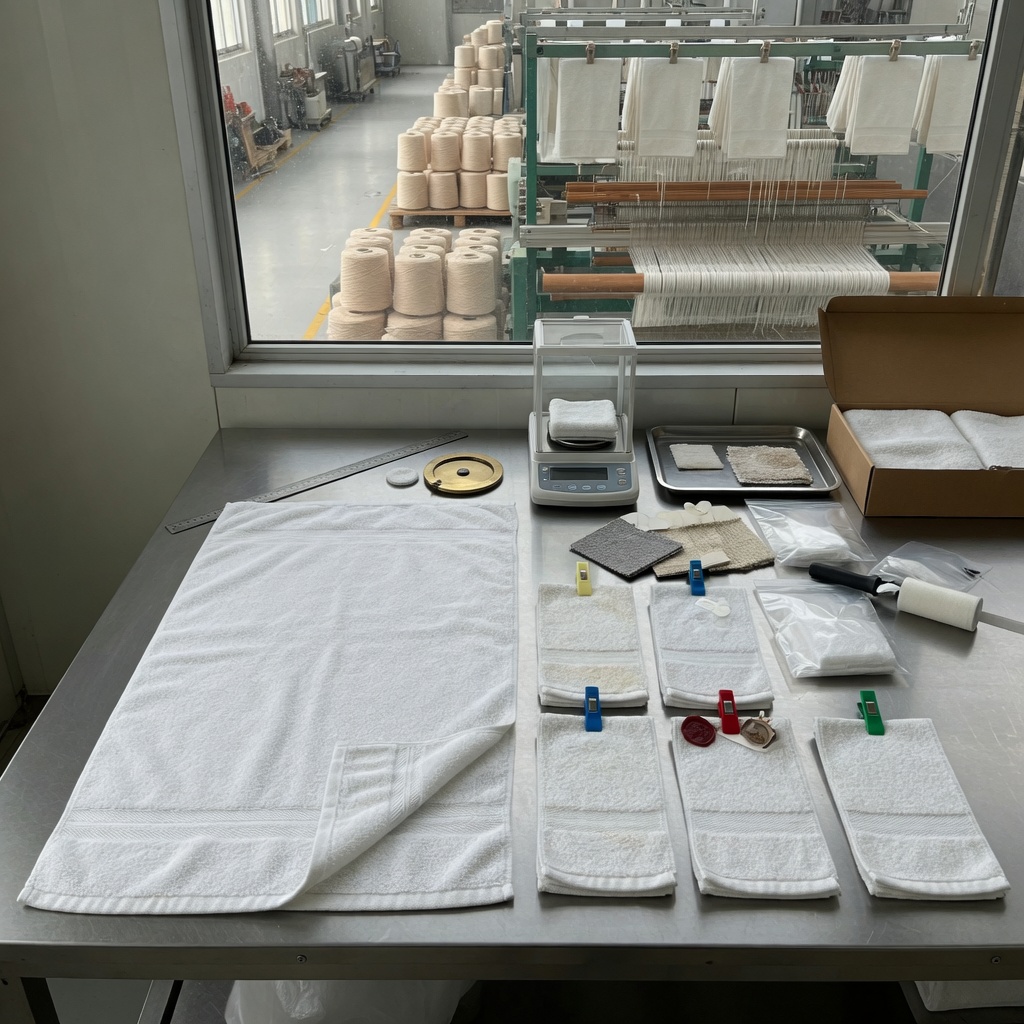
By Vincent Xi, Editorial Author
For a European hotel towel RFQ, OEM product development capability means more than returning a sample quickly. The award question is whether a supplier can translate a controlled SKU brief into a representative sample, validate it against agreed methods, freeze the approved construction and manufacturing route, and reproduce it in bulk with lot-specific release evidence. Nominal GSM, general capacity statements, and certificate references are inputs to that assessment; none replaces the evidence chain.
Ask every shortlisted supplier to complete the same evidence schedule. Record intended EU member state destinations, non-EU EEA destinations, the applicable UK jurisdiction, and European country-specific or tender conditions on separate RFQ lines. An undefined Europe-compliant claim is not an acceptance criterion.
The supplied commercial sources help frame development and supplier-qualification questions. The Sale Turkish Towels page discusses hotel-towel construction, performance, customization, and production approval, while the Hede Towel page raises questions about yarn, testing, customization, lead time, capacity, quality control, shipping, and certification evidence (Sale Turkish Towels; Hede Towel). These pages do not prove another supplier's product, site, capacity, certification, lead time, or order performance.
Europe RFQ gates for product development capability
Use the following gates to decide whether a proposed hotel towel is ready to move from development into manufacturing.
| Decision gate | Evidence required from the supplier | Release condition | Hold condition |
|---|---|---|---|
| Controlled development brief | SKU revision, hotel use profile, laundry assumptions, destination, material, construction, dimensions, basis weight, appearance, branding, packing, tolerances, and exclusions | Each requirement has a controlled value or reference, an evidence type, an owner, and an approver | Materials, destinations, tolerances, exclusions, or responsibilities remain implicit |
| Representative development sample | Sample identity and revision linked to fiber, yarn, terry construction, dimensions, nominal GSM, borders, hems, finish, color, decoration, and intended manufacturing route | The supplier states what the sample represents and identifies every provisional element or route difference | The sample differs from intended bulk without a written difference assessment |
| Validation plan | Agreed sample identity, conditioning, laundering, drying, measurement methods, checkpoints, reporting units, thresholds, and responsible test party | Results are traceable to the submitted sample and comparable with buyer-approved criteria | A result lacks sample identity, method, condition, unit, threshold, or responsible party |
| Pre-production freeze | Controlled approval sample, final specification, artwork, packing approval, route declaration, and change procedure | Commercial construction, appearance, packing, and route are version-controlled before bulk release | Substitutions or process changes can occur without assessment and buyer authorization |
| Manufacturing scale-up | Named site, subcontracted stages, SKU-specific output basis, allocated capacity, material booking, lead-time stages, lot controls, and recovery plan | The production plan is tied to the quoted SKU mix and order window | Capacity is generic, allocation is unstated, or sample-to-bulk fidelity is unexplained |
| Destination evidence | Separate evidence rows for each applicable EU, non-EU EEA, UK, and European country-specific destination | Applicability, document ownership, scope, and current status are confirmed for each destination | A generic European evidence pack is offered without destination or entity checks |
| Lot release | Lot-specific inspection, test, packing, traceability, deviation, and authorization records | Release records match the purchase agreement, approved sample, and identified production lot | Records are generic, expired, unrelated to the lot, or missing acceptance criteria |
System capability can be reviewed without requesting another customer's confidential records. Suitable evidence may include blank development forms, anonymized inspection formats, sample-revision templates, change-request forms, and example lot-traceability structures.
Build a measurable hotel towel development brief
Every RFQ requirement should identify the value and unit, measurement condition, method or controlled reference, permitted tolerance, approval evidence, responsible party, and deviation authority.
| Specification block | RFQ fields | Approval evidence |
|---|---|---|
| SKU and use profile | Towel type, intended hotel use, laundry and drying processes, handling constraints, replacement criteria, destination, and buyer assumptions | Accepted use-profile record with revision, exclusions, and approvers |
| Material and yarn | Declared fiber composition, yarn definition, pile and ground construction, material restrictions, sourcing conditions, and substitution policy | Construction sheet and material declaration linked to the approved sample |
| Geometry and basis weight | Finished length and width, conditioning state, measurement method, nominal basis weight, borders, hems, decoration position, and permitted variation | Conditioned measurements tied to an identified sample revision |
| Appearance and branding | Controlled color reference, whiteness expectation where relevant, handle reference, decoration method, artwork revision, dimensions, and placement tolerance | Approved physical sample and controlled artwork |
| Performance | Absorbency, drying behavior, lint, dimensional change, relevant colorfastness, laundered appearance, hem condition, and edge integrity | Results produced under the agreed protocol with sample identity, units, and thresholds |
| Packing and traceability | Fold, pack configuration, carton protection, moisture controls, label inputs, lot marks, destination instructions, and approved substitutions | Packing sample, packing specification, and lot-specific release checklist |
Keep published figures in their stated scope
The undated Sale Turkish Towels page supplied for this revision states 450-600 g/m2 as that publisher's hotel-towel development range. The unit is grams per square metre, the scope is the publisher's own stated range, the date context is that no publication date was supplied, and the source is Sale Turkish Towels. It is not presented here as a European requirement, a buyer recommendation, a LUMA & CO. TEXTILE specification, or proof of another supplier's capability (Sale Turkish Towels).
The same page discusses absorbency, durability, drying speed, industrial-wash considerations, embroidery, jacquard customization, and approval before production scaling. These are attributed development topics, not verified results for another product or factory (Sale Turkish Towels).
Check specification arithmetic before sampling
Example assumption to verify in the supplier quote: for a hypothetical cotton-terry bath towel in this RFQ exercise, assume finished dimensions of 0.70 m by 1.40 m and nominal basis weight of 500 g/m2. These values are buyer-side example assumptions created for this article's calculation. They are not a sourced benchmark, recommendation, product claim, or supplier offer.
0.70 m x 1.40 m x 500 g/m2 = 490 g per towel
The resulting 490 g per towel is an illustrative area-based calculation for the same hypothetical SKU. Verify every input in the supplier quote and approved sample record, including finished measurement condition, conditioning state, basis-weight method, borders, hems, decoration, and production tolerance.
This calculation checks internal consistency only. It does not establish absorbency, drying behavior, lint, laundering durability, colorfastness, or edge integrity. Those outcomes need separately agreed methods and acceptance thresholds.
Control samples and wash validation before manufacturing release
Every development sample should have an identity, revision, issue status, purpose, construction record, manufacturing-route statement, and list of differences from intended bulk production.
| Sample stage | Controlled purpose | Traceability required | Release evidence |
|---|---|---|---|
| Feasibility submission | Tests whether the proposed construction, appearance, performance targets, tolerances, and packing can be combined | Supplier, site or route, materials, provisional elements, sample identity, and revision | Written response identifying unresolved risks and proposed controls |
| Development sample | Represents intended terry construction, borders, hems, dimensions, nominal GSM, finish, and decoration | Construction sheet, route declaration, measurements, and difference statement | Buyer disposition against the controlled development brief |
| Wash-validation set | Compares tested samples with retained unwashed controls from the same revision | Sample allocation, conditioning, wash and dry records, checkpoints, and observations | Traceable results against the buyer-approved protocol |
| Pre-production approval sample | Freezes commercial construction, appearance, artwork, packing, and route | Controlled sample, final revision, approvers, and approval status | Written authorization to begin bulk manufacturing |
| Bulk comparison sample | Represents an identified production lot against the approved sample and written tolerances | Lot identity, sampling record, measurements, deviations, and disposition | Lot-specific release or documented corrective action |
Convert an industrial-wash claim into a reproducible protocol. Define the machine or program, sample quantity, load in kg, detergent and chemistry, dose unit, relevant water conditions, temperature in degrees Celsius, cycle sequence, drying method, evaluation checkpoints, conditioning duration, measurement methods, and pass/fail criteria. Reports should connect dimensions, mass, absorbency, drying behavior, lint, color, appearance, borders, hems, and edge condition to the identified samples.
The Sale Turkish Towels page's discussion of industrial washing and approval before scaling supports asking for these development controls, but it does not supply an order-specific protocol or result (Sale Turkish Towels). A sample-speed statement remains a scheduling input until the supplier identifies whether yarn, weaving, wet processing, finishing, sewing, decoration, inspection, and packing represent the intended bulk route.
Verify manufacturing scale-up for the approved SKU
One supplied source illustrates why headline capacity needs order-specific qualification. On its undated page, Minh Khai Textile states capacity of up to 12 shipping containers per month for its own towel operation. The unit is shipping containers per month, the scope is that publisher's stated operation, the date context is that no publication date was supplied, and the source is Minh Khai Textile. The page context supplied for this revision does not define container size, utilization, SKU mix, order allocation, or a sustained operating period. The figure cannot establish another supplier's capacity or be converted reliably into towels per production period (Minh Khai Textile).
The same publisher describes a yarn-to-packaging process for its operation. Treat that description as a publisher claim requiring verification for the quoted order. The RFQ should show which stages occur at the named manufacturing site, which are subcontracted, and how lot identity is preserved across material receipt, weaving, wet processing, finishing, sewing, decoration, inspection, and packing (Minh Khai Textile).
| Scale-up question | Evidence required | Procurement control |
|---|---|---|
| Where will each stage occur? | Legal entity, site address, process-stage map, and declared subcontractors | Buyer authorization before a site or subcontractor changes |
| Will bulk follow the sample route? | Comparison of development, pre-production, and bulk routes | Difference assessment and additional validation before release |
| Is capacity allocated to this SKU mix? | SKU-specific output basis, quoted order window, allocated capacity, competing assumptions, and recovery plan | Allocation evidence tied to the supplier quote |
| Are materials controlled? | Material booking, approved sources, incoming checks, lot identity, and substitution process | No substitution without documented assessment and authorization |
| Can the lot be reconciled? | Coding from incoming material through finished cartons, linked to samples, tests, and inspections | Shipment hold where records cannot be reconciled |
| Are changes controlled? | Change request covering material, construction, process, site, decoration, packing, and schedule | Named approvers, impact assessment, revalidation decision, and revision update |
| Can deviations be contained? | Escalation, containment, correction, reinspection, schedule impact, and release authority | Contractual hold, corrective action, or rejection under agreed criteria |
The Hede Towel page supports asking suppliers about lead time, capacity, quality control, shipping, testing, and supporting documents. It does not answer those questions for the supplier under review (Hede Towel).
Separate European destination evidence during product development
The supplied commercial sources are not regulatory authorities and do not establish a particular EU, EEA, UK, or national legal requirement. Product development should instead produce accurate product, entity, site, material, labeling, packaging, and traceability information for destination review. The buyer's designated adviser should confirm current applicability for the intended destination and placing-on-market date.
| Destination line | Supplier evidence requested in the RFQ | Buyer-side verification before approval |
|---|---|---|
| Intended EU member state destinations | Actual member states, selling and importing entities, product and material declarations, traceability inputs, available test evidence, labeling inputs, packaging data, and document owners | Applicable EU-level requirements, member-state conditions, language needs, supply-chain responsibilities, evidence status, and contract allocation |
| Intended non-EU EEA destinations | Actual destination, importer or distributor, product information, available test evidence, traceability, labels, packaging information, and document availability | Current destination-specific requirements and any differences from the EU evidence file |
| Intended UK destination | Applicable UK jurisdiction, importer or distributor, product information, available test evidence, traceability, labels, packaging, and document ownership | Current requirements for the identified jurisdiction without assuming that an EU or EEA file is sufficient |
| European country-specific, hotel-group, or tender conditions | Buyer-supplied terms, required language, product criteria, environmental information requests, packaging instructions, evidence format, and approval owner | Applicability, current wording, document priority, conflicts, and responsible party |
For each submitted report, certificate, or declaration, compare the legal entity, manufacturing site, product description, sample identity, method, result, issue status, validity, and proposed-order scope. Record mismatches, corrective actions, owners, deadlines, and release decisions.
Where a standard or certification scheme is relevant, request the exact identifier and edition where applicable, certificate holder, site scope, product scope, issuing body, issue status, expiry status, and independent verification route. Keep the standard's published requirement or method separate from the buyer's contractual threshold and the supplier's routine practice. Naming a method does not prove a passing result, and displaying a scheme name does not establish current certification.
Product development capability award checklist
- [ ] Identify the buying entity, selling entity, manufacturing site, and declared subcontractors for the proposed order.
- [ ] Create a controlled SKU line for each towel type, size, color, construction, finish, branding method, and packing configuration.
- [ ] Record EU member state, non-EU EEA, UK-jurisdiction, and European country-specific destinations separately.
- [ ] State the hotel use profile, laundry and drying processes, handling constraints, and replacement criteria supplied to the manufacturer.
- [ ] Specify dimensions, measurement condition, nominal GSM, calculated mass where used, tolerances, and evidence method.
- [ ] Define fiber composition, yarn, pile and ground construction, borders, hems, finish, and substitution policy.
- [ ] Attach controlled color references, artwork revisions, decoration dimensions, and placement tolerances.
- [ ] Define conditioning, measurement, laundering, drying, and performance methods, including units, thresholds, report format, and pass/fail rules.
- [ ] Control sample identity, revision, retained controls, route differences, approval status, and change authority.
- [ ] Require an approved pre-production sample before bulk manufacturing release.
- [ ] Verify document holder, site, product scope, issue status, validity, and verification details where documents are relevant.
- [ ] Obtain SKU-specific material-booking terms, lead-time stages, allocated capacity, order-window assumptions, and recovery controls.
- [ ] Define lot identity, incoming controls, in-process checks, final inspection, packing checks, deviation handling, and shipment-release authority.
- [ ] Put approved specifications, samples, artwork, methods, evidence duties, change controls, revalidation triggers, remedies, and release conditions into the purchase agreement.
Evidence method, limitations, and verification
Source contexts
The commercial pages supplied for this article are publisher-authored educational or marketing material, and no publication dates were supplied. Their statements are used as attributed context, not as independent laboratory, regulatory, certification, audit, or order-level manufacturing evidence.
- Development context: Sale Turkish Towels supports attribution of that publisher's stated basis-weight range and its discussion of performance, industrial washing, customization, and approval before scaling (Sale Turkish Towels).
- Supplier-question context: Hede Towel supports RFQ questions concerning yarn, testing, customization, lead time, capacity, quality control, shipping, and certification evidence (Hede Towel).
- Scale-up context: Minh Khai Textile supports attribution of that publisher's process description and stated container capacity, both of which require current, order-specific verification (Minh Khai Textile).
- Authorship context: The LUMA & CO. TEXTILE profile identifies Vincent Xi as Editorial Author (Vincent Xi author profile).
Methodology
Source statements were retained only when tied to a supplied URL and attributed to the named publisher. Publisher-specific figures remain attached to their stated unit, scope, and undated source context. They were not transferred to another supplier, averaged into a benchmark, or treated as a European requirement. Source topics were converted into buyer-controlled RFQ fields, evidence requests, decision gates, and change controls. Other exact values are labeled as example assumptions or calculations to verify in the supplier quote.
Limitations and what to verify
The supplied evidence does not include independent laboratory reports, full test methods, sample plans, dated production records, current certificate files, audit findings, purchase-order records, or lot-level traceability. It does not establish LUMA & CO. TEXTILE manufacturing integration, capacity, MOQ, lead time, sample timing, certification, test results, or hotel towel performance.
Before award, verify supplier and site identity, subcontracted stages, sample-to-bulk fidelity, material sources, document authenticity, certificate scope where relevant, test-sample identity, methods and conditions, buyer thresholds, allocated capacity, lead-time assumptions, tolerances, packing, lot traceability, destination applicability, change control, release authority, and contractual remedies. Destination applicability depends on current rules, product facts, supply-chain roles, destination, and placing-on-market date; obtain current advice for each applicable EU, non-EU EEA, UK, or European country-specific destination.
Author and experience scope
The first-party LUMA & CO. TEXTILE author profile identifies Vincent Xi as Editorial Author. It supplies no basis for a first-hand manufacturing, factory-inspection, laboratory-testing, certification, customer-outcome, or product-use claim, so none is made here.
Discuss Your Requirements
Review our manufacturing capabilities, then share your specifications for a supplier-fit review.