Gym Towel Wholesale Supplier Communication Workflow Review for United States Buyers
Vincent Xi
Editorial Author
https://www.lumacotextile.com/authors/vincent-xi/
United States buyers evaluating a gym towel wholesale supplier must scrutinize the communication workflow before approving physical fabric swatches. A reliable wholesale supply contract demands enforceable written protocols detailing who responds to the initial RFQ, how pre-production sample sign-offs are documented, when scheduled manufacturing progress reports are delivered, and which point of contact resolves transit delays or quality defects. This gym towel wholesale supplier communication workflow review treats these administrative milestones as core commercial controls rather than secondary administrative tasks.
According to an industry towel wholesaler guide, top-tier vendors reply to commercial inquiries within 1 to 5 hours and offer support 24 hours a day, 7 days a week, with dedicated account managers circulating regular production updates and resolving fulfillment discrepancies (7 Qualities to Look for in a Towel Wholesaler). Scope: that publication's specific criteria for "top suppliers." Unit: response elapsed time in hours from inquiry receipt, alongside continuous daily and weekly coverage as claimed. As-of context: the referenced guide does not publish an empirical survey date, measurable sample size, or technical definition of what constitutes an acceptable substantive reply. United States procurement teams must treat that claim as a vendor inquiry benchmark rather than an independently verified industry performance standard.
United States Wholesale Supply Facts the Communication Workflow Review Must Carry
Structured communication transforms technical specifications, labeling mandates, landed costs, and port deliveries into legally enforceable purchase terms for United States destinations. Every commercial commitment requires an assigned operational owner, an archival document trail, and an agreed clock.
Product specifications belong in the contractual purchase order thread rather than informal presentation decks. An established towel-vendor RFP checklist advises procurement teams to require documented weight per dozen, exact fiber breakdown, and standardized performance tests—specifically AATCC absorbency and colorfastness ratings—alongside dye-lot consistency parameters and customization minimums (RFP Checklist: What to Ask a Towel Vendor Before You Sign). Citing an AATCC testing method in an inquiry defines the buyer's quality threshold; it does not indicate that the vendor or LUMA & CO. TEXTILE holds an active institutional certification, nor does it substitute for an accredited laboratory report. If a supplier quotes test compliance, the file must specify the testing laboratory name, report date, and exact method number. If laboratory verification is omitted from the procurement budget, the written agreement must state that no testing was ordered so later communications cannot imply third-party verification.
Care and origin labeling requires formal sign-off before raw material cutting begins. Buyers must demand draft artwork displaying the mandatory fiber-content breakdown, declared country of origin, and external carton shipping marks. United States procurement officers must cross-reference this artwork with U.S. Customs and Border Protection origin-marking regulations and Federal Trade Commission textile labeling rules. This editorial review does not constitute legal counsel and does not treat marketing assertions as regulatory clearance.
Landed cost modeling is compromised when merchandise and freight charges are bundled into an opaque lump sum. Example calculation and assumption to verify in the supplier quote (not a quoted market price or official tariff schedule): assume a merchandise cost of USD 4.00 per gym towel across an order volume of 1,000 pieces, totaling USD 4,000.00 in merchandise value. Add an assumed USD 650.00 for international ocean freight and USD 150.00 for customs entry brokerage and domestic drayage. This yields an illustrative landed stack of USD 4,800.00, or USD 4.80 per unit. Scope: one hypothetical containerized United States import delivery. As-of context: baseline arithmetic illustration; buyers must replace each line item with binding figures from their supplier quote. The final pro forma invoice must state the applicable Incoterm, transaction currency, and explicit allocation of terminal handling charges.
Stated delivery timelines are commercially actionable only when anchored to discrete production gates: pre-production sample dispatch, bulk cargo handoff at the designated Incoterm transfer point, or physical receipt at a named United States distribution warehouse. An estimated transit date detached from a specific logistics milestone leaves the buyer without recourse if production slips.
Communication Workflow Review: Response Clocks, Owners, and Update Cadence
Procurement integrity requires balancing response speed against technical accuracy. While marketing materials frequently highlight 1 to 5 hour response windows, immediate replies are often automated confirmations or superficial sales acknowledgements. A comprehensive reply providing finished towel dimensions, weight basis per dozen, yarn composition, Pantone color references, minimum order quantities, packaging configurations, Incoterm allocations, and sampling schedules takes longer to compile but represents a dependable wholesale supply partner. Establish separate contractual response metrics: hours to the initial human reply, and business days to a complete commercial offer. Example assumption for vendor evaluation: allow 1 business day for an initial operational response and 3 business days for a complete technical quotation, scoring vendors strictly against accepted written commitments.
Account administration requires a designated commercial lead, an assigned operational deputy, declared primary operating hours, and an explicit agreement governing which communication channel controls the contract. The guide's reference to dedicated account managers is a vendor sales description rather than an audited operational metric. Round-the-clock customer coverage assists a United States distribution facility only if the after-hours contact has contractual authority to resolve quantity shortages or redirect freight. Simple message logging without escalation authority does not provide operational security.
Channel protocol is just as critical as response latency. A unified, central purchase thread containing the initial RFQ, approved sample notes, change orders, and shipping notices ensures clean auditing. While separate mailboxes for sales, billing, and freight forwarding can speed internal routing for the mill, they create significant tracking risks for the buyer unless master agreement terms explicitly confirm that formal email purchase orders override instant messaging or verbal agreements.
Progress updates must state the purchase order number, total units in progress, active factory department, and the projected milestone completion date. Digital production photographs sent without these baseline tracking fields do not fulfill milestone reporting obligations. Example assumption for inbox management: during an assumed 15-business-day manufacturing run, daily notes create 15 separate messages, whereas twice-weekly updates generate 6 focused reports. Buyers should prioritize milestones that document substantive production stage completions over repetitive status messages.
Sample Approval Messages That Release Bulk Cutting
An informal verbal approval or casual message does not protect the buyer against non-conforming goods. A binding sample sign-off must restate the exact technical specifications the mill floor is contracted to produce.
The approval record must incorporate core criteria from the RFP checklist: finished dimensions, weight per dozen, fiber blend, color target, carton packing breakdown, and agreed laboratory validation. Customization minimum order quantities (MOQs) represent another core requirement on the checklist, which notes that minimums vary significantly across suppliers. Require the vendor to state its effective MOQ in pieces or dozens, broken down separately for standard stock terry towels versus custom-woven jacquard or branded gym towels.
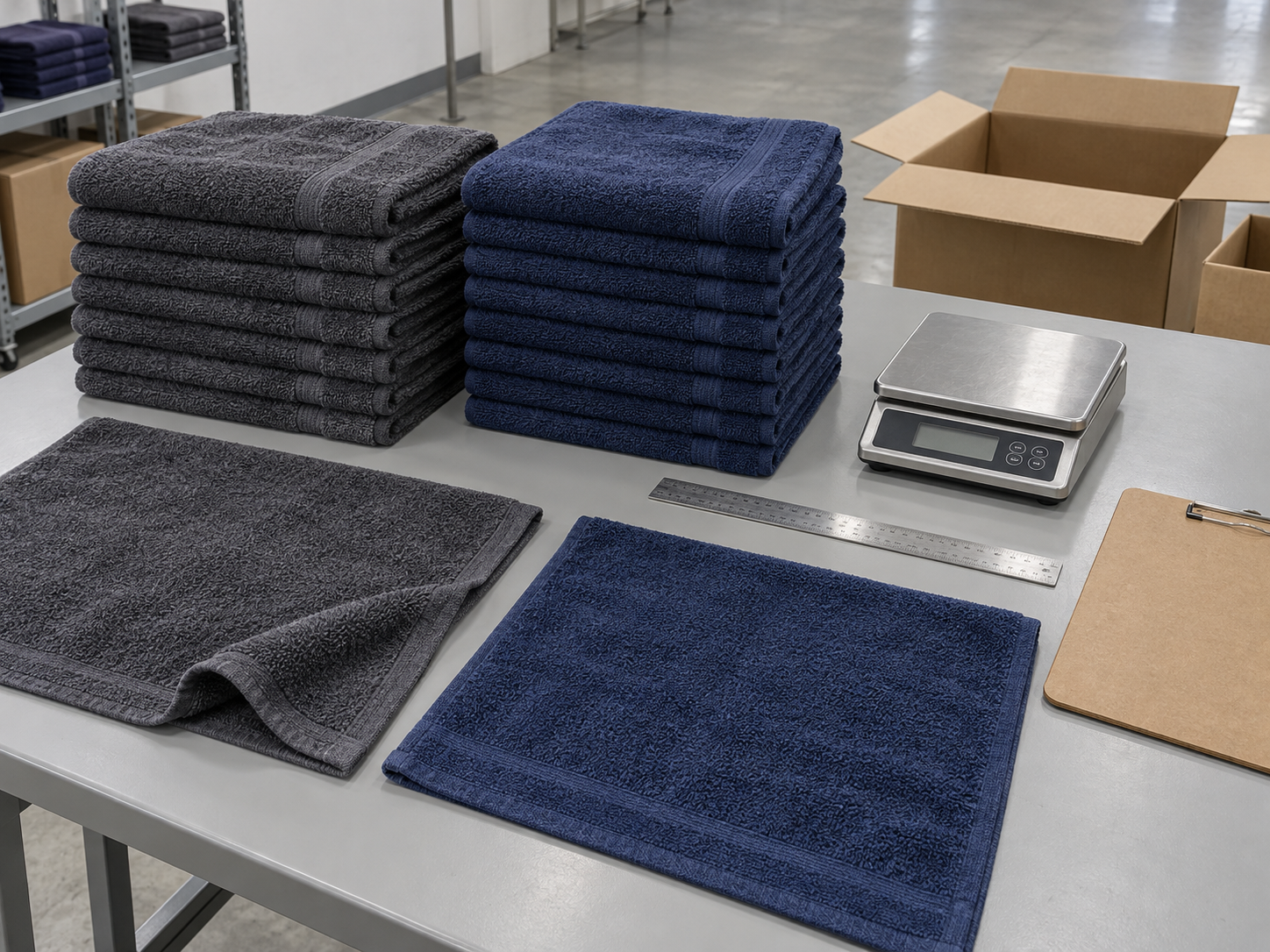
Example assumption for an RFQ comparison sheet: an order of 1,200 gym towels split evenly across two colorways (charcoal and navy at 600 pieces each). If the vendor enforces a written MOQ of 500 pieces per dye lot, both lines qualify. If the vendor mandates 1,000 pieces per color, the procurement schedule fails, requiring the buyer to either adjust order volume or consolidate into a single colorway. These figures represent illustrative planning assumptions that must be verified against current vendor rate cards.
Dye-lot terms must specify whether repeat orders within an agreed timeframe will be held to the physical retention standard from the initial run, and whether newly spun or dyed yarn lots require fresh lab-dip sign-off before manufacturing proceeds. Follow-up production notices must repeat the purchase order number and active line tally, allowing inventory managers to catch production bottlenecks before domestic marketing schedules or gym facility openings are compromised.
What a Gym Towel Service Guide Can and Cannot Teach a Wholesale Buyer
A commercial laundry guide for fitness facilities addresses linen management, counted intake, shortage documentation, wash sorting, fiber-specific care for microfiber versus ring-spun cotton, peak turnaround times, formal onboarding calls, and parallel service runs during vendor transitions (Hiring a Gym Towel Service). This source outlines an active commercial laundry service agreement. It does not reflect an industrial cut-and-sew textile manufacturing workflow, nor does it describe factory procedures at LUMA & CO. TEXTILE.
Procurement practices that translate effectively to bulk wholesale purchasing are counted intake controls and structured pre-production kickoff conferences. Define the verification count unit in advance (individual towels, banded dozens, or sealed master cartons), establish the shortage filing deadline, and confirm whether missing pieces trigger an immediate replacement shipment or a ledger credit memo. Use the kickoff call to confirm technical specifications, FTC care-label copy, carton markings, exact United States delivery addresses, and primary escalation contacts. Parallel sourcing—running two suppliers concurrently during onboarding—is a service transition strategy that wholesale buyers can mirror only through paid pilot trial orders if factory MOQs permit. Buyers should not expect suppliers to waive standard production minimums for trial runs.
Peak-day turnaround in a regional laundry plant cannot be equated to mill-level manufacturing lead times. The manufacturing equivalent highlighted on the RFP checklist is reorder lead time, for which industry sources provide no universal timeline. Similarly, supplier assertions regarding standing warehouse inventory must be confirmed using a dated available-to-promise inventory manifest rather than general promotional statements. Require suppliers to quote reorder lead times in business days from written sample release to the agreed Incoterm transfer point, noting in writing whether statutory holiday shutdowns alter that calendar.
Decision Table: Compare Communication Before the Wholesale Order
Evaluate suppliers strictly on documented written commitments. Leave fields unverified until substantiated by formal quotations. The 1 to 5 hour inquiry metric serves as a marketing reference point rather than an enforceable operational standard. A vendor that commits in writing to a complete, itemized technical offer over a defined three-day window provides far greater commercial protection than a supplier providing an immediate one-hour sales response lacking specifications, packing details, or Incoterm definitions.
| Control | What the buyer specifies | What to compare | What to verify before award | How it is used to accept or reject |
|---|---|---|---|---|
| Reply clocks | Time zone; hours to first human reply; business days to complete offer | Claimed 1-5 hours versus committed business-day clocks | Written timestamps on a buyer-submitted test RFQ | An incomplete or overdue offer pauses or restarts vendor review |
| Owner and channel | Named role, backup contact, and prevailing message channel | Centralized single thread versus split sales and shipping mailboxes | Backup contact demonstrates written responsiveness | Side-channel or chat-based instructions are declared non-binding |
| Sample release | Dimensions, fiber, weight basis, color target, packing, lab test scope | Weight per dozen against quote terminology and tolerances | Note restates exact spec; one-word approval is invalid | Bulk production deviating from the note constitutes nonconforming goods |
| Dye lot and reorder | Re-approval rule for new lots; reorder lead time in business days | On-hand warehouse stock versus made-to-order manufacturing lead time | Stated lead time terminates at the named Incoterm handover point | Visual or shade disputes evaluated solely against the approved standard |
| Labels and cartons | Fiber breakdown, country of origin, carton layout marks | Drafting responsibility and final buyer sign-off protocol | Buyer validates draft text against applicable U.S. regulatory guidelines | Cartons lacking mandatory shipping marks fail document acceptance |
| Landed-cost lines | Named Incoterm; separate goods, packing, freight, and customs clearance lines | Freight payer designation and inland transport scope | Currency designation (USD or stated foreign exchange terms) | Invoice lines deviating from itemized quotation are disputed prior to payment |
| Shortage and defect | Count unit, claim filing window, photo evidence, reship or credit remedy | Notice window duration stated in hours or business days | Documented escalation contacts and executive backup | Absence of supplier response within window activates default remedy |
| Delay notice | Missed milestone notification window and revised delivery plan format | Proactive supplier notification versus reactive response after buyer inquiry | Milestone schedule aligns with chosen Incoterm handoff | Revised dates issued without documented cause and recovery plan remain unaccepted |
Delays, Short Counts, and Quality Discrepancies
Commercial problem resolution is enforceable only when written discrepancy notices specify the precise failure point, the quantity affected, the contract remedy, and a binding resolution date. Informal telephone reassurances that do not enter the official purchase order thread cannot be enforced.
Example calculation to verify against receiving dock manifests (illustrative baseline model, not an empirical defect rate): a United States receiving warehouse expects 40 master cartons containing 25 gym towels each, totaling 1,000 pieces. Physical intake tallies 970 pieces. The delivery shortage is 30 pieces, or 3.0 percent of the total purchase order. Scope: one assumed import delivery. As-of context: arithmetic planning model. The governing master purchase contract, not this example, dictates whether this shortfall triggers an expedited air-freight dispatch, a line-item credit memo on future invoices, or a joint recount inspection. The commercial laundry service guide illustrates intake logging protocols, but does not publish industrial manufacturing error distributions.
Establish explicit defect classifications that warehouse personnel can log objectively: dropped terry loops, unraveled edge hems, untrimmed loose threads, out-of-tolerance dimensions, or visible color variations against the retained sample. If laboratory testing was excluded from the contract, reject supplier arguments that cite unverified external test norms. If formal third-party testing was contracted, require the vendor to specify whether reported discrepancies are visual approximations or substantiated by an accredited testing facility.
Milestone delay notices must state which production phase slipped, provide a revised delivery date, identify the root cause, and present a practical schedule recovery plan. Require written buyer authorization prior to split shipments, as partial cargo receipts alter container freight rates, receiving dock staffing, and total landed unit costs. While requesting trade references is standard procurement due diligence, this review does not publish historical vendor compliance records or client rosters. Commercial evaluations must rely entirely on verified documentation submitted during the RFQ review.
RFQ Checklist
- Ask the supplier to name the official commercial channel, the operational time zone, maximum hours to an initial human reply, and business days to a complete gym towel offer detailing dimensions, fiber composition, weight per dozen, color references, pack quantities, minimum order quantities, Incoterms, and pre-production sampling schedules.
- Require the manufacturer to issue a written sample-approval note that restates technical specifications and confirms whether AATCC absorbency, AATCC colorfastness, or no laboratory testing is included, providing the lab name and test date if reports are cited.
- Specify reorder lead time in business days from written approval to the agreed Incoterm transfer point, requiring written notification if seasonal peak production periods alter that timeline.
- Ask the supplier to itemize the United States delivery quotation into separate merchandise, packaging, international transit, and customs brokerage lines under a defined Incoterm and specified currency.
- Require the manufacturer to submit draft care-label wording (fiber content and country of origin) and outer carton markings for buyer review, holding bulk fabric cutting until formal sign-off is logged.
- Specify the official intake count unit, the claim filing window for shortages and manufacturing defects, required photographic evidence, the financial remedy structure, and primary and secondary escalation contacts.
- Ask the supplier to define the maximum notification window following a missed production milestone, requiring root-cause documentation and written buyer pre-approval before executing any split shipments.
- Require written dye-lot governance specifying whether repeat replenishment orders require fresh physical lab-dip approval before bulk export to the United States warehouse.
Evidence Notes, Method, and Limits
Method. Procurement controls and procedural workflows detailed in this review are synthesized from the three referenced source publications. Numerical models reflecting purchase volumes, response intervals, and landed cost breakdowns are baseline assumptions intended to be replaced with verified supplier quotations. The towel wholesaler qualities guide provides data regarding the 1 to 5 hour response claim, 24/7 support representations, and account manager responsibilities covering production monitoring and discrepancy resolution. The towel vendor RFP checklist informs core criteria for weight per dozen, fiber specifications, AATCC absorbency and colorfastness protocols, stock verification, replenishment lead times, dye-lot control, minimum order quantities, defect claims, and escalation management. The commercial laundry service guide provides operational frameworks for counted intake, shortage protocols, load sorting, fabric-specific laundering processes, peak turnaround considerations, onboarding calls, and parallel sourcing. This analysis incorporates no search-volume, cost-per-click, keyword ranking, or search-traffic metrics. No proprietary pricing structures, internal quality certifications, factory audit files, or customer account histories have been introduced.
Limits. The 1 to 5 hour response window and 24/7 customer support models reflect vendor marketing claims rather than audited manufacturing performance benchmarks; the source publication does not supply empirical sample sizes, publication dates, or clear standards for what constitutes an acceptable response. The RFP checklist identifies essential screening questions but establishes no universal pass/fail thresholds for towel weights, production schedules, or factory MOQs. The laundry service guide addresses facility linen management rather than mill-level manufacturing operations. None of the cited publications represents a LUMA & CO. TEXTILE testing standard or formal audit report. Editorial Author Vincent Xi has not conducted factory inspections, commissioned time-study tests, or executed proprietary order trials for this review; no first-person operational experience is claimed. The author profile is accessible at https://www.lumacotextile.com/authors/vincent-xi/. Prior to executing a United States wholesale supply agreement, buyers must independently verify response benchmarks, product specifications, labeling mandates, Incoterm allocations, production milestones, and dispute resolution terms within their binding commercial contract.
Discuss Your Requirements
Review our manufacturing capabilities, then share your specifications for a supplier-fit review.