Gym Towel Sourcing Digital Integration Readiness for United States Procurement
Vincent Xi Editorial Author, LUMA & CO. TEXTILE https://www.lumacotextile.com/authors/vincent-xi/
United States gym, studio, and multi-club buyers should treat gym towel sourcing digital integration readiness as a written procurement gate, not a catalog extra. Do not release a gym-towel purchase order until the RFQ freezes identifier type (RFID inlay, QR, barcode, or none), attachment method and location, uniqueness of IDs, commercial-laundry compatibility, fiber, care, and origin documents required at United States entry, a landed-cost worksheet that isolates tagging and encoding, and delivery clocks that split fabric, tagging, encoding, and freight. Specify how reads will map to member cards, wristbands, dispensers, or check-in software, and whether inbound cartons must scan at a club or 3PL dock. Cited pages give directional figures for loss, wash life, laundry cost, and inventory ratio; they do not replace club logs, tagged-sample reads, or entry documents. This page is a gym towel procurement specification for that United States B2B task—not a full catalog and not a software-selection guide.
Author basis. Vincent Xi is named as Editorial Author for LUMA & CO. TEXTILE at the author URL above. This page uses that editorial role only. It does not claim mill employment, factory visits, laboratory tests, awards, client names, customer outcomes, or first-person laundry or club trials.
How this article was derived. Operational figures below are transcribed from three publicly available operator- and supplier-facing pages: Flyby Global’s towel-tracking explainer, Towel Depot’s Commercial Gym Towels Professional Buyer’s Guide 2026, and Towel Supercenter’s fitness-center towel-rotation guide. Each number is kept with unit, scope, and as-of context. They are not mill tests, customs rulings, or LUMA & CO. TEXTILE laboratory results.
Limitations (verify on the quote, on samples, and on entry documents). Vendor “up to” loss-reduction figures on the cited Flyby page are not accompanied by an independent study date. Wash-cycle claims depend on detergent, temperature, extract, and chemical load. RFID and QR survival depend on attachment, fold, and tunnel-finisher practice. United States duty, marking, and care-label details must be confirmed with the importer of record and customs broker for the actual origin, construction, and HTS. Delivery dates are not textile quality; they fail if tagging, encoding, or carton-serial files slip. Do not assume any mill is certified to a named standard unless a current certificate is attached to the lot. Example calculations and buyer-set AQLs in this brief are planning assumptions to verify, not measured results.
Digital integration readiness: gym towel RFQ go/no-go
Digital integration readiness, for gym towel procurement, is a written ability of a lot to enter an inventory, dispenser, or member-usage system without destroying towel function or creating unreadable IDs after commercial laundry. It is not a claim that the mill “does software.” Separate three layers on the RFQ:
- Physical layer — fiber, GSM, hem, and size that still meet club hand-feel and absorbency after the identifier is added.
- Identifier layer — RFID inlay, sewn-in or heat-applied QR/barcode, or no on-towel tag if the system tracks only the member credential at a dispenser.
- Data and delivery layer — unique vs batch IDs, encoding owner, export file format, carton-to-serial mapping, and who can write IDs after goods arrive in the United States.
Approve the lot only when these exist as documents, not slogans: construction spec; identifier spec (type, frequency band, protocol if RFID, unique serial format); attachment drawing with millimeter location; laundry-and-read report on tagged samples run in the club’s or contractor’s formula; United States labeling strike-off; line-item landed cost; and a delivery calendar that names production, tagging/encoding, cargo readiness, and transit as separate clocks.
Hold for “smart ready” language without a sample read on the club’s actual reader model, origin-only encoding when the serial file will not exist until after United States arrival, or tagged remnants mixed with untagged pieces in the same SKU.
Reject non-unique IDs when the system requires uniqueness, colliding serials in the same namespace, a laundry contractor that will not sign a tag-safe SOP, or a proprietary encoding scheme the tracker cannot ingest.
Flyby Global describes fitness centers digitizing towel operations with systems that record every movement in real time via member cards, wristbands, QR codes, or PIN, reducing towel loss and over-usage by up to 30 percent, detecting unreturned items, and producing consumption dashboards (Flyby Global, towel tracking system explainer). Scope: fitness-center towel operations as described by that vendor. Unit: percent reduction in loss and over-usage, stated as “up to 30 percent.” As-of: not dated as a formal study on the cited page—treat as vendor-stated directional performance until the club’s own logs confirm it.
Towel Supercenter describes sourcing bulk gym towels, then using automated dispensers that scan membership cards, with RFID tags on towels for instant inventory counts, loss pinpointing, and rotation through the clean-to-laundry cycle (Towel Supercenter, towel rotation guide). That is an operator architecture, not a mill standard. The RFQ must say whether the identifier lives on the towel, on the dispenser only, or on both.
Specify attachment and protocol; do not assume them. Ask whether the tag is (a) a sewn pocket at the hem or side seam, (b) a heat-seal patch, (c) a woven or printed QR in the hem tape, or (d) none, with tracking only at issue/return points. If club readers already use a stated band and protocol, write the club’s actual requirement on the mill RFQ—for example UHF EPC Gen2 / ISO 18000-63 or HF. That names a reader constraint, not a mill certification. Do not accept unnamed “RFID compatible” language. Require the mill to state maximum wash temperature, extract, and chemical exposure the identifier is designed for, and whether a failed tag still leaves a usable towel.
United States labeling, landed cost, and delivery controls
United States B2B buyers remain the importer of record even when a mill offers “DDP-style” language. The same gym towel lot must clear marking rules, remain readable in the club’s digital stack, and arrive with files the receiving dock can use.
Labeling and marking to put in the RFQ (verify with counsel and the broker, not as mill marketing):
- Fiber content and country-of-origin marking in the form required for the textile product at United States entry. Treat classification, marking, and any fiber-identification rule as a facts-and-law determination for the importer of record.
- Care-cycle language that matches the laundry the club actually uses, not a consumer home-wash pictogram the contractor will ignore. Confirm whether a care label is an entry requirement for this product class or only a club/laundry specification; do not copy apparel-only rules onto towels without that check.
- RN or equivalent identification if the United States party is the responsible labeler.
- Placement that does not cover an RFID antenna or QR window.
- Distinguish a standard’s requirement (a test method or marking rule the buyer names) from a mill’s own practice. LUMA & CO. TEXTILE is not asserted here as certified to any named scheme; request current documents per lot if a buyer standard is mandatory.
Landed-cost lines that digital integration changes:
- Fabric and cut-and-sew unit price.
- Identifier hardware (inlay, QR print, encoding labor) as a separate line, not buried in “accessories.”
- Encoding or serialization fees if IDs must match an existing club database, including a line for encoding after United States arrival if origin encoding is not usable.
- Freight, insurance, duty, broker fees, and any additional United States tariffs for the actual origin—shown separately as estimates to verify with the broker, not promised rates.
- HTS as a broker-confirmed line. Do not copy a mill’s suggested code onto the entry without that review.
- Expected premature-fail rate for tags and the replacement-towel policy.
- Inventory carrying: tracking can support a leaner buffer only after loss data exists.
Delivery and receiving controls (keep these on the same RFQ as the textile):
- Incoterm and named place; the United States buyer still owns classification, marking, and ISF/entry even when freight is prepaid.
- Split lead time: fabric, cut-and-sew, tagging, encoding, cargo-ready date, and ocean or air transit to the United States as separate clocks—not one “X days” promise.
- Carton map: unique serials (or batch IDs, if that is all the system needs) listed by carton and pallet for club or 3PL receiving.
- Pack-out: inner packaging must not block a required inbound scan; confirm foil or metal-adjacent packs with the reader vendor.
- Advance ship notice / packing-list format the club can ingest; unused serials remaining at the mill must be quarantined or destroyed under the data-ownership clause.
- Peak-capacity statement for United States club openings or seasonal membership ramps—capacity is a quote field, not a demand statistic.
Wash life, inventory ratio, laundry model, and tracking hardware
Towel Depot’s 2026 professional buyer’s guide states that buyers of commercial gym towels select durable options lasting 200-plus wash cycles, that outsourcing laundry can save 30–40 percent, and that a 3:1 inventory ratio supports operations; facilities add usage-tracking dispensers and digital check-in systems that monitor distribution, flag members exceeding limits, and control costs (Towel Depot, Commercial Gym Towels Professional Buyer’s Guide 2026). Scope: commercial gym towel buyers as described in that 2026 guide. Units: wash cycles (count, “200-plus”); percent laundry-cost savings (30–40 percent; confirm the cost base on the live page when using it as a planning factor); inventory ratio (3:1, towels in system relative to daily/peak issue—confirm the guide’s exact operational definition on the live page when quoting). As-of: the 2026 buyer’s guide title/date context on the cited page.
Example calculation (assumption to verify in the supplier quote and the club’s visit data, not a measured result). If a club records 2,000 member visits per week and issues 2 towels per visit, weekly issues = 4,000 towels. If laundry turnaround is 48 hours and the 3:1 circulating inventory ratio from the 2026 Towel Depot guide is used only as a planning factor, circulating stock is on the order of 12,000 pieces plus a stated shrink buffer. Digital issue limits can reduce that buffer; they do not automatically reduce the first fill. Confirm visit counts, issue rules, laundry hours, and delivery windows before locking MOQ.
Construction vs identifier. Heavier terry and denser hems usually survive more washes but make a thicker dispenser stack and a bulkier RFID pocket. Freeze fiber, GSM, and size before choosing tag geometry. If the club requires a named wash-test method, write that method on the RFQ and run it on tagged samples. Do not treat a mill’s unpublished wash claim as the same as the 200-plus cycles in the 2026 Towel Depot guide, and do not treat either as a LUMA laboratory result.
On-towel RFID vs dispenser-only control. On-towel RFID supports cycle counts and loss location in the Towel Supercenter rotation architecture cited above. Dispenser-only systems that scan the member card can enforce issue limits without embedding hardware in every towel. The vendor-stated “up to 30 percent” loss and over-usage reduction on the Flyby page is framed around recording movement via credentials or codes; it does not prove every towel must be chipped.
Owned laundry vs outsourced laundry. The 30–40 percent laundry-cost saving from outsourcing in the Towel Depot 2026 guide (vendor/operator figure; confirm the cost base on the live page) can dwarf the unit-price difference between two towel lots. Digital integration then becomes a three-party problem: mill, club, and laundry contractor. The contractor must agree to RFID-safe pockets, tunnel temperature, and not to cut off hems. Put the laundry SOP on the RFQ as an exhibit.
First-fill volume vs ongoing replenishment. Flyby describes consumption dashboards; any reduction in unnecessary purchases is a club-log outcome after baseline measurement, not a mill lead-time change. Do not cut the opening PO by 30 percent because a tracker “can” reduce loss; cut replenishment only after 60–90 days of club data (planning assumption to verify, not a cited study).
Buyer decision table: conventional lots vs digitally trackable gym towels
Use the table to specify, compare, and approve—not to pick a brand. Every row should appear as a field on the RFQ or sample report.
| Decision field | Conventional gym towel lot | Digitally integrated lot | What the United States buyer should require |
|---|---|---|---|
| Primary job | Absorbency, hand, and 200-plus wash durability as a commercial baseline from buyer guides | Same textile job plus a readable identifier through laundry | Written wash-cycle target, test method name if used, and pass/fail on tagged samples |
| Identifier | None, or a woven logo only | RFID inlay, QR/barcode, or credential-only at dispenser | Type, frequency band/protocol if RFID, unique vs batch ID, encoding location (origin vs United States), and who encodes |
| Attachment | Hem and side-seam construction only | Sewn pocket, heat-seal, or hem-tape code | Location in millimeters, stitch type, and whether a failed tag can be removed without shredding the towel |
| Inventory planning | 3:1 circulating ratio as a published operations factor (Towel Depot 2026 guide) | Same ratio, then tighten from actual loss logs | First-fill formula, review date after go-live, and max issue per member |
| Loss / over-use control | Staff observation | Real-time movement via cards, bands, QR, or PIN; vendor-stated up to 30 percent reduction in loss and over-usage (Flyby explainer, undated study on page) | Club-owned dashboard access, exception reports, and a 90-day validation window (planning window to set in the RFQ) |
| Laundry interface | Standard commercial wash | Tag-safe temperature, extract, and chemical list | Contractor sign-off; do not accept mill “washable” without contractor SOP |
| U.S. labeling | Fiber, care as specified, origin | Same, plus any extra label real estate taken by the tag | Pre-production label strike-off approved by importer of record |
| Landed cost | Fabric + cut/sew + freight + duty | Above plus inlays, encoding, higher first-article cost | Line-item quote; no bundled “tech fee” without unit count |
| Delivery / receiving | Carton count and weight | Those plus serial-to-carton file and scan-ready pack-out | Split clocks; ASN format; named United States delivery place |
| Failure mode | Hole, stain, hem blow-out | Those plus dead tag, duplicate ID, unreadable QR after bleach | AQL for textile and read-rate AQL on a stated reader |
| Reorder | Count dirty vs clean | System count plus physical audit | Cycle-count method and who is authorized to write IDs |
| Sample pack | Size, color, GSM, hem | Those plus tagged pieces through the real laundry | Tag photo, read log, hand-feel after N washes (N set by buyer; 20–50 tagged pieces is an example RFQ sample size, not a lab result) |
| Contract | Price, lead time, MOQ | Those plus ID namespace, data export format, and spare-inlay bank | Data ownership and destruction of unused serials |
How usage-tracking dispensers change gym towel order quantities
The buyer task remains gym towel sourcing digital integration readiness—not dispenser shopping. Dispenser and check-in rules still change volume, SKU mix, and delivery cadence, so they belong on the mill RFQ as constraints.
If members are limited to a stated number of towels per visit, peak dirty-bin volume falls and so can the 3:1 planning ratio after the club has evidence. If the dispenser only authenticates the member and issues an untagged towel, the mill RFQ stays close to a conventional terry spec. If the dispenser or return chute must read the towel, every SKU that shares the system needs a consistent tag location.
Ask the dispenser vendor for read distance, locker/metal issues, wet-towel reads, and whether serials must be unique globally or only within the club. Put those answers on the mill RFQ. Do not let the mill invent a proprietary ID scheme the club’s system cannot ingest.
Optical QR codes fail on dark terry more often than RFID. If the brand book demands black or charcoal gym towels, RFID or high-contrast hem tape is a specification choice. Bleach and optical brighteners can fade printed codes; state allowed chemistry.
Practical RFQ checklist for United States gym towel lots
Each item is something a United States buyer can specify, compare, verify, approve, or order. Delete lines that do not apply; do not replace them with slogans.
- Product family and SKU list — Gym towel sizes, GSM, fiber, color; whether hand, shower, and staff towels share one identifier scheme.
- Digital integration readiness statement — Declare on-towel RFID, on-towel QR, dispenser-credential only, or not offered. No “smart ready” language.
- Identifier specification — Band, protocol, RFID memory, unique serial format, QR contrast, encoding location (origin vs after United States arrival), sample read on the club’s reader model.
- Attachment drawing — Millimeter location from hem and side seam; stitch type; pocket fabric; no inlay in the wettest center panel unless tested.
- Laundry profile — Max °C, extract, detergent class, bleach, tunnel finish; contractor name if chosen.
- Durability target — Wash-cycle goal with the tag installed (buyer may use 200-plus cycles from the 2026 Towel Depot guide); name the protocol.
- Read-rate acceptance — Example: 98%+ reads on a named reader after N washes (percent and N are RFQ assumptions, not cited lab results).
- Inventory policy — First-fill from visit data and a 3:1 planning ratio from the 2026 guide, plus the date the ratio will be revised from logs.
- Issue limits — Max towels per member per visit in software; do not ship mixed ID formats that break limit logic.
- U.S. labeling kit — Fiber, origin, importer identity, care text required by entry rules or club/laundry spec; placement that does not cover the tag antenna.
- Landed-cost worksheet — Unit towel, unit tag, encoding, cartons, weights, broker-confirmed HTS, freight term, duty and additional-origin tariff as lines to verify, not promised rates.
- Delivery clocks and Incoterm — Fabric, tagging, encoding, cargo-ready, and United States transit as separate dates; named place; who files entry.
- Receiving file — ASN or CSV mapping serials to carton, pallet, and SKU; quarantine unused serials.
- MOQ and color-lot — Whether tagged and untagged remnants can mix; no silent inlay-vendor substitution.
- Pre-production sample — Untagged and tagged samples; United States club or named-contractor laundry trial before bulk cut.
- Bulk audit — Textile AQL plus 100% or sampled ID scan for uniqueness and duplicates.
- Spare strategy — Extra untagged vs pre-encoded replacement pieces without colliding serials.
- Failure and claims — Dead-tag definition, photo evidence, textile vs tag claims.
- Change control — No inlay or sewing-line change without a new tagged sample.
- Approval gates — Sign-off from operations, laundry, procurement, and the importer of record before cut.
Sample protocol and QC before the first United States container
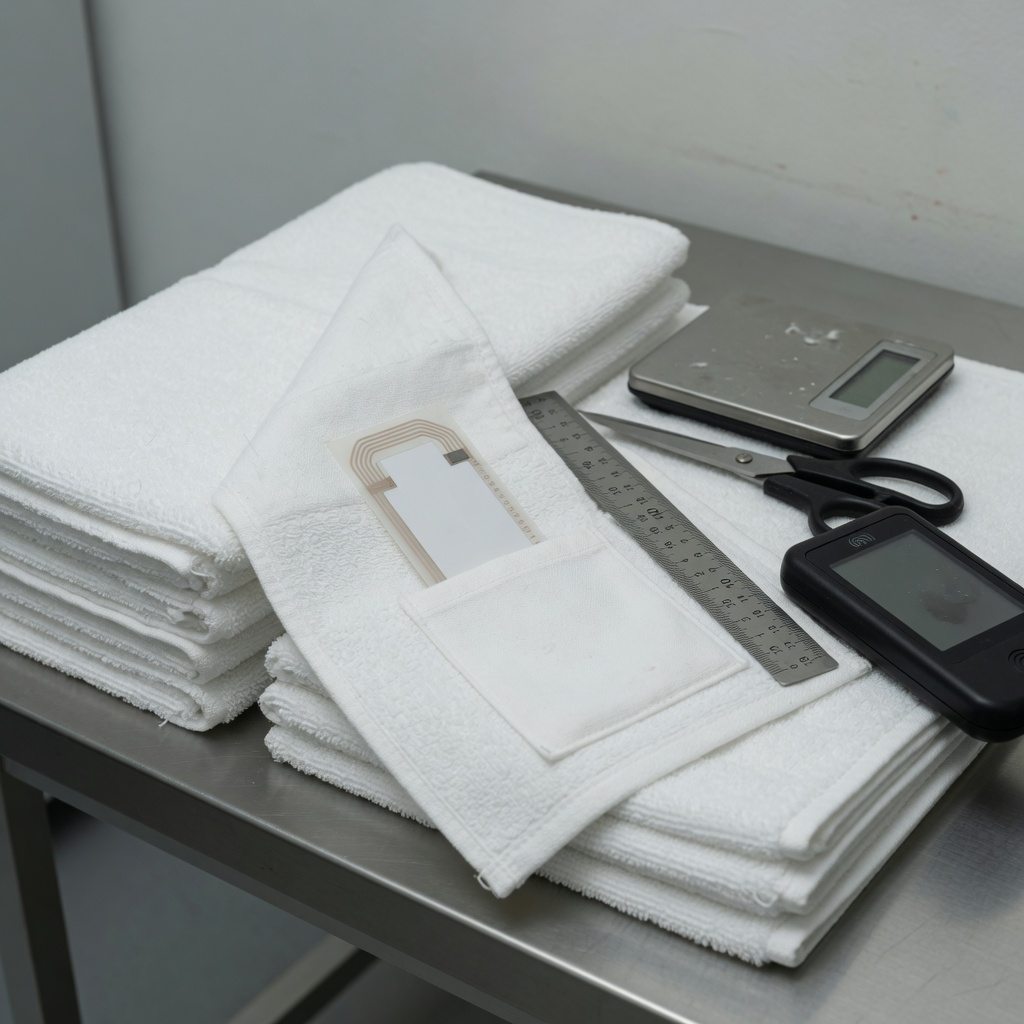
Approve a digitally ready gym towel when three files exist: construction spec, identifier spec, and laundry-and-read report. A realistic QC scene is a stainless table, stacked terry pieces, one hem folded to show the inlay pocket, a handheld reader, a scale, and a ruler—not a software screenshot.
Run tagged samples through the same wash formula the club or contractor will use. Record dimensional change, hem integrity, antenna or QR survival, and hand. Confirm issue and return events match the physical count for a pilot bay before scaling SKUs across United States locations. Do not authorize bulk cut on a reader-lab demo that never entered the club’s extract and chemistry.
Source context 1. Flyby Global positions towel tracking as real-time movement recording that can reduce loss and over-usage by up to 30 percent and feed purchasing dashboards (https://www.flybyglobal.com/what-is-a-towel-tracking-system/). Use it for dashboard and exception-report requirements, not as a mill certificate.
Source context 2. Towel Depot’s 2026 commercial guide supplies the 200-plus wash, 30–40 percent outsourced-laundry, 3:1 inventory, and dispenser/check-in framing (https://thetoweldepot.com/blog/commercial-gym-towels-professional-buyers-guide-2026). Use it to set planning defaults that the RFQ then forces the mill, laundry, and freight plan to answer.
Source context 3. Towel Supercenter describes bulk sourcing plus RFID-enabled rotation and card-scanning dispensers (https://www.towelsupercenter.com/blog/the-ultimate-guide-how-to-build-an-efficient-towel-rotation-system-for-your-fitness-center/). Use it to decide whether IDs belong on the towel or only at the machine.
This editorial is written for United States B2B procurement of the gym-towel product family under a digital-integration facet. Confirm every number that will appear on a purchase order against the live supplier quote, the club’s visit file, and current United States entry documents.
Discuss Your Requirements
Review our manufacturing capabilities, then share your specifications for a supplier-fit review.